Philosophy, By Nicholas Murray Butler

Books, Philosophy

This is a book about philosophy from M. Butler, an American philosopher. I like to high lite these books because they are in the public domain and can therefore be downloaded for free on the internet, I do that on archive.org. I understand that writers have to get paid for their work but the consequence of that is that many people cannot buy the books they want to read because of the cost. That’s why I like these old books and as long as you remember that it was written in an other time you can still learn something from it.


Philosophy

By Nicholas Murray Butler

1908

By THE COLUMBIA UNIVERSITY PRESS.


PREFACE

This lecture was delivered as one of a series, the purpose of which was to present in summary and compact form a view of each of several sciences and of philosophy as these exist at the present day. In outlining philosophy, its subject-matter and its method, it was the purpose of the lecture clearly to differentiate philosophy from science, and to cut away the odd and unfitting scientific garments in which some contemporary writers have sought to clothe philosophy. Some of the passing forms of so-called philosophic thought are wholly below the plane on which philosophy moves. They are not philosophy, nor yet philosophies ; they are travesties of both. No one who has not grasped the distinction between the three orders of thinking, or ways of knowing, can hope, I think, to understand what philosophy is or what the word philosophy means. To call something philosophy is not to make it so.

PHILOSOPHY

One of the most famous books ever written, and one of the most influential — the Metaphysics of Aristotle — opens with this sentence, “ All men by nature are actuated with the desire of knowledge.” This desire of knowledge and the wonder which it hopes to satisfy are the driving power behind all the changes that we, with careless, question-begging inference, call progress. They and their reactions upon man’s other wants and needs have, since history began, wholly altered the appearance of the dwelling-place of man as well as man’s relation to his dwelling-place. Yet the physical changes are insignificant, great and numerous as they are. The Alps that tried the endurance of Hannibal are the same mountains that tested the skill of Napoleon. The sea that was beaten by the banked oars of the triremes of Carthage, presents the same surface and the same shores to the fast-going, steam-driven vessel of to-day. But the air, once only a zephyr or a hurricane, is now the bearer of man’s silent message to his distant fellow. The crude ore once deeply hidden in the earth, has been dug and drawn and fashioned into Puck’s girdle. The words that bore the deathless verse of Homer from bard to a group of fascinated hearers, and with whose fading sounds the poems passed beyond recall, are fixed on the printed page in a hundred tongues. They carry to a million eyes what once could reach but a hundred ears. Human aspiration has cast itself, chameleon-like, into the form of noblest verse, of sweetest music, of most moving oratory, of grandest painting, of most splendid architecture, of serenest reflection, of freest government. And the end is not yet. The forces — the desire for knowledge and wonder— that have so moved man’s world, and are so moving it, must be treated with at least the respect due to age and to great achievement.

The naive consciousness of man has always told him that the existence of that consciousness and its forms were the necessary framework for his picture of himself and his world. Long before Kant proved that macht zwar Verstand die Natur aber er schafft sie nicht , man had acted instinctively on the principle. The world that poured into his consciousness through the senses, Locke’s windows of the soul, was accepted as he found it, and for what the senses did not reveal man fashioned explanations in the forge of his imagination. The unseen powers of heaven and earth, of air and water, of earthquake and thunderbolt, were like himself, but greater, grander. They had human loves and hates, human jealousies and ambitions. Behind the curtain of events they played their game of superhuman life. Offerings and gifts won their aid and their blessing; neglect or disdain brought down their antagonism and their curses. So it was that the desire for knowledge and the wonder of man made the mythologies ; each mythology bearing the image of that racial facet of humanity’s whole by which it was reflected. The Theogony, ascribed to Hesiod, shows the orderly completeness to which these mythologies attained.

The mythologies represent genuine reflection and not a little insight. They reveal man’s simple, naive consciousness busying itself with the explanation of things. The mythologies were genuine, and their gods and their heroes were real, by every test of genuineness and reality known to the uncritical mental processes which fashioned them.

Change and decay, growth, life and death, are the phases of experience that most powerfully arouse man’s wonder and stimulate his desire to know. Where do men and things come from ? How are they made ? How do they grow? What becomes of them after their disappearance or death? — these are the questions for which an answer is sought. The far-away Indian in his Upanishads cried out: “Is Brahman the cause ? Whence are we born ? Whereby do we live, and whither do we go ? O, ye who know Brahman, tell us at whose command we abide, whether in pain or in pleasure! ” To these questions the mythologies offered answers which were sufficient for long periods of time, and which are to-day sufficient for a great portion, perhaps by far the greater portion, of the human race.

An important step, far-reaching in its consequences, was taken when man first sought the cause of change and decay in things themselves and in the laws which appeared to govern things, rather than in powers and forces outside of and beyond them. When the question was first asked, What is it that persists amid all changes and that underlies every change? a new era was about to dawn in the history of man’s wonder and his desire to know. Thales, who first asked this question and first offered an answer to it, deserves his place at the head of the list of the Seven Wise Men of Greece. After Thales the wise men of Greece left off telling tales and busied themselves with an examination of experience and with direct reflection upon it.

It is to be noticed, however, that the evidence of the senses is no longer accepted at its face value. With Thales something new comes into view. It is the systematic search for the explanation of things that appear, with the assumption that the explanation lies behind the appearances themselves and is concealed by them. But as yet, mans gaze was wholly outward. The relation of the nature that he observed to his own consciousness was implied, but unquestioned. Consciousness itself and the knowing process remained to be examined. To turn man’s gaze from outward to inward, to change the center of gravity of his desire to know, of his wonder, from nature to man himself, was the service of Socrates. That man is a reasoning animal, that knowledge must be examined and tested by standards of its own, and that conduct must be founded on rational principles, are the immortal teachings of Socrates, as much needed now as when he first unfolded them. They mark him forever as the discoverer of the intellectual life. Of Socrates it may truly be said, in the stately verse of ^Eschylus: —

I brought to earth the spark of heavenly fire, Concealed at first, and small, but spreading soon Among the sons of men, and burning on,

Teacher of art and use, and fount of power.

(Prometheus Vinctus, 109.)

The maxim, “ An unexamined life is not worth living,” is the priceless legacy of Socrates to the generations of men who have followed him upon this earth. The beings who have stood on humanity’s summit are those, and only those, who have heard the voice of Socrates across the centuries. The others are a superior kind of cattle.

The intellectual life, once discovered, was eagerly pursued by the two men who have done most to shape the thought of the Western World. For two generations the brilliant insight and noble imagery of Plato and the persistently accurate analytic and synthetic powers of Aristotle poured out for the use of men the rapid results of wide observation, profound reflection, and subtlest intellectual sympathy. For nearly two thousand years the scholars of the world could find little else to occupy them than the problems which Plato and Aristotle had proposed and the solutions which they had offered. The weight of their authority was so great that it prevented the spirit of new inquiry from rising to its feet for a period longer than half of all recorded history.

In a general way, different types of problem were marked off from each other during the whole of this long period of development and study, but the lines of distinction that seem clear to-day were not often noticed or followed. Questions as to an unseen and superior power, as to logical processes, and as to natural objects and laws were curiously intermingled. Astronomy, mathematics, mechanics, and medicine broke off one by one from the parent stem, but it was a long time before the other separate sciences that we moderns know, were able to follow them. Both Plato and Aristotle had indicated the distinction between the different orders of human thinking which is all-controlling, but neither they nor their most influential successors maintained the distinction consistently by any means. So it happened that what we call science, what we call philosophy, and what we call theology were for a long time inextricably mixed.

Read the rest of the book on archive.org or download the PDF: Philosophy By Nicholas Murray Butler 1908

Nicholas Murray Butler

Nicholas Murray Butler (April 2, 1862 – December 7, 1947) was an American philosopher, diplomat, and educator. Butler was president of Columbia University, president of the Carnegie Endowment for International Peace, and a recipient of the Nobel Peace Prize. He became so well known and respected that The New York Times printed his Christmas greeting to the nation every year. Wikepedia

 

Day 662, Heraclitus and time.

., Day's pictures, Philosophy

Day 662-1

Artical from “Encyclopedia of time” SAGA publication 2009

Heraclitus
(c. 530–475 bce)
Heraclitus is considered among the greatest of the Presocratic philosophers. Flux and time play particularly important roles in his thinking. Even though the fragments of his book On Nature had an enormous impact upon such diverse philosophers as Plato, G. W. F. Hegel, Friedrich Nietzsche, and Martin Heidegger, not much is known concerning the particulars of his life. However, we do know that he was born in Ephesus, came from an old aristocratic family, and looked unfavorably upon the masses. According to Apollodrus, he was about 40 years old in the 69th Olympiad (504–501 BCE).
Relativity of Time
The most influential aspect of Heraclitus’ thinking about time is the concept of the Great Year or the eternal recurrence of everything, an idea that was taken up later by Zeno of Citium (the founder of the Stoa) and Nietzsche. However, within his philosophy, Heraclitus also clarifies other aspects of time. He was clearly aware of the relativity of time. When he explains that the sun is needed for the alteration between night and day to occur, it becomes clear that he was conscious that daytime and nighttime are dependent upon certain conditions. A certain time exists only within a specific
framework or paradigm. If the framework changes, then the concept of time within it changes, too. We would not have daytime within a world without the sun. Time is dependent upon a specific perspective, and many distinctions concerning time cannot be drawn from only a cosmic or universal perspective.
Unity of Opposites
Heraclitus criticized Hesiod for not having the best knowledge concerning daytime and nighttime. Only the masses regard Hesiod as a wise man, but truly he was not. According to Heraclitus, daytime and nighttime are one, which Hesiod had failed to realize. From a global perspective, one cannot distinguish daytime and nighttime. One has to be a participating spectator in order to employ the distinction meaningfully. Even though the distinction in question works well from a pragmatic perspective, this does not imply that it is correct. From a universal perspective, the distinction between day and night is not supposed to make any sense, as God is supposed to represent the unity of opposites; that is, God is supposed to be the unity of day and night, as well as summer and winter.
Time as Metaphor
Even though opposites do not exist, Heraclitus himself employs opposites. Concerning time, he clearly holds that there are people who are connected to the night and others who are linked to the day, and he attributes different values to these two types of paradigms. According to him, only the night-roamers are the initiated ones. They have wisdom and they do not belong to the masses. The masses are uninitiated and are connected to the day. Even though, from a global perspective, night and day are one, nighttime and daytime stand for something different. Here, they represent people who are either initiated or uninitiated into wisdom.
Time and Order
Only the initiated know what time really is. Time is a type of orderly motion with limits and periods. Heraclitus also specifies in more detail what he understands as order concerning time, and he explains that it is important that the same order exists on various levels. However, time cannot be reduced to only one aspect of order, as Heraclitus also identifies time with a playing child; that is, time is the kingdom of a playing child. Even though the aspect of order is necessary for games, there is more to the process of playing a game, as there are also the aspects of playfulness, freedom,
and chaos. To stress also the important disorderly element represented by time, Heraclitus attribute to this concept his idea of the unity of opposites. Wherever there is order, there has to be chaos. However, that chaos is relevant might only mean that even though there is one certain order in the universe, we cannot securely predict the future. Even though everything is necessary, from our perspective anything can happen, as it is impossible for us to foresee the future.
Time Is Cyclical
According to Heraclitus, the order of time is the cycle. Periods and cycles appear at various levels of existence. There is the world cycle or Great Year, but there is also a human cycle, the cycle of procreation. Human beings are born, grow up, and give birth to other human beings so that the cycle of human life can start again, which happens approximately every 30 years. In this way, a man becomes a father and then a grandfather. However, the most important idea in the philosophical reception of his thought is Heraclitus’ world cycle, referred to as the Great Year, or the eternal recurrence of everything. Analogous to human lives, there is a period or a cycle in the progression of world history. The world is supposed to be an ever-living fire that is kindled and
extinguished in regular cycles. One cycle represents a Great Year, which has the (surely metaphorical) duration of 10,800 human years. By presenting the Great Year in his philosophy of time, Heraclitus also reveals an option for an immanent type of immortality. The concept of the Great Year is of relevance on various levels. It may be analyzed from a metaphysical, natural philosophical, scientific, ethical, and religious perspective.

Stefan Lorenz Sorgner


Day 650, How to make up your mind.

Day's pictures, Our mind

Day 650-1

It is really popular In our modern culture to say that someone should “make up their own mind”. That you should trust your own feelings and don’t listen to what others say. If you understand that advice as just another platitude than there is not so much harm in it but if you take them literally than there is a big problem.  The problem is that you assume that we can make up our own mind but the best we can do is to stick with an internal narrative that is for the most part plagiarized.

Day 649, Algebra.

Day's pictures

Day 649-1

I sometimes wonder why philosophy is so underrated. I write about Nietzsche almost every day on this blog, it takes a couple of minutes to read it and maybe share your opinion. I haven’t got any response yet on those post while other posts have. I have hardly any readers, so I don’t expect mush, but still, it is somewhat disappointing. And it’s not only me and the quality I deliver, other blogs, podcasts, youtubers and books about philosophy are all relatively small. The people that attract larger audiences write often about there own lives or about other people and sprinkle some of their own opinion on it. The people I ask why they don’t read more philosophy tell me that it is to heavy, boring or difficult or they are to tired after work and want to relax and don’t want to struggle with a book and a subject they are not really interested in. And I can understand all these reasons, I too work and want to wind down when I come home, but that’s why I read a little bit in a philosophy book everyday and don’t try to struggle through a chapter if I don’t have the time. Another problem is that philosophy is not easily relatable compared to personal stories and opinions for instance. Philosophy is like algebra, it is not easy to understand, and you get through live by just knowing what 1+1 is. Like algebra, philosophy is one of the cornerstones of our society, and I admit that I don’t know much about algebra and math, but I don’t discuss a mathematician, but than again,  we all have an opinion about society. A society that is as complex as a mathematical formula, a formula that most of us don’t understand but somehow, we think we can comment on it. By reading a couple of introductory books about philosophy you would quickly learn that life is not build upon opinions, that there is such a thing as a search for truth. And if most people in this world would understand that a search for truth means that you don’t have it yet, we would be more in agreement with each other.

The only true wisdom is in knowing you know nothing. Socrates


We are what we think. All that we are arises with our thoughts. With our thoughts, we make the world.  Buddha


Real knowledge is to know the extent of one’s ignorance. Confucius


The misfortune of the wise is better than the prosperity of the fool. Epicurus


Pictures of Nietzsche

., Philosophy

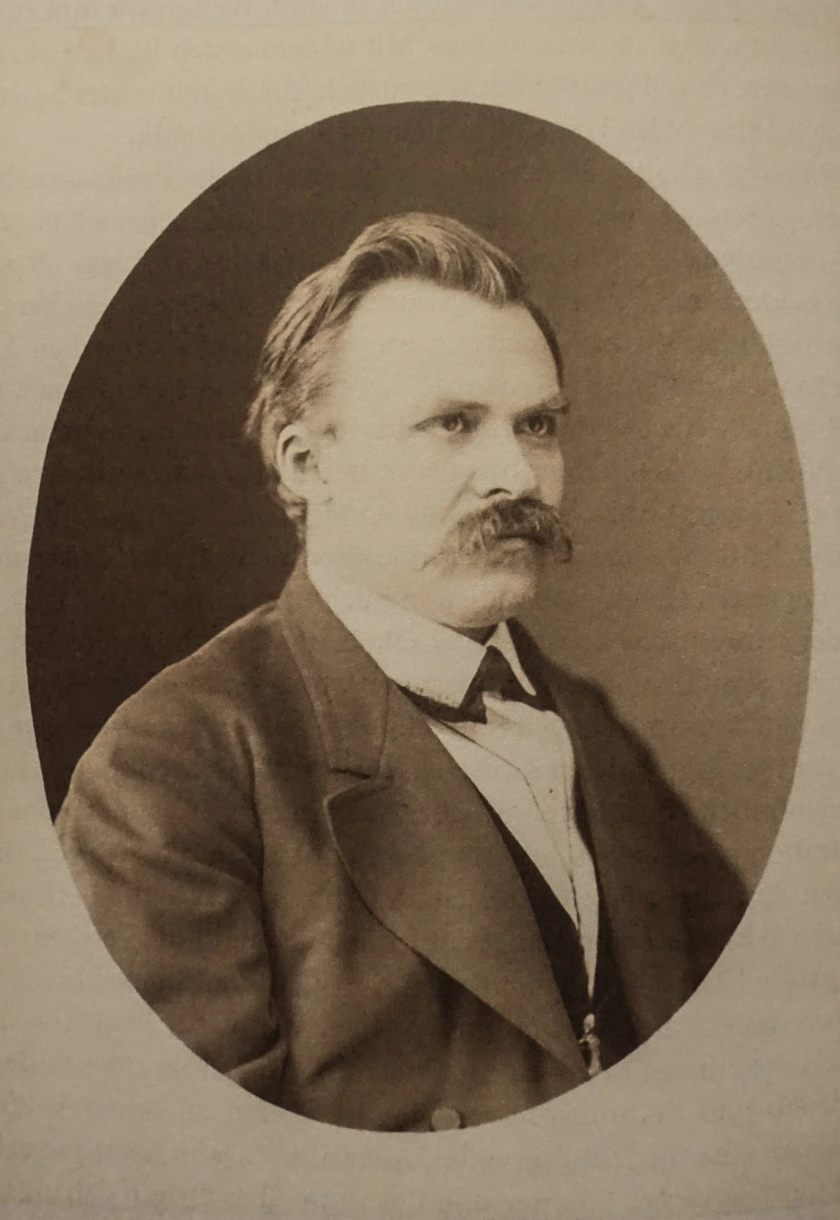
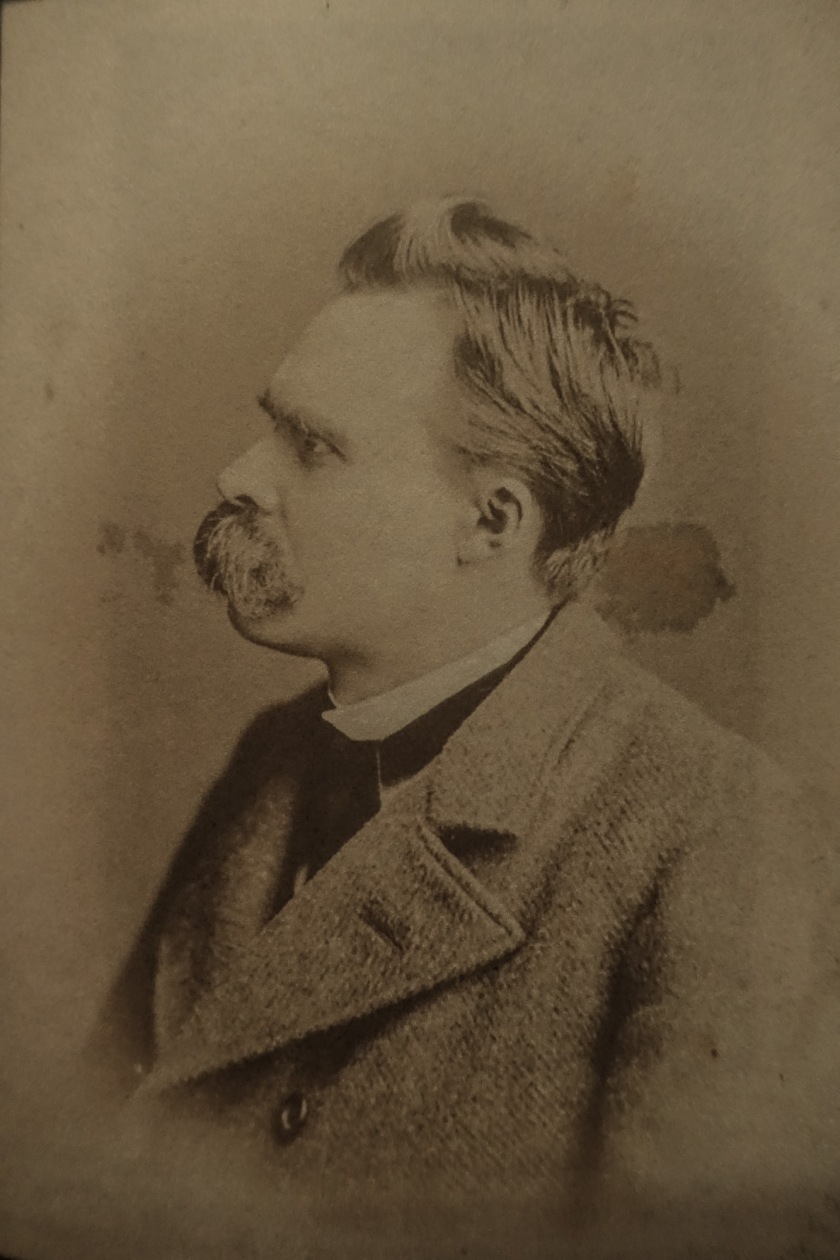
There are roughly 23 occasions, 47 pictures total, where there were pictures taken of Nietzsche, alone and in company.  Most pictures are from his time as a student and professor in Basel and from when he was sick. A lot of the pictures that you see here you can find on the internet, but I can recommend reading the book: “Habt ihr noch eine photographie von mir” From Hansdieter Erbsmehl. It is written in German and if that is no problem you will find a lot of information about each picture from what he is wearing to information about the letters he has written and wherein he talks about the pictures. Besides reading his own books and a biography this is a good way to place Nietzsche in his time and place.

DSC02029

Naumburg, 1861 16 years old. This is the first picture of Nietzsche.

DSC02030

Naumberg, 1862 17 years old. Part of a series of 3 pictures.

DSC02022

Healtresort in Halle/Saaie, 1868 23 years old.

DSC02024

Vacation in Lugano, 1871 26 years old

DSC02025

Professor Basel, 1873 28 years old.

DSC02033

Naumberg, 1882 37 years old. Part of a series of 5 pictures. The last pictures of Nietzsche before he got ill and the only ones made during his active period as a writer/philosopher.

DSC02026

With mother in Naumberg 1890/91 46 years old. Nietzsche is already sick here and no longer accountable for his actions.

DSC02028

Naumberg 1894 49/50 years old.

DSC02032

Naumberg 1899 55 years old. Part of a series of 16 pictures. One of the last pictures. of Nietzsche.


Human all too human: 29. Intoxicated by the scent of the blossoms

Human all too human

Reading Friedrich Nietzsche’s Human all too human

Read the introduction here

You can read the aphorism I discuss here in English and German below the main article.

My take on it.

Deep thoughts make us better than animals, and we will get closer to the essence of the world, but we prefer religion or art over science to get there. But these are not better ways to understand the world. This error made man deep and it gave us religion and art. Pure knowledge could not have brought does two in the world, because whoever shows us the real world bring disillusion. The world of art and religion is so wonderful and brings all kinds of emotions. because of this they deny the real world of knowledge. This results in a philosophy that logically (Does F.N. mean that the depth of their world is their justification?) denies the real world and this view can still be combined with affirming or denying the real world.

In one sentence:

The real world can exist together with the deniers.

 Synopsis, quote from the translation by Helen Zimmern and my take on it

It is believed that the deeper man thinks, the more delicately he feels the higher he rises above the animals, Deep thoughts make us better than animals, the nearer will he approach the real essence of the world and its knowledge. and we will get closer to the essence of the world,  Man does that through science, but he likes to do it more through art and religions. But we prefer religion or art over science to get there. These certainly are blossoms of the world, but by no means any nearer to the root of the world than the stalk. But it is not a better way for understanding the nature of things although most believe so. But these are not better ways to understand the world. Error has made man so deep, sensitive, and inventive that he has put forth such blossoms as religions and arts. This error made man deep and it gave us religion and art, Pure knowledge could not have been capable of it. pure knowledge could not have brought does two in the world, Whoever shows us the real world will bring us the most disagreeable disillusionment1. because whoever shows us the real world bring disillusion. Not the world as thing-in-itself, but the world as representation (as error) is so full of meaning, so deep, so wonderful, bearing happiness and unhappiness in its lap. The world of art and religion is so wonderful and brings all kinds of emotions. This result leads to a philosophy of the logical denial of the world, which, because of this they deny the real world. however, can be combined with a practical world-affirming just as well as with its opposite. This results in a philosophy that logically (Does F.N. mean that the depth of their world is their justification?) denies the real world and this view can still be combined with affirming or denying the real world.

1 A feeling of disappointment resulting from the discovery that something is not as good as one believed it to be.


Human, all too human a book for free spirits Part I translated by Helen Zimmern 1909

  1. INTOXICATED BY THE SCENT OF THE BLOSSOMS.—It is supposed that the ship of humanity has always a deeper draught, the heavier it is laden ; it is believed that the deeper a man thinks, the more delicately he feels, the higher he values himself, the greater his distance from the other animals,—the more he appears as a genius amongst the animals,—all the nearer will he approach the real essence of the world and its knowledge; this he actually does too, through science, but he means to do so still more through his religions and arts. These certainly are blossoms of the world, but by no means any nearer to the root of the world than the stalk ; it is not possible to understand the nature of things better through them, although almost every one believes he can. Error has made man so deep, sensitive, and inventive that he has put forth such blossoms as religions and arts. Pure knowledge could not have been capable of it. Whoever were to unveil for us the essence of the world would give us all the most disagreeable disillusionment. Not the world as thing-in-itself, but the world as representation (as error) is so full of meaning, so deep, so wonderful, bearing happiness and unhappiness in its bosom. This result leads to a philosophy of the logical denial of the world, which, however, can be combined with a practical world-affirming just as well as with its opposite.

Menschliches allzu menschlich 1878/80

  1. Vom Dufte der Blüthen berauscht. – Das Schiff der Menschheit, meint man, hat einen immer stärkeren Tiefgang, je mehr es belastet wird; man glaubt, je tiefer der Mensch denkt, je zarter er fühlt, je höher er sich schätzt, je weiter seine Entfernung von den anderen Thieren wird, – je mehr er als das Genie unter den Thieren erscheint, – um so näher werde er dem wirklichen Wesen der Welt und deren Erkenntniss kommen: diess thut er auch wirklich durch die Wissenschaft, aber er meint diess noch mehr durch seine Religionen und Künste zu thun. Diese sind zwar eine Blüthe der Welt, aber durchaus nicht der Wurzel der Welt näher, als der Stengel ist: man kann aus ihnen das Wesen der Dinge gerade gar nicht besser verstehen, obschon diess fast jedermann glaubt. Der Irrthum hat den Menschen so tief, zart, erfinderisch gemacht, eine solche Blüthe, wie Religionen und Künste, herauszutreiben. Das reine Erkennen wäre dazu ausser Stande gewesen. Wer uns das Wesen der Welt enthüllte, würde uns Allen die unangenehmste Enttäuschung machen. Nicht die Welt als Ding an sich, sondern die Welt als Vorstellung (als Irrthum) ist so bedeutungsreich, tief, wundervoll, Glück und Unglück im Schoosse tragend. Diess Resultat führt zu einer Philosophie der logischen Weltverneinung: welche übrigens sich mit einer praktischen Weltbejahung ebensogut wie mit deren Gegentheile vereinigen lässt.

Sources:

I will read a Dutch translation that is based on the work of researchers Colli and Montinari. I also use a translation from R.J.Hollingdale and the Gary Handwerk translation from the Colli-Montinari edition. Both are more modern than the copyright free translation I use here. This is a translation from 1909 by Helen Zimmern, who knew Nietzsche personally, but there was no critical study of Nietzsche’s work done back then and this translation suffers from that. The same goes for the translation from Alexander Harvey. My German is not good enough to pretend that I can translate it better than the professionals do but I will use the original as a referee.

  1. Menselijk al te menselijk een boek voor vrije geesten, translated by Thomas Graftdijk, 2000. Buy it here
  2. Human, all too human a book for free spirits, translated by R.J.Hollingdale, 1986
  3. Human, all too human a book for free spirits I V3, translated by Gary handwerk 1997
  4. Human, all too human a book for free spirits Part I, translated by Helen Zimmern 1909. Read it  here
  5. Human, all too human a book for free spirits, translated by Alexander Harvey, 1908. Read it here
  6. Menschliches allzu menschlich 1878/80. Read it here


Human all too human: 24. The possibility of progress.

Human all too human

Reading Friedrich Nietzsche’s Human all too human

Read the introduction here

You can read the aphorism I discuss here in English and German below the main article.

Synopsis, quote from the translation by Helen Zimmern and my take on it.

When a wise man from an old culture swears no longer to deal with people that believe in progress, he is right. Because his great culture lies behind him and its history teaches that it will never be young again; some sort of stupidity is needed to deny this. Old cultures will not turn young again. But man can consciously decide to move on to another culture, instead of unconsciously move on like before. But you can decide to move on This way they can create better conditions for the propagation of man for their nourishment, education and instruction. They can manage the earth better economically and control the power of man. When you shoose to move on you can better manage the world This new, conscious culture kills the old, which, regarded as a whole, has led an unconscious animal and plant life; it also kills distrust in progress, —progress is possible. This new conscious culture outshines the old unconscious culture. It is off course important to know that progress not necessarily follows, but you can not deny it either. But with the old culture progress is unthinkable. Progress is not guaranteed, but also not denied like with the old culture. Even if romantic fantasy has also constantly used the word ” progress ” to denote its aims (for instance, circumscribed primitive national cultures), it borrows the picture of it in any case from the past; its thoughts and ideas on this subject are entirely without originality. The romantic ideal of old cultures is borrowed from old cultures and not original.

In one sentence:

You can choose progress but some copy the old cultures to make-up new.


Human, all too human a book for free spirits Part I translated by Helen Zimmern 1909

  1. THE POSSIBILITY OF PROGRESS.—When a scholar of the ancient culture forswears the company of men who believe in progress, he does quite right. For the greatness and goodness of ancient culture lie behind it, and historical education compels one to admit that they can never be fresh again ; an unbearable stupidity or an equally insufferable fanaticism would be necessary to deny this. But men can consciously resolve to develop themselves towards a new culture ; whilst formerly they only developed unconsciously and by chance, they can now create better conditions for the rise of human beings, for their nourishment, education and instruction ; they can administer the earth economically as a whole, and can generally weigh and restrain the powers of man. This new, conscious culture kills the old, which, regarded as a whole, has led an unconscious animal and plant life; it also kills distrust in progress,—progress is possible. I must say that it is over-hasty and almost nonsensical to believe that progress must necessarily follow ; but how could one deny that it is possible? On the other hand, progress in the sense and on the path of the old culture is not even thinkable. Even if romantic fantasy has also constantly used the word ” progress ” to denote its aims (for instance, circumscribed primitive national cultures), it borrows the picture of it in any case from the past ; its thoughts and ideas on this subject are entirely without originality.

Menschliches allzu menschlich 1878/80

  1. Möglichkeit des Fortschritts. – Wenn ein Gelehrter der alten Cultur es verschwört, nicht mehr mit Menschen umzugehen, welche an den Fortschritt glauben, so hat er Recht. Denn die alte Cultur hat ihre Grösse und Güte hinter sich und die historische Bildung zwingt Einen, zuzugestehen, dass sie nie wieder frisch werden kann; es ist ein unausstehlicher Stumpfsinn oder ebenso unleidliche Schwärmerei nöthig, um diess zu leugnen. Aber die Menschen können mit Bewusstsein beschliessen, sich zu einer neuen Cultur fortzuentwickeln, während sie sich früher unbewusst und zufällig entwickelten: sie können jetzt bessere Bedingungen für die Entstehung der Menschen, ihre Ernährung, Erziehung, Unterrichtung schaffen, die Erde als Ganzes ökonomisch verwalten, die Kräfte der Menschen überhaupt gegen einander abwägen und einsetzen. Diese neue bewusste Cultur tödtet die alte, welche, als Ganzes angeschaut, ein unbewusstes Thier- und Pflanzenleben geführt hat; sie tödtet auch das Misstrauen gegen den Fortschritt, -er ist möglich. Ich will sagen: es ist voreilig und fast unsinnig, zu glauben, dass der Fortschritt nothwendig erfolgen müsse; aber wie könnte man leugnen, dass er möglich sei? Dagegen ist ein Fortschritt im Sinne und auf dem Wege der alten Cultur nicht einmal denkbar. Wenn romantische Phantastik immerhin auch das Wort “Fortschritt” von ihren Zielen (z.B. abgeschlossenen originalen Volks-Culturen) gebraucht: jedenfalls entlehnt sie das Bild davon aus der Vergangenheit; ihr Denken und Vorstellen ist auf diesem Gebiete ohne jede Originalität.

Sources:

I will read a Dutch translation that is based on the work of researchers Colli and Montinari. I also use a translation from R.J.Hollingdale and the Gary Handwerk translation from the Colli-Montinari edition. Both are more modern than the copyright free translation I use here. This is a translation from 1909 by Helen Zimmern, who knew Nietzsche personally, but there was no critical study of Nietzsche’s work done back then and this translation suffers from that. The same goes for the translation from Alexander Harvey. My German is not good enough to pretend that I can translate it better than the professionals do but I will use the original as a referee.

  1. Menselijk al te menselijk een boek voor vrije geesten, translated by Thomas Graftdijk, 2000. Buy it here
  2. Human, all too human a book for free spirits, translated by R.J.Hollingdale, 1986
  3. Human, all too human a book for free spirits I V3, translated by Gary handwerk 1997
  4. Human, all too human a book for free spirits Part I, translated by Helen Zimmern 1909. Read it  here
  5. Human, all too human a book for free spirits, translated by Alexander Harvey, 1908. Read it here
  6. Menschliches allzu menschlich 1878/80. Read it here


Reading Philosophy

Philosophy

Nietzsche by j m kennedyAt this page you will find some introductions to Nietzsche from different books about Nietzsche and his work. Sometimes people ask me what to read first from Nietzsche, or any other philosopher, and I always tell them to start with a book about Nietzsche. Starting with a book from Nietzsche himself is like putting someone into a forest where he sees a few trees, and ask him to describe the whole forest. Reading Nietzsche is hard enough, if you read some opinions from other professionals you will get a bird’s eye view of his work. If you than start reading his own work, it is easier to put it in its proper context. I myself like reading books about Nietzsche from different periods of time, you will find different looks at him and they are sprinkled with thoughts and ideas of the time they are written. Reading these old books give me also the feeling that I’m not the only one reading his work, some of the books I show here were written by other Nietzsche enthusiasts when there were hardly any cars around, America was at war with Spain and Nietzsche himself just died. So, for anybody that wants to learn Nietzsche’s work, study books about Nietzsche himself and his work and then start with his own work…in proper order…and a spoiler: Nietzsche himself is also more interested in the person behind the philosophy, where you’re from, your character and upbringing will tell you more about the meaning of his or her philosophy.

Got to the books here

20. A few steps back

Human all too human

Reading Friedrich Nietzsche’s Human all too human

Read the introduction here

You can read the aphorism I discuss here in English and German below the main article.

Synopsis, quote from the translation by Helen Zimmern and my take on it.

A few steps back1 back A high culture is attained when man rises above superstitious and religious notions and fears. If he has attained to this degree of freedom, he has still also to overcome metaphysics with the greatest exertion of his intelligence. Man has to overcome explanations that they got with the help of metaphysics, the unseen or not material world, after he rises above superstitious believes After this he has to look back and understand the historical and psychological basis of these mindsets. He must recognize how the greatest advancement of humanity has come therefrom, and how man would rob itself from the greatest achievements if it doesn’t look back. After this, man has to look back and realize that the greatest advancements of man came from this period,  With regard to philosophical metaphysics, I see more people that attained the negative goal of thinking that even positive metaphysics is an error, but more people think that positive2 metaphysics is bad. but few that take a few steps back on the ladder. one ought to look out, perhaps, over the last steps of the ladder, but not try to stand upon them. It is advised to remind yourself of the positive achievement of metaphysics, The most enlightened only succeed so far as to free themselves from metaphysics and look back upon it with superiority, while it is necessary here, too, as in the hippodrome, to turn around the end of the course. even the most enlightened, must turn around and acknowledge this fact.

In one sentence:

Don’t dismiss positive metaphysics to fast.

1The German word “Einige sprossen zurück” is normally translated in English as “some/a few rungs back. Zimmern, Harvey and Hollindale translated it as “A few steps back, Handwerk and Graftdijk as “A few rungs back/Een paar sporten terug”. It is probably not wrong, but I associate “steps back” more with a step backwards and not downwards on a ladder, and that is what Nietzsche uses in this aphorism, he probably meant seeing more or les depending on where you are on the ladder, “but as yet few who climb a few rungs backwards; one ought to look out, perhaps, over the last steps of the ladder”.

2Don’t know what Nietzsche meant with “positive metaphysics” other than metaphysics that has a positive effect. Don’t know what he counted as such.

Human, all too human a book for free spirits Part I translated by Helen Zimmern 1909

  1. A FEW STEPS BACK.—A degree of culture, and assuredly a very high one, is attained when man rises above superstitious and religious notions and fears, and, for instance, no longer believes in guardian angels or in original sin, and has also ceased to talk of the salvation of his soul,—if he has attained to this degree of freedom, he has still also to overcome metaphysics with the greatest exertion of his intelligence. Then, however, a retrogressive movement is necessary ; he must understand the historical justification as well as the psychological in such representations, he must recognise how the greatest advancement of humanity has come therefrom, and how, without such a retrocursive movement, we should have been robbed of the best products of hitherto existing mankind. With regard to philosophical metaphysics, I always see increasing numbers who have attained to the negative goal (that all positive metaphysics is error), but as yet few who climb a few rungs backwards ; one ought to look out, perhaps, over the last steps of the ladder, but not try to stand upon them. The most enlightened only succeed so far as to free themselves from metaphysics and look back upon it with superiority, while it is necessary here, too, as in the hippodrome, to turn round the end of the course.

Menschliches allzu menschlich 1878/80

  1. Einige Sprossen zurück. – Die eine, gewiss sehr hohe Stufe der Bildung ist erreicht, wenn der Mensch über abergläubische und religiöse Begriffe und Aengste hinauskommt und zum Beispiel nicht mehr an die lieben Englein oder die Erbsünde glaubt, auch vom Heil der Seelen zu reden verlernt hat: ist er auf dieser Stufe der Befreiung, so hat er auch noch mit höchster Anspannung seiner Besonnenheit die Metaphysik zu überwinden. Dann aber ist eine rückläufige Bewegung nöthig: er muss die historische Berechtigung, ebenso die psychologische in solchen Vorstellungen begreifen, er muss erkennen, wie die grösste Förderung der Menschheit von dorther gekommen sei und wie man sich, ohne eine solche rückläufige Bewegung, der besten Ergebnisse der bisherigen Menschheit berauben würde. – In Betreff der philosophischen Metaphysik sehe ich jetzt immer Mehrere, welche an das negative Ziel (dass jede positive Metaphysik Irrthum ist) gelangt sind, aber noch Wenige, welche einige Sprossen rückwärts steigen; man soll nämlich über die letzte Sprosse der Leiter wohl hinausschauen, aber nicht auf ihr stehen wollen. Die Aufgeklärtesten bringen es nur so weit, sich von der Metaphysik zu befreien und mit Ueberlegenheit auf sie zurückzusehen: während es doch auch hier, wie im Hippodrom, noth thut, um das Ende der Bahn herumzubiegen.

Sources:

I will read a Dutch translation that is based on the work of researchers Colli and Montinari. I also use a translation from R.J.Hollingdale and the Gary Handwerk translation from the Colli-Montinari edition. Both are more modern than the copyright free translation I use here. This is a translation from 1909 by Helen Zimmern, who knew Nietzsche personally, but there was no critical study of Nietzsche’s work done back then and this translation suffers from that. The same goes for the translation from Alexander Harvey. My German is not good enough to pretend that I can translate it better than the professionals do but I will use the original as a referee.

  1. Menselijk al te menselijk een boek voor vrije geesten, translated by Thomas Graftdijk, 2000. Buy it here
  2. Human, all too human a book for free spirits, translated by R.J.Hollingdale, 1986
  3. Human, all too human a book for free spirits I V3, translated by Gary handwerk 1997
  4. Human, all too human a book for free spirits Part I, translated by Helen Zimmern 1909. Read it  here
  5. Human, all too human a book for free spirits, translated by Alexander Harvey, 1908. Read it here
  6. Menschliches allzu menschlich 1878/80. Read it here


19. Number

Human all too human

Reading Friedrich Nietzsche’s Human all too human

Read the introduction here

You can read the aphorism I discuss here in English, German and Dutch below the main article.

Synopsis, quote from the translation by Helen Zimmern and my take on it.

The discovery of the laws of numbers is made upon the ground of the original, already prevailing error, that there are many similar things (but in reality there is nothing similar), at least, that there are things (but there is no “thing”). The law of numbers is based on the (mistaken) belief in similarity and that there are things When you assume there is variety, you assume there are more things of one, but here we are mistaken and invent things that are not there. We see lots of different things and assume there are more of each Our sensations of space and time are false, for they lead consistently1 to logical contradictions. In science we know there are false quantities but as these quantities are at least constant, as, for instance, our sensation of time and space, the conclusions of science have still perfect accuracy and certainty in their connection with one another; Science works with false premises, but they work for specific questions like Newtonian and quantum physics one may continue to build upon them. Up to the point where our assumptions, the constant errors, no longer work with our conclusions like in the theory of atoms. You can work with these theories up to the point that they don’t work anymore There still we always feel ourselves compelled to the acceptance of a ” thing ” or material ” substratum”2 that is moved, Like with a theory of atoms, were our believe in numbers no longer works, we still belief in things whilst the whole scientific procedure has pursued the very task of resolving everything substantial (material) into motion ; here, too, we still separate with our sensation the mover and the moved and cannot get out of this circle, because the belief in things has from immemorial times been bound up with our being. We still separate the mover from the moved, there is no specific movement without our observation When Kant3 says, ” The understanding does not derive its laws from Nature, but dictates them to her, Nature has no order besides the order we give it to her” it is perfectly true with regard to the idea of Nature which we are compelled to associate with her (Nature = World as representation, that is to say as error), but which is the summing up of a number of errors of the understanding. The laws of numbers are entirely inapplicable to a world which is not our representation—these laws obtain only in the human world. Number work only for a world seen thru our eyes, a world created by our way of looking to the world, made of things, similarity, numbers.

In one sentence:

We exist but live in a man made world

1Zimmern translate the German “consequent” (konsequent) as “examined in sequence” is better translated as consequent or consistently.

2substratum” A foundation or basis of something.

3 In the Dutch translation is a note pointing to this quote of Kant from his book: Prolegomena zu einer jeden künftigen Metaphysik die als Wissenschaft wird auftreten können. Page 320 (82) 36 here you can read it.


Human, all too human a book for free spirits Part I translated by Helen Zimmern 1909

  1. NUMBER.—The discovery of the laws of numbers is made upon the ground of the original, already prevailing error, that there are many similar things (but in reality there is nothing similar), at least, that there are things (but there is no “thing”). The supposition of plurality always presumes that there is something which appears frequently,—but here already error reigns, already we imagine beings, unities, which do not exist. Our sensations of space and time are false, for they lead—examined in sequence—to logical contradictions. In all scientific determinations we always reckon inevitably with certain false quantities, but as these quantities are at least constant, as, for instance, our sensation of time and space, the conclusions of science have still perfect accuracy and certainty in their connection with one another; one may continue to build upon them—until that final limit where the erroneous original suppositions, those constant faults, come into conflict with the conclusions, for instance in the doctrine of atoms. There still we always feel ourselves compelled to the acceptance of a ” thing ” or material ” substratum ” that is moved, whilst the whole scientific procedure has pursued the very task of resolving everything substantial (material) into motion ; here, too, we still separate with our sensation the mover and the moved and cannot get out of this circle, because the belief in things has from immemorial times been bound up with our being. When Kant says, ” The understanding does not derive its laws from Nature, but dictates them to her,” it is perfectly true with regard to the idea of Nature which we are compelled to associate with her (Nature = World as representation, that is to say as error), but which is the summing up of a number of errors of the understanding. The laws of numbers are entirely inapplicable to a world which is not our representation—these laws obtain only in the human world.

Menschliches allzu menschlich 1878/80

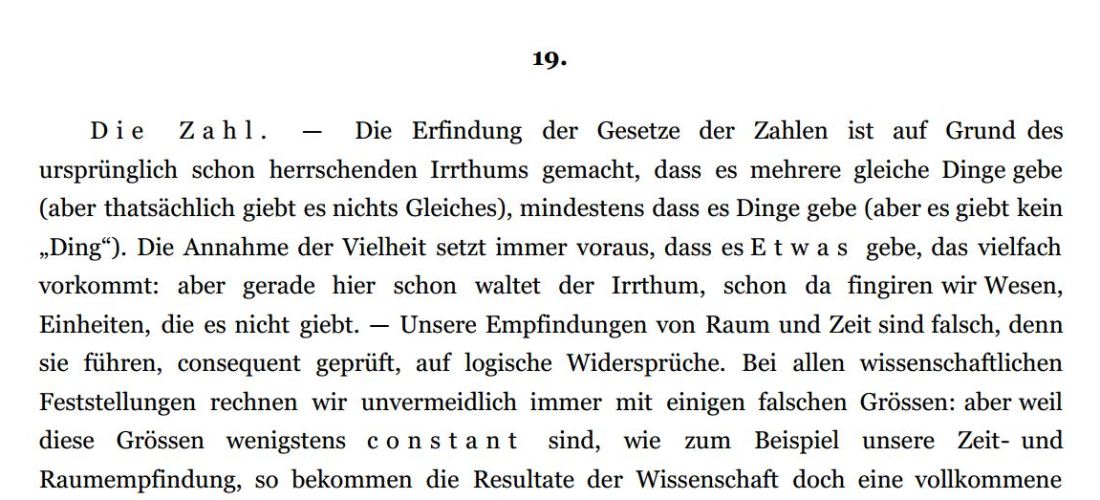
  1. Die Zahl. – Die Erfindung der Gesetze der Zahlen ist auf Grund des ursprünglich schon herrschenden Irrthums gemacht, dass es mehrere gleiche Dinge gebe (aber thatsächlich giebt es nichts Gleiches), mindestens dass es Dinge gebe (aber es giebt kein “Ding”). Die Annahme der Vielheit setzt immer voraus, dass es Etwas gebe, das vielfach vorkommt: aber gerade hier schon waltet der Irrthum, schon da fingiren wir Wesen, Einheiten, die es nicht giebt. – Unsere Empfindungen von Raum und Zeit sind falsch, denn sie führen, consequent geprüft, auf logische Widersprüche. Bei allen wissenschaftlichen Feststellungen rechnen wir unvermeidlich immer mit einigen falschen Grössen: aber weil diese Grössen wenigstens constant sind, wie zum Beispiel unsere Zeit- und Raumempfindung, so bekommen die Resultate der Wissenschaft doch eine vollkommene Strenge und Sicherheit in ihrem Zusammenhange mit einander; man kann auf ihnen fortbauen – bis an jenes letzte Ende, wo die irrthümliche Grundannahme, jene constanten Fehler, in Widerspruch mit den Resultaten treten, zum Beispiel in der Atomenlehre. Da fühlen wir uns immer noch zur Annahme eines “Dinges” oder stofflichen “Substrats”, das bewegt wird, gezwungen, während die ganze wissenschaftliche Procedur eben die Aufgabe verfolgt hat, alles Dingartige (Stoffliche) in Bewegungen aufzulösen: wir scheiden auch hier noch mit unserer Empfindung Bewegendes und Bewegtes und kommen aus diesem Zirkel nicht heraus, weil der Glaube an Dinge mit unserem Wesen von Alters her verknotet ist. – Wenn Kant sagt “der Verstand schöpft seine Gesetze nicht aus der Natur, sondern schreibt sie dieser vor”, so ist diess in Hinsicht auf den Begriff der Natur völlig wahr, welchen wir genöthigt sind, mit ihr zu verbinden (Natur = Welt als Vorstellung, das heisst als Irrthum), welcher aber die Aufsummirung einer Menge von Irrthümern des Verstandes ist. – Auf eine Welt, welche nicht unsere Vorstellung ist, sind die Gesetze der Zahlen gänzlich unanwendbar: diese gelten allein in der Menschen-Welt.

19. Het getal. – De uitvinding van de getallenwetten is gedaan op grond van de oorspronkelijk al heersende dwaling dat er verschillende identieke dingen zijn (maar in feite is er niets identieks), of althans dat er dingen zijn (maar er is geen ‘ding’). De veronderstelling van de veelheid gaat er altijd al van uit dat eriets is wat veelvuldig voorkomt: maar juist hier regeert de dwaling al, reeds hier fingeren wij wezenheden, eenheden die niet bestaan. – Onze gewaarwordingen van ruimte en tijd zijn vals, want bij consequent onderzoek blijken zij tot logische tegenstrijdigheden te leiden. Bij al onze wetenschappelijke bevindingen rekenen we onvermijdelijk altijd met enkele valse grootheden: maar omdat deze grootheden ten minste constant zijn, zoals bijvoorbeeld onze gewaarwording van tijd en ruimte, krijgen de resultaten van de wetenschap toch een volmaakte strengheid en zekerheid in hun onderlinge samenhang: men kan erop voortbouwen – tot aan dat uiterste punt, waarop de verkeerde basisveronderstellingen, de genoemde constante fouten, in conflict komen met de resultaten, bijvoorbeeld in de atomenleer. We voelen ons hier nog steeds gedwongen uit te gaan van een ‘ding’ of stoffelijk ‘substraat’ dat bewogen wordt, terwijl de hele wetenschappelijke procedure juist heeft gepoogd al het dingachtige (stoffelijke) tot bewegingen te ontleden: ook hier blijven we ten slotte zitten met onze gewaarwording van iets wat beweegt en iets wat bewogen wordt en we komen deze tovercirkel niet uit omdat het geloof aan dingen van oudsher met onze natuur verweven is. – Als Kant zegt ‘het verstand put zijn wetten niet uit de natuur, maar schrijft ze haar voor’ dan is dit volledig waar ten aanzien van het begrip van de natuur dat wij genoodzaakt zijn met haar te verbinden (natuur = wereld als voorstelling, dat wil zeggen als dwaling), maar dat de optelsom is van een grote hoeveelheid dwalingen van het verstand. – Op een wereld die niet onze voorstelling is zijn de getallenwetten in het geheel niet toepasbaar: zij gelden alleen in de mensenwereld.


Sources:

I will read a Dutch translation that is based on the work of researchers Colli and Montinari. I also use a translation from R.J.Hollingdale and the Gary Handwerk translation from the Colli-Montinari edition. Both are more modern than the copyright free translation I use here. This is a translation from 1909 by Helen Zimmern, who knew Nietzsche personally, but there was no critical study of Nietzsche’s work done back then and this translation suffers from that. The same goes for the translation from Alexander Harvey. My German is not good enough to pretend that I can translate it better than the professionals do but I will use the original as a referee.

  1. Menselijk al te menselijk een boek voor vrije geesten, translated by Thomas Graftdijk, 2000. Buy it here
  2. Human, all too human a book for free spirits, translated by R.J.Hollingdale, 1986
  3. Human, all too human a book for free spirits I V3, translated by Gary handwerk 1997
  4. Human, all too human a book for free spirits Part I, translated by Helen Zimmern 1909. Read it  here
  5. Human, all too human a book for free spirits, translated by Alexander Harvey, 1908. Read it here
  6. Menschliches allzu menschlich 1878/80. Read it here


18.Fundamental questions of metaphysics

Human all too human

Reading Friedrich Nietzsche’s Human all too human

Read the introduction here

You can read the aphorism I discuss here in English an German below the main article.

Synopsis, quote from the translation by Helen Zimmern and my take on it.

The history of thoughts will contain a statement by a famous logician1 and it will be seen in new light: “The primordial general law of the cognizant knowing subject consists in the inner necessity of recognizing every object in itself in its own nature, as a thing identical with itself, consequently self-existing and at bottom remaining ever the same and unchangeable: in short, in recognizing everything as a substance.” Everything that thinks needs to see the others whole, not changing, its identity from itself.  Even this law came from somewhere and one day it will be shown how in lower organisms this came to be. These organisms see first one thing and then they see more but only with one quality at a time or one relation to it. Our ancestors see only one, stand alone, quality at a time The first step in logic is the judgment, the nature of which, according to the decision of the best logicians, consists in belief. At the bottom of all belief lies the sensation of the pleasant or the painful in relation to the sentient subject. In logic you first have judgment which comes from belief which comes from pleasant or painful sensations. We organic beings have originally no interest in anything but its relation to us in connection with pleasure and pain. We are interested in the feelings our interactions with others bring, we are not interested in the other.  Between moments we have a feeling and notice this, lie moments of rest, of non-feeling; the world and everything is then without interest for us, we notice no change in it (as even now a deeply interested person does not notice when any one passes him). When we have a feeling, and are aware of it, all other inputs are blocked. From the period of the lower organism’s man has inherited the belief that similar things exist (this theory is only contradicted by the matured experience of the most advanced science). Humans inherited from lower beings the belief that similar things exist2. The primordial belief of everything organic from the beginning is perhaps even this, that all the rest of the world is one and immovable. From the believe in similar thing stems the believe that the world is one and never changing. The point furthest removed from those early beginnings of logic is the idea of Causality, In those early days of logical thinking there was no notion of causality3. indeed we still really think that all sensations and activities are acts of the free will4 Our idea of a free will comes from those early “logical” days. when the sentient individual contemplates himself, he regards every sensation, every alteration as something isolated, that is to say, unconditioned and disconnected,—it rises up in us without connection with anything foregoing or following. If we think about ourselves, we look at everything that happens to us as something that stands on its own. Therefore, belief in the freedom of the will is an original error of everything organic, as old as the existence of the awakenings of logic in it Without a notion of causality, the sensations we have stands on their own, and feel to originate from themselves. Our thoughts and actions can be seen as originating from ourselves instead of being caused by something else. But inasmuch as all metaphysics has concerned itself chiefly with substance and the freedom of will, it may be designated as the science which treats of the fundamental errors of mankind, but treats of them as if they were fundamental truths.

In one sentence:

From the beginning we thought “in boxes” and our free will saw no causes.

1Note from the Dutch translation point’s to the Russian philosopher Afrikan Spir, Denken und wirklichkeit, p177 “So sehr hat sich dem menschlichen Bewusstsein der Gedanke unbedingter, von dem Subjecte unabhängig existirender Gegenstände eingeprägt, dass der Begriff des Objects überhaupt mit dem des Unbedingten geradezu als identificirt oder verschmolzen erscheint. Nicht allein gewöhnlichen Leuten, sondern selbst philosophischen Männern ist dieser Begriff des Objects .am geläufigsten. Das lehrt uns die Geschichte der Philosophie. Das Bewusstsein, dass die Objecte des Erkennens von diesem letzteren selbst abhängig sind“ (Read more)

2 “gleiche Dinge“ or same things. The belief that there are same things, my take on that is that for example a spider with a red cross wil bring a similar reaction as the next spider with a red cross even if there are small differences. Our ancestors believed in similar thing, otherwise it would be to dangerous if they examine every spider with a red cross they encounter.

3“Causality (also referred to as causation,[1] or cause and effect) is the natural or worldly agency or efficacy that connects one process (the cause) with another process or state (the effect), where the first is partly responsible for the second, and the second is partly dependent on the first. In general, a process has many causes, which are said to be causal factors for it, and all lie in its past. An effect can in turn be a cause of, or causal factor for, many other effects, which all lie in its future. Causality is metaphysically prior to notions of time and space.” (Read more)

4 Free will is the ability to choose between different possible courses of action unimpeded. (Read more)


Human, all too human a book for free spirits Part I translated by Helen Zimmern 1909

  1. FUNDAMENTAL QUESTIONS OF METAPHYSICS.—When the history of the rise of thought comes to be written, a new light will be thrown on the following statement of a distinguished logician :— “The primordial general law of the cognisant subject consists in the inner necessity of recognising every object in itself in its own nature, as a thing identical with itself, consequently self-existing and at bottom remaining ever the same and unchangeable : in short, in recognising everything as a substance.” Even this law, which is here called ” primordial,” has evolved: it will some day be shown how gradually this tendency arises in the lower organisms, how the feeble mole-eyes of their organisations at first see only the same thing,—how then, when the various awakenings of pleasure and displeasure become noticeable, various substances are gradually distinguished, but each with one attribute, i.e. one single relation to such an organism. The first step in logic is the judgment,—the nature of which, according to the decision of the best logicians, consists in belief. At the bottom of all belief lies the sensation of the pleasant or the painful in relation to the sentient subject. A new third sensation as the result of two previous single sensations is the judgment in its simplest form. We organic beings have originally no interest in anything but its relation to us in connection with pleasure and pain. Between the moments (the states of feeling) when we become conscious of this connection, lie moments of rest, of non-feeling ; the world and everything is then without interest for us, we notice no change in it (as even now a deeply interested person does not notice when any one passes him). To the plant, things are as a rule tranquil and eternal, everything like itself. From the period of the lower organisms man has inherited the belief that similar things exist (this theory is only contradicted by the matured experience of the most advanced science). The primordial belief of everything organic from the beginning is perhaps even this, that all the rest of the world is one and immovable. The point furthest removed from those early beginnings of logic is the idea of Causality,—indeed we still really think that all sensations and activities are acts of the free will ; when the sentient individual contemplates himself, he regards every sensation, every alteration as something isolated, that is to say, unconditioned and disconnected,—it rises up in us without connection with anything foregoing or following. We are hungry, but do not originally think that the organism must be nourished ; the feeling seems to make itself felt without cause and purpose, it isolates itself and regards itself as arbitrary. Therefore, belief in the freedom of the will is an original error of everything organic, as old as the existence of the awakenings of logic in it ; the belief in unconditioned substances and similar things is equally a primordial as well as an old error of everything organic. But inasmuch as all metaphysics has concerned itself chiefly with substance and the freedom of will, it may be designated as the science which treats of the fundamental errors of mankind, but treats of them as if they were fundamental truths.

Menschliches allzu menschlich 1878/80

  1. Grundfragen der Metaphysik. – Wenn einmal die Entstehungsgeschichte des denkens geschrieben ist, so wird auch der folgende Satz eines ausgezeichneten Logikers von einem neuen Lichte erhellt dastehen: “Das ursprüngliche allgemeine Gesetz des erkennenden Subjects besteht in der inneren Nothwendigkeit, jeden Gegenstand an sich, in seinem eigenen Wesen als einen mit sich selbst identischen, also selbstexistirenden und im Grunde stets gleichbleibenden und unwandelbaren, kurz als eine Substanz zu erkennen.” Auch dieses Gesetz, welches hier “ursprünglich” genannt wird, ist geworden: es wird einmal gezeigt werden, wie allmählich, in den niederen Organismen, dieser Hang entsteht, wie die blöden Maulwurfsaugen dieser Organisationen zuerst Nichts als immer das Gleiche sehen, wie dann, wenn die verschiedenen Erregungen von Lust und Unlust bemerkbarer werden, allmählich verschiedene Substanzen unterschieden werden, aber jede mit Einem Attribut, das heisst einer einzigen Beziehung zu einem solchen Organismus. – Die erste Stufe des Logischen ist das Urtheil; dessen Wesen besteht, nach der Feststellung der besten Logiker, im Glauben. Allem Glauben zu Grunde liegt die Empfindung des Angenehmen oder Schmerzhaften in Bezug auf das empfindende Subject. Eine neue dritte Empfindung als Resultat zweier vorangegangenen einzelnen Empfindungen ist das Urtheil in seiner niedrigsten Form. – Uns organische Wesen interessirt ursprünglich Nichts an jedem Dinge, als sein Verhältniss zu uns in Bezug auf Lust und Schmerz. Zwischen den Momenten, in welchen wir uns dieser Beziehung bewusst werden, den Zuständen des Empfindens, liegen solche der Ruhe, des Nichtempfindens: da ist die Welt und jedes Ding für uns interesselos, wir bemerken keine Veränderung an ihm (wie jetzt noch ein heftig Interessirter nicht merkt, dass jemand an ihm vorbeigeht). Für die Pflanze sind gewöhnlich alle Dinge ruhig, ewig, jedes Ding sich selbst gleich. Aus der Periode der niederen Organismen her ist dem Menschen der Glaube vererbt, dass es gleiche Dinge giebt (erst die durch höchste Wissenschaft ausgebildete Erfahrung widerspricht diesem Satze). Der Urglaube alles Organischen von Anfang an ist vielleicht sogar, dass die ganze übrige Welt Eins und unbewegt ist. – Am fernsten liegt für jene Urstufe des Logischen der Gedanke an Causalität: ja jetzt noch meinen wir im Grunde, alle Empfindungen und Handlungen seien Acte des freien Willens; wenn das fühlende Individuum sich selbst betrachtet, so hält es jede Empfindung, jede Veränderung für etwas Isolirtes, das heisst Unbedingtes, Zusammenhangloses: es taucht aus uns auf, ohne Verbindung mit Früherem oder Späterem. Wir haben Hunger, aber meinen ursprünglich nicht, dass der Organismus erhalten werden will, sondern jenes Gefühl scheint sich ohne Grund und Zweck geltend zu machen, es isolirt sich und hält sich für willkürlich. Also: der Glaube an die Freiheit des Willens ist ein ursprünglicher Irrthum alles Organischen, so alt, als die Regungen des Logischen in ihm existiren; der Glaube an unbedingte Substanzen und an gleiche Dinge ist ebenfalls ein ursprünglicher, ebenso alter Irrthum alles Organischen. Insofern aber alle Metaphysik sich vornehmlich mit Substanz und Freiheit des Willens abgegeben hat, so darf man sie als die Wissenschaft bezeichnen, welche von den Grundirrthümern des Menschen handelt, doch so, als wären es Grundwahrheiten.

Sources:

I will read a Dutch translation that is based on the work of researchers Colli and Montinari. I also use a translation from R.J.Hollingdale and the Gary Handwerk translation from the Colli-Montinari edition. Both are more modern than the copyright free translation I use here. This is a translation from 1909 by Helen Zimmern, who knew Nietzsche personally, but there was no critical study of Nietzsche’s work done back then and this translation suffers from that. The same goes for the translation from Alexander Harvey. My German is not good enough to pretend that I can translate it better than the professionals do but I will use the original as a referee.

  1. Menselijk al te menselijk een boek voor vrije geesten, translated by Thomas Graftdijk, 2000. Buy it here
  2. Human, all too human a book for free spirits, translated by R.J.Hollingdale, 1986
  3. Human, all too human a book for free spirits I V3, translated by Gary handwerk 1997
  4. Human, all too human a book for free spirits Part I, translated by Helen Zimmern 1909. Read it  here
  5. Human, all too human a book for free spirits, translated by Alexander Harvey, 1908. Read it here
  6. Menschliches allzu menschlich 1878/80. Read it here


17. metaphysical explanations

Human all too human

Reading Friedrich Nietzsche’s Human all too human

Read the introduction here

You can read the aphorism I discuss here in English an German below the main article.

Synopsis, quote from the translation by Helen Zimmern and my take on it.

The young person appreciates answers coming from the unseen world because they show him something highly significant in things that are unpleasant to him, and if he is dissatisfied with himself it will be easier when he finds likeness between his misery and that of the unseen world. This makes him feel less responsible and in makes it more interesting. Later he will get distrustful of the whole metaphysical method of explanation; then perhaps it grows clear to him that those results can be obtained equally well and more scientifically in another way: that physical and historical explanations produce the feeling of personal relief to at least the same extent as the metaphysical, and that the interest in life and its problems is perhaps still more aroused thereby.

In one sentence:

Answers from the unseen world are less fulfilling than answers from the seen world


Human, all too human a book for free spirits Part I translated by Helen Zimmern 1909

17.METAPHYSICAL EXPLANATIONS.—The young man values metaphysical explanations, because they show him something highly significant in things which he found unpleasant or despicable, and if he is dissatisfied with himself, the feeling becomes lighter when he recognises the innermost world-puzzle or world-misery in that which he so strongly disapproves of in himself. To feel himself less responsible and at the same time to find things more interesting—that seems to him a double benefit for which he has to thank metaphysics. Later on, certainly, he gets distrustful of the whole metaphysical method of explanation ; then perhaps it grows clear to him that those results can be obtained equally well and more scientifically in another way : that physical and historical explanations produce the feeling of personal relief to at least the same extent, and that the interest in life and its problems is perhaps still more aroused thereby.

Menschliches allzu menschlich 1878/80

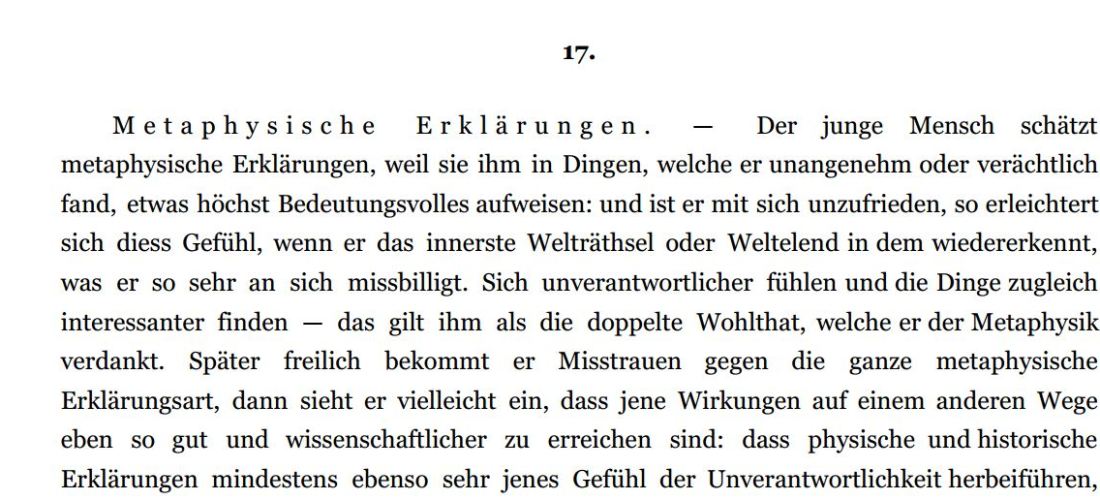
  1. Metaphysische Erklärungen. – Der junge Mensch schätzt metaphysische Erklärungen, weil sie ihm in Dingen, welche er unangenehm oder verächtlich fand, etwas höchst Bedeutungsvolles aufweisen: und ist er mit sich unzufrieden, so erleichtert sich diess Gefühl, wenn er das innerste Welträthsel oder Weltelend in dem wiedererkennt, was er so sehr an sich missbilligt. Sich unverantwortlicher fühlen und die Dinge zugleich interessanter finden – das gilt ihm als die doppelte Wohlthat, welche er der Metaphysik verdankt. Später freilich bekommt er Misstrauen gegen die ganze metaphysische Erklärungsart, dann sieht er vielleicht ein, dass jene Wirkungen auf einem anderen Wege eben so gut und wissenschaftlicher zu erreichen sind: dass physische und historische Erklärungen mindestens ebenso sehr jenes Gefühl der Unverantwortlichkeit herbeiführen, und dass jenes Interesse am Leben und seinen Problemen vielleicht noch mehr dabei entflammt wird.

Sources:

I will read a Dutch translation that is based on the work of researchers Colli and Montinari. I also use a translation from R.J.Hollingdale and the Gary Handwerk translation from the Colli-Montinari edition. Both are more modern than the copyright free translation I use here. This is a translation from 1909 by Helen Zimmern, who knew Nietzsche personally, but there was no critical study of Nietzsche’s work done back then and this translation suffers from that. The same goes for the translation from Alexander Harvey. My German is not good enough to pretend that I can translate it better than the professionals do but I will use the original as a referee.

  1. Menselijk al te menselijk een boek voor vrije geesten, translated by Thomas Graftdijk, 2000. Buy it here
  2. Human, all too human a book for free spirits, translated by R.J.Hollingdale, 1986
  3. Human, all too human a book for free spirits I V3, translated by Gary handwerk 1997
  4. Human, all too human a book for free spirits Part I, translated by Helen Zimmern 1909. Read it  here
  5. Human, all too human a book for free spirits, translated by Alexander Harvey, 1908. Read it here
  6. Menschliches allzu menschlich 1878/80. Read it here


16. Phenomenon and thing-in-itself

Human all too human

Reading Friedrich Nietzsche’s Human all too human

Read the introduction here

You can read the aphorism I discuss here in English an German below the main article.

Synopsis, quote from the translation by Helen Zimmern and my take on it

Philosophers see life and experiences as a picture that never changes. This picture must be correctly interpreted in order to come to a conclusion about the being that produced the picture or about the thing-in-itself1 what is regarded as sufficient ground for the world that appears to us. Philosophers see life as not changing Opposite to this, more logical minded people, after they described the metaphysical or unseen world as without a cause, have concluded that there was no connection between unseen world and the world which is known to us. Scientist see no connection between unseen and seen world So that the thing-in-itself should most certainly not appear in the phenomenon, (existing thing) and every conclusion from the former as regards the latter is to be rejected. Both sides forget that this painting of our life and experiences is still growing and cannot be used to look for a conclusion for the cause of it or deny one. (the sufficing cause)2 Our life and experiences are growing and cannot be used to predicts its cause. For ages we looked into the worlds pretentions, with blind inclination, passion, or fear, and illogical thoughts that this world has gradually become so terrible, full of meaning and of soul, it has acquired color—but we were the colorists. Our subjective eyes colored the world It is the intellect that has made this picture of life and experiences appear and put its mistaken fundamental conceptions into things. Later the philosophers started to see that the world we experience and the thing-in-itself are completely different and stopped drawing conclusions from our experiences out of the thing-in-itself, the philosophers will finely see that you cannot draw experience out of the thing-in-itself And in the worst case they will demand that we reject our personal will, so we can reach that what is real, that one may become real. Don’t know what F.N. meant with this Others have collected all the characteristic features of our world of appearance that is, the idea of the world spun out of intellectual errors and inherited by us, instead of blaming the intellect, they blamed the world-in-itself as the cause of the fact of this very sinister character of the world. Others blamed the world-in-itself and not the interpreter.  With all these opinions, the thorough process of science, that one day will celebrate its place in a history of thought, will deal with maybe as follows: That which we now call the world is the result of a mass of errors and fantasies which arose gradually in the general development of organic being, which are inter-grown with each other, and are now inherited by us as the accumulated treasure of all the past and it is a treasure, for the value of our humanity depends upon it. From this world of representation strict science is really only able to liberate us to a very slight extent—as it is also not at all desirable—inasmuch as it cannot essentially break the power of primitive habits of feeling; but it can gradually clarify the history of the rise of that world as representation,—and lift us, at least for moments, above and beyond the whole process. Perhaps we shall then recognize that the thing in itself is worth a Homeric laugh; that it seemed so much, indeed everything, and is really empty, namely, empty of meaning.”

Maybe it was not my day but I had a hard time with this aphorism, as if the different parts not really fitted with each other.

In one sentence:

Science will overcome the mistakes made by interpreting  life and experiences.

1 Objects as they are independent of observation (Read more)

2The Principle of Sufficient Reason is a powerful and controversial philosophical principle stipulating that everything must have a reason, cause, or ground. (Read more)


Human, all too human a book for free spirits Part I translated by Helen Zimmern 1909

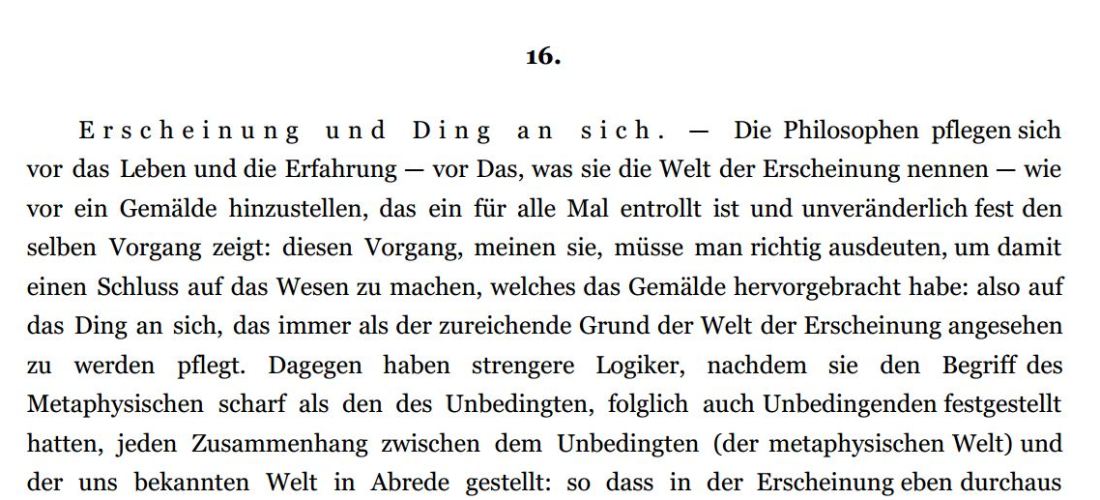
  1. PHENOMENON AND THING-IN-ITSELF.—Philosophers are in the habit of setting themselves before life and experience—before that which they call the world of appearance—as before a picture that is once for all unrolled and exhibits unchangeably fixed the same process,—this process, they think, must be rightly interpreted in order to come to a conclusion about the being that produced the picture : about the thing-in-itself, therefore, which is always accustomed to be regarded as sufficient ground for the world of phenomenon. On the other hand, since one always makes the idea of the metaphysical stand definitely as that of the unconditioned, consequently also unconditioning, one must directly disown all connection between the unconditioned (the metaphysical world) and the world which is known to us ; so that the thing-in-itself should most certainly not appear in the phenomenon, and every conclusion from the former as regards the latter is to be rejected. Both sides overlook the fact that that picture—that which we now call human life and experience—has gradually evolved,—nay, is still in the full process of evolving,—and therefore should not be regarded as a fixed magnitude from which a conclusion about its originator might be deduced (the sufficing cause) or even merely neglected. It is because for thousands of years we have looked into the world with moral, æsthetic, and religious pretensions, with blind inclination, passion, or fear, and have surfeited ourselves in the vices of illogical thought, that this world has gradually become so marvellously motley, terrible, full of meaning and of soul, it has acquired colour—but we were the colourists; the human intellect, on the basis of human needs, of human emotions, has caused this ” phenomenon ” to appear and has carried its erroneous fundamental conceptions into things. Late, very late, it takes to thinking, and now the world of experience and the thing-in-itself seem to it so extraordinarily different and separated, that it gives up drawing conclusions from the former to the latter—or in a terribly mysterious manner demands the renunciation of our intellect, of our personal will, in order thereby to reach the essential, that one may become essential. Again, others have collected all the characteristic features of our world of phenomenon,—that is, the idea of the world spun out of intellectual errors and inherited by us,—and instead of accusing the intellect as the offenders, they have laid the blame on the nature of things as being the cause of the hard fact of this very sinister character of the world, and have preached the deliverance from Being. With all these conceptions the constant and laborious process of science (which at last celebrates its greatest triumph in a history of the origin of thought) becomes completed in various ways, the result of which might perhaps run as follows :—”That which we now call the world is the result of a mass of errors and fantasies which arose gradually in the general development of organic being, which are inter-grown with each other, and are now inherited by us as the accumulated treasure of all the past —as a treasure, for the value of our humanity depends upon it. From this world of representation strict science is really only able to liberate us to a very slight extent—as it is also not at all desirable—inasmuch as it cannot essentially break the power of primitive habits of feeling ; but it can gradually elucidate the history of the rise of that world as representation,—and lift us, at least for moments, above and beyond the whole process. Perhaps we shall then recognise that the thing in itself is worth a Homeric laugh ; that it seemed so much, indeed everything, and is really empty, namely, empty of meaning.”

Menschliches allzu menschlich 1878/80

  1. Erscheinung und Ding an sich. – Die Philosophen pflegen sich vor das Leben und die Erfahrung – vor Das, was sie die Welt der Erscheinung nennen – wie vor ein Gemälde hinzustellen, das ein für alle Mal entrollt ist und unveränderlich fest den selben Vorgang zeigt: diesen Vorgang, meinen sie, müsse man richtig ausdeuten, um damit einen Schluss auf das Wesen zu machen, welches das Gemälde hervorgebracht habe: also auf das Ding an sich, das immer als der zureichende Grund der Welt der Erscheinung angesehen zu werden pflegt. Dagegen haben strengere Logiker, nachdem sie den Begriff des Metaphysischen scharf als den des Unbedingten, folglich auch Unbedingenden festgestellt hatten, jeden Zusammenhang zwischen dem Unbedingten (der metaphysischen Welt) und der uns bekannten Welt in Abrede gestellt: so dass in der Erscheinung eben durchaus nicht das Ding an sich erscheine, und von jener auf dieses jeder Schluss abzulehnen sei. Von beiden Seiten ist aber die Möglichkeit übersehen, dass jenes Gemälde – Das, was jetzt uns Menschen Leben und Erfahrung heisst – allmählich geworden ist, ja noch völlig im Werden ist und desshalb nicht als feste Grösse betrachtet werden soll, von welcher aus man einen Schluss über den Urheber (den zureichenden Grund) machen oder auch nur ablehnen dürfte. Dadurch, dass wir seit Jahrtausenden mit moralischen, ästhetischen, religiösen Ansprüchen, mit blinder Neigung, Leidenschaft oder Furcht in die Welt geblickt und uns in den Unarten des unlogischen Denkens recht ausgeschwelgt haben, ist diese Welt allmählich so wundersam bunt, schrecklich, bedeutungstief, seelenvoll geworden, sie hat Farbe bekommen, – aber wir sind die Coloristen gewesen: der menschliche Intellect hat die Erscheinung erscheinen lassen und seine irrthümlichen Grundauffassungen in die Dinge hineingetragen. Spät, sehr spät – besinnt er sich: und jetzt scheinen ihm die Welt der Erfahrung und das Ding an sich so ausserordentlich verschieden und getrennt, dass er den Schluss von jener auf dieses ablehnt – oder auf eine schauerlich geheimnissvolle Weise zum Aufgeben unsers Intellectes, unsers persönlichen Willens auffordert: um dadurch zum Wesenhaften zu kommen, dass man wesenhaft werde. Wiederum haben Andere alle charakteristischen Züge unserer Welt der Erscheinung – das heisst der aus intellectuellen Irrthümern herausgesponnenen und uns angeerbten Vorstellung von der Welt – zusammengelesen und anstatt den Intellect als Schuldigen anzuklagen, das Wesen der Dinge als Ursache dieses thatsächlichen, sehr unheimlichen Weltcharakters angeschuldigt und die Erlösung vom Sein gepredigt. – Mit all diesen Auffassungen wird der stetige und mühsame Process der Wissenschaft, welcher zuletzt einmal in einer Entstehungsgeschichte des Denkens seinen höchsten Triumph feiert, in entscheidender Weise fertig werden, dessen Resultat vielleicht auf diesen Satz hinauslaufen dürfte: Das, was wir jetzt die Welt nennen, ist das Resultat einer Menge von Irrthümern und Phantasien, welche in der gesammten Entwickelung der organischen Wesen allmählich entstanden, in einander verwachsen [sind] und uns jetzt als aufgesammelter Schatz der ganzen Vergangenheit vererbt werden, – als Schatz: denn der Werth unseres Menschenthums ruht darauf. Von dieser Welt der Vorstellung vermag uns die strenge Wissenschaft thatsächlich nur in geringem Maasse zu lösen – wie es auch gar nicht zu wünschen ist -, insofern sie die Gewalt uralter Gewohnheiten der Empfindung nicht wesentlich zu brechen vermag: aber sie kann die Geschichte der Entstehung jener Welt als Vorstellung ganz allmählich und schrittweise aufhellen – und uns wenigstens für Augenblicke über den ganzen Vorgang hinausheben. Vielleicht erkennen wir dann, dass das Ding an sich eines homerischen Gelächters werth ist: dass es so viel, ja Alles schien und eigentlich leer, nämlich bedeutungsleer ist.

Sources:

I will read a Dutch translation that is based on the work of researchers Colli and Montinari. I also use a translation from R.J.Hollingdale and the Gary Handwerk translation from the Colli-Montinari edition. Both are more modern than the copyright free translation I use here. This is a translation from 1909 by Helen Zimmern, who knew Nietzsche personally, but there was no critical study of Nietzsche’s work done back then and this translation suffers from that. The same goes for the translation from Alexander Harvey. My German is not good enough to pretend that I can translate it better than the professionals do but I will use the original as a referee.

  1. Menselijk al te menselijk een boek voor vrije geesten, translated by Thomas Graftdijk, 2000. Buy it here
  2. Human, all too human a book for free spirits, translated by R.J.Hollingdale, 1986
  3. Human, all too human a book for free spirits I V3, translated by Gary handwerk 1997
  4. Human, all too human a book for free spirits Part I, translated by Helen Zimmern 1909. Read it  here
  5. Human, all too human a book for free spirits, translated by Alexander Harvey, 1908. Read it here
  6. Menschliches allzu menschlich 1878/80. Read it here


Free will

Drawings from the bottom of the drawer.

Drawings from the bottom of the drawer.

I have made some drawings in the past and they all came alive because of overflowing thoughts and philosophies and the urge to visualize them. The lack of words, and listeners, to express myself put my fantasy at work and I started these drawings. I have no talent for drawing or ambition in that direction. I only judge my work, and deem it finished, in so far as it pleases my eye and sense of proportion. I will now try to describe some of these drawings and tell something about the thoughts behind it. Bear in mind that some drawings are almost 20 years old and that my thoughts about them now compared to my intentions then can differ now, but I hope only in details and nuances and not in the core meaning.

tekening -1


We see here a checkerboard floating through space. This checkerboard resembles your life and is part of an underlying construction. On the checkerboard stands a depiction of you. The mechanical cross stands for religion and/or a constructed governing force that holds the checkerboard in place and can tilt it, so to slide you to one side unknowingly.  In the background you see a similar contraption where the other person, like you, is consuming parts of other people’s lives or at least the places where you could go. Underneath the main checkerboard hangs a large construct that you don’t see at the other one. This constrict works like a counterweight, and is made of knowledge, and dampens the effect of the steering crosses. I made it with a pen you couldn’t erase, to simulate life, when I made a little mistake I turned it in a flower as a sign of hope.

The checkerboard

If we get born, we are “thrown” into a specific situation. You are born in a specific country, class, religion, age, political system and so on. All these situations play a great role in your life if you want it to or not. If you are born in China in 1968 you cannot pretend to be only influenced by Brazilian culture when your 4 years old. What happens around you has a strong influence on you and how you will become when you grow up. You can go along with your culture and or rebel against it, but in both cases, you react to the situation you were “thrown” in at your birth. The checkerboard represents the life you are in and all the possibilities available to you in that life. You have a limited choice in where you stand but it all depends on where you grew up. The construction where the checkerboard rest on represents the constructed nature of most of the things and situations that influence us. Your are born in a specific family, there are many different forms of family life through the ages and in all the different cultures. You can have a typical 21st century western family with a mom and dad and two kids or, a family from 300 years ago in another part of the world where you live in a big building with 10 brothers and sister, uncles, aunts, grandmother, grandfather, and your parents. Both are constructed ways of living together, life, culture and history made these groups the way they are, nature has not so much to do with it. It is not hard to imagine what an effect these two different groups would have on you when you grow up in either one of them. You as a person have no choice in that, you are formed by your circumstances. “Everyone is the other and no one is himself.” Martin Heidegger

The iron crosses.

The iron cross represents the mechanism that has a more steering role after you start making “your own” choices in where to stand on the “checkerboard” that is given to you by your birth. Let’s say you are born in a religious family, then there are only a few places on your checkerboard where you can go to, to become an atheist. If you remain in a country that is heavily controlled by religious rulers than this “iron cross” represent these rulers and will tilt you on the checkerboard to a place where you will stay religious. Let’s say that you now move to a secular country, you will still be bound by the checkerboard or possibilities given to you by birth but now the “iron cross” or authorities will not steer you away from the little secular squares you have, but steer you towards it. Another way of reaching the few secular squares you have, in this example, is by studying and gaining knowledge. This knowledge might work as a counterweight to the forces in your religious country have on the direction of your life, and thus might steer you to the secular spaces on your checkerboard. This is most likely not a conscious move on your part, if you by coincidence start reading the “wrong” books this so-called counterweight might form without you knowing it. This iron cross is not only representing religion but all man-made constructs that steer your life, like the form of government or social structures you live under. All of these, steer your life towards their wishes. Remember that these constructs are not controlled by humans, they might be invented by them, but they live a life of their own and steer you as well as the so called rulers that are proclaiming and defending that system.

The others

The others, or other people in your life, take away pieces of your checkerboard or life. We do the same thing when we are in the vicinity of others.  Let’s take the religious person from before as an example. If I, an atheist, would become a friend with a religious person and we start talking and discussing life I will slowly eat away from their religious side of their checkerboard till I potentially consume, enough religious parts that they have no choice and land on a secular square despite the pull of the “cross” or system they live under. They will also feast on my secular squares and it depends on their quality and the pull of the system where I live under to see if and when in the end I will give.

In short.

You are born in specific circumstances that will give you a limited amount of choices. Society will guide your future choices, by the way of social pressure or laws but self-education can make you more independent. Other people will take away choices like someone telling you, while growing up, what you can’t do, and this will make it harder and harder to reach that goal that you desire.

Where is the free will?

I think that our free will is encapsulated in an imaginary tiny box. In that box we have free will but just outside that the box is everything we do in the world and determent by the world. Free will is something we think, but we act deterministic. We think we made a choice, and that is the limit of our freedom, we can think.

Let’s say you agree with me that we are thrown into the world and that YOU have had no choice in that. You had no choice in the circumstances you grew up in, it is determent for you. So, you might think that you choose that school later in life, but that choice was already made by the time and place you were born. You can choose from different schools, that all belonged to that specific time and place, you were born. That you choose the technical school was probably because of an example or someone talked you into it and don’t forget your genetic makeup. It is impossible to prove that there was a single point in your life where you decided to go to that school without influences from outside. Even if you stubbornly choose the opposite of all that surrounds you it still just the opposite of what was already determined.  Like I said, it feels like a choice, but it isn’t. There are all kinds of forces steering us forward. This doesn’t mean that you than give up. If you know that life is like that you can use that little freedom in your head to prepare yourself for the movements of life. I can give you an example of that: in my training as a Marine we learned certain fighting skills whereby you use the force of your opponent to defeat him. A little guy could, by accepting the forces around him, the powerful swing going towards his face, and stepping aside and lightly guide the powerful blow in a direction where the opened my stumble by means of his own forward momentum, and thus using these forces to beat a towering hulk. Your freedom rest in excepting the forces around you and not get overwhelmed by it. Your freedom lies, encapsulated, in that little box in your mind, and only there you can be free as long as you are not overwhelmed by the forces around you.