
Day 2119, looking for.
Day's pictures, Poetry



Today I was in the hospital for a minor operation; I had a hernia in the groin. It was the first time for me to be in a hospital for myself and not for a visit. Like I approach most things in life, I was quite interested in the process. It was not that interesting or exhilarating looking back, but I remember two things the most: when I took a selfie for my family, I saw myself in the picture as an old guy in a hospital. Both things are, of course, through, but it is the instant association with hospitals and sickness when you see these “clothes” on you. Seeing myself like this made it immediately different from a routine visit to the doctor or dentist. It was not stressful; it just made it more official and serious than the feeling I had when I went into it, just an observation. Maybe we could have some fancier and more colorful clothes next time, and all the patients wear a baseball cap with a smile on it, so everybody still knows who’s who, just a little bit more joy and colors.


When you call yourself an Indian or a Muslim or a Christian or a European, or anything else, you are being violent. Do you see why it is violent? Because you are separating yourself from the rest of mankind. When you separate yourself by belief, by nationality, by tradition, it breeds violence. So a man who is seeking to understand violence does not belong to any country, to any religion, to any political party or partial system; he is concerned with the total understanding of mankind.

First essay: ‘Good and Evil’, ‘Good and Bad’
12 – At this juncture I cannot suppress a sigh and one last hope. What do I find absolutely intolerable? Something which I just cannot cope alone with and which suffocates me and makes me feel faint? Bad air! Bad air! That something failed comes near me, that I have to smell the bowels of a failed soul! … Apart from that, what cannot be borne in the way of need, deprivation, bad weather, disease, toil, solitude? Basically we can cope with everything else, born as we are to an underground and battling existence; again and again we keep coming up to the light, again and again we experience our golden hour of victory, – and then there we stand, the way we were born, unbreakable, tense, ready for new, more difficult and distant things, like a bow that is merely stretched tauter by affliction. – But
115.
The so-called “Ego.”—Language and the prejudices upon which language is based very often act as obstacles in our paths when we proceed to explore internal phenomena and impulses: as one example, we may instance the fact that there are only words to express the superlative degrees of these phenomena and impulses. Now, it is our habit no longer to observe accurately when words fail us, since it is difficult in such cases to think with precision: in former times, even, people involuntarily came to the conclusion that where the domain of words ceased, the domain of existence ceased also. Wrath, hatred, love, pity, desire, recognition, joy, pain: all these are names indicating extreme conditions; the milder and middle stages, and even more particularly the ever active lower stages, escape our attention, and yet it is they which weave the warp and woof of our character and destiny. It often happens that these extreme outbursts—and even the most moderate pleasure or displeasure of which we are actually conscious, whether in partaking of food or listening to a sound, is possibly, if properly estimated, merely an extreme outburst,—destroy the texture and are then violent exceptions, in most cases the consequences of some congestions,—and how easily as such can they mislead the observer! as indeed they mislead the person acting! We are all of us not what we appear to be according to the conditions for which alone we have consciousness and words, and consequently praise and blame. We fail to recognise ourselves after these coarse outbursts which are known to ourselves alone, we draw conclusions from data where the exceptions prove stronger than the rules; we misinterpret ourselves in reading our own ego’s pronouncements, which appeared to be so clear. But our opinion of ourselves, this so-called ego which we have arrived at by this wrong method, contributes henceforth to form our character and destiny.

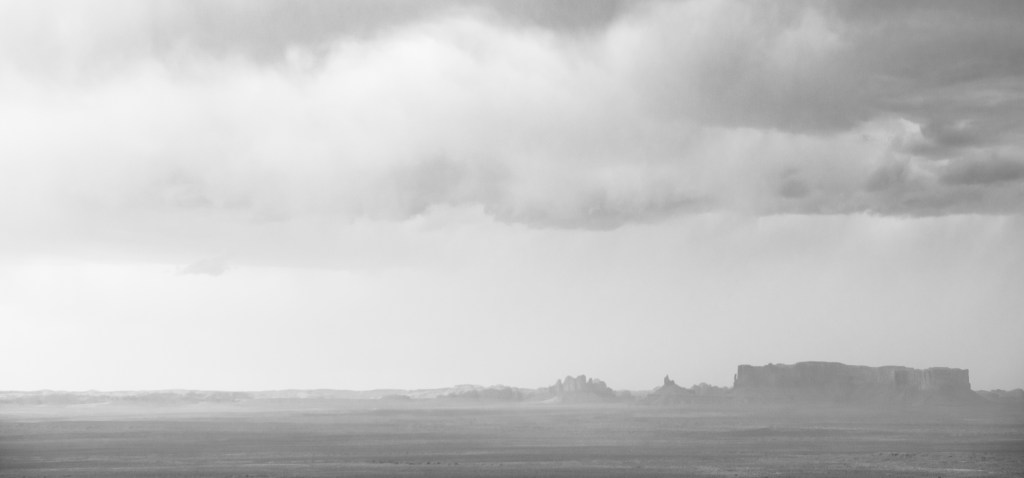
Utah, America, 2016
 Nochrisis