
I saw the flowers today
parading their beauty
opening up
~
like the dresses I see
getting shorter
when the sun gets higher





11. The Pessimist of the Intellect.—He whose intellect is really free will think freely about the intellect itself, and will not shut his eyes to certain terrible aspects of its source and tendency. For this reason others will perhaps designate him the bitterest opponent of free thought and give him that dreadful, abusive name of “pessimist of the intellect”: accustomed as they are to typify a man not by his strong point, his pre-eminent virtue, but by the quality that is most foreign to his nature.

6. Against visionaries.—The visionary denies the truth to himself, the liar only to others

Beyond good and evil, Part 8 people and fatherland, 249. Every nation has its own ” Tartuffery,” and calls that its virtue. —One does not know—cannot know, the best that is in one.
Friedrich Nietzsche

The gay science, 346 Our question mark. – But you do not understand this? lndeed, people will have trouble understanding us. We are searching for words, perhaps also for ears. Who are we anyway? lf we simply called ourselves godless (to use an old expression), or unbelievers, or even immoralists, we would not think that these words came near to describing us: we are all three of them, at too advanced a stage for anyone to comprehend – for you to comprehend, my curious gentlemen -how it feels. No! No longer with the bitterness and passion of the one who has

Nochrisis
By Friedrich Nietzsche
First chapter.
PREJUDICES OF PHILOSOPHERS.
5.
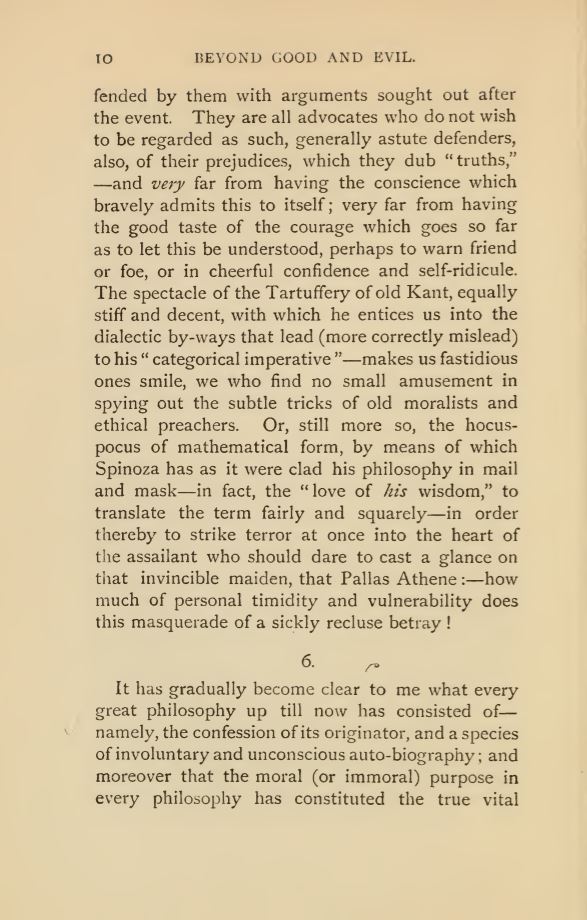
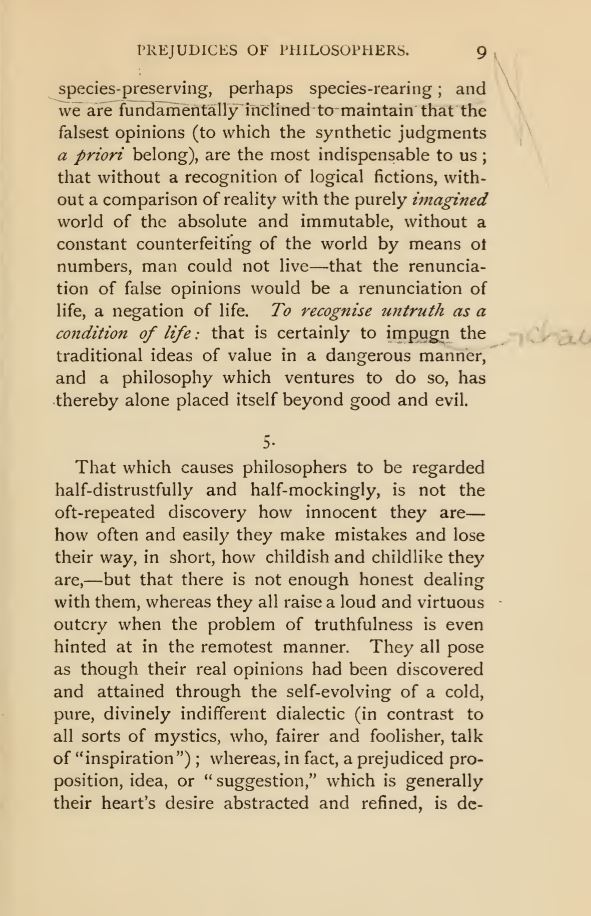
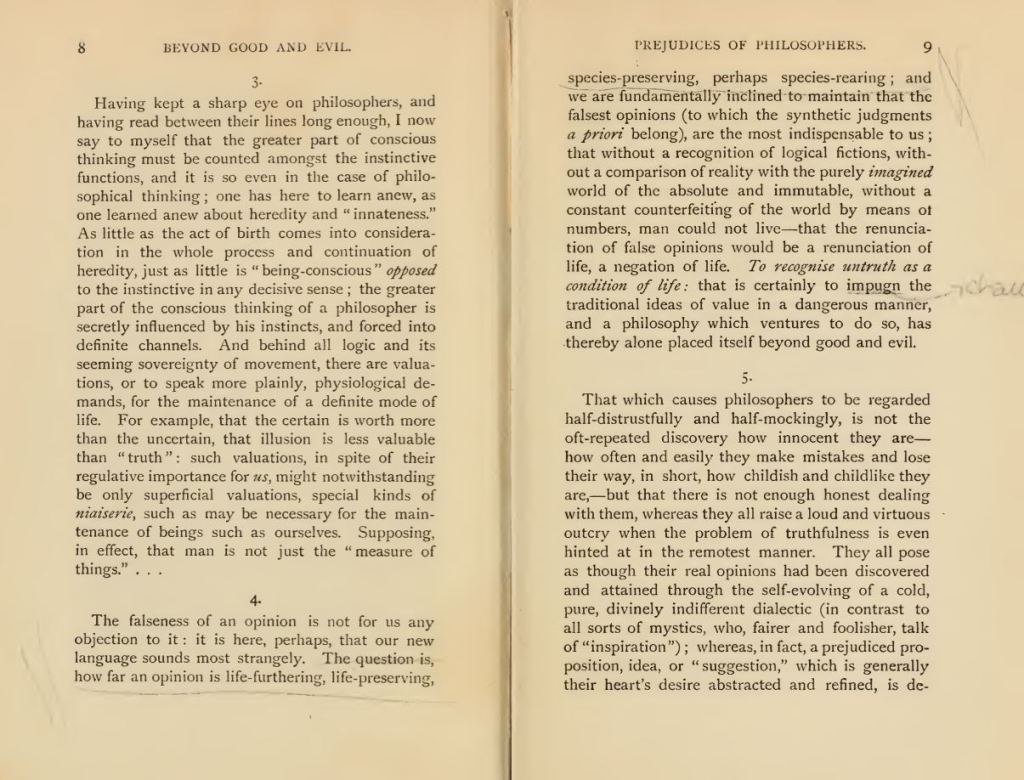
That which causes philosophers to be regarded half-distrustfully and half-mockingly, is not the oft-repeated discovery how innocent they are—how often and easily they make mistakes and lose their way, in short, how childish and childlike they are,—but that there is not enough honest dealing with them, whereas they all raise a loud and virtuous outcry when the problem of truthfulness is even hinted at in the remotest manner. They all pose as though their real opinions had been discovered and attained through the self-evolving of a cold, pure, divinely indifferent dialectic (in contrast to all sorts of mystics, who, fairer and foolisher, talk of “inspiration”); whereas, in fact, a prejudiced proposition, idea, or ” suggestion,” which is generally their heart’s desire abstracted and refined, is defended by them with arguments sought out after the event. They are all advocates who do not wish to be regarded as such, generally astute defenders, also, of their prejudices, which they dub ” truths,” —and very far from having the conscience which bravely admits this to itself; very far from having the good taste of the courage which goes so far as to let this be understood, perhaps to warn friend or foe, or in cheerful confidence and self-ridicule. The spectacle of the Tartuffery* of old Kant, equally stiff and decent, with which he entices us into the dialectic by-ways that lead (more correctly mislead) to his” categorical imperative”—makes us fastidious ones smile, we who find no small amusement in spying out the subtle tricks of old moralists and ethical preachers. Or, still more so, the hocuspocus of mathematical form, by means of which Spinoza has as it were clad his philosophy in mail and mask—in fact, the “love of his wisdom,” to translate the term fairly and squarely—in order thereby to strike terror at once into the heart of the assailant who should dare to cast a glance on that invincible maiden, that Pallas Athene**:—how much of personal timidity and vulnerability does this masquerade of a sickly recluse betray!
* hypocrisy
** ancient Greek goddess associated with wisdom, handicraft, and warfare
Translated by Helen Zimmerm
1909
Nochrisis
By Friedrich Nietzsche
First chapter.
PREJUDICES OF PHILOSOPHERS.
4.
The falseness of an opinion is not for us any objection to it: it is here, perhaps, that our new language sounds most strangely. The question is, how far an opinion is life-furthering, life-preserving, species-preserving, perhaps species-rearing; and we are fundamentally inclined to maintain that the falsest opinions (to which the synthetic judgments a priori* belong), are the most indispensable to us; that without a recognition of logical fictions, with out a comparison of reality with the purely imagined world of the absolute and immutable, without a constant counterfeiting of the world by means of numbers, man could not live—that the renunciation of false opinions would be a renunciation of life, a negation of life. To recognize untruth as a condition of life : that is certainly to impugn the traditional ideas of value in a dangerous manner, and a philosophy which ventures to do so, has: thereby alone placed itself beyond good and evil.
Translated by Helen Zimmerm
1909
*

 Nochrisis