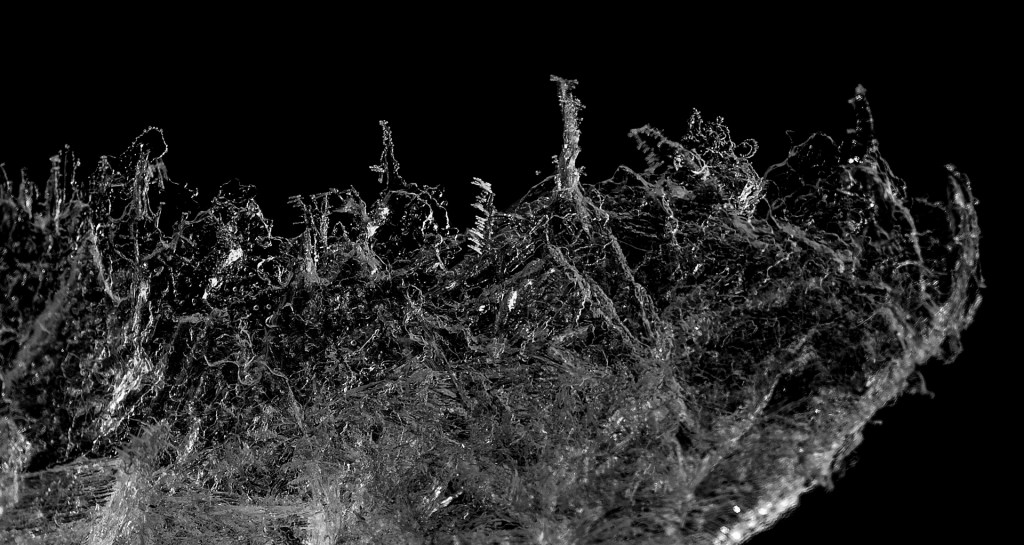
Day 2353, glass.

Day's pictures, Poetry
We all live alone
pretending to look at the world through misformed glass 

the windows don’t open in this cellar 
we breathe through cracks we made 
we love the fresh air to get in 
not out there 

My “fresh air”, so to say, is reading books from people that I can relate to. I would like to meet people that are still alive and have similar thoughts like these long-dead philosophers, but no one has taught me the secret sign that like-minded people give each other when they cross each other in life. I like to read Nietzsche, but it doesn’t really matter which philosopher you read because they all share a willingness to search and question and have all seen the underlying problems. Their answers might be different, but I don’t think that answers are that important to get wiser; maybe answers function is being an anchor, and having one might tempt you to throw it overboard in rougher weather or when tired of sailing

Underneath are some quotes from one of Nietzsche’s last books: Twilight of the idols, or how to philosophize with a hammer. The hammer he uses is not one we use for driving nails but one the doctor uses to test reflexes and abnormalities in the nervous system…just so you know. Stucked between these quotes is a famous one “Out of life’s school of war: What does not destroy me, makes me stronger.” Because of all the (mis)use, it is now some kind of a platitude for me, but that doesn’t take away that you can still write a book about this one quote if you want.

Day 2347, opening doors.

Day's pictures, Philosophy

Friedrich Nietzsche

Daybreak

Thoughts on the prejudices of morality

Book I

19 Morality makes stupid. – Custom represents the experiences of men of earlier times as to what they supposed useful and harmful – but the sense for custom (morality) applies, not to these experiences as such, but to the age, the sanctity, the indiscussability of the custom. And so this feeling is a hindrance to the acquisition of new experiences and the correction of customs: that is to say, morality is a hindrance to the creation of new and better customs: it makes stupid.

35 Feelings and their origination in judgments. – ‘Trust your feelings!’ – But feelings are nothing final or original; behind feelings there stand judgments and evaluations which we inherit in the form of feelings (inclinations, aversions). The inspiration born of a feeling is the grandchild of a judgment – and often of a false judgment! – and in any event not a child of your own! To trust one’s feelings – means to give more obedience to one’s grandfather and grandmother and their grandparents than to the gods which are in us: our reason and our experience.

55 ‘Ways’. – The supposed ‘shorter ways’ have always put mankind into great danger; at the glad tidings that such a shorter way has been found, they always desert their way – and lose their way.

Day 2271, association.

Day's pictures

Friedrich Nietzsche

Human all too human

Of the first and last things

14 Association. —All strong feelings are associated with a variety of allied sentiments and emotions. They stir up the memory at the same time. When we are under their influence we are reminded of similar states and we feel a renewal of them within us. Thus are formed habitual successions of feelings and notions, which, at last, when they follow one another with lightning rapidity are no longer felt as complexities but as unities. In this sense we hear of moral feelings, of religious feelings, as if they were absolute unities. In reality they are streams with a hundred sources and tributaries. Here again, the unity of the word speaks nothing for the unity of the thing.

Day 2257, preface

Day's pictures

Friedrich Nietzsche

On the genealogy of morality

Preface I

We are unknown to ourselves, we knowers: and with good reason. We have never looked for ourselves, – so how are we ever supposed to find ourselves? How right is the saying: ‘Where your treasure is, there will your heart be also’;! our treasure is where the hives of our knowledge are. As born winged-insects and intellectual honey-gatherers we are constantly making for them, concerned at heart with only one thing – to ‘bring something home’. As far as the rest of life is concerned, the so-called ‘experiences’, – who of us ever has enough seriousness for them? or enough time? I fear we have never really been ‘with it’ in such matters: our heart is simply not in it – and not even our ear! On the contrary, like somebody divinely absent-minded and sunk in his own thoughts who, the twelve strokes of midday having just boomed into his ears, wakes with a start and wonders ‘What hour struck?’, sometimes we, too, afterwards rub our ears and ask, astonished, taken aback, ‘What did we actually experience then?’ or even, ‘Who are we, in fact?’ and afterwards, as I said, we count all twelve reverberating strokes of our experience, of our life, of our being – oh! and lose count …

Day 2215, history today.

Day's pictures

Friedrich Nietzsche

Human all too human II

Mixed opinion and maxims

382 The final lesson of history. -“Ah, if only I had lived at that time!” -these are the words of foolish and frivolous human beings. We will instead, with regard to every bit of history that we have seriously considered, though it may be the most highly praised land of the past, cry out in the end: “anything rather than back there again! The spirit of that age would press down upon you with the weight of a hundred atmospheres, you would not enjoy what is good and beautiful about it, and you would not be able to digest what is bad.” -It is certain that the world to come will judge our age in the same way: it must have been unbearable, life in it has become unlivable. -And yet everyone puts up with his own age?-Yes, and precisely because the spirit of his age not only lies upon him, but is also within him. The spirit of the age offers its own resistance to itself and bears itself up.

Day 2187,

Day's pictures

Friedrich Nietzsche

On the genealogy of morality

Third Treatise: What Do Ascetic Ideals Mean?

5. What then do ascetic ideals mean? In the case of an artist, as we have grasped by now: absolutely nothing! … Or so many things that it is as good as absolutely nothing! … Let us first of all eliminate artists: they are far from standing independently enough in the world and against the world for their valuations and the changes in these to deserve interest in themselves! In all ages they have been valets of a morality or philosophy or religion; quite apart from the fact that, unfortunately, they have often enough been the all-too-pliant courtiers of their disciples and patrons, and flatterers with a good nose for old or newly rising powers. At the very least they always need a protective armor, a backing, a previously established authority: artists never stand by themselves, standing alone goes against their deepest instincts…

You can read the rest here: https://www.gutenberg.org/files/52319/52319-h/52319-h.htm


Day 2152, question.

Day's pictures

Friedrich Nietzsche

Twilight of the Idols

Epigrams and Arrows

37 You’re running ahead?—Are you doing so as a shepherd? Or as an exception? A third case would be the escapee . . . First question of conscience.

38 Are you genuine, or just an actor? A representative? Or the very thing that’s represented? In the end you may simply be an imitation of an actor . . . Second question of conscience.

Day 2145, shadows.

Day's pictures

Friedrich Nietzsche

Human all to human II, Mixed Opinions and Maxims

335 Warmth in the heights. -It is warmer upon the heights than people in the valleys believe, especially in winter. The thinker knows all that this comparison implies.

39 Why stupid people so often become malicious. -To the reproaches of an opponent, where our head feels itself too weak to respond, our heart responds by casting suspicion upon the motives behind his reproaches.

122 Good memory. -There are many who do not become thinkers only because their memories are too good.

Day 2125, peace.

Daily picture


Friedrich Nietzsche

Human, All Too Human II

The Wanderer and His Shadow

284 The means to a genuine peace. -No government at present concedes that it maintains an army in order to satisfy occasional desires for conquest; instead, it is supposed to serve the purpose of self-defense. The morality that justifies self-defense is called upon as its advocate. But that means: reserving morality for ourselves and immorality for our neighbor, because he must be thought to be aggressive and imperialistic, if our state has to be thinking about the means of self-defense; moreover, our explanation of why we need an army declares him, who denies his aggressiveness just as much as our state does and for his part, too, supposedly maintains an army only for reasons of self-defense,

Day 2115, view from a view from my window.

Day's pictures

I love reading letters written by people I admire like this example written by Friedrich Nietzsche to his good friend Peter Gast; it humanizes these people from who you normally only read the best they can produce and not about their daily lives. This comes out of a book written in 1921 by Oscar Levy, who translated a lot of Nietzsche’s work when it first got known outside Germany. You can read the book on archive.org, this letters starts on on page 139.

NIETZSCHE TO PETER GAST.

Sils-MaIaria, end of August, 1881.

But this is splendid news, my dear friend! Above all that you should have finished! At the thought of· this first great achievement of your life, I feel indescribably happy and solemn ; I shall not fail to remember August 24, 1881 ! How things are progressing ! But as soon as I think of your work I am overcome by a

Day 2097, abandoned.

Day's pictures

Friedrich Nietzsche

The gay Science

Book Four: St. Januarius

331- Better deaf than deafened – Formerly one wanted to be talked about; that is no longer enough, since the market has grown too large – only a shout will do. As a result, even good voices shout themselves down, and the best goods are offered by hoarse voices; without the vendors’ cry and hoarseness there is no longer any genius. That is, to be sure, a bad epoch for a thinker; he must learn how to find his own quietude even between two noises, and pretend he is deaf until he really is. As long as he has not learned this, he runs the risk of going to pieces from impatience and headaches.