
In this picture you can see lady justice stranded somewhere bagging for some money. There are enough places where there is a lack of justice, I leave it up to you to come up with an example.

In this picture you can see lady justice stranded somewhere bagging for some money. There are enough places where there is a lack of justice, I leave it up to you to come up with an example.


Think about it…we live here, all 7 billion on a planet in a vast universe. Those 7 billion people have all an opinion about this life but…is there anyone who actually knows what’s going on? Imagine this: we are all stuck in an elevator, all 7 billion of us, and the button to call for help is missing, we all been in situations like that, its uncomfortable, you start looking at each other for answers, your mind start racing and you try to stick to some thought that calms you down. I think we are in that situation here on earth and there are a lot of people shouting what is going on, but that doesn’t help you one bit in figuring out what really is going on. We just don’t know what’s going on outside the lift.
I thought about this when someone on YouTube quoted Einstein in saying something like: “the universe is not stranger than we do imagine, it’s stranger than we can imagine”. Einstein, is in this “locked in a lift scenario” the lift repairmen locked in with us. What he say’s has some weight and if he point’s out that we could not imagine a solution to the “why is the lift stuck” problem, who can? There is no one at this planet that can say with certainty what’s going on, even the president of America, the best specimen earth has to offer, doesn’t know that, and he’s is the one that opens the door when the Martians knock on it and ask: “why are you stuck here?”. (Did I just prove Einstein wrong?)


It is always nice to visit your home country. I had my reasons to leave the Netherlands and moved to Norway but some things I miss. Walking in Amsterdam with my colleagues from Norway and seeing their reactions to red lights and funny smells reminded me how used I am to the Dutch way of dealing with drugs and prostitution. I think that my colleagues are seen as progressives in Norway, but their reaction genuinely surprised me. They were opposed to it and telling stories how bad drugs is and how prostitutes are all forced in doing their work. We discussed it and how I think that their view is influenced by the propaganda the Norwegian government is spewing, something the Dutch government does to off course, but then the other way. I learned that Drugs and prostitution can be found in any society and that it’s stupid to bury the problem like they do, for instance, in Norway. For us it’s legal to buy soft drugs to prevent kids from coming in contact with hard drugs and some prostitutes might still do their work against there wishes but most of them don’t and can leave their job mush easier and work safer. I know it’s a culture clash, but more and more countries are going this rational way, so I think it is the right way. But Norway is in many ways a paternalistic country, or as they say in America: they have a nanny state. Alcohol is also strongly regulated here, you can’t buy a beer after a certain time and all the other kinds of alcohol are only for sale in stores controlled by the government. Thankfully I am detached enough from Norwegian society that it doesn’t border me that much, but if I think about it, it can annoy me that they don’t give me the freedom to do what I want with my own body, these colleagues literally say that they don’t mind taking away my freedom to buy beer at 20:05 or smoke a harmless joint. On of there arguments is that they have to pay for the damage I do to society when I get sick or addicted. But what about the people that do dangerous sports, don’t sport, eat fat, work to hard or do whatever life choice they make that is dangerous and unhealthy, do you forbid those activities? I see no reason why someone could withhold you from doing potentially stupid things to yourself, as long as you don’t endanger others it’s fine for me.
Related to this story and how hypocritical people are is this story from today in the Guardian: Link It’s about the legal and synthetic version of heroin: OxyContin. Hundreds of thousands of people have died from these legal drugs that are as addictive as the illegal versions.
“But few know their wealth comes from Purdue Pharma, a private Connecticut company the family developed and wholly owns. In 1995, the company revolutionized the prescription painkiller market with the invention of OxyContin, a drug that is a legal, concentrated, chemical version of morphine or heroin. It was designed to be safe; when it first came to market, its slow-release formula was unique. After winning government approval it was hailed as a medical breakthrough, which Goldin now refers to as “magical thinking”.
It was aggressively marketed to doctors – many of whom were taken on lavish junkets, given misleading information and paid to give talks on the drug – while patients were wrongly told the pills were a reliable long-term solution to chronic pain, and in some cases offered coupons for a month’s free sample.”
I always like to look at today’s society from the future, let’s say 300 years from now. I think that they would describe a drugs problem around the end of the 20th century but the biggest criminals are not the small fry like Joaquin Guz or Pablo Escobar but the large pharmaceutical companies followed closely by their supportive governments.




This picture is taken in a beautiful part of America and the sign tells a story of that place. Look at all the marks that the foreigners left as a sign of their appreciation, to show the world that they traveled all the way to this great place. I chose this picture and changed it to use it as a commentary on our society that is heading more and more towards a “me” focused world instead of a world where the other (you) also counts. People say more and more: “I don’t want refugees because I don’t trust them” instead of YOU come from a country destroyed by a war and YOU have it much worse than I have so YOU can come here.
The internet brought the world and its people closer together compared to 20, 50 or a 100 years ago but this technical marvel has not brought our hearts closer together. Twitter brought us the Arab spring and a fifth of the world is connected on Facebook and you would think that we would be more understanding of each other. Instead we see more and more people and governments closing their doors and longing back to the day’s where everything was neat in a box and labeled for clarity. Our modern need to take selfies is a vivid reminder of this, we like to share with the world a picture of ourselves, look at me.
I was this week for work in Amsterdam and there I saw the famous selfie sticks in use and I paid some attention. To be fair, the people were taking photos of all the sites, but they stuck their head in front of it and the camera every time. Imagine these people showing their pictures back home to some family members: here is a picture of me, and me, and me and my friend, and me etc. They showed the world where they have been instead of what that other world looks like. But maybe I’m not fair, 20 years ago it was not possible to easily make selfies with the film camera’s we had back then and it was a lot of work to send a couple of hundred friends a copy of your pictures. Maybe the modern technique has only awoken a slumbering need in us humans. Maybe there was never a Youtah and always a Metah


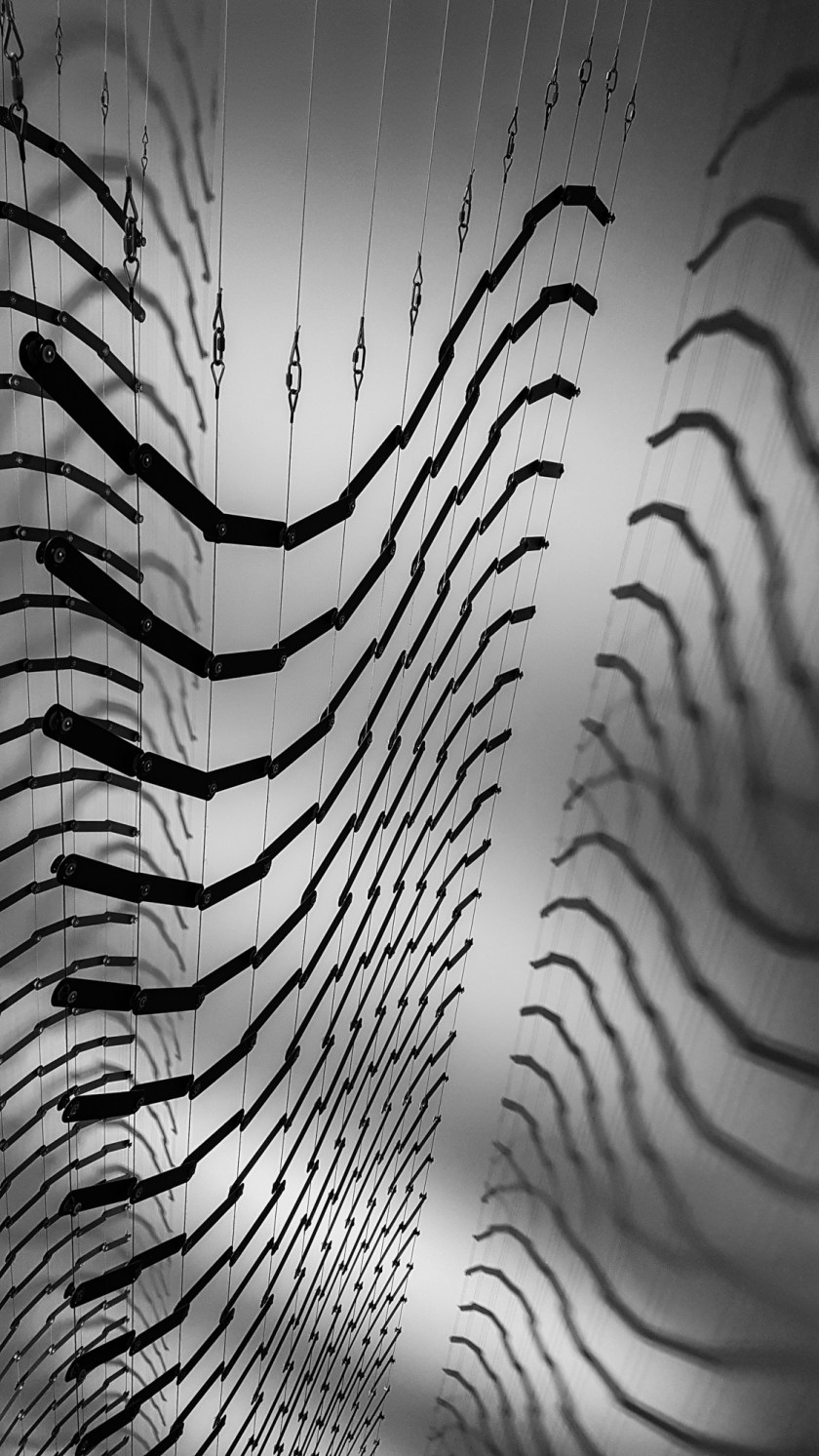
Communication is movement,
dispersed by intention
as light throwing a shadow
and unsharp mask.


The mysterious boat
Last night, as everything slept,
The wind sighed with unknowing,
Running through the lane,
I found no rest upon my pillow
It is the moon, still, that gives me
A deep sleep, – a good conscience.
I brushed sleep away from my
Senses and ran to the beach.
Moonlight shone and I met man and boat
Calmly upon the warm sands,
Sleepy both – shepherd and sheep –
Sleepy the boat slips away from land.
One hour, maybe two,
Or, was it a year? – to me
Suddenly sense and thought
Seem to be an eternal sameness,
Amid this abyss without limits,
I do myself upon the past.
– Morning came, a boat stands
In the black depth and rests – rests . . .
What happened? She called – hundreds
Called me: what was it? Blood? – –
Nothing happened? We sleep, sleep
All sleeps – ah, so good! So good!
Gestern nachts, als alles schlief,
Kaum der Wind mit ungewissen
Seufzern durch die Gassen lief,
Gab mir Ruhe nicht das Kissen,
Noch der Mohn, noch, was sonst tief
Schlafen macht, – ein gut Gewissen.
Endlich schlug ich mir den Schlaf
Aus dem Sinn und lief zum Strande.
Mondhell war’s und mild, ich traf
Mann und Kahn auf warmem Sande,
Schläfrig beide, Hirt und Schaf: –
Schläfrig stieß der Kahn vom Lande.
Eine Stunde, leicht auch zwei,
Oder war’s ein Jahr? – da sanken
Plötzlich mir Sinn und Gedanken
In ein ewiges Einerlei,
Und ein Abgrund ohne Schranken
Tat sich auf: – da war’s vorbei!
– Morgen kam: auf schwarzen Tiefen
steht ein Kahn und ruht und ruht . . .
Was geschah? so rief’s, so riefen
Hundert bald: was gab es? Blut? – –
Nichts geschah! Wir schliefen, schliefen
Alle – ach, so gut! so gut!
From:
The Peacockand the Buffalo
The Poetry of Nietzsche
Translated by James Luchte
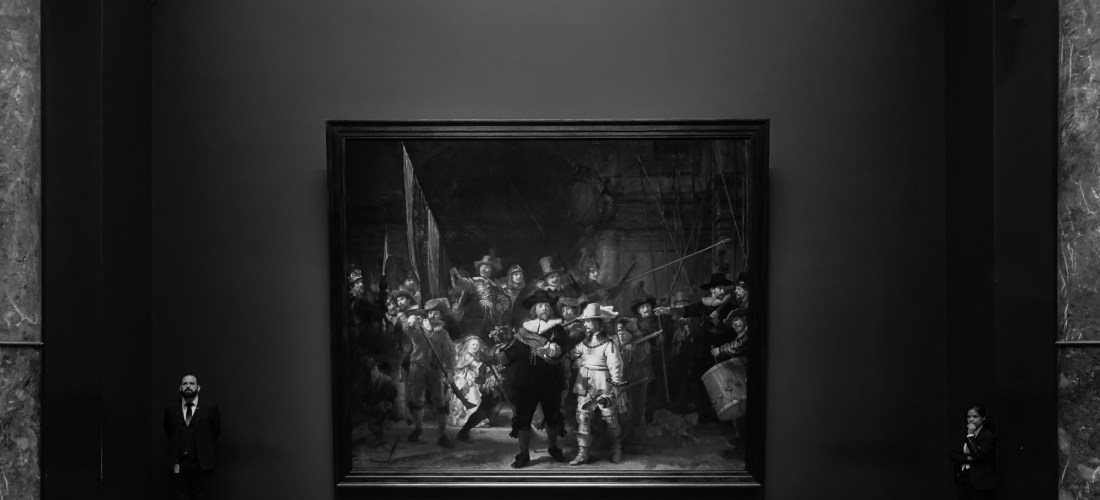
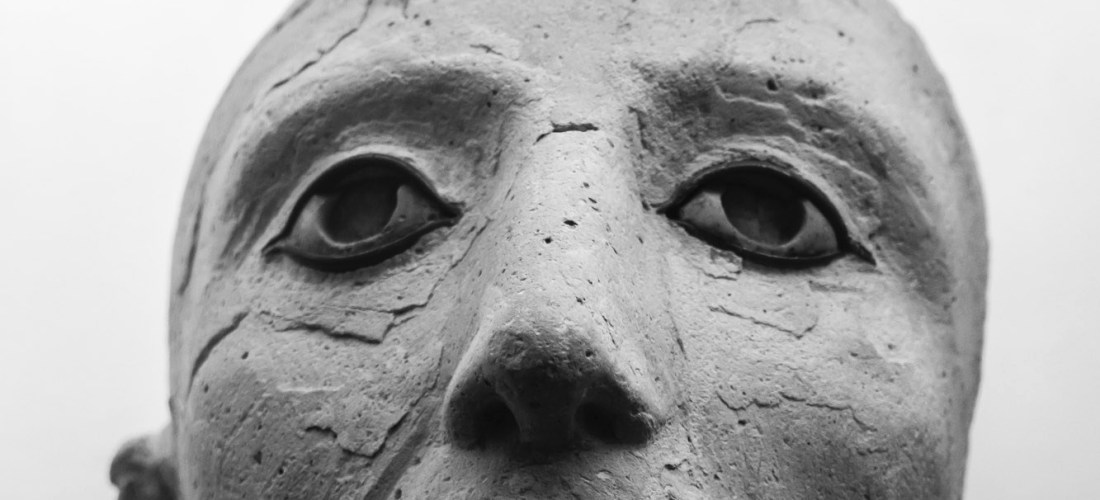
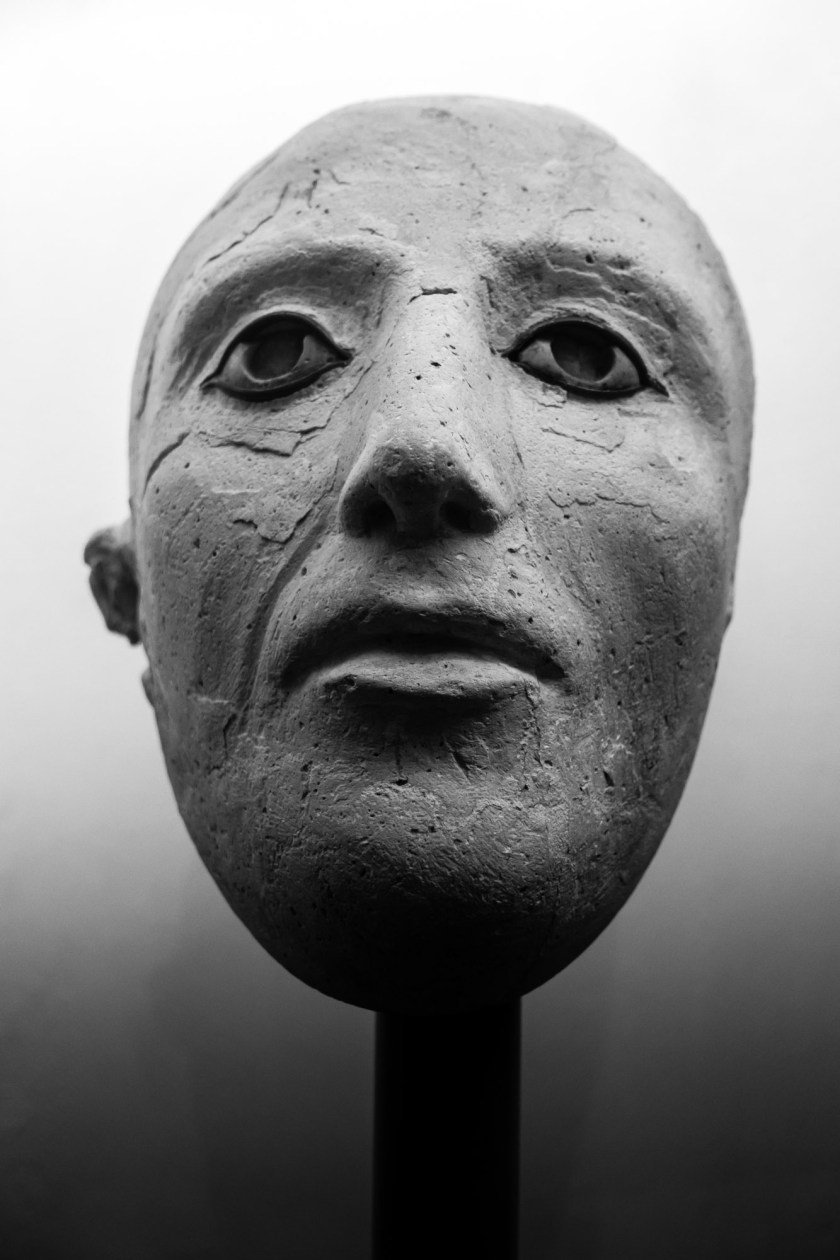
Some pictures from our visit to the rijksmuseum with some famous pictures and lots of other interesting things to see.




Amsterdam by night, tourist in my own country. It’s known and unknown to me, coming from far with only birds and wind to distract my silence.


My ideas on the origin of our moral prejudices—for this is the subject ofthis polemic—received their first, brief, and provisional expression in the collection of aphorisms that bears the title Human, All-Too-Human. A Book for Free Spirits. This book was begun in Sorrento during a winter when it was given to me to pause as a wanderer pauses and look back across the broad and dangerous country my spirit had traversed up to that time. This was in the winter of 1876–77; the ideas themselves are older. They were already in essentials the same ideas that I take up again in the present treatises—let us hope the long interval has done them good, that they have become riper, clearer, stronger, more perfect! That I still cleave to them today, however, that they have become in the meantime more and more firmly attached to one another, indeed entwined and interlaced with one another, strengthens my joyful assurance that they might have arisen in me from the first not as isolated, capricious, or sporadic things but from a common root, from a fundamental will of knowledge, pointing imperiously into the depths, speaking more and more precisely, demanding greater and greater precision. For this alone is fitting for a philosopher. We have no right to isolated acts of any kind: we may not make isolated errors or hit upon isolated truths. Rather do our ideas, our values, our yeas and nays, our ifs and buts, grow out of us with the necessity with which a tree bears fruit—related and each with an affinity to each, and evidence of one will,one health, one soil, one sun.—Whether you like them, these fruits of ours?—But what is that to the trees! What is that to us, to us philosophers!

This is a book about philosophy from M. Butler, an American philosopher. I like to high lite these books because they are in the public domain and can therefore be downloaded for free on the internet, I do that on archive.org. I understand that writers have to get paid for their work but the consequence of that is that many people cannot buy the books they want to read because of the cost. That’s why I like these old books and as long as you remember that it was written in an other time you can still learn something from it.


By Nicholas Murray Butler
1908
By THE COLUMBIA UNIVERSITY PRESS.
This lecture was delivered as one of a series, the purpose of which was to present in summary and compact form a view of each of several sciences and of philosophy as these exist at the present day. In outlining philosophy, its subject-matter and its method, it was the purpose of the lecture clearly to differentiate philosophy from science, and to cut away the odd and unfitting scientific garments in which some contemporary writers have sought to clothe philosophy. Some of the passing forms of so-called philosophic thought are wholly below the plane on which philosophy moves. They are not philosophy, nor yet philosophies ; they are travesties of both. No one who has not grasped the distinction between the three orders of thinking, or ways of knowing, can hope, I think, to understand what philosophy is or what the word philosophy means. To call something philosophy is not to make it so.
PHILOSOPHY
One of the most famous books ever written, and one of the most influential — the Metaphysics of Aristotle — opens with this sentence, “ All men by nature are actuated with the desire of knowledge.” This desire of knowledge and the wonder which it hopes to satisfy are the driving power behind all the changes that we, with careless, question-begging inference, call progress. They and their reactions upon man’s other wants and needs have, since history began, wholly altered the appearance of the dwelling-place of man as well as man’s relation to his dwelling-place. Yet the physical changes are insignificant, great and numerous as they are. The Alps that tried the endurance of Hannibal are the same mountains that tested the skill of Napoleon. The sea that was beaten by the banked oars of the triremes of Carthage, presents the same surface and the same shores to the fast-going, steam-driven vessel of to-day. But the air, once only a zephyr or a hurricane, is now the bearer of man’s silent message to his distant fellow. The crude ore once deeply hidden in the earth, has been dug and drawn and fashioned into Puck’s girdle. The words that bore the deathless verse of Homer from bard to a group of fascinated hearers, and with whose fading sounds the poems passed beyond recall, are fixed on the printed page in a hundred tongues. They carry to a million eyes what once could reach but a hundred ears. Human aspiration has cast itself, chameleon-like, into the form of noblest verse, of sweetest music, of most moving oratory, of grandest painting, of most splendid architecture, of serenest reflection, of freest government. And the end is not yet. The forces — the desire for knowledge and wonder— that have so moved man’s world, and are so moving it, must be treated with at least the respect due to age and to great achievement.
The naive consciousness of man has always told him that the existence of that consciousness and its forms were the necessary framework for his picture of himself and his world. Long before Kant proved that macht zwar Verstand die Natur aber er schafft sie nicht , man had acted instinctively on the principle. The world that poured into his consciousness through the senses, Locke’s windows of the soul, was accepted as he found it, and for what the senses did not reveal man fashioned explanations in the forge of his imagination. The unseen powers of heaven and earth, of air and water, of earthquake and thunderbolt, were like himself, but greater, grander. They had human loves and hates, human jealousies and ambitions. Behind the curtain of events they played their game of superhuman life. Offerings and gifts won their aid and their blessing; neglect or disdain brought down their antagonism and their curses. So it was that the desire for knowledge and the wonder of man made the mythologies ; each mythology bearing the image of that racial facet of humanity’s whole by which it was reflected. The Theogony, ascribed to Hesiod, shows the orderly completeness to which these mythologies attained.
The mythologies represent genuine reflection and not a little insight. They reveal man’s simple, naive consciousness busying itself with the explanation of things. The mythologies were genuine, and their gods and their heroes were real, by every test of genuineness and reality known to the uncritical mental processes which fashioned them.
Change and decay, growth, life and death, are the phases of experience that most powerfully arouse man’s wonder and stimulate his desire to know. Where do men and things come from ? How are they made ? How do they grow? What becomes of them after their disappearance or death? — these are the questions for which an answer is sought. The far-away Indian in his Upanishads cried out: “Is Brahman the cause ? Whence are we born ? Whereby do we live, and whither do we go ? O, ye who know Brahman, tell us at whose command we abide, whether in pain or in pleasure! ” To these questions the mythologies offered answers which were sufficient for long periods of time, and which are to-day sufficient for a great portion, perhaps by far the greater portion, of the human race.
An important step, far-reaching in its consequences, was taken when man first sought the cause of change and decay in things themselves and in the laws which appeared to govern things, rather than in powers and forces outside of and beyond them. When the question was first asked, What is it that persists amid all changes and that underlies every change? a new era was about to dawn in the history of man’s wonder and his desire to know. Thales, who first asked this question and first offered an answer to it, deserves his place at the head of the list of the Seven Wise Men of Greece. After Thales the wise men of Greece left off telling tales and busied themselves with an examination of experience and with direct reflection upon it.
It is to be noticed, however, that the evidence of the senses is no longer accepted at its face value. With Thales something new comes into view. It is the systematic search for the explanation of things that appear, with the assumption that the explanation lies behind the appearances themselves and is concealed by them. But as yet, mans gaze was wholly outward. The relation of the nature that he observed to his own consciousness was implied, but unquestioned. Consciousness itself and the knowing process remained to be examined. To turn man’s gaze from outward to inward, to change the center of gravity of his desire to know, of his wonder, from nature to man himself, was the service of Socrates. That man is a reasoning animal, that knowledge must be examined and tested by standards of its own, and that conduct must be founded on rational principles, are the immortal teachings of Socrates, as much needed now as when he first unfolded them. They mark him forever as the discoverer of the intellectual life. Of Socrates it may truly be said, in the stately verse of ^Eschylus: —
I brought to earth the spark of heavenly fire, Concealed at first, and small, but spreading soon Among the sons of men, and burning on,
Teacher of art and use, and fount of power.
(Prometheus Vinctus, 109.)
The maxim, “ An unexamined life is not worth living,” is the priceless legacy of Socrates to the generations of men who have followed him upon this earth. The beings who have stood on humanity’s summit are those, and only those, who have heard the voice of Socrates across the centuries. The others are a superior kind of cattle.
The intellectual life, once discovered, was eagerly pursued by the two men who have done most to shape the thought of the Western World. For two generations the brilliant insight and noble imagery of Plato and the persistently accurate analytic and synthetic powers of Aristotle poured out for the use of men the rapid results of wide observation, profound reflection, and subtlest intellectual sympathy. For nearly two thousand years the scholars of the world could find little else to occupy them than the problems which Plato and Aristotle had proposed and the solutions which they had offered. The weight of their authority was so great that it prevented the spirit of new inquiry from rising to its feet for a period longer than half of all recorded history.
In a general way, different types of problem were marked off from each other during the whole of this long period of development and study, but the lines of distinction that seem clear to-day were not often noticed or followed. Questions as to an unseen and superior power, as to logical processes, and as to natural objects and laws were curiously intermingled. Astronomy, mathematics, mechanics, and medicine broke off one by one from the parent stem, but it was a long time before the other separate sciences that we moderns know, were able to follow them. Both Plato and Aristotle had indicated the distinction between the different orders of human thinking which is all-controlling, but neither they nor their most influential successors maintained the distinction consistently by any means. So it happened that what we call science, what we call philosophy, and what we call theology were for a long time inextricably mixed.
Read the rest of the book on archive.org or download the PDF: Philosophy By Nicholas Murray Butler 1908
Nicholas Murray Butler (April 2, 1862 – December 7, 1947) was an American philosopher, diplomat, and educator. Butler was president of Columbia University, president of the Carnegie Endowment for International Peace, and a recipient of the Nobel Peace Prize. He became so well known and respected that The New York Times printed his Christmas greeting to the nation every year. Wikepedia


Artical from “Encyclopedia of time” SAGA publication 2009
Heraclitus
(c. 530–475 bce)
Heraclitus is considered among the greatest of the Presocratic philosophers. Flux and time play particularly important roles in his thinking. Even though the fragments of his book On Nature had an enormous impact upon such diverse philosophers as Plato, G. W. F. Hegel, Friedrich Nietzsche, and Martin Heidegger, not much is known concerning the particulars of his life. However, we do know that he was born in Ephesus, came from an old aristocratic family, and looked unfavorably upon the masses. According to Apollodrus, he was about 40 years old in the 69th Olympiad (504–501 BCE).
Relativity of Time
The most influential aspect of Heraclitus’ thinking about time is the concept of the Great Year or the eternal recurrence of everything, an idea that was taken up later by Zeno of Citium (the founder of the Stoa) and Nietzsche. However, within his philosophy, Heraclitus also clarifies other aspects of time. He was clearly aware of the relativity of time. When he explains that the sun is needed for the alteration between night and day to occur, it becomes clear that he was conscious that daytime and nighttime are dependent upon certain conditions. A certain time exists only within a specific
framework or paradigm. If the framework changes, then the concept of time within it changes, too. We would not have daytime within a world without the sun. Time is dependent upon a specific perspective, and many distinctions concerning time cannot be drawn from only a cosmic or universal perspective.
Unity of Opposites
Heraclitus criticized Hesiod for not having the best knowledge concerning daytime and nighttime. Only the masses regard Hesiod as a wise man, but truly he was not. According to Heraclitus, daytime and nighttime are one, which Hesiod had failed to realize. From a global perspective, one cannot distinguish daytime and nighttime. One has to be a participating spectator in order to employ the distinction meaningfully. Even though the distinction in question works well from a pragmatic perspective, this does not imply that it is correct. From a universal perspective, the distinction between day and night is not supposed to make any sense, as God is supposed to represent the unity of opposites; that is, God is supposed to be the unity of day and night, as well as summer and winter.
Time as Metaphor
Even though opposites do not exist, Heraclitus himself employs opposites. Concerning time, he clearly holds that there are people who are connected to the night and others who are linked to the day, and he attributes different values to these two types of paradigms. According to him, only the night-roamers are the initiated ones. They have wisdom and they do not belong to the masses. The masses are uninitiated and are connected to the day. Even though, from a global perspective, night and day are one, nighttime and daytime stand for something different. Here, they represent people who are either initiated or uninitiated into wisdom.
Time and Order
Only the initiated know what time really is. Time is a type of orderly motion with limits and periods. Heraclitus also specifies in more detail what he understands as order concerning time, and he explains that it is important that the same order exists on various levels. However, time cannot be reduced to only one aspect of order, as Heraclitus also identifies time with a playing child; that is, time is the kingdom of a playing child. Even though the aspect of order is necessary for games, there is more to the process of playing a game, as there are also the aspects of playfulness, freedom,
and chaos. To stress also the important disorderly element represented by time, Heraclitus attribute to this concept his idea of the unity of opposites. Wherever there is order, there has to be chaos. However, that chaos is relevant might only mean that even though there is one certain order in the universe, we cannot securely predict the future. Even though everything is necessary, from our perspective anything can happen, as it is impossible for us to foresee the future.
Time Is Cyclical
According to Heraclitus, the order of time is the cycle. Periods and cycles appear at various levels of existence. There is the world cycle or Great Year, but there is also a human cycle, the cycle of procreation. Human beings are born, grow up, and give birth to other human beings so that the cycle of human life can start again, which happens approximately every 30 years. In this way, a man becomes a father and then a grandfather. However, the most important idea in the philosophical reception of his thought is Heraclitus’ world cycle, referred to as the Great Year, or the eternal recurrence of everything. Analogous to human lives, there is a period or a cycle in the progression of world history. The world is supposed to be an ever-living fire that is kindled and
extinguished in regular cycles. One cycle represents a Great Year, which has the (surely metaphorical) duration of 10,800 human years. By presenting the Great Year in his philosophy of time, Heraclitus also reveals an option for an immanent type of immortality. The concept of the Great Year is of relevance on various levels. It may be analyzed from a metaphysical, natural philosophical, scientific, ethical, and religious perspective.
Stefan Lorenz Sorgner

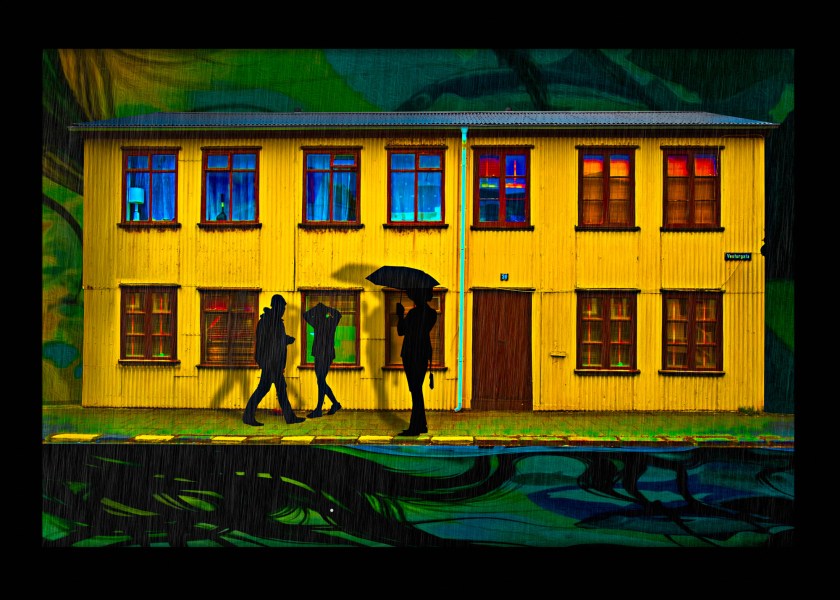
This time no heavy stuff, just a fun picture made from 3 different ones taken in Iceland. I like to make some rules for myself, I often start with one picture and for this one I could only use pictures from that trip, just to limit my choices. Another limit is time, you can spend hours fine-tuning a picture, but I have other things to do to. Normally I have no plan and just start playing in Lightroom with one picture and see where it goes from there.



We are unknown to ourselves, we men of knowledge—and with good reason. We have never sought ourselves—how could it happen that we should ever find ourselves? It has rightly been said: “Where your treasure is, there will your heart be also”1 our treasure is where the beehives of our knowledge are. We are constantly making for them, being by nature winged creatures and honey-gatherers of the spirit; there is one thing alone we really care about from the heart—“bringing something home.” Whatever else there is in life, so-called “experiences”—which of us has sufficient earnestness for them? Or sufficient time? Present experience has, I am afraid, always found us “absent-minded”: we cannot give our hearts to it—not even our ears! Rather, as one divinely preoccupied and immersed inhimself into whose ear the bell has just boomed with all its strength the twelve beats of noon suddenly starts up and asks himself: “what really was that which just struck?” so we sometimes rub our ears afterward and ask, utterly surprised and disconcerted, ”what really was that which we have just experienced?” and moreover: “who are we really?” and, afterward as aforesaid, count the twelve trembling bell-strokes of our experience, our life, our being—and alas! miscount them.—So we are necessarily strangers to ourselves, we do not comprehend ourselves, we have to misunderstand ourselves, for us the law “Each is furthest from himself” applies to all eternity—we are not “men of knowledge” with respect to ourselves.


I made this picture in Photoshop at the end of December 2016. I think it was after reading an article about Syria and the lack of compassion we westerners have with those people. I imagined how someone is watching tv and see destroyed houses and dead people on the street and that they casually lean over to get some chips, maybe change the channel to watch a cartoon as if nothing happened. Or you can compare it with watching a beautiful landscape, you mumble something to your spouse, and you turn around and walk on to the next place…”Ooh yea, more bombs, what can you do”
The frustration is off course also pointed at myself, I still remember when ISIS blow up some historical monuments, I was more chocked by that the than by the constant news of dead children washed ashore. Maybe that’s why I make these pictures and write about it, I don’t want it to be normal, I don’t want to be jaded, see that kind of needless suffering as another landscape I have seen before.
The picture below is the original i made at the Grand Canyon, the background are two picture from the net and are from a city in Syria. I hope it catches our western distance to that war and our voyeurism.

 Nochrisis