Month: November 2017
9. The metaphysical world
Human all too humanSynopsis and my take on it:
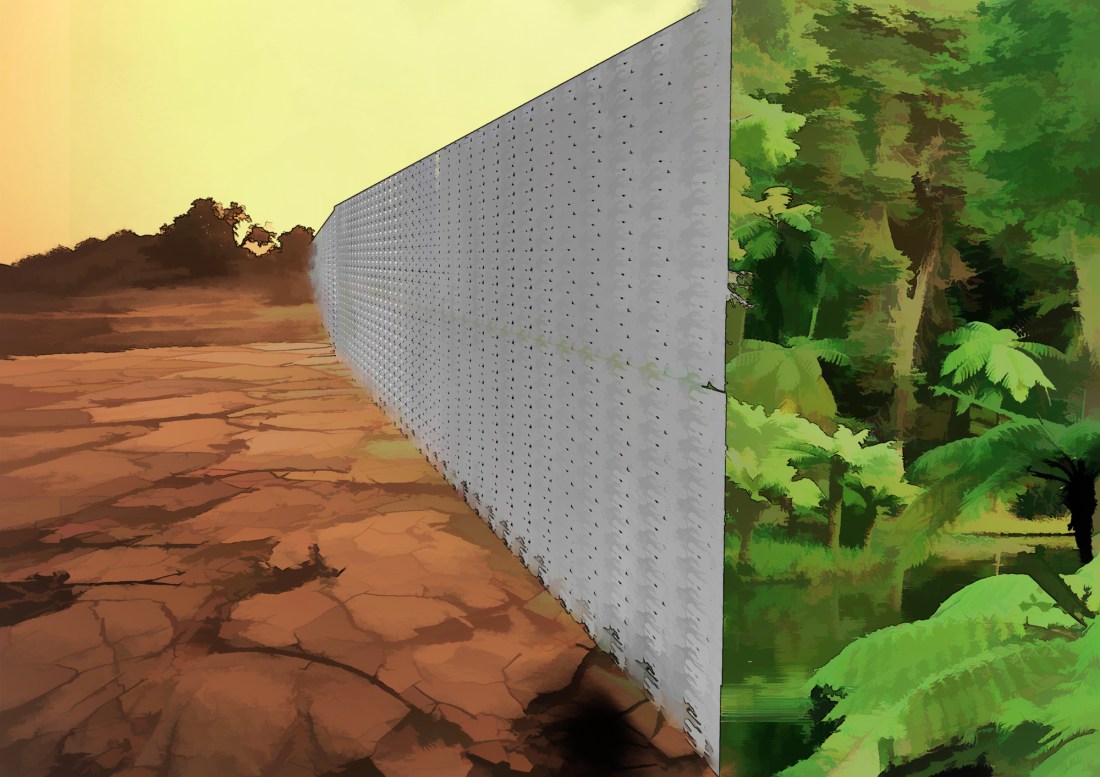
“It is true that there might be a metaphysical world; the absolute possibility of it is hardly (kaum or barely) to be disputed “I think that Nietzsche means the link between the outside world and the thing that perceives it in our “head”. The link is the “metaphysical world”, “we look at everything through the human head and cannot cut this head off” Would there be a world without our head. Is N. referring to the famous tree allegory?1 There is not a world as we perceive it outside our human perception, think about colors we see vs the “real” colors2. But everything that makes metaphysical assumptions “valuable, terrible, delightful for man” is caused by “passion, error, and self-deception;” If people try to explain this link human failure causes the outcome. the worst method of getting knowledge, “not the best” If you find this at the basis of religion and metaphysics than “they (the metaphysical world) have been refuted. Then there still always remains that possibility N refers here to the possibility of a metaphysical world; but there is nothing to be done with it”. But is “it possible to let happiness, salvation, and life depend on the spider-thread of such a possibility.” This metaphysical world is “incomprehensible to us” It is impossible to envision the link between the real world and what we perceive, it’s like directly seeing gravity. If it would be proved it would be irrelevant knowledge. “more irrelevant than the knowledge of the chemical analysis of water to the sailor in danger in a storm.”
In one sentence:
The road to the real world can’t be explained
1 Philosopher George Berkeley, in his work, A Treatise Concerning the Principles of Human Knowledge (1710), proposes, “But, say you, surely there is nothing easier than for me to imagine trees, for instance, in a park […] and nobody by to perceive them […] The objects of sense exist only when they are perceived; the trees therefore are in the garden […] no longer than while there is somebody by to perceive them. (Wikipedia)
2 As we go about our daily lives, we tend to assume that our perceptions—sights, sounds, textures, tastes—are an accurate portrayal of the real world. Sure, when we stop and think about it—or when we find ourselves fooled by a perceptual illusion—we realize with a jolt that what we perceive is never the world directly, but rather our brain’s best guess at what that world is like, a kind of internal simulation of an external reality. (Read more)
Human, all too human a book for free spirits Part I, translated by Helen Zimmern 1909
- THE METAPHYSICAL WORLD.—It is true that there might be a metaphysical world ; the absolute possibility of it is hardly to be disputed. We look at everything through the human head and cannot cut this head off; while the question remains, What would be left of the world if it had been cut off ? This is a purely scientific problem, and one not very likely to trouble mankind ; but everything which has hitherto made metaphysical suppositions valuable, terrible, delightful for man, what has produced them, is passion, error, and self-deception ; the very worst methods of knowledge, not the best, have taught belief therein. When these methods have been discovered as the foundation of all existing religions and metaphysics, they have been refuted. Then there still always remains that possibility ; but there is nothing to be done with it, much less is it possible to let happiness, salvation, and life depend on the spider-thread of such a possibility. For nothing could be said of the metaphysical world but that it would be a different condition, a condition inaccessible and incomprehensible to us; it would be a thing of negative qualities. Were the existence of such a world ever so well proved, the fact would nevertheless remain that it would be precisely the most irrelevant of all forms of knowledge: more irrelevant than the knowledge of the chemical analysis of water to the sailor in danger in a storm.
Menschliches allzumenschlich 1878/80
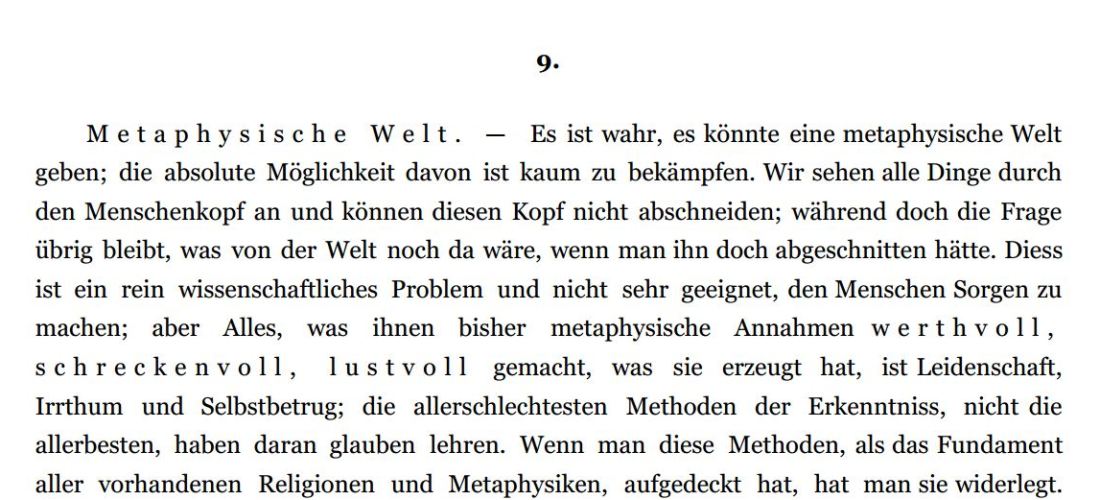
- Metaphysische Welt. – Es ist wahr, es könnte eine metaphysische Welt geben; die absolute Möglichkeit davon ist kaum zu bekämpfen. Wir sehen alle Dinge durch den Menschenkopf an und können diesen Kopf nicht abschneiden; während doch die Frage übrig bleibt, was von der Welt noch da wäre, wenn man ihn doch abgeschnitten hätte. Diess ist ein rein wissenschaftliches Problem und nicht sehr geeignet, den Menschen Sorgen zu machen; aber Alles, was ihnen bisher metaphysische Annahmen werthvoll, schreckenvoll, lustvoll gemacht, was sie erzeugt hat, ist Leidenschaft, Irrthum und Selbstbetrug; die allerschlechtesten Methoden der Erkenntniss, nicht die allerbesten, haben daran glauben lehren. Wenn man diese Methoden, als das Fundament aller vorhandenen Religionen und Metaphysiken, aufgedeckt hat, hat man sie widerlegt. Dann bleibt immer noch jene Möglichkeit übrig; aber mit ihr kann man gar Nichts anfangen, geschweige denn, dass man Glück, Heil und Leben von den Spinnenfäden einer solchen Möglichkeit abhängen lassen dürfte. – Denn man könnte von der metaphysischen Welt gar Nichts aussagen, als ein Anderssein, ein uns unzugängliches, unbegreifliches Anderssein; es wäre ein Ding mit negativen Eigenschaften. – Wäre die Existenz einer solchen Welt noch so gut bewiesen, so stünde doch fest, dass die gleichgültigste aller Erkenntnisse eben ihre Erkenntniss wäre: noch gleichgültiger als dem Schiffer in Sturmesgefahr die Erkenntniss von der chemischen Analysis des Wassers sein muss.
Sources:
I will read a Dutch translation that is based on the work of researchers Colli and Montinari. I also use a translation from R.J.Hollingdale and the Gary Handwerk translation from the Colli-Montinari edition. Both are more modern than the copyright free translation I use here. This is a translation from 1909 by Helen Zimmern, who knew Nietzsche personally, but there was no critical study of Nietzsche’s work done back then and this translation suffers from that. The same goes for the translation from Alexander Harvey. My German is not good enough to pretend that I can translate it better than the professionals do but I will use the original as a referee.
- Menselijk al te menselijk een boek voor vrije geesten, translated by Thomas Graftdijk, 2000. Buy it here
- Human, all too human a book for free spirits, translated by R.J.Hollingdale, 1986
- Human, all too human a book for free spirits I V3, translated by Gary handwerk 1997
- Human, all too human a book for free spirits Part I, translated by Helen Zimmern 1909. Read it here
- Human, all too human a book for free spirits, translated by Alexander Harvey, 1908. Read it here
- Menschliches allzu menschlich 1878/80. Read it here
Shield
Our mind
When I was in my early twenties I thought for a brief moment that I had all the answers in me, like most people do when their young. After living in different parts of the world, and looking around, I realized that the world is more complex, my inexperienced certainty seemed to be baseless. I started asking people about their thoughts on specific subjects, and got different answers or none at all. I realized that people either have an opinion, are clueless or don’t care. The ones with an opinion often use it as a shield to protect themselves in a discussion or when confronted with undermining facts. The problem with a shield is that as long as it works there is no need to change it, as long as you stay around like minded people your fine. And if you’re among strangers you hold it tighter. These people have their opinion and I wondered where they got it from, or if they ever doubted it. How can you not doubt your opinion? If the next 10 people you meet have a different one, you cannot all be right.
If you ask people to lay down their shield, to step back and look where their opinion comes from, they often cannot do that, don’t understand the question, or get angry. It’s hard to recognize that you don’t know, and that you are vulnerable without a shield.
Flowers in my garden
pictures
8. Pneumatic explanation of nature
Human all too humanYou can read the aphorism I discuss here below the main article.
Synopsis and my take on it:
Pneumatic 1 explanation of nature. “Metaphysics” 2 In this case Nietzsche means, in my opinion, the study of the relation between mind and matter “explains the writing of Nature” (The natural science) Mystically “as the Church and her learned men formerly did with the Bible.” It requires the skill of a philologists 3 to understand the true meaning of a text. But bad interpretation “with regard to books” is not overcome and “one still constantly comes across in developed societies the remains of allegorical 4 and mystic interpretation” And in the study of nature there is even worse interpretation and mystical thinking
In one sentence:
Nature mistakenly seen by former bible scholars
1 Pneumatology is the study of spiritual beings and phenomena, especially the spiritual aspect of human beings and the interactions between humans and God. (Wikipedia)
2 Stanford Encyclopedia of Philosophy: It is not easy to say what metaphysics is. Ancient and Medieval philosophers might have said that metaphysics was, like chemistry or astrology, to be defined by its subject-matter: metaphysics was the “science” that studied “being as such” or “the first causes of things” or “things that do not change”. It is no longer possible to define metaphysics that way, for two reasons. (Read more)
3 Philology is the study of language in oral and written historical sources; it is a combination of literary criticism, history, and linguistics. It is more commonly defined as the study of literary texts as well as oral and written records, the establishment of their authenticity and their original form, and the determination of their meaning. A person who pursues this kind of study is known as a philologist. (Wikipedia)
4 As a literary device, an allegory is a metaphor whose vehicle may be a character, place or event, representing real-world issues and occurrences. Allegory (in the sense of the practice and use of allegorical devices and works) has occurred widely throughout history in all forms of art, largely because it can readily illustrate or convey complex ideas and concepts in ways that are comprehensible or striking to its viewers, readers, or listeners. (Wikipedia)
Human, all too human a book for free spirits Part I, translated by Helen Zimmern 1909
- PNEUMATIC EXPLANATION OF NATURE.—Metaphysics explains the writing of Nature, so to speak, pneumatically, as the Church and her learned men formerly did with the Bible. A great deal of understanding is required to apply to Nature the same method of strict interpretation as the philologists have now established for all books with the intention of clearly understanding what the text means, but not suspecting a double sense or even taking it for granted. Just, however, as with regard to books, the bad art of interpretation is by no means overcome, and in the most cultivated society one still constantly comes across the remains of allegorical and mystic interpretation, so it is also with regard to Nature, indeed it is even much worse.
Menschliches allzumenschlich 1878/80
- Pneumatische Erklärung der Natur. – Die Metaphysik erklärt die Schrift der Natur gleichsam pneumatisch, wie die Kirche und ihre Gelehrten es ehemals mit der Bibel thaten. Es gehört sehr viel Verstand dazu, um auf die Natur die selbe Art der strengeren Erklärungskunst anzuwenden, wie jetzt die -Philologen sie für alle Bücher geschaffen haben: mit der Absicht, schlicht zu verstehen, was die Schrift sagen will, aber nicht einen doppelten Sinn zu wittern, ja vorauszusetzen. Wie aber selbst in Betreff der Bücher die schlechte Erklärungskunst keineswegs völlig überwunden ist und man in der besten gebildeten Gesellschaft noch fortwährend auf Ueberreste allegorischer und mystischer Ausdeutung stösst: so steht es auch in Betreff der Natur – ja noch viel schlimmer
Sources:
I will read a Dutch translation that is based on the work of researchers Colli and Montinari. I also use a translation from R.J.Hollingdale and the Gary Handwerk translation from the Colli-Montinari edition. Both are more modern than the copyright free translation I use here. This is a translation from 1909 by Helen Zimmern, who knew Nietzsche personally, but there was no critical study of Nietzsche’s work done back then and this translation suffers from that. The same goes for the translation from Alexander Harvey. My German is not good enough to pretend that I can translate it better than the professionals do but I will use the original as a referee.
- Menselijk al te menselijk een boek voor vrije geesten, translated by Thomas Graftdijk, 2000. Buy it here
- Human, all too human a book for free spirits, translated by R.J.Hollingdale, 1986
- Human, all too human a book for free spirits I V3, translated by Gary handwerk 1997
- Human, all too human a book for free spirits Part I, translated by Helen Zimmern 1909. Read it here
- Human, all too human a book for free spirits, translated by Alexander Harvey, 1908. Read it here
- Menschliches allzu menschlich 1878/80. Read it here
Pictures of Norway
pictures
7. The kill-joy in science
Human all too humanIn one sentence:
Socratic search for happiness binds science
Human, all too human a book for free spirits Part I, translated by Helen Zimmern 1914
- THE KILL-JOY IN SCIENCE.—Philosophy separated from science when it asked the question, “Which is the knowledge of the world and of life which enables man to live most happily?” This happened in the Socratic schools ; the veins of scientific investigation were bound up by the point of view of happiness,—and are so still.
Menschliches allzumenschlich 1878/80
- Der Störenfried in der Wissenschaft. Die Philosophie schied sich von der Wissenschaft, als sie die Frage stellte: welches ist diejenige Erkenntnis der Welt und des Lebens, bei welcher der Mensch am glücklichsten lebt? Dies geschah in den sokratischen Schulen: durch den Gesichtspunkt des Glücks unterband man die Blutadern der wissenschaftlichen Forschung – und tut es heute noch.
Sources:
I will read a Dutch translation that is based on the work of researchers Colli and Montinari. I also use a translation from R.J.Hollingdale that is more modern than the copyright free translation I use here. This is a translation from 1909 by Helen Zimmern, who knew Nietzsche personally, but there was no critical study of Nietzsche’s work done back then and this translation suffers from that. The same goes for the translation from Alexander Harvey. My German is not good enough to pretend that I can translate it better than the professionals do but I will use the original as a referee.
- Menselijk al te menselijk een boek voor vrije geesten, translated by Thomas Graftdijk, 2000. Buy it here
- Human, all too human a book for free spirits, translated by R.J.Hollingdale, 1996
- Human, all too human a book for free spirits I V3, translated by Gary handwerk 1997
- Human, all too human a book for free spirits Part I, translated by Helen Zimmern 1909. Read it here
- Human, all too human a book for free spirits, translated by Alexander Harvey, 1908. Read it here
- Menschliches allzu menschlich 1878/80. Read it here

Behind that paper thin wall
Our mind
I’m rereading the book Human all too Human from Friedrich Nietzsche. I have read the book before, and if I look at it I can clearly see the evidence of that. In this book Nietzsche writes in aphorisms, short pieces that are mostly self-contained, they are not clearly linked together. The advantage of this is that you can read one aphorism and think about it separated from the rest of the book. I have been doing that for the last week, but because I also wanted to write about the aphorisms and tried to analyze them, I used more time than I thought. It made me wonder how much I really understood them when I read them for the first time 15 years ago and read the book in a couple of weeks. Maybe I am so much slower now. Or was I less critical in the past and skipped over the bits that made no sense to me back then?
6. The scientific spirit partially but not wholly powerful
Human all too humanYou can read the aphorism I discuss here below the main article.
Synopsis and my take on it:
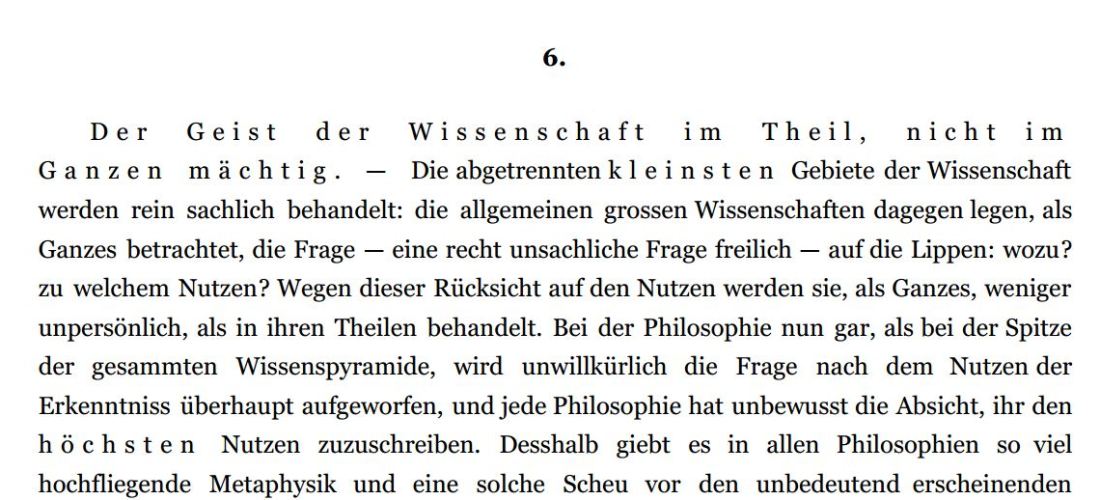
“The smallest subdivisions of science” are treated objectively but science “as a whole” is not.1 Science as an entity is treated more personally, People take questions about science more personal than question about specific aspects of science like the functioning of a telescope, we can find use in that, compared to the conclusion taken from its observations, what can we do with that kind of knowledge? In philosophy, “as the apex of the entire pyramid of science” there is the involuntarily questioning of the usefulness of knowledge and as an unconscious intention of the philosophy they give it (knowledge) the highest usefulness. Knowledge is questioned because that’s what philosophers do, but to do this they need knowledge. Nietzsche sees this unconscious reaction to give knowledge the highest usefulness as a reason for the dominance of metaphysics (thoughts2) over physics in philosophy. Because the questioning of knowledge is a thought process, philosophers see little value in solving real world problems. Philosophy “desires, what art does, to give the greatest possible depth and meaning to life” and science seeks knowledge. “So far there has been no philosopher in whose hands philosophy has not grown into an” defense for knowledge. Both science and philosophy value knowledge because logic dictates it. “They are all tyrannized over by logic, and this is optimism—in its essence.” And Nietzsche throws in at the end the concept of logic and optimism that are both hard to place in the rest of this aphorism “and logic is by its nature optimism” (Hollingdale) Maybe it’s logical to search for knowledge and by doing so you assume you find an answer, hence the optimism.
In one sentence:
Philosophers think knowledge, scientist see knowledge.
1The translation by Zimmern translate “…werden rein sachlich behandelt” with “…are dealt with purely in relation to themselves” while the Dutch translation, Hollingdale and I translate it more like “are treated purely objectively”. It might not be of much significance, but it got my attention.
2 …The modern view assumes that the objects studied by metaphysics exist inside the mind of an observer, so the subject becomes a form of introspection and conceptual analysis. … (Wikipedia)
Human, all too human a book for free spirits Part I, translated by Helen Zimmern 1909
- THE SCIENTIFIC SPIRIT PARTIALLY BUT NOT WHOLLY POWERFUL.—The smallest subdivisions of science taken separately are dealt with purely in relation to themselves,—the general, great sciences, on the contrary, regarded as a whole, call up the question—certainly a very non-objective one—”Wherefore? To what end?” It is this utilitarian consideration which causes them to be dealt with less impersonally when taken as a whole than when considered in their various parts. In philosophy, above all, as the apex of the entire pyramid of science, the question as to the utility of knowledge is involuntarily brought forward, and every philosophy has the unconscious intention of ascribing to it the greatest usefulness. For this reason there is so much high-flying metaphysics in all philosophies and such a shyness of the apparently unimportant solutions of physics ; for the importance of knowledge for life must appear as great as possible. Here is the antagonism between the separate provinces of science and philosophy. The latter desires, what art does, to give the greatest possible depth and meaning to life and actions ; in the former one seeks knowledge and nothing further, whatever may emerge thereby. So far there has been no philosopher in whose hands philosophy has not grown into an apology for knowledge ; on this point, at least, every one is an optimist, that the greatest usefulness must be ascribed to knowledge. They are all tyrannised over by logic, and this is optimism—in its essence.
Menschliches allzumenschlich 1878/80
- Der Geist der Wissenschaft im Theil, nicht im Ganzen mächtig. – Die abgetrennten kleinsten Gebiete der Wissenschaft werden rein sachlich behandelt: die allgemeinen grossen Wissenschaften dagegen legen, als Ganzes betrachtet, die Frage – eine recht unsachliche Frage freilich – auf die Lippen: wozu? zu welchem Nutzen? Wegen dieser Rücksicht auf den Nutzen werden sie, als Ganzes, weniger unpersönlich, als in ihren Theilen behandelt. Bei der Philosophie nun gar, als bei der Spitze der gesammten Wissenspyramide, wird unwillkürlich die Frage nach dem Nutzen der Erkenntniss überhaupt aufgeworfen, und jede Philosophie hat unbewusst die Absicht, ihr den höchsten Nutzen zuzuschreiben. Desshalb giebt es in allen Philosophien so viel hochfliegende Metaphysik und eine solche Scheu vor den unbedeutend erscheinenden Lösungen der Physik; denn die Bedeutsamkeit der Erkenntniss für das Leben soll so gross als möglich erscheinen. Hier ist der Antagonismus zwischen den wissenschaftlichen Einzelgebieten und der Philosophie. Letztere will, was die Kunst will, dem Leben und Handeln möglichste Tiefe und Bedeutung geben; in ersteren sucht man Erkenntniss und Nichts weiter, – was dabei auch herauskomme. Es hat bis jetzt noch keinen Philosophen gegeben, unter dessen Händen die Philosophie nicht zu einer Apologie der Erkenntniss geworden wäre; in diesem Puncte wenigstens ist ein jeder Optimist, dass dieser die höchste Nützlichkeit zugesprochen werden müsse. Sie alle werden von der Logik tyrannisirt: und diese ist ihrem Wesen nach Optimismus.
Sources:
I will read a Dutch translation that is based on the work of researchers Colli and Montinari. I also use a translation from R.J.Hollingdale and the Gary Handwerk translation from the Colli-Montinari edition. Both are more modern than the copyright free translation I use here. This is a translation from 1909 by Helen Zimmern, who knew Nietzsche personally, but there was no critical study of Nietzsche’s work done back then and this translation suffers from that. The same goes for the translation from Alexander Harvey. My German is not good enough to pretend that I can translate it better than the professionals do but I will use the original as a referee.
- Menselijk al te menselijk een boek voor vrije geesten, translated by Thomas Graftdijk, 2000. Buy it here
- Human, all too human a book for free spirits, translated by R.J.Hollingdale, 1986
- Human, all too human a book for free spirits I V3, translated by Gary handwerk 1997
- Human, all too human a book for free spirits Part I, translated by Helen Zimmern 1909. Read it here
- Human, all too human a book for free spirits, translated by Alexander Harvey, 1908. Read it here
- Menschliches allzu menschlich 1878/80. Read it here

5. Misunderstanding of dreams
Human all too humanIn one sentence:
Our dreams divided the one inside.
Human, all too human a book for free spirits Part I, translated by Helen Zimmern 1909
5. MISUNDERSTANDING OF DREAMS. —In the ages of a rude and primitive civilization man believed that in dreams he became acquainted with a second actual world; herein lies the origin of all metaphysics. Without dreams there could have been found no reason for a division of the world. The distinction, too, between soul and body is connected with the most ancient comprehension of dreams, also the supposition of an imaginary soul-body, therefore the origin of all belief in spirits, and probably also the belief in gods. ” The dead continues to live, for he appears to the living in a dream ” : thus men reasoned of old for thousands and thousands of years.
Menschliches allzumenschlich 1878/80
5. Missverständniss des Traumes. – Im Traume glaubte der Mensch in den Zeitaltern roher uranfänglicher Cultur eine zweite reale Welt kennen zu lernen; hier ist der Ursprung aller Metaphysik. Ohne den Traum hätte man keinen Anlass zu einer Scheidung der Welt gefunden. Auch die Zerlegung in Seele und Leib hängt mit der ältesten Auffassung des Traumes zusammen, ebenso die Annahme eines Seelenscheinleibes, also die Herkunft alles Geisterglaubens, und wahrscheinlich auch des Götterglaubens. “Der Todte lebt fort; denn er erscheint dem Lebenden im Traume”: so schloss man ehedem, durch viele Jahrtausende hindurch.
Sources:
I will read a Dutch translation that is based on the work of researchers Colli and Montinari. I also use a translation from R.J.Hollingdale and the Gary Handwerk translation from the Colli-Montinari edition. Both are more modern than the copyright free translation I use here. This is a translation from 1909 by Helen Zimmern, who knew Nietzsche personally, but there was no critical study of Nietzsche’s work done back then and this translation suffers from that. The same goes for the translation from Alexander Harvey. My German is not good enough to pretend that I can translate it better than the professionals do but I will use the original as a referee.
- Menselijk al te menselijk een boek voor vrije geesten, translated by Thomas Graftdijk, 2000. Buy it here
- Human, all too human a book for free spirits, translated by R.J.Hollingdale, 1986
- Human, all too human a book for free spirits I V3, translated by Gary handwerk 1997
- Human, all too human a book for free spirits Part I, translated by Helen Zimmern 1909. Read it here
- Human, all too human a book for free spirits, translated by Alexander Harvey, 1908. Read it here
- Menschliches allzu menschlich 1878/80. Read it here

4. Astrology and the like
Human all too humanYou can read the aphorism I discuss here below the main article.
Synopsis and my take on it:
The things people like in religions, morals and aesthetic seem to belong to the surface and not the heart of it. The people like the idea behind religion, morals and aesthetics, the lofty words, and shiny bits but they don’t want to see the fundament. But they deceive themselves because they feel moved by it, like the stars do in astrology. The stars seem to point out our future, but they just shine. “the moral man, however, takes it for granted that what he has essentially at heart must also be the essence and heart of things”. The moral man takes what’s fundamental in him and sees that as the essence of the things.
In one sentence:
The ideas shine but the truth lies in the heart.
Human, all too human a book for free spirits Part I, translated by Helen Zimmern 1909
4. ASTROLOGY AND THE LIKE.—It is probable that the objects of religious, moral, æsthetic and logical sentiment likewise belong only to the surface of things, while man willingly believes that here, at least, he has touched the heart of the world ; he deceives himself, because those things enrapture him so profoundly, and make him so profoundly unhappy, and he therefore shows the same pride here as in astrology. For astrology believes that the firmament moves round the destiny of man; the moral man, however, takes it for granted that what he has essentially at heart must also be the essence and heart of things.
Menschliches allzumenschlich 1878/80
4. Astrologie und Verwandtes. – Es ist wahrscheinlich, dass die Objecte des religiösen, moralischen und ästhetischen Empfindens ebenfalls nur zur Oberfläche der Dinge gehören, während der Mensch gerne glaubt, dass er hier wenigstens an das Herz der Welt rühre; er täuscht sich, weil jene Dinge ihn so tief beseligen und so tief unglücklich machen, und zeigt also hier denselben Stolz wie bei der Astrologie. Denn diese meint, der Sternenhimmel drehte sich um das Loos des Menschen; der moralische Mensch aber setzt voraus, Das, was ihm wesentlich am Herzen liege, müsse auch Wesen und Herz der Dinge sein.
Sources:
I will read a Dutch translation that is based on the work of researchers Colli and Montinari. I also use a translation from R.J.Hollingdale and the Gary Handwerk translation from the Colli-Montinari edition. Both are more modern than the copyright free translation I use here. This is a translation from 1909 by Helen Zimmern, who knew Nietzsche personally, but there was no critical study of Nietzsche’s work done back then and this translation suffers from that. The same goes for the translation from Alexander Harvey. My German is not good enough to pretend that I can translate it better than the professionals do but I will use the original as a referee.
- Menselijk al te menselijk een boek voor vrije geesten, translated by Thomas Graftdijk, 2000. Buy it here
- Human, all too human a book for free spirits, translated by R.J.Hollingdale, 1986
- Human, all too human a book for free spirits I V3, translated by Gary handwerk 1997
- Human, all too human a book for free spirits Part I, translated by Helen Zimmern 1909. Read it here
- Human, all too human a book for free spirits, translated by Alexander Harvey, 1908. Read it here
- Menschliches allzu menschlich 1878/80. Read it here
3. Appreciation of Simple Truths
Human all too humanYou can read the aphorism I discuss here below the main article.
Synopsis and my take on it:
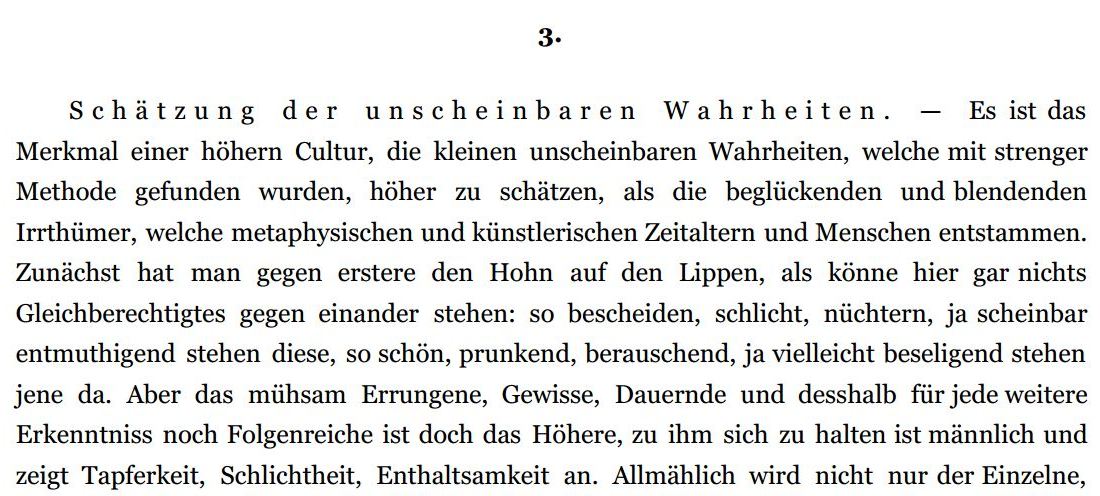
An advanced civilization appreciates small scientific truth more than the blinding shine coming from metaphysical and artistic forms. The admirers of forms mock the admirers of “unpretentious truths” because the forms are so “beautiful, splendid, enchanting”. But the scientific truth is “hard won” and “manly”. Not only the individual but the whole of mankind “will be elevated to this manliness”. “The admirers of forms” will cling to the old truth after the scientific spirit succeeds, because they can’t or won’t appreciate the simple scientific truths. At the and of this aphorism Nietzsche writes that those worlds views have changed places and “the kingdom of the inward, spiritual beauty constantly grows deeper and wider”
This last quote was from the Helen Zimmern, 1914 translation. Below are the same passages but from different translators.
“because it cannot see that the richness of inner, rational beauty always spreads and deepens” Alexander Harvey, 1908
“spiritual beauty is continually growing deeper and wider” R. J. Hollingdale, 1986
“the realm of inner, spiritual beauty is continually deepening and expanding” Google translator 2017
“das Reich der inneren, geistigen Schönheit sich fortwährend vertieft und erweitert” F.Nietzsche 1878
In one sentence:
The appreciation of scientific beauty is slowly replacing the appreciation for external beauty.
Human, all too human a book for free spirits Part I, translated by Helen Zimmern 1914
3. ESTIMATION OF UNPRETENTIOUS TRUTHS.— It is the mark of a higher culture to value the little unpretentious truths which have been discovered by means of rigorous method more highly than the errors handed down by metaphysical ages and men, which blind us and make us happy. At first, one has scorn on his lips for unpretentious truths, as if they could offer no match for the others: they stand so modest, simple, sober, even apparently discouraging, while the other truths are so beautiful, splendid, enchanting, or even enrapturing. But truths that are hard won, certain, enduring, and therefore still of consequence for all further knowledge are the higher; to keep to them is manly, and shows bravery, simplicity, restraint. Eventually, not only the individual, but all mankind will be elevated to this manliness, when men finally grow accustomed to the greater esteem for durable, lasting knowledge and have lost all belief in inspiration and a seemingly miraculous communication of truths.
The admirers of forms, with their standard of beauty and sublimity, will, to be sure, have good reason to mock at first, when esteem for unpretentious truths and the scientific spirit first comes to rule, but only because either their eye has not yet been opened to the charm of the simplest form, or because men raised in that spirit have not yet been fully and inwardly permeated by it, so that they continue thoughtlessly to imitate old forms (and poorly, too, like someone who no longer really cares about the matter). Previously, the mind was not obliged to think rigorously; its importance lay in spinning out symbols and forms. That has changed ; that earnestness in the symbolical has become the mark of a lower culture. As our arts themselves grow evermore intellectual, our senses more spiritual, and as, for instance, people now judge concerning what sounds well to the senses quite differently from how they did a hundred years ago, so the forms of our life grow ever more spiritual, to the eye of older ages perhaps uglier, but only because it is incapable of perceiving how the kingdom of the inward, spiritual beauty constantly grows deeper and wider, and to what extent the inner intellectual look may be of more importance to us all than the most beautiful bodily frame and the noblest architectural structure
Menschliches allzumenschlich 1878/80
3. Schätzung der unscheinbaren Wahrheiten. – Es ist das Merkmal einer höhern Cultur, die kleinen unscheinbaren Wahrheiten, welche mit strenger Methode gefunden wurden, höher zu schätzen, als die beglückenden und blendenden Irrthümer, welche metaphysischen und künstlerischen Zeitaltern und Menschen entstammen. Zunächst hat man gegen erstere den Hohn auf den Lippen, als könne hier gar nichts Gleichberechtigtes gegen einander stehen: so bescheiden, schlicht, nüchtern, ja scheinbar entmuthigend stehen diese, so schön, prunkend, berauschend, ja vielleicht beseligend stehen jene da. Aber das mühsam Errungene, Gewisse, Dauernde und desshalb für jede weitere Erkenntniss noch Folgenreiche ist doch das Höhere, zu ihm sich zu halten ist männlich und zeigt Tapferkeit, Schlichtheit, Enthaltsamkeit an. Allmählich wird nicht nur der Einzelne, sondern die gesammte Menschheit zu dieser Männlichkeit emporgehoben werden, wenn sie sich endlich an die höhere Schätzung der haltbaren, dauerhaften Erkenntnisse gewöhnt und allen Glauben an Inspiration und wundergleiche Mittheilung von Wahrheiten verloren hat. – Die Verehrer der Formen freilich, mit ihrem Maassstabe des Schönen und Erhabenen, werden zunächst gute Gründe zu spotten haben, sobald die Schätzung der unscheinbaren Wahrheiten und der wissenschaftliche Geist anfängt zur Herrschaft zu kommen: aber nur weil entweder ihr Auge sich noch nicht dem Reiz der schlichtesten Form erschlossen hat oder weil die in jenem Geiste erzogenen Menschen noch lange nicht völlig und innerlich von ihm durchdrungen sind, so dass sie immer noch gedankenlos alte Formen nachmachen (und diess schlecht genug, wie es jemand thut, dem nicht mehr viel an einer Sache liegt). Ehemals war der Geist nicht durch strenges Denken in Anspruch genommen, da lag sein Ernst im Ausspinnen von Symbolen und Formen. Das hat sich verändert; jener Ernst des Symbolischen ist zum Kennzeichen der niederen Cultur geworden; wie unsere Künste selber immer intellectualer, unsere Sinne geistiger werden, und wie man zum Beispiel jetzt ganz anders darüber urtheilt, was sinnlich wohltönend ist, als vor hundert Jahren: so werden auch die Formen unseres Lebens immer geistiger, für das Auge älterer Zeiten vielleicht hässlicher, aber nur weil es nicht zu sehen vermag, wie das Reich der inneren, geistigen Schönheit sich fortwährend vertieft und erweitert und in wie fern uns Allen der geistreiche Blick jetzt mehr gelten darf, als der schönste Gliederbau und das erhabenste Bauwerk.
I use a Dutch translation that is based on the work of researchers Colli and Montinari. I also read a copyrighted translation by R.J.HolllingdaleI that is much better than the one I can show you here and that is a copyright free. It is a translation from 1914 that you can also read here and here. If you want to read it in German you can do that here, my German is not good enough to pretend that I can translate it better than the professionals do but I will use it as a referee. I did not find a copyright free Dutch edition but you can buy and then download it here if you like it, I will make some pictures of the first aphorism so you can see if you like it.
Sources:
I will read a Dutch translation that is based on the work of researchers Colli and Montinari. I also use a translation from R.J.Hollingdale that is more modern than the copyright free translation I use here. This is a translation from 1909 by Helen Zimmern, who knew Nietzsche personally, but there was no critical study of Nietzsche’s work done back then and this translation suffers from that. The same goes for the translation from Alexander Harvey. My German is not good enough to pretend that I can translate it better than the professionals do but I will use the original as a referee.
- Menselijk al te menselijk een boek voor vrije geesten, translated by Thomas Graftdijk, 2000. Buy it here
- Human, all too human a book for free spirits, translated by R.J.Hollingdale, 1996
- Human, all too human a book for free spirits I V3, translated by Gary handwerk 1997
- Human, all too human a book for free spirits Part I, translated by Helen Zimmern 1909. Read it here
- Human, all too human a book for free spirits, translated by Alexander Harvey, 1908. Read it here
- Menschliches allzu menschlich 1878/80. Read it here
Elvis
History
I finished a book about Elvis Presley today and that was interesting. I off course new about him. I’ve even been to Graceland, but that’s because our flight got diverted during a storm and we had to spend a day in Memphis. I knew a little bit about him, his singing, acting, singing career, his popularity with the ladies and the pills that killed him at the end.

Opinion
Quotes“there are no eternal facts as there are no absolute truths.”
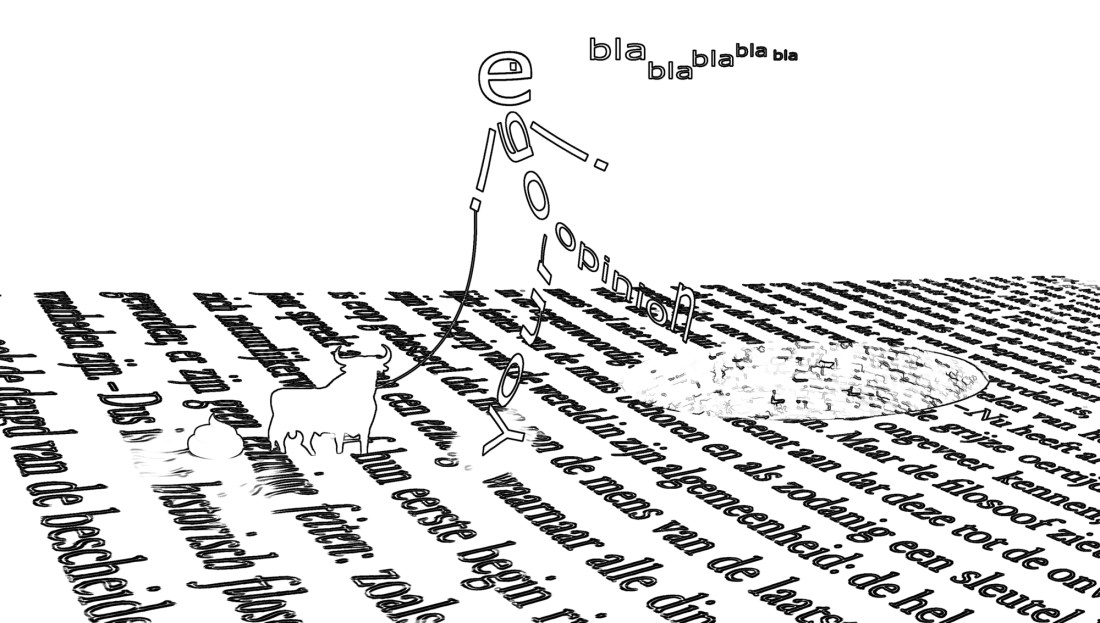
This is a famous quote by Nietzsche and I am tempted to give my opinion about it, but I don’t. The reason I don’t like to that is complicated, but I can give an example that might explain it. If someone ask me what I think of a piece of music from for instance Mozart, I can tell them if I like it or not, but I cannot be critical about the quality of the music because that would mean that I think that I am at the same level as a Mozart. Only if I studied classical music, composition and so on, I can begin to understand Mozart’s quality’s and I can start thinking about giving a critique.
The same goes for a quote from a famous philosopher. I cannot critic it because I don’t know how it is connected with the rest of the philosopher’s work. If I have an opinion about it, I must be honest and admit that that opinion is based on that of another philosophers work with a similar status than the one that I am commenting on. The same goes for agreeing to, do you really know what you are agreeing with?
An opinion is surrounded by pitfalls, watch your step.

2. Inherited faults of philosophers
Human all too humanYou can read the aphorism I discuss here below the main article.
Synopsis and my take on it:
Nietzsche begins with writing that “all philosophers” look upon man as “aeterna veritas” or eternal truth and unchangeable, but they only use a limited timeframe to define man. Some philosophers define man by recent developments like religion and political events. But man has evolved, including their understanding of things. Philosophers still see the instincts of humans as unalterable facts and key to the understanding of the world, but everything essential in human evolution took place ages ago, before our written history. Think of our “lizard brain” combined with the aphorism 1. Nietzsche goes on by writing that they, the philosophers, speak of man since they started writing as unaltered or “eternal man”. And then follows a famous quote “Yet everything evolved: there are no eternal facts as there are no absolute truths.” In the light of this aphorism it seems to me that he speaks of man not fixt but ever changing despite he also pointed out that “everything essential in the development of mankind took place in primeval times, long before the four thousand years we more or less know about” hinting at a more stable beginning lingering on, in us.
In one sentence:
Man’s being cannot be fixed in time or connected to an event and identified with it.
Human, all too human a book for free spirits Part I, translated by Helen Zimmern 1914
2. INHERITED FAULTS OF PHILOSOPHERS.—All philosophers have the common fault that they start from man in his present state and hope to attain their end by an analysis of him. Unconsciously they look upon ” man ” as an aeterna veritas(eternal truth), as a thing unchangeable in all commotion, as a sure measure of things. Everything the philosopher has declared about man is, however, at bottom no more than a testimony as to the man of a very limited period of time. Lack of historical sense is the family failing of all philosophers; many, without being aware of it, even take the most recent manifestation of man, such as has arisen under the impress of certain religions, even certain political events, as the fixed form from which one has to start out. They will not learn that man has become, that the faculty of cognition has become; while some of them would have it that the whole world is spun out of this faculty of cognition. Now, everything essential in the development of mankind took place in primeval times, long before the four thousand years we more or less know about; during these years mankind may well not have altered very much. But the philosopher here sees “instincts” in man as he now is and assumes that these belong to the unalterable facts of mankind and to that extent could provide a key to the understanding of the world in general: the whole of teleology is constructed by speaking of the man of the last four millennia as of an eternal man towards whom all things in the world have had a natural relationship from the time he began. But everything has become: there are no eternal facts, just as there are no absolute truths. Consequently what is needed from now on is historical philosophizing, and with it the virtue of modesty.
Menschliches allzumenschlich 1878/80
2. Erbfehler der Philosophen. – Alle Philosophen haben den gemeinsamen Fehler an sich, dass sie vom gegenwärtigen Menschen ausgehen und durch eine Analyse desselben an’s Ziel zu kommen meinen. Unwillkürlich schwebt ihnen “der Mensch” als eine aeterna veritas, als ein Gleichbleibendes in allem Strudel, als ein sicheres Maass der Dinge vor. Alles, was der Philosoph über den Menschen aussagt, ist aber im Grunde nicht mehr, als ein Zeugniss über den Menschen eines sehr beschränkten Zeitraumes. Mangel an historischem Sinn ist der Erbfehler aller Philosophen; manche sogar nehmen unversehens die allerjüngste Gestaltung des Menschen, wie eine solche unter dem Eindruck bestimmter Religionen, ja bestimmter politischer Ereignisse entstanden ist, als die feste Form, von der man ausgehen müsse. Sie wollen nicht lernen, dass der Mensch geworden ist, dass auch das Erkenntnissvermögen geworden ist; während Einige von ihnen sogar die ganze Welt aus diesem Erkenntnissvermögen sich herausspinnen lassen. – Nun ist alles Wesentliche der menschlichen Entwickelung in Urzeiten vor sich gegangen, lange vor jenen vier tausend Jahren, die wir ungefähr kennen; in diesen mag sich der Mensch nicht viel mehr verändert haben. Da sieht aber der Philosoph “Instincte” am gegenwärtigen Menschen und nimmt an, dass diese zu den unveränderlichen Thatsachen des Menschen gehören und insofern einen Schüssel zum Verständniss der Welt überhaupt abgeben können; die ganze Teleologie ist darauf gebaut, dass man vom Menschen der letzten vier Jahrtausende als von einem ewigen redet, zu welchem hin alle Dinge in der Welt von ihrem Anbeginne eine natürliche Richtung haben. Alles aber ist geworden; es giebt keine ewigen Thatsachen: sowie es keine absoluten Wahrheiten giebt. – Demnach ist das historische Philosophiren von jetzt ab nöthig und mit ihm die Tugend der Bescheidung.
Sources:
I will read a Dutch translation that is based on the work of researchers Colli and Montinari. I also use a translation from R.J.Hollingdale and the Gary Handwerk translation from the Colli-Montinari edition. Both are more modern than the copyright free translation I use here. This is a translation from 1909 by Helen Zimmern, who knew Nietzsche personally, but there was no critical study of Nietzsche’s work done back then and this translation suffers from that. The same goes for the translation from Alexander Harvey. My German is not good enough to pretend that I can translate it better than the professionals do but I will use the original as a referee.
- Menselijk al te menselijk een boek voor vrije geesten, translated by Thomas Graftdijk, 2000. Buy it here
- Human, all too human a book for free spirits, translated by R.J.Hollingdale, 1986
- Human, all too human a book for free spirits I V3, translated by Gary handwerk 1997
- Human, all too human a book for free spirits Part I, translated by Helen Zimmern 1909. Read it here
- Human, all too human a book for free spirits, translated by Alexander Harvey, 1908. Read it here
- Menschliches allzu menschlich 1878/80. Read it here

Tax robbers
SocietyWhy are rich individuals and large companies trying to evade paying taxes in the country that gave them the stable climate and infrastructure that was necessary to grow their businesses. If they are so smart that they think it’s all because of them that they and their company succeed let them try the same thing in a poor country without a decent infrastructure and a well-educated labor force.
Why are people so upset about paying taxes? Countries that are famous for their high tax rates are also high on the list of happiest countries. Paying taxes makes everybody happier. Countries are also better as a whole when the gap between the higher and lower incomes are small.
I think it’s laziness if people defend rich people and companies with the argument that I often here, companies like Apple and Google/Alphabet need so much money and pay high salaries because of all the things they invent. If I remember correctly, lots of companies like this were founded by people with little money and resources and their first products were more revolutionary than everything they invented after that. Money was not the only thing that drove these people, they had ideas and vision and worked with that. That spirit disappears often when a company gets big and fat, by than they need all the incentives they can get to move.
Companies can pay more taxes, if they cut wages on the top management, that obviously only works for the money and not because they believe in something or have a vision. High income individuals can also pay more taxes till we spread the wealth we have better. The generations that live now are born in this wealth, we have done nothing for it except maintaining it. This wealth is made the last few hundred years and in big parts by entrepreneurs that bought cheap or stole from peoples that were not ready for this kind of trade and power and could not resist. They got rich exploiting the poor and uneducated.
In many cultures money is still the number one motivator and that’s a shame because if it wasn’t and we would stick our heads together as a world we could solve a lot of problems.

 Nochrisis