
Day 2073, path.
Day's pictures
Epictetus was a philosopher born in 50 AD, so more than 400 years later than Plato. There are no writings left written by himself, only work written down by pupils. His main work is called the Discourses. He is a stoic, and his work revolves around self-knowledge, discipline, logic, and reason.
This is a quote that summons up his work, in my opinion: “It’s not what happens to you, but how you react to it that matters.”
Underneath, you can read the first chapter of the Discourses. It is not the nicest read; it is structured and dry, but it forces you to think carefully about what he writes and where he goes.
Book One, Chapter 1
Of the things which are in our Power, and not in our Power
Of all the faculties, you will find not one which is capable of contemplating itself; and, consequently, not capable either of approving or disapproving. How far does the grammatic art possess the contemplating power? As far as forming a judgement about what is written and spoken. And how far music? As far as judging about melody. Does either of them then contemplate itself? By no means. But when you must write something to your friend, grammar will tell you what words you must write; but whether you should write or not, grammar will not tell you. And so it is with music as to musical sounds; but whether you
Friedrich Nietzsche
Human all too human
223 Where we must travel. -Immediate self-observation is far from sufficient for getting to know ourselves: we need history, for the past flows on, through us, in a hundred waves; indeed, we are ourselves nothing except what we experience at every moment of this onward flow. And even here, if we want to descend into the river of what seems to be our most individual and personal nature, the saying of Heraclitus holds true: we do not step into the same river twice. This is a truth that has gradually become stale, to be sure, but that has nonetheless remained as powerful and nourishing as it ever was: just like the other one that says, in order to understand history, we must seek out the living remains of historical epochs-that we must travel, as the patriarch Herodotus traveled, to other nations-these are, in fact, only the solidified earlier stages of cultures, on which we can place ourselves-to so-called savage and half-savage peoples, especially, where human beings have removed or not yet put on the garments of Europe.

One of the advantages of living in a foreign country is that I am no longer tempted to buy all kinds of old books. I lived close to a place called Deventer, and Deventer is known for the biggest outdoor book market in Europe. Because of this market that is open for a long weekend at the end of the summer, Deventer has a lot of stores where you can buy used books. I love going to these stores and buying old books like the one you see underneath. Modern books like this often have better translations and interpretations, but I just like that feeling that lasts for a second of me being there in 1911 and buying that book and opening the pages sitting in one of those old-fashioned café’s. Touching an old book is the closest I can get to that fleeting feeling.
This particular book goes about Roman stoicism, but because I want to keep it to Greek Philosophers, I chose a chapter about Heraclitus. Heraclitus is not as well known as the big three (Socrates, Plato, and Aristoteles), but there are enough more modern philosophers that have him in high regard, and through these philosophers, I came in contact with his work. There is not much over from his writings, and he is best known because others talked and wrote about him. I will leave you now with one chapter of this book from 1911 written by Edward Vernon Arnold.

The pictures you see were from a trip we made in 2014 to Greece. Most people go to the islands, but we decided to rent a car and drive through the main country and visit the ancient sites. It is a beautiful country with relatively few tourists, so all the sites are not overcrowded, and you can really enjoy it. We hadn’t planned to go to Greece that year; we wanted to visit my girlfriend’s family in America, so we prepared everything, and then I wanted to check-in at the airport, and the lady behind the counter told me that my passport was not valid anymore, it was just out of date. So that was some stress; we saved just enough money for the trip to America, but it was luckily enough to buy some new tickets to Greece and rent a car for three weeks and stay in the many reasonably priced hotels. It was a little bit stressful to travel without a passport, but it was still in Europe, so it should go alright, and it did. Greece popped in my head when I had to make a quick decision; we had already traveled through Norway for half a day, and my mind was set to go on holiday that day. Greece still had nice weather; it was at the end of September, so that was a plus, and I was always interested in seeing where all these philosophers lived that I know and sometimes read. It was an excellent choice; it was a shame that we couldn’t see her family, but we also learned that we could be flexible together when confronted with bad luck.

Underneath, you can read part of a text by Aristotle. It is not sure if Aristotle wrote it or one of his students; you can read more on Wikipedia. You can read the whole text on Classic Archive. I find these old texts interesting; we still live in a society with a short attention span. We might know that there were wars and pandemics before but let us not learn from those events. I am a little cynical in this regard; is it possible to learn from history? I think you can if you put in the effort, but in the real world, it is almost impossible. It is much easier for people to react to a “new” situation head-on without studying the problem and seeing if there is something to learn from the past. I can’t speak for Aristotle, but I assume that he wrote this as some kind of education for future rulers, he probably still had hope, or maybe he was just like me and liked to write about it without any expectations, just writing for an imaginary world where people read history books to see how (not) to react at current situations.
16
Such was the origin and such the vicissitudes of the tyranny of Pisistratus. His administration was temperate, as has been said before, and more like constitutional government than a tyranny. Not only was he in every respect humane and mild and ready to forgive those who offended, but, in addition, he advanced money to the poorer people to help them in their labours, so that they might make their living by agriculture. In this he had two objects, first that they might not spend their time in the city but might be scattered over all the face of the country, and secondly that, being moderately well off and occupied with their own business, they might have neither the wish nor the time to attend to public affairs.

Athens – Greece, 2014
I always find it fascinating that these conversations were going on in Greece more than 2300 years ago. This is one of Socrates’s conversations written by Plato. The name of the person Socratis is talking to is Meno, and it is a discussion about virtue and if you can learn it or if it comes by nature. This is a link to the Wikipedia article: Meno, and this is a link to the book on Gutenberg.org where you can read the rest of the dialog.
[Meno] Can you tell me, Socrates, whether virtue is acquired by teaching or by practice; or if neither by teaching nor practice, then whether it comes to man by nature, or in what other way?
[Socrates] O Meno, there was a time when the Thessalians were famous among the other Hellenes only for their riches and their riding; but now, if I am not mistaken, they are equally famous for their wisdom, especially at Larisa, which is the native city of your friend Aristippus. And this is Gorgias’ doing; for when he came there, the flower of the Aleuadae, among them your admirer Aristippus, and the other chiefs of the Thessalians, fell in love with his wisdom. And he has taught you the habit of answering questions in a grand and bold style, which becomes those who know, and is the style in which he himself answers all comers; and

We interpret the world we see and live in
but should we not start with just looking

One of Nietzsche’s core concepts is the thought that you should live in such a way that the life you live can be repeated over and over again without change. You could do this by accepting life as it is and also start making decisions with this idea in mind. In his work, Nietzsche tries to show you life as it is, including all the “tricks” we use to sugarcoat reality, like hope in an afterlife or a purpose here on earth. Most of these hopes and purposes are sold by religions and political systems; they try to give their visions, and they often compete with each other in violent ways; it is bad for the world and all of us individually. The eternal return is a thought experiment that can help you when you want to find out how much you can live without reason and purpose but just for the beauty and miracle of it.
This quote is one of the first times Nietzsche speaks about this concept; you can read more on Wikipedia and in many other places in Nietzsche’s writings.

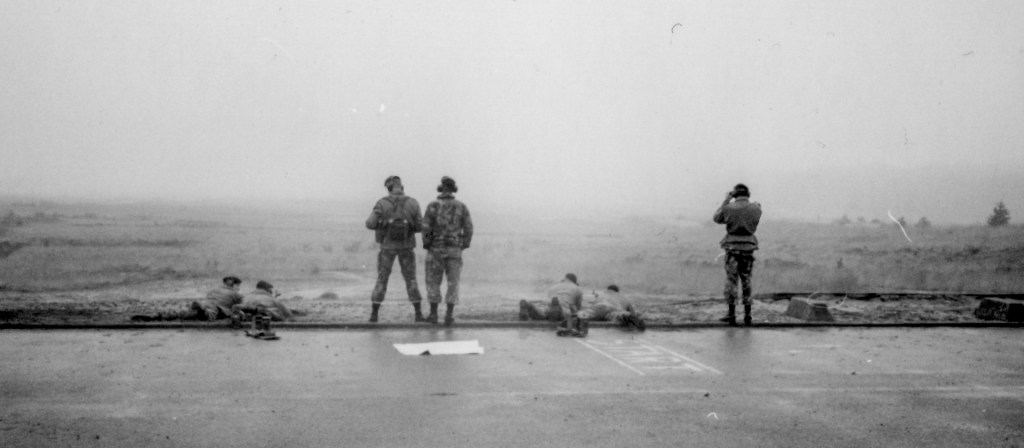


Slide film, 1996, Arnhem – the Netherlands
In many lectures about 20th-century philosophy, you will hear about Albert Camus. I have always been interested in his work, and through these lectures, I know quite a lot about him, but I have never read his books. I started reading Myth of Sisyphus, and today at work, I also started listening to a good audiobook of that book on YouTube.
You might have heard of Sisyphus; he is the Greek God that had to push a giant boulder up the hill over and over. This feeling of an endless drag, of pushing that boulder up the hill over and over again, or in our case: of getting up, eating, working, eating, sleeping, and getting up again, is demoralizing. Many people feel the despair of this and seek relief from that feeling. According to Camus, we have three options: 1 believe in an improbable God not for relief now but a better life after death, 2 suicide and 3, except the futility of life and live with it.

7 Learning to feel differently about space. – Is it the real things or the imaginary things which have contributed most to human happiness? What is certain is that the extent of the space between the highest happiness and the deepest unhappiness has been produced only with the aid of the imaginary things. This kind of feeling of space is, consequently, being continually reduced under the influence of science: just as science has taught us, and continues to teach us, to feel that the eanh is small and the solar-system itself no more than a point.
Friedrich Nietzsche, Daybreak – book 1
 Nochrisis