148 Poets as the easers of life. -The poets, insofar as they, too, want to make our lives easier, either turn our gaze away from the toilsome present or help the present acquire new colors by shining light upon it from the past. To be capable of this, they must themselves be turned back toward the past in many respects: so that we can use them as bridges to far away times and ideas, to dying or deceased religions and cultures. They are, in fact, always and necessarily epigones. Admittedly, we can say some unfavorable things about the means that they use to make life easier: they soothe and heal only temporarily, only for the moment; they even keep people from working toward genuine improvement of their circumstances, because they suspend and, by palliating it, discharge the passion that impels dissatisfied people toward action.
139 Said to be higher! – You say that the morality of pity is a higher morality than that of stoicism? Prove it! but note that ‘higher’ and ‘ lower’ in morality is not to be measured by a moral yardstick: for there is no absolute morality. So take your yardstick from elsewhere and – watch out!
3 If ever one breath came to me of the creative breath and of that heavenly need that constrains even accidents to dance star-dances; if I ever laughed the laughter of creative lightning which is followed obediently but grumblingly by the long thunder of the deed; if I ever played dice with gods at the gods’ table, the earth, till the earth quaked and burst and snorted up floods of fire-for the earth is a table for gods and trembles with creative new words and gods’ throws: Oh, how should I not lust after eternity and after the nuptial ring of rings, the ring of recurrence? Never yet have I found the woman from whom I wanted children, unless it be this woman whom I love: for I love you, 0 eternity. For I love you, 0 eternity!
281 Doors. -Like the man, the child sees doors in everything that it experiences or learns: but for the former they are entrances, for the latter always only passageways.
1 1 8 What is our neighbour! – What do we understand to be the boundaries of our neighbour: I mean that with which he as it were engraves and impresses himself into and upon us? We understand nothing of him except the change in us of which he is the cause – our knowledge of him is like hollow space which has been shaped. We attribute to him the sensations his actions evoke in us, and thus bestow upon him a false, inverted positivity. According to our knowledge of ourself we make of him a satellite of our own system: and when he shines for us or grows dark and we are the ultimate cause in both cases – we nonetheless believe the opposite! World of phantoms in which we live! I nverted, upsidedown, empty world, yet dreamed of as full and upright!
If people set out towards their opinion, what they believe or think to know, do they know where to go? Or do you believe that your opinion comes from within you, arising from somewhere deep?
Some observations
Understanding where our knowledge comes from is important in our highly opinionated world. When and when not to trust our knowledge, opinions, and beliefs is important, in my opinion.
We all can live with our truths and go as far as to say that we all have “a right to our own truths.” If you say that the sky is blue, you will be right because most of us will agree, but if you say that that particular person is the best person for that job, you might find out that others disagree. You still have your truth, but it might be wise to find out what qualities you rank high and which ones the others do. If you like the character and attitude of the person you prefer, but the others point out the lack of qualification, you might have a starting point from where you can find out what is more important instead of just stating your opinion. It is often not enough to state your opinion, so finding out the reason why you have these opinions can also be important.
There is a possibility that you end up endlessly questioning your beliefs. If the question is, like in the example above, if personality or adjudication is more important, you might have anecdotal stories where an uneducated new employee lifted a company’s morals. Still, the other might use common sense that education is usually used to decide who to hire. Anecdotal evidence needs more scrutiny, but what is expected is not always the road to follow, especially when change is needed. In this example, the two sides might have discovered that one side thought that change was needed, and the other just wanted a new employee. Now you’re on the road to finding out what the reasons are that part of the company wants to change and the other part does not. From here, you can only go deeper, and maybe you will find out that you didn’t even know what you wanted or what the question was.
You say the sky is blue, but it is more correct to say that the sky looks blue. This is what my friendly AI minion says about it: The sky appears blue due to a phenomenon called Rayleigh scattering. When sunlight enters the Earth’s atmosphere, it collides with molecules and small particles, scattering the shorter blue wavelengths of light more than the longer red wavelengths. This scattering causes us to perceive the sky as blue during the day.
This is what NASA’s Space Place tells us: Sunlight reaches Earth’s atmosphere and is scattered in all directions by all the gases and particles in the air. Blue light is scattered more than the other colors because it travels as shorter, smaller waves. This is why we see a blue sky most of the time.
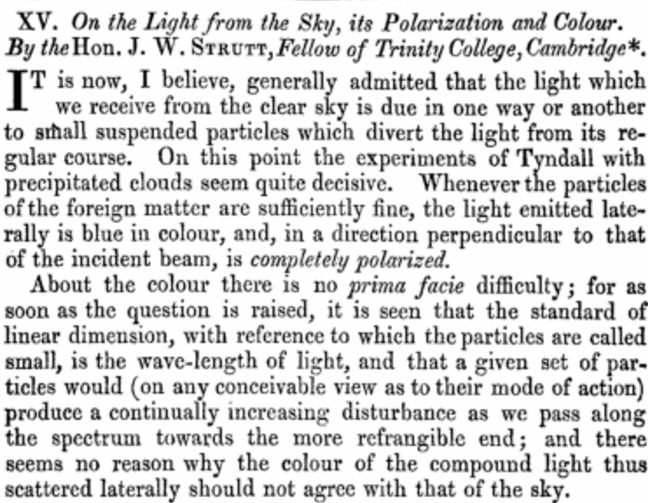
And here is a Quote from the scientist who wrote all of this down for the first time in 1871, John William strutt, 3rd Baron Rayleigh:
This was just a 10-minute search on the internet to “debunk” something that most of us take for granted. It is, of course, enough to say that the sky is blue, but say at least to the younger people that there is a but after you stated the obvious because for young people, there is still hope.
Friedrich Nietzsche
Human, All Too Human II
Mixed Opinions and Maxims
6 Against visionaries. -The visionary denies the truth to himself, the liar only to others.
261 One weapon twice as good as two. -It is an unequal battle when one person speaks for his position with head and heart, the other only with his head: the first has the sun and wind against him, as it were, and his two weapons interfere with each other: he loses the prize-in the eyes of truth. Admittedly, the victory of the second with his one weapon is seldom a victory according to the heart of all the other spectators and costs him his popularity among them.
270 The eternal child. -We believe that fairy tales and games belong to childhood: shortsighted as we are! As if we would like to live without fairy tales and games at any age! Admittedly, we call it something else and experience it differently, but this is precisely what speaks for it being exactly the same thing – for the child, too, feels that games are his work and fairy tales his truth. The brevity of life should preserve us from pedantically separating the ages oflife – as if each one brought something new – and a poet should sometime present to us a human being two hundred years old who really does live without fairy tales and games.
21 Observance of the law‘. – If obedience to a moral precept produces a result different from the one promised and expected, and instead of the promised good fortune the moral man unexpectedly encounters ill fortune and misery, the conscientious and fearful will always be able to recourse to saying: ‘ something was overlooked in the way it was performed’. In the worst event, a profoundly sorrowful and crushed mankind will even decree: ‘ it is impossible to perform the precept properly, we are weak and sinful through and through and in the depths of us incapable of morality, consequently we can lay no claim to success and good fonune. Moral precepts and promises are for better beings than we are.
35 Feelings and their origination in judgments. – ‘Trust your feelings!’ – But feelings are nothing final or original; behind feelings there stand judgments and evaluations which we inherit in the form of feelings ( inclinations, aversions). The inspiration born of a feeling is the grandchild of a judgment – and often of a false judgment! – and in any event not a child of your own! To trust one’s feelings – means to give more obedience to one’s grandfather and grandmother and their grandparents than to the gods which are in us: our reason and our experience.
There have been times in my life when I hit rock bottom. After the first few times, I learned how to brace myself when I found myself on a familiar trajectory. Being curious by nature, I never really judged the place; I also observed the joyous times in my life from an appropriate distance. I don’t try to judge. In some sense, all strong emotions have something in common, and that is that they are strong.
But man has such a predilection for systems and abstract deductions that he is ready to distort the truth intentionally, he is ready to deny the evidence of his senses only to justify his logic. Fyodor Dostoyevsky, Notes from the Underground
But are strong emotions of love, wonder, or winning not better than feelings of loss and depression, you might ask? Yes, of course, at first glance. What do all these emotions have in common? They are all finite; they start at a certain point and end eventually. The more a certain feeling repeats itself in your life, the more you get used to it, and its impact will slowly diminish. The reason why you feel that first strong emotion of love or loss that strong, is because you don’t know what follows; it might never end, is what you want to believe. The reason you feel it is so strong is unfamiliarity.
Feeling love is, at first glance, a more positive feeling than loss, but as we all know, after love, the break up comes eventually, even if it takes many years when death finally demands its toll. Loss, on the other hand, starts on a down note, but how good is the feeling of finding what was lost back? My point is that feelings have a whole spectrum that, on average, evens out. Emotions are there; in some sense, you should feel the joy and negativity; just feel them without too much judgment.
I do and have done this kind of rationalization whenever I am down, but also when I am up, and I can tell you when you are up and think about this stuff…then it doesn’t always help. But jokes aside, rationalizing your feelings does help you stay somewhat calm during a surge of emotions, but you have to be lucky to have that ability. I don’t know if it can be taught.
One ought to hold on to one’s heart; for if one lets it go, one soon loses control of the head too. Friedrich Nietzsche
3 Everything has its day.– When man gave all things a sex he thought, not that he was playing, but that he had gained a profound insight: – it was only very late that he confessed to himself what an enormous error this was, and perhaps even now he has not confessed it completely. – In the same way man has ascribed to all that exists a connection with morality and laid an ethical significance on the world’s back. One day this will have as much value, and no more, as the belief in the masculinity or femininity of the sun has today.
373 Arrogance. -There is nothing against which we should guard more carefully than against the growth of the weed that is called arrogance and that spoils all we reap; for there is an arrogance in affection, in signs of respect, in benevolent familiarity, in caresses, in friendly advice, in admission of errors, in pity for others, and all these beautiful things arouse repugnance if that weed sprouts among them. An arrogant person, that is, anyone who wants to seem more important than he is or is considered to be, always miscalculates. To be sure, he has a momentary success in his favor, insofar as those people in whose presence he behaves arrogantly generally pay him the degree of honor that he demands, whether out of fear or indolence; but they take a terrible revenge for this by subtracting exactly as much from the value that they previously ascribed to him as there is excess in the amount that he has demanded. There is nothing for which people make us pay more dearly than humiliating them. An arrogant person can make his genuinely great merit so suspect and so small in the eyes of others that they trample it into the dust.-Even a proud demeanor is something that we should allow ourselves only where we can be quite certain not to be misunderstood or to be considered arrogant, in front of friends or wives, for example. For there is no greater folly in our relations with other people than acquiring a reputation for being arrogant; it is even worse than not having learned how to tell lies politely.
487 The passion for things. -Anyone who directs his passion toward things (sciences, the public welfare, cultural interests, arts) takes much of the fire away from his passion for people (even when they are representatives of those things, as statesmen, philosophers, artists are the representatives of their creations).
118 If anything at all has been achieved, it is a more innocuous relation to the senses, a more joyous, benevolent, Goethean attitude toward sensuality; also a prouder feeling regarding the search for knowledge, so that the “pure fool” is not given much credit.
123 The unfinished problems I pose anew: the problem of civilization, the fight between Rousseau and Voltaire around 1760. Man becomes more profound, mistrustful, “immoral,” stronger, more confident of himself -and to this extent “more natural”: this is “progress.”- At the same time, in accordance with a kind of division of labor, the strata that have become more evil are separated from those that have become milder and tamer-so that the overall fact is not noticed immediately.- It is characteristic of strength, of the self-control and fascination of strength, that these stronger strata possess the art of making others experience their progress in evil as something higher. It is characteristic of every “progress” that the strengthened elements are reinterpreted as “good.”
65 Whither honesty can lead. – Someone had the bad habit of occasionally examining the motives of his actions, which were as good and bad as the motives of everyone else, and honestly saying what they were. He excited at first revulsion, then suspicion, gradually became altogether proscribed and declared an outlaw in society, until finally the law took notice of this infamous being on occasions when usually it closed its eyes. Lack of ability to keep silent about the universal secret, and the irresponsible tendency to see what no one wants to see – himself – brought him to prison and a premature death.
491 Self-observation. – Man is very well defended against himself, against being reconnoitred and besieged by himself, he is usually able to perceive of himself only his outer walls. The actual fortress is inaccessible, even invisible to him, unless his friends and enemies play the traitor and conduct him in by a secret path.
1. We are unknown to ourselves, we knowers: and for a good reason. We have never sought ourselves—how then should it happen that we find ourselves one day? It has rightly been said: “where your treasure is, there will your heart be also”; our treasure is where the beehives of our knowledge stand. We are forever underway toward them, as born winged animals and honey-gatherers of the spirit, concerned with all our heart about only one thing “bringing home” something. As for the rest of life, the so-called “experiences”—who of us even has enough seriousness for them? Or enough time? In such matters I’m afraid we were never really “with it”: we just don’t have our heart there—or even our ear! Rather, much as a divinely distracted, self-absorbed person into whose ear the bell has just boomed its twelve strokes of noon suddenly awakens and wonders, “what did it actually toll just now?” so we rub our ears afterwards and ask, completely amazed, completely disconcerted, “what did we actually experience just now?” still more: “who are we actually?” and count up, afterwards, as stated, all twelve quavering bellstrokes of our experience, of our life, of our being—alas! and miscount in the process … We remain of necessity strangers to ourselves, we do not understand ourselves, we must mistake ourselves, for us the maxim reads to all eternity: “each is furthest from himself,”—with respect to ourselves we are not “knowers” …
349 In a dispute. -If we simultaneously contradict an opinion and lay out our own, our continual consideration of that other opinion generally disturbs the natural delivery of our own: it appears more purposeful, more severe, perhaps somewhat exaggerated.












 Nochrisis