Beyond good and evil, prelude to a philosophy of the future
By Friedrich Nietzsche
First chapter.
PREJUDICES OF PHILOSOPHERS.
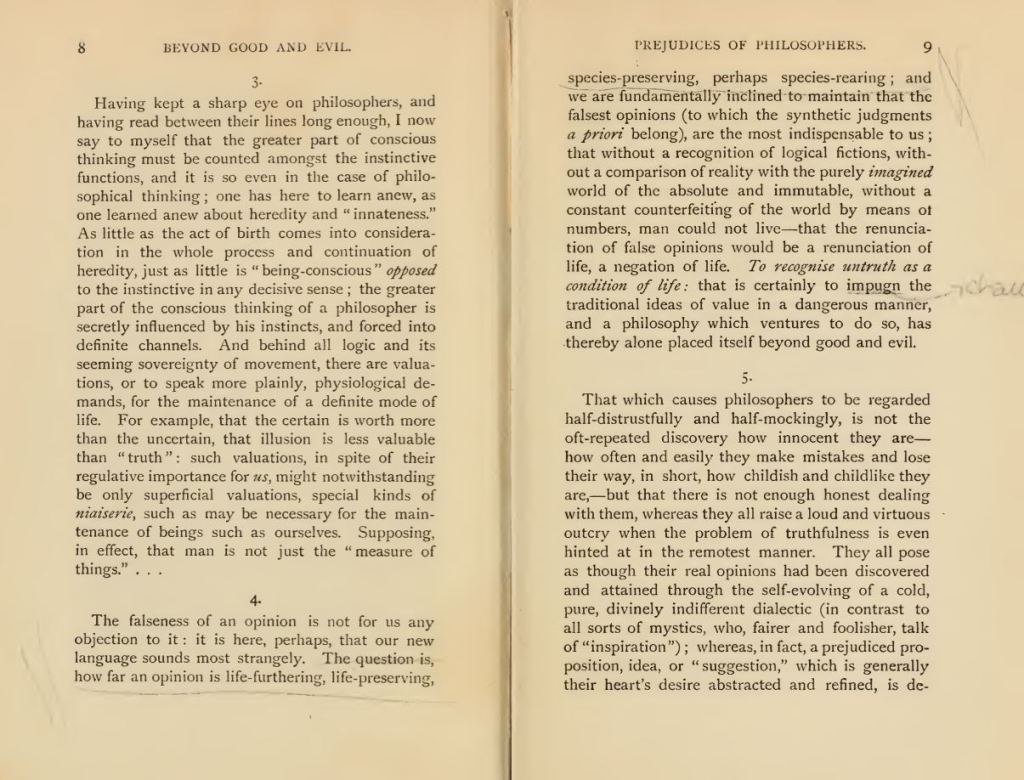
4.
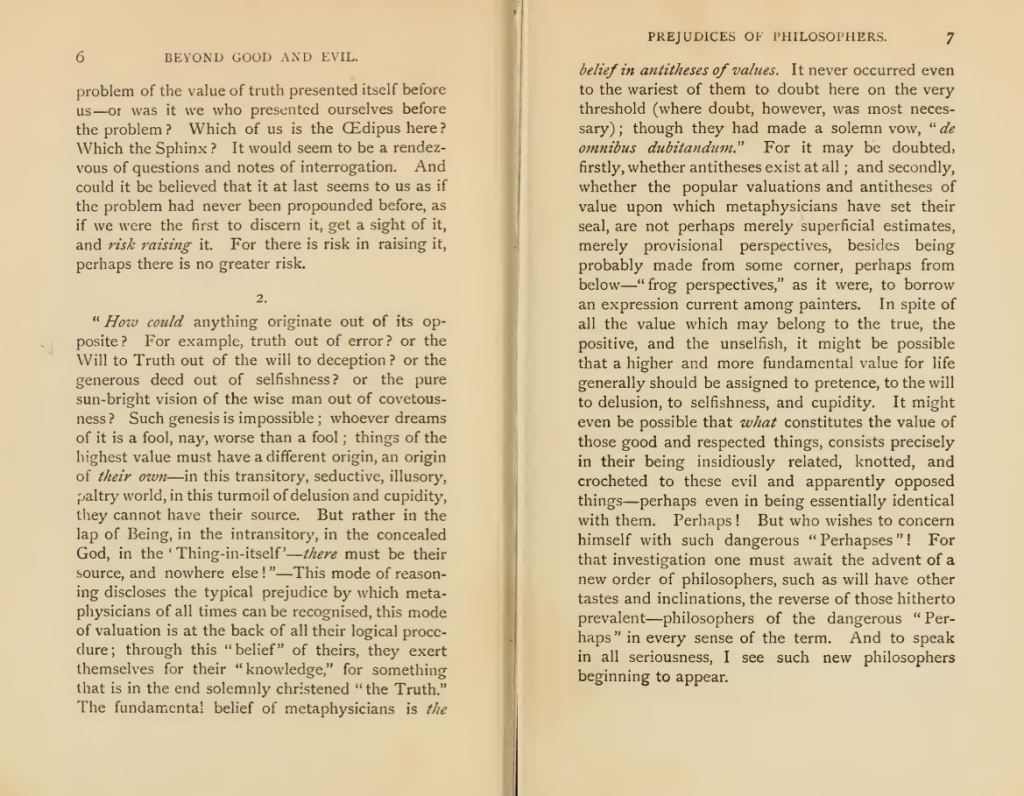
The falseness of an opinion is not for us any objection to it: it is here, perhaps, that our new language sounds most strangely. The question is, how far an opinion is life-furthering, life-preserving, species-preserving, perhaps species-rearing; and we are fundamentally inclined to maintain that the falsest opinions (to which the synthetic judgments a priori* belong), are the most indispensable to us; that without a recognition of logical fictions, with out a comparison of reality with the purely imagined world of the absolute and immutable, without a constant counterfeiting of the world by means of numbers, man could not live—that the renunciation of false opinions would be a renunciation of life, a negation of life. To recognize untruth as a condition of life : that is certainly to impugn the traditional ideas of value in a dangerous manner, and a philosophy which ventures to do so, has: thereby alone placed itself beyond good and evil.
Beyond good and evil, prelude to a philosophy of the future
By Friedrich Nietzsche
First chapter.
PREJUDICES OF PHILOSOPHERS.
3.
Having kept a sharp eye on philosophers, and having read between their lines long enough, I now say to myself that the greater part of conscious thinking must be counted amongst the instinctive functions, and it is so even in the case of philosophical thinking; one has here to learn anew, as one learned anew about heredity and “innateness.” As little as the act of birth comes into consideration in the whole process and continuation of heredity, just as little is ” being-conscious ” opposed to the instinctive in any decisive sense; the greater part of the conscious thinking of a philosopher is secretly influenced by his instincts, and forced into definite channels. And behind all logic and its seeming sovereignty of movement, there are valuations, or to speak more plainly, physiological demands, for the maintenance of a definite mode of life. For example, that the certain is worth more than the uncertain, that illusion is less valuable than “truth”: such valuations, in spite of their regulative importance for us, might notwithstanding be only superficial valuations, special kinds of niaiserie*, such as may be necessary for the maintenance of beings such as ourselves. Supposing, in effect, that man is not just the “measure of things.” . . .
Beyond good and evil, prelude to a philosophy of the future
By Friedrich Nietzsche
First chapter.
PREJUDICES OF PHILOSOPHERS.
2.
” How could anything originate out of its opposite? For example, truth out of error? or the Will to Truth out of the will to deception? or the generous deed out of selfishness? Or the pure sun-bright vision of the wise man out of covetousness ? Such genesis is impossible; whoever dreams of it is a fool, nay, worse than a fool; things of the highest value must have a different origin, an origin of their own—in this transitory, seductive, illusory, paltry world, in this turmoil of delusion and cupidity, they cannot have their source. But rather in the lap of Being, in the intransitory, in the concealed God, in the “Thing-in-itself“—there must be their source, and nowhere else!”—This mode of reasoning discloses the typical prejudice by which metaphysicians of all times can be recognised, this mode of valuation is at the back of all their logical procedure; through this “belief” of theirs, they exert themselves for their “knowledge,” for something that is in the end solemnly christened ” the Truth.” The fundamental belief of metaphysicians is the belief in antitheses of values. It never occurred even to the wariest of them to doubt here on the very threshold (where doubt, however, was most necessary); though they had made a solemn vow, ” de omnibus dubitandum” For it may be doubted, firstly, whether antitheses exist at all ; and secondly, whether the popular valuations and antitheses of value upon which metaphysicians have set their seal, are not perhaps merely superficial estimates, merely provisional perspectives, besides being probably made from some corner, perhaps from below—” frog perspectives,” as it were, to borrow an expression current among painters. In spite of all the value which may belong to the true, the positive, and the unselfish, it might be possible that a higher and more fundamental value for life generally should be assigned to pretense, to the will to delusion, to selfishness, and cupidity. It might even be possible that what constitutes the value of those good and respected things, consists precisely in their being insidiously related, knotted, and crocheted to these evil and apparently opposed things—perhaps even in being essentially identical with them. Perhaps ! But who wishes to concern himself with such dangerous ” Perhapses ” ! For that investigation one must await the advent of a new order of philosophers, such as will have other tastes and inclinations, the reverse of those hitherto prevalent—philosophers of the dangerous ” Perhaps ” in every sense of the term. And to speak in all seriousness, I see such new philosophers beginning to appear.
Beyond good and evil, prelude to a philosophy of the future
By Friedrich Nietzsche
First chapter.
PREJUDICES OF PHILOSOPHERS.
I.
The Will to Truth, which is to tempt us to many a hazardous enterprise, the famous truthfulness of which all philosophers have hitherto spoken with respect, what questions has this will to truth not laid before us! What strange, perplexing, questionable questions! It is already a long story; yet it seems as if it were hardly commenced. Is it any wonder if we at last grow distrustful, lose patience, and turn impatiently away? That this sphinx teaches us at last to ask questions ourselves? Who is it really that puts questions to us here? What really is this “Will to Truth” in us? In fact we made a long halt at the question as to the origin of this Will—until at last we came to an absolute standstill before a yet more fundamental question. We inquired about the value of this Will. Granted that we want the truth : why not rather untruth? And uncertainty? Even ignorance? The problem of the value of truth presented itself before us—or was it we who presented ourselves before the problem? Which of us is the Oedipus here? Which the Sphinx ? It would seem to be a rendezvous of questions and notes of interrogation. And could it be believed that it at last seems to us as if the problem had never been propounded before, as if we were the first to discern it, get a sight of it, and risk raising it. For there is risk in raising it, perhaps there is no greater risk.
Full of energy I streamed down to a sea, driven by a need to go.
Halfway my journey, a cold eastern wind sung and gripped me, it took away the light and open sky, a barrier was composed, and a part of me conducted and stayed behind.
That part of me is for always lost, and will collapse the further I move away.
Some of it will follow me, eventually, but I will never know, when I will meet it again.
The idea of the beginning of motion is one that we get only from reflection on what happens in ourselves, where we find by experience that merely by willing something – merely by a thought of the mind – we can move parts of our bodies that have been at rest. So that it seems to me that our sensory perception of the operations of bodies gives us only a very imperfect and obscure idea of active power, since it provides no idea of the power to begin any action, whether physical or mental. If you think you have a clear idea of power from your observations of colliding bodies, I shan’t quarrel with you, because sensation is one of the ways by which the mind gets its ideas. But I thought it worthwhile to consider – just in passing – whether the mind doesn’t receive its idea of active power more clearly from reflection on its own operations than from any external sensation.









 Nochrisis