Day 2888, Interpreting random Nietzsche 2.

Daily picture, Philosophy
Two young soldiers on patrol with us, plus a road sign, our camp was in Ampil, Cambodia 1993

444 War. – Against war it can be said: it makes the victor stupid, the defeated malicious. In favour of war: through producing these two effects it bar­barizes and therefore makes more natural; it is the winter or hibernation time of culture, mankind emerges from it stronger for good and evil. From Human All Too Human

This aphorism is more self-explanatory.  I don’t know if Nietzsche celebrates the act of war; he was a medic in the Franco-Prussian war of 1870, but I don’t know if he was confronted by the violence of war or only by the result of exploding bombshells. Most people who knew Nietzsche say that he was a friendly man, kind and polite. Not the typical war monger or brut you might think of when reading some of his works. I think that war was, for Nietzsche, more of an abstraction than the gruesome reality it is. There have always been periods through history where society suddenly takes a few steps forward, and this might often seem to happen after a war, but it is hard to unravel what happens in a society, especially when something as gruesome as a war is going on. I know that for many people, war is still something to celebrate, probably for other reasons than Nietzsche does, but for me, raised at the end of the Cold War by a passivist mother, war is something you want to avoid.

I think that Nietzsche is more right when he says: it makes the victor stupid, the defeated malicious, but that is also more of an open door. He also says that war bar­barizes and therefore makes more natural. I am not sure what he wants to say, but nature is, of course, barbarous, with no morals or thoughts of the future and past to guide it. He goes on to say: it is the winter or hibernation time of culture, mankind emerges from it stronger for good and evil. Again, I don’t think that during a war, progression stops or hibernates, as he implies*. He ends with the idea that we get stronger out of it, as I discussed earlier, but the last words are for good and evil, so maybe he balances it out again, and has he merely put us on the wrong foot when we read this aphorism. As if we reacted with our own “barbarous”  mind. With Nietzsche, you never know

*I just started reading Victor Frankl’s book Man’s Search for Meaning, A book that originates in the Nazzi death camps, and it has helped society to move forward in several ways. No hibernation in the epicenter of that war. 

Day 2887, Interpreting random Nietzsche.

Daily picture, Philosophy
Cambodia in 1993

6o To desire to revenge and then to carry out revenge means to be the victim of a vehement attack of fever which
then, however, passes: but to desire to revenge without possessing the strength and courage to carry out revenge means to carry about a chronic illness, a poisoning of body and soul. Morality, which looks only at intentions, assesses both cases equally; in the ordinary way the former case is assessed as being the worse (on account of the evil consequences which the act of revenge will perhaps produce). Both evaluations are short­ sighted. From Human All Too Human 

Reading philosophy can be challenging. Reading Nietzsche can be challenging, too. There are many reasons why I read a lot of Nietzsche. First of all, he just spoke to me; it’s like we enjoy the same music and stick with each other to enjoy it; there is no higher philosophical reason for it. I didn’t know anything about philosophy when I started reading it, so I could not be attracted to anyone’s philosophy. One thing that I still appreciate is that Nietzsche, for the most part, asks questions through all kinds of answers. He is not trying to tell you how the world works through elaborate systems spanning hundreds of pages. He writes aphorisms from one sentence to a couple of pages that are all loosely connected with the ones before and after. You can read his books from beginning to end but you can also open one and just read one of the aphorisms and think about it. 

Interpretation

Italic = Nietzsche’s text Bolt = my interpretation and rewording 

To desire to revenge and then to carry out revenge means to be the victim of a vehement attack of fever which then, however, passes: but to desire to revenge without possessing the strength and courage to carry out revenge means to carry about a chronic illness, a poisoning of body and soul. If you act directly on the urge to take revenge, that feeling that comes over you and clouds your judgment like a fever does, you will be freed of that feeling to take revenge. If you don’t act on that urge but take it with you, it might consume you from the inside out. Morality, which looks only at intentions, assesses both cases equally; Morality for Nietzsche is often closely related to Christianity and, in this case, the thought of revenge or the act of revenge is the same for an all-knowing God. in the ordinary way the former case is assessed as being the worse (on account of the evil consequences which the act of revenge will perhaps produce). The ordinary way is how secular society judges you, and acting on an urge is worse than not acting on it. Both evaluations are short­ sighted. And like Nietzsche tends to do, he throws a spanner in the works and forces you to think. The moralistic view is short sighted because of the judgment of an urge but the “ordinary way” because of the outcome of acting on that urge? In this case, it might help to read the aphorism before this one because, at this moment (late in the evening after a day’s work outside), I don’t see the other cause where the “short sighted(nes)” alludes to. Maybe he wants to tell us that it is, in both cases, a disease that makes us feel like taking revenge, or better said, we don’t choose to feel what we feel, and we don’t choose how we react; we react. Our circumstances determine how we react; there is no I that acts.  

Day 2657, Only your past knows the truth about your past.

Daily picture, Philosophy

Your self-image is partly formed by your past and what you remember, consciously or not. You probably have been in a situation like this: you get greeted by your classmates at a reunion with welcome cheers and fond memories; you might feel confused if you have lived all those years with the memory that you were a loner at that school and making friends was difficult for you. Why do you remember certain situations from the past differently than others do?

We have many memories and feelings about past events that we can never verify. Consequently, we can never be sure of what our “self” is or who we are because thinking of yourself as a loner instead of a more popular kid in the classroom might greatly affect your self-image. Despite this, most of what we remember and feel as a part of our self-image is probably true. However, it is hard to determine which parts; this might be a source of our insecurities about who we are.

We also add new memories every moment we live; they might not immediately affect your “self.” but some of them can have significant effects in the future without you realizing it. In this constant stream of input, finding the source of new and important events might be difficult when looking back, overwhelmed as we are by our senses. Your memories might feel focused at a certain time in the past when you remember them, but the reality is often that these memories are a collage of miner events put together later to fit your current self-image. We not only have a hard time locating the source of our memories at a later date, but we also play a part in their construction after the fact, and both of them are in constant motion.

We often feel our self, but many of us are also looking for our self. We often hold on to a self and let our inner workings or unconsciousness maintain that image of our self(s) through subtle manipulation. No matter what is happening, your self is constantly in motion, going nowhere but always becoming.

Gilles Deleuze has written about the self in his work; underneath, you can read some quotes. There is also a famous study about memories of the 9/11 attack that highlights the problems we have with memories; read it here: https://news.lafayette.edu/2021/09/07/remembering-9-11-are-flashbulb-memories-accurate-20-years-later/ or do a search for it.

  “The self is only a threshold, a door, a becoming between two multiplicities.”

“To affirm is not to bear, carry, or harness oneself to that which exists, but on the contrary to unburden, unharness, and set free that which lives.”

“Lose your face: become capable of loving without remembering, without phantasm and without interpretation, without taking stock. Let there just be fluxes, which sometimes dry up, freeze or overflow, which sometimes combine or diverge.”

Gilles Deleuze

Day 2656, Windows of opportunity.

Daily picture, Philosophy

Life is unfair. Why do I say that? Because we are free and unfree at the same time.

“Man is condemned to be free; because once thrown into the world, he is responsible for everything he does. It is up to you to give [life] a meaning.”

Jean-Paul Sartre

Sartre takes our freedom to the extreme in that we can take our own life and end it at any moment. We are condemned to find a reason to live and not take the final step, and this finding of a reason is the meaning you give to your life.

If you are not satisfied with parts of your life, let’s say your work becomes meaningless to you, you can repeat to yourself all the reasons why you should keep this job, like feeding your family and paying the mortgage. These reasons are all valid for your particular life, but you as a human being can just stand up after lunch, walk away, and don’t stop walking till you are far away from your life, literally. We don’t do this because of moral reasons, society and responsibilities, but the fact that we can do it makes this tension between our freedom and unfreedom so interesting.

A second problem is that there is no general reason for life or to keep on living besides the fact that we do. Our basic instincts functions like eating and breathing extend our life till its natural end without much effort on our part. You can believe in some sort of god or afterlife, but that is not more than a personal reason to live for and not one that is grounded in what we know, the facts.

We humans, thinking animals, have, through our living together, invented all kinds of reasons why we live, and we have written books full of rules that tell us what to do and what not to do. We all know this, even if you can’t read or end up in a society that is alien to you, you know that there are rules, and you try to follow them. We are conditioned to follow these written and unwritten rules, but none of these rules relate to any facts about life. The only rule with any basis in facts is that we can ignore all these man-made rules and regulations. We can ignore a red light at a crossroad; no one stops you the next time you approach this symbol that forbids… you are free to make a choice.

All these rules are, of course, necessary to let our society function, but like Sartre said, we are ultimately free to stand up and go our own way, we are condemned to be free.

“My thought is me: that’s why I can’t stop. I exist because I think… and I can’t stop myself from thinking. At this very moment – it’s frightful – if I exist, it is because I am horrified at existing. I am the one who pulls myself from the nothingness to which I aspire.”

Jean-Paul Sartre

Day 2651, the time when.

Daily picture, Philosophy

It is hard to make decisions in a world, or better said, a universe that doesn’t care about you, that has no plan or conscious direction. Do I move here or there, and shall I take that job? These questions matter to you and maybe some people around you, but none of the people you meet on the street that day are thinking about your choices. It is personal to you, and your choice will only make a small wrinkle around you that no one further away from you will notice.   

Your choice is trivial in the greater scheme of things and, in that sense, also for your life. Yes, moving to another city will change your life, but the factual choice to go, yes or no, is meaningless because either way, your life goes on, and only your opinion of that life matters; almost no one else cares remember. You can, and probably will, make sense of either choice, and when it turns out to be a bad choice, well… this might put more pressure on your next choice. Still, the fact is also that you never will know how life would have gone if you made the other choice; in this case, you can only compare your so-called bad direction with an imaginary other direction.

There are no objectively good decisions in life because there are no written rules or blueprints of how life should be. It’s probably best to throw dice or tap into your memories and feel how it was when you were eight and wandered around attracted by directions you didn’t even know were there, the time when the directions made the decisions.

Day 2650, behind the curtains.

Daily picture, Philosophy

The idea of a crossroad where I sit down, waiting for a clue, is something I came up with yesterday while sitting down to write something. Today I looked around at the world and the people I met and wondered: do they ever think about their life in metaphors. I don’t get the impression that they do due to how they answer my probing questions and react to my remarks. But they might have their own reasons to hide that part of their life from me and maybe the rest of the world. Perhaps this is due to their character, life experience, or just my faulty interpretation.

I rarely ask someone directly what they think of me and my ideas. It might be me, but that is not something we do in the society I live in. Only children, drunkards, or otherwise intoxicated people seem to ask these kinds of direct questions.

I wish I could be a kid again and ask the people in the store if they ever sit at a crossroad in life, waiting for an answer. Why and when do we change from being a child, full of wonder and little shame, into these buttoned-up so-called grownups with our wonder tamed and locked inside behind the curtains.  

Day 2649, choices.

Daily picture, Philosophy

For the last twenty-five years, I have been at a crossroad. After a while, I realized I better sit down, realizing it would be a long wait. It took even longer to learn where the different roads would lead to but to be honest, I am still not sure.

Somewhere during that time, I wrote down that I was pretty lucky. I at least realized there was a crossroad where I was; so many people only find this out when they are a long way in one or another direction. Looking back, they only see the decisions they could have made, waving at me from a distance. But maybe there is something to say for hindsight instead of unclear foresight. I let life decide a lot of directions; I am pretty sure I even believe that I choose most of them willingly and freely; they are mostly related to the mundane parts of life, like where to live and what job to take to pay the bills. The crossroad I am sitting on, waiting, decides the direction…it determines how you deal with your own consciousness in a corrupt(ting) society and maybe even a corrupt human nature.

Many people pass me where I sit and tell me that they know that there is nothing to know, and they go on to live for their own till an empty end where they take their contradictions with them into their oblivion. Others are certain of the direction to take, joining all the others on that path as individuals in a traffic jam. The certainty that leads you on this path is the other side of the first one; they both have the same value, but only for the believer.

Day 2347, opening doors.

Day's pictures, Philosophy

Friedrich Nietzsche

Daybreak

Thoughts on the prejudices of morality

Book I

19 Morality makes stupid. – Custom represents the experiences of men of earlier times as to what they supposed useful and harmful – but the sense for custom (morality) applies, not to these experiences as such, but to the age, the sanctity, the indiscussability of the custom. And so this feeling is a hindrance to the acquisition of new experiences and the correction of customs: that is to say, morality is a hindrance to the creation of new and better customs: it makes stupid.

35 Feelings and their origination in judgments. – ‘Trust your feelings!’ – But feelings are nothing final or original; behind feelings there stand judgments and evaluations which we inherit in the form of feelings (inclinations, aversions). The inspiration born of a feeling is the grandchild of a judgment – and often of a false judgment! – and in any event not a child of your own! To trust one’s feelings – means to give more obedience to one’s grandfather and grandmother and their grandparents than to the gods which are in us: our reason and our experience.

55 ‘Ways’. – The supposed ‘shorter ways’ have always put mankind into great danger; at the glad tidings that such a shorter way has been found, they always desert their way – and lose their way.

Day 2346, imaginary world.

Day's pictures, Philosophy, Poetry
You wonder out there
and I can only see you
a being nothing

For the last few weeks, I have been reading books about child development and how we grow up and become the adults we are. I don’t do this without reason; I still wonder why I have such an interest in who and what we are. I know that most people have questions and, on occasion, also pursue these, but for me, it’s something I do every day. I have not done this my whole life; before philosophy, I was curious about many things, and I pried open all the toys I got to see what was inside. Later this curiosity made me look inside myself because I broke down and wanted to know why. I was born with a more than average curiosity, you might say.

Personal tragedies can often be a reason for some soul searching, but most people I know moved on once life was on the rails again and demanded their attention again. I’ve never stopped, and I think it’s because I was always curious and maybe slightly obsessive. But if it is just part of me to be this interested in philosophy and the search for what’s inside, why would I then write a book about what I learned if like-minded people are the only ones that read it?

We humans are, in essence, self-centered beings. We look at the world from a specific standpoint, uniquely ours, because of our experiences and a mostly unconscious feeling that other people are not really like us*, not really there, you could say. We mostly assume that other people are real because they do like we do, but all our experiences and hidden thoughts are only ours and are an impregnable wall between us and the other. This is the reason, I think, why it is so hard for me to imagine why other people are not as enthusiastic about philosophy as I am. I can’t penetrate their mind (Are they even real?) and can only project my experiences onto them.

I know that this is one way of looking at this problem; the fact is that most people are not interested in philosophy and asking the hard questions to one’s self. So besides my self-interest, what is the reason for me to write about my thoughts? I believe that it is important, and if more people would think twice about why they have certain opinions, the world would be a better place. I also don’t have the Illusion that what I have to say is something special or unique, I just say it slightly different than others have done it a thousand times before. I just wonder if it is possible to change people from not so curious about why we are what we are to enthusiastic questioners about why they believe and do the things they do.

Day 2236, human nature.

Day's pictures, Philosophy

David Hume

Treatise of human nature

Book I: The understanding

Section 1: The origin of our ideas All the perceptions of the human mind fall into two distinct kinds, which I shall call ‘impressions’ and ‘ideas’. These differ in the degrees of force and liveliness with which they strike upon the mind and make their way into our thought or consciousness. The perceptions that enter with most force and violence we may name ‘impressions’; and under this name I bring all our sensations, passions, and emotions, as they make their first appearance in the soul [= ‘mind’; no religious implications]. By ‘ideas’ I mean the faint images of the others in thinking and reasoning: for example, all the perceptions aroused by your reading this book – apart from perceptions arising from sight and touch, and apart from the immediate pleasure or uneasiness your reading may cause in you. I don’t think I need to say much to explain this distinction: everyone will readily perceive for himself the difference between feeling (·impressions·) and thinking (·ideas·).

Read about this book here: https://en.wikipedia.org/wiki/A_Treatise_of_Human_Nature

Read this book here: https://www.gutenberg.org/ebooks/4705


Day 1848, Prejudices of philosophers 5

Daily picture, Philosophy, Poetry

The philosophers

and pompous thinkers

step in the same puddles

on that road we all walk

~

its just that they do it

not by accident

but while trying not to

Nochrisis


Beyond good and evil, prelude to a philosophy of the future

By Friedrich Nietzsche

First chapter.

PREJUDICES OF PHILOSOPHERS.

5.

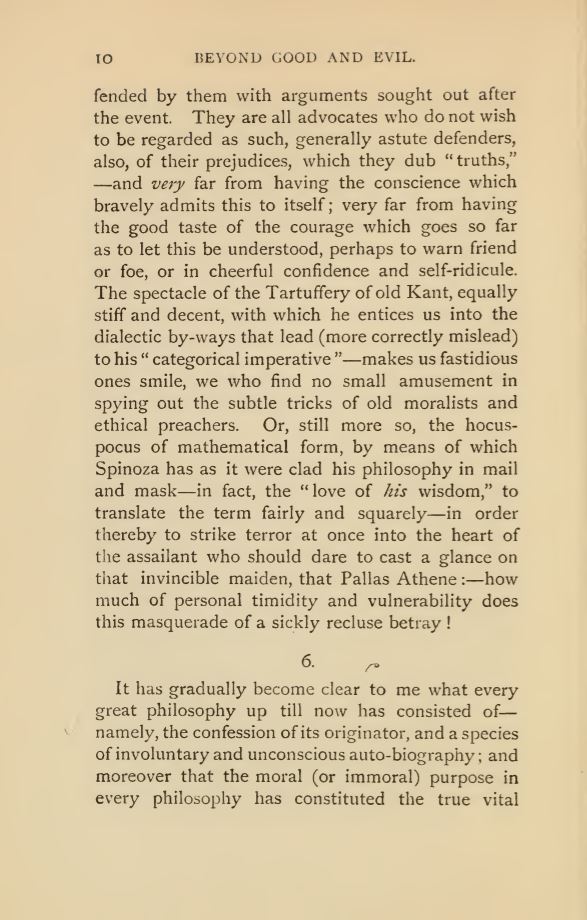
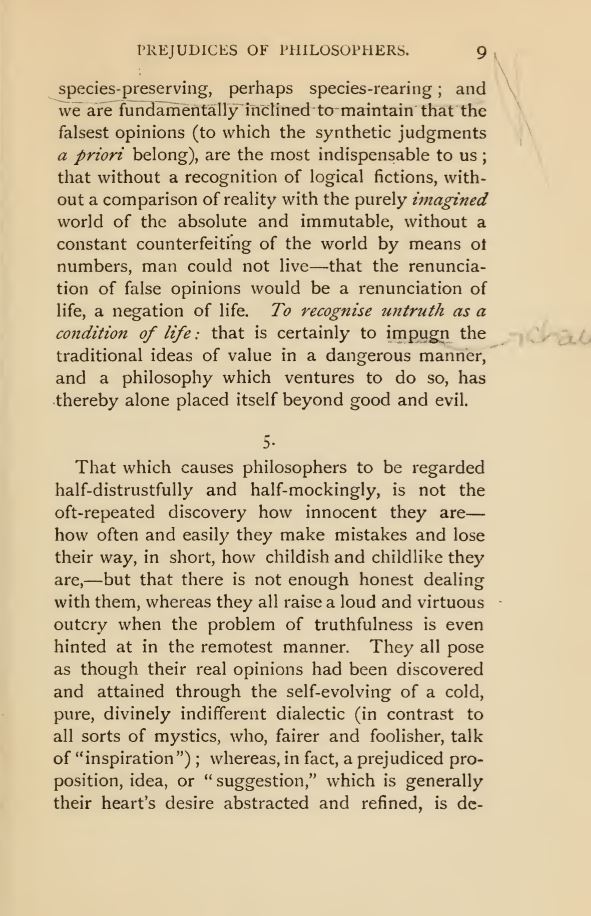
That which causes philosophers to be regarded half-distrustfully and half-mockingly, is not the oft-repeated discovery how innocent they are—how often and easily they make mistakes and lose their way, in short, how childish and childlike they are,—but that there is not enough honest dealing with them, whereas they all raise a loud and virtuous outcry when the problem of truthfulness is even hinted at in the remotest manner. They all pose as though their real opinions had been discovered and attained through the self-evolving of a cold, pure, divinely indifferent dialectic (in contrast to all sorts of mystics, who, fairer and foolisher, talk of “inspiration”); whereas, in fact, a prejudiced proposition, idea, or ” suggestion,” which is generally their heart’s desire abstracted and refined, is defended by them with arguments sought out after the event. They are all advocates who do not wish to be regarded as such, generally astute defenders, also, of their prejudices, which they dub ” truths,” —and very far from having the conscience which bravely admits this to itself; very far from having the good taste of the courage which goes so far as to let this be understood, perhaps to warn friend or foe, or in cheerful confidence and self-ridicule. The spectacle of the Tartuffery* of old Kant, equally stiff and decent, with which he entices us into the dialectic by-ways that lead (more correctly mislead) to his” categorical imperative”—makes us fastidious ones smile, we who find no small amusement in spying out the subtle tricks of old moralists and ethical preachers. Or, still more so, the hocuspocus of mathematical form, by means of which Spinoza has as it were clad his philosophy in mail and mask—in fact, the “love of his wisdom,” to translate the term fairly and squarely—in order thereby to strike terror at once into the heart of the assailant who should dare to cast a glance on that invincible maiden, that Pallas Athene**:—how much of personal timidity and vulnerability does this masquerade of a sickly recluse betray!

* hypocrisy

** ancient Greek goddess associated with wisdom, handicraft, and warfare

Translated by Helen Zimmerm

1909

Day 1847, Prejudices of philosophers 4

Daily picture, Philosophy, Poetry

In our life

truth is like a friend from a distant time

a memory we cherish

but one we don’t need

Nochrisis


Beyond good and evil, prelude to a philosophy of the future

By Friedrich Nietzsche

First chapter.

PREJUDICES OF PHILOSOPHERS.

4.

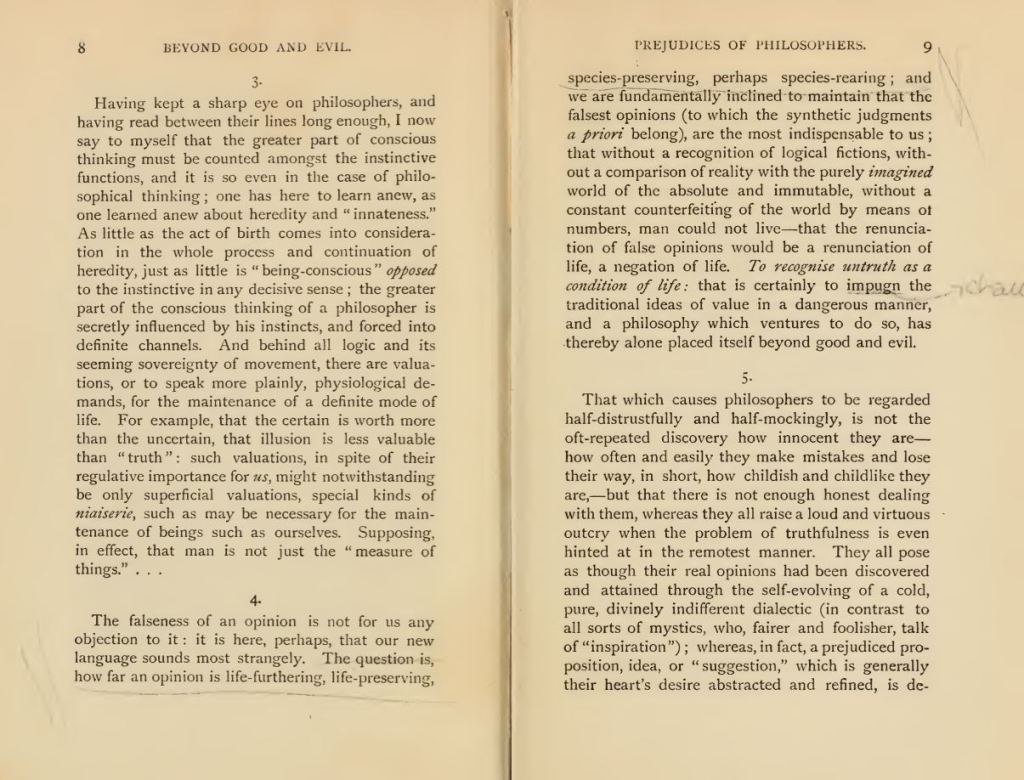
The falseness of an opinion is not for us any objection to it: it is here, perhaps, that our new language sounds most strangely. The question is, how far an opinion is life-furthering, life-preserving, species-preserving, perhaps species-rearing; and we are fundamentally inclined to maintain that the falsest opinions (to which the synthetic judgments a priori* belong), are the most indispensable to us; that without a recognition of logical fictions, with out a comparison of reality with the purely imagined world of the absolute and immutable, without a constant counterfeiting of the world by means of numbers, man could not live—that the renunciation of false opinions would be a renunciation of life, a negation of life. To recognize untruth as a condition of life : that is certainly to impugn the traditional ideas of value in a dangerous manner, and a philosophy which ventures to do so, has: thereby alone placed itself beyond good and evil.

Translated by Helen Zimmerm

1909

*

Day 1846, Prejudices of philosophers 3

Day's pictures, Philosophy, Poetry

When we think hard

like walking up a narrow mountain trail

we tend not to look at the world

the scenery around us

we stair at our feet

and do our next step

on what seems to be true

and safe for ourselves

Nochrisis


Beyond good and evil, prelude to a philosophy of the future

By Friedrich Nietzsche

First chapter.

PREJUDICES OF PHILOSOPHERS.

3.

Having kept a sharp eye on philosophers, and having read between their lines long enough, I now say to myself that the greater part of conscious thinking must be counted amongst the instinctive functions, and it is so even in the case of philosophical thinking; one has here to learn anew, as one learned anew about heredity and “innateness.” As little as the act of birth comes into consideration in the whole process and continuation of heredity, just as little is ” being-conscious ” opposed to the instinctive in any decisive sense; the greater part of the conscious thinking of a philosopher is secretly influenced by his instincts, and forced into definite channels. And behind all logic and its seeming sovereignty of movement, there are valuations, or to speak more plainly, physiological demands, for the maintenance of a definite mode of life. For example, that the certain is worth more than the uncertain, that illusion is less valuable than “truth”: such valuations, in spite of their regulative importance for us, might notwithstanding be only superficial valuations, special kinds of niaiserie*, such as may be necessary for the maintenance of beings such as ourselves. Supposing, in effect, that man is not just the “measure of things.” . . .

*silliness

Translated by Helen Zimmerm

1909

Day 1845, Prejudices of philosophers 2

Daily picture, Philosophy, Poetry

You see the world as evil

that can not bear your pride

~

your values come from there

but not this rock we’re on

~

the blindness of our thoughts

is the reason why you hate

Nochrisis

Beyond good and evil, prelude to a philosophy of the future

By Friedrich Nietzsche

First chapter.

PREJUDICES OF PHILOSOPHERS.

2.

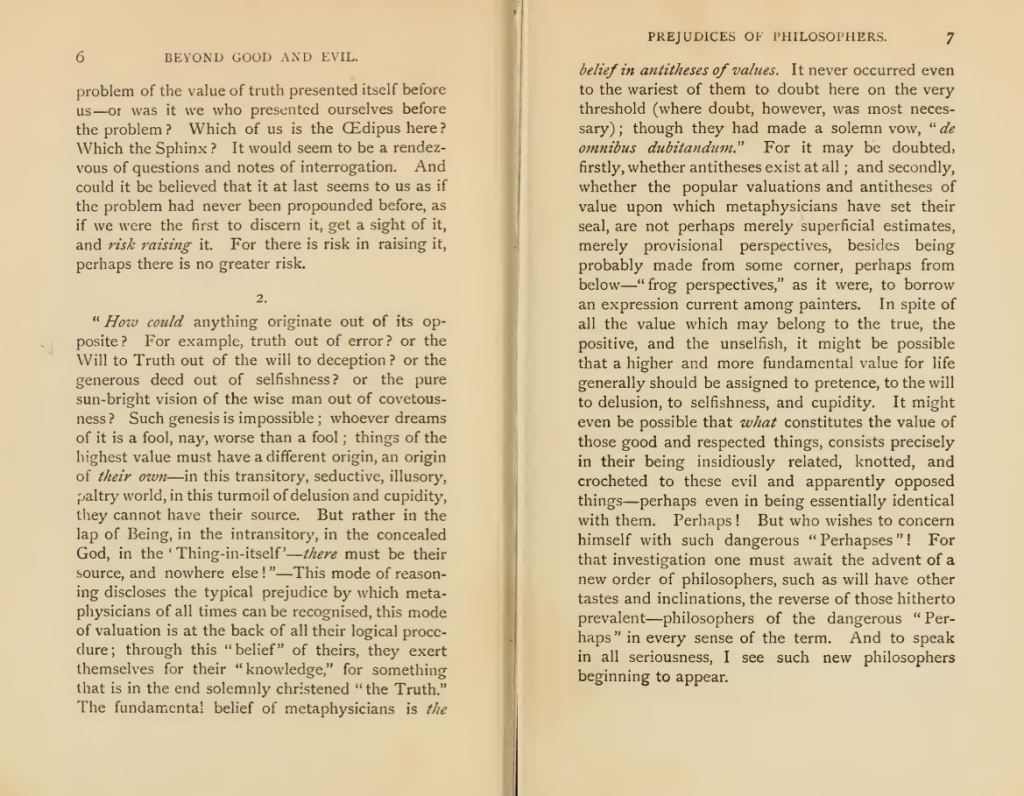
” How could anything originate out of its opposite? For example, truth out of error? or the Will to Truth out of the will to deception? or the generous deed out of selfishness? Or the pure sun-bright vision of the wise man out of covetousness ? Such genesis is impossible; whoever dreams of it is a fool, nay, worse than a fool; things of the highest value must have a different origin, an origin of their own—in this transitory, seductive, illusory, paltry world, in this turmoil of delusion and cupidity, they cannot have their source. But rather in the lap of Being, in the intransitory, in the concealed God, in the “Thing-in-itself“—there must be their source, and nowhere else!”—This mode of reasoning discloses the typical prejudice by which metaphysicians of all times can be recognised, this mode of valuation is at the back of all their logical procedure; through this “belief” of theirs, they exert themselves for their “knowledge,” for something that is in the end solemnly christened ” the Truth.” The fundamental belief of metaphysicians is the belief in antitheses of values. It never occurred even to the wariest of them to doubt here on the very threshold (where doubt, however, was most necessary); though they had made a solemn vow, ” de omnibus dubitandum” For it may be doubted, firstly, whether antitheses exist at all ; and secondly, whether the popular valuations and antitheses of value upon which metaphysicians have set their seal, are not perhaps merely superficial estimates, merely provisional perspectives, besides being probably made from some corner, perhaps from below—” frog perspectives,” as it were, to borrow an expression current among painters. In spite of all the value which may belong to the true, the positive, and the unselfish, it might be possible that a higher and more fundamental value for life generally should be assigned to pretense, to the will to delusion, to selfishness, and cupidity. It might even be possible that what constitutes the value of those good and respected things, consists precisely in their being insidiously related, knotted, and crocheted to these evil and apparently opposed things—perhaps even in being essentially identical with them. Perhaps ! But who wishes to concern himself with such dangerous ” Perhapses ” ! For that investigation one must await the advent of a new order of philosophers, such as will have other tastes and inclinations, the reverse of those hitherto prevalent—philosophers of the dangerous ” Perhaps ” in every sense of the term. And to speak in all seriousness, I see such new philosophers beginning to appear.

Translated by Helen Zimmerm

1909

Day 1752, tired.

Day's pictures, Philosophy

I live in Trondheim, a normal city in the middle of Norway. If you look at the map you will see that it is only 600km from the polar circle, around the same height as Fairbanks in the middle of Alaska. We have more of a sea climate here so it is not as cold as in Fairbanks, today it was -13. The thing that is strange here, something I am used to, but also not. It is the lack of sunlight. The first ten years in Norway I lived above the polar circle , and there you have some light between 10:00 and 13:00, but we didn’t see the sun for almost two moths. Here in Trondheim we have more daylight, but because I am at work during the day I can only see the sun in the weekends. I think there is a reason why people that live in the North are more mellow, specially compared with the more vibrant people that live closer to the equator. This is just a long way of telling you that today, at the end of the week, I am pretty tired and monotone.

Today I am not gonna write about one of my old poems. When I have little inspiration I will pick one of the books from Friedrich Nietzsche and pick a random aphorism and let my brain chew on that for a while. You can see that I have a separate tab on my blog about Nietzsche. He is not the only philosopher I like to read, but he is the one that spoke to me the most. People sometimes ask me what I like about him, and I have to admit that I have a hard time explaining it, specially when the person that ask me knows only little about philosophy. The problem is that there are no philosophers that stand alone and isolated in history. Every thinker, scientist or inventor stands on the shoulders of his or her predecessors. Nietzsche is one of the first philosophers who also was a psychologist, he is really good in dissecting the mind and pointing at the reasons why we do the things we do. But giving this as a reason is only half the story because attached to Nietzsche are all these predecessors and the people that came after him. Nietzsche is the spill in my world of philosophy, and the spill is important but so is the rest around it.


There are a lot of things we know better now, then before. I rather go to the doctor now then 2000 years ago, the same goes for traveling or just living in a house. All these things have improved over the years. What Nietzsche, off course, talks about, are the so called thinkers and moralizers. If you just pickup a book about the history of philosophy, you will soon realize that the Greek, 2500 years ago, already where walking in the direction we are still going. Around that time there where also other places around the world where people started to think about, and explain the world. Because I am born in the so called west, I recognize more in what the ancient Greek where writing back then then I do with what the thinkers from India or China wrote for instance. You can read text from Greek philosophers that are so modern, that a lot of people today would have problems agreeing with it, because it is to progressive.

We live in modern times but the barbarians are still among us, some are even rulers.