Caged animals Caged animals From cage to cage From institution to institution
From one cage to another I move, the setting changes, but I do not, not yet outside where I want to be, outside that cage.
But that world outside might exist only here inside my head, as hope without bars.
All those people out there, outside my cage, I do not despise for their freedom, but for their carelessness, their lack.
A lack of appreciation for their cage without bars, their naivety, their not knowing their own reality.
As a caged being I can say nothing, I can pace back and forth like an animal, but I am not able to speak.
As an animal I think in images, feelings and reactions without words that teach me, teach me nothing.
People talk and talk and convince each other, confuse each other that this is so and that is so, but only with words.
Only with words, hearsay, from once, from the past, from him or her, but without feeling.
Feeling that originates from the deepest of what we all are, caged animals.
Sunday 25 march 2007
In October 2006, I moved to Norway. It’s been 20 years, so I can be forgiven for not remembering everything so clearly, but aside from that excuse, I had a clear story in my mind about those first few years. This weekend, I read my blog from the first three years in Norway. Well, I didn’t actually read it all; I skimmed over it while I copied the text into a document (103 pages, 80.000 words) and fed it to a chatbot. I asked it all kinds of questions and requested it to show me all the quotes, and I was quite surprised. For the last 10 years, I’ve been writing a lot, and I feel like I know myself pretty well now. Because I think I know myself now, the time before the ten-year mark seems like the dark ages to me. It’s a period where I obviously thought about things. I left many relics behind in the form of books I’ve bought in those dark ages, but in my mind, it all felt pretty trivial.
The blog post was meant for family to read, and for the most part, it’s lighthearted. I talk about the weather, my work, and what I do in my free time. But I was also not afraid to share my feelings about life, myself, and the people around me.
One of my go-to stories when people ask why I moved to Norway is about the book “Nooit Meer Slapen” (Never Sleep Again) by the famous Dutch novelist W.F. Hermans. I read that book around age 16, and I can’t quite explain why it resonated with me, but what it represented stayed with me. I realize more and more how it reflects a part of me, the 16-year-old me, wearing a “Great Pretender” T-shirt, was already more aware than his intellect could put into words. The novel shows that human attempts to find certainty, meaning, and success often fail in an indifferent world where knowledge is unreliable and people are fundamentally alone.
When butterflies don’t fly.
Fading away, overwhelmed in lies.
Wings eager, restricted by weeds.
Cracked mud of the soil grades the time.
When butterflies couldn’t fly.
Day 864
Individuals, according to my past individuals
Definition by Chatbot: The concept of the individual is not as simple as it appears. It is often presented as a single, distinct human being, defined by unique biological, psychological, and social traits. But this definition is superficial. The idea of the individual as an autonomous, self-determining agent is largely an illusion. The mind does not generate ideas in isolation; it is shaped by language, culture, and education. Thoughts are constructed from what we absorb from others, from the environment, from history. The individual is not a self-contained entity but a reflection of inherited ideas and external forces.
Reinterpretations of older work, see the quotes underneath.
Summary of 10 years of writing by Chat.Mistral and curated by me.
As I reflect on my writings and the recurring ideas that have shaped my philosophical exploration, I see a tapestry of interconnected themes. These themes are not just abstract concepts but deeply personal reflections on what it means to be human, to search for meaning, and to navigate the complexities of existence. Here are the ten most common themes that have emerged in my work, expressed in my own voice and with the depth they deserve:
The Nature of Reality
One of the central themes in my philosophy is the exploration of the nature of reality. I often find myself questioning how we perceive and understand the world around us. This theme involves delving into the complexities of human existence and the influence of our environment on our personal identity. As I’ve written, “The world is complex, much of our thinking is inherited, and certainty is rare.” This idea captures the essence of my inquiry into reality—acknowledging that our understanding is often shaped by factors beyond our immediate perception.
The Human Condition
My writings frequently reflect on the essence of being human—the struggles, emotions, and experiences that define our existence. I delve into topics such as the role of visionaries, the impact of environment on mood, and the struggle with depression. These reflections are deeply personal, drawing on my own experiences and observations. In one of my entries, I wrote:
“Humanity learns to walk like a baby does, and what can you teach a baby? You can only encourage it with gestures and sounds because the rest has no meaning to them.”
This passage highlights my belief that our understanding of the human condition is a gradual process, shaped by our experiences and interactions with the world.
The Search for Meaning
The search for meaning is a recurring theme in my work. I investigate the purpose and meaning of life, and how individuals can find meaning in their existence. This theme is central to my philosophical musings and reflections. As I’ve expressed:
“Philosophy gave me a manual for life, and maybe I’m still figuring it out, but one thing it has taught me so far is how to stand without ground beneath my feet, which is very useful if you’ve ever been depressed.”
This idea underscores the importance of finding meaning even in the face of uncertainty and instability. It’s about embracing the journey of self-discovery and understanding that meaning is not always readily apparent but must be sought through introspection and reflection.
Our narrow minds make us believe that we live in strange days. And we are, but not particularly stranger than ever before. With every step we take, we forget the third or praise the ground it had just stepped on. Our world might be destroyed by climate change or nuclear war, but people have lived for thousands of years in worlds no larger than the six houses around them or the small city they inhabited in fear of instant destruction. The theatre we live in now might be as large as the whole world and the angst real, but don’t pretend it’s new.
I don’t have many good reasons for my aversion to this kind of doom-and-gloom. We will always live among nay-sayers and deniers, and the idea of progress is a challenge for many, but don’t forget that these people are also happy to have clean water to drink and to visit a dentist when they have a toothache. Progress does not care what we think; it will move forward, and no one is innocent in this game of who is to blame.
Don’t forget that behind all the nonsense we believe in and are willing to die for are people who bleed when they get cut, mourn their loved ones, and even fall in love for the first time, just like we do, even when these feelings are hidden behind shame and fear. You know for yourself what is hidden inside, we are all afraid to look in the mirror, to look deep in the reflections of our own eyes.
I think, therefore I am is what Descartes famously said. He seems to clarify later that the thinking is undeniable, but that little can yet be concluded about the nature of the thinker. A critique that you can make, and is made, is the “I” in this phrase. How could Descartes concluded thet the “I” he identifies with is the thing that does the thinking?
It is hard to ignore the feeling that there is something in us that does the thinking and that we call I. The reason is that I feel like I think about it. But the I that thinks is also the I that makes bodily sounds, and how much do you control those?
In light of this, “I” seems more like a linguistic tool we use to communicate with others and with ourselves. Our bodies breathe and digest without our intervention, yet we still say that we breathe and digest, just as we say “I think this or that,” even though our control over thinking may not be very different.
But man’s craving for grandiosity is now suffering the third and most bitter blow from present-day psychological research which is endeavouring to prove to the “ ego ” of each one of us that he is not even master in his own house, but that he must remain content with the veriest scraps of information about what is going on unconsciously in his own mind.
Even as a wooden boat builder, I need to stay updated with the times. Today, I took a course on how we can use AI. While I’ve used ChatGPT to translate some of my work writings, I also feel some resistance—not because of the technology itself but because of the hype surrounding it and since it’s owned by billionaires. Still, I have to admit that the possibilities are impressive. It still makes many mistakes, but that’s something you can notice and work around. I also now understand that what we upload is supposed to stay private and won’t be used to train the algorithm, which makes it easier to let the AI “learn” my own work.
I’ve been writing for over ten years, periodically reviewing my old work, organizing it by themes, and considering whether to use it as material for a book. I uploaded everything into ChatGPT’s database and started asking questions. I quickly realized it’s a valuable tool, provided I learn how to ask the right questions. For now, I just had some fun asking if it could summarize my work and imagine an external person describing the book I might have written. It’s quite flattering to read, and I probably wouldn’t have phrased it that way myself. But honestly, I don’t have a clear overview of the roughly 100,000 words I’ve written over the last years. I can only share how I feel right now. It’s a fun experiment, and I can also ask AI to suggest chapters and write summaries. Still, I already know that I need to review each sentence to ensure accurate interpretation; luckily, the AI can show where it pulls its information from. Overall, it’s a fantastic tool.
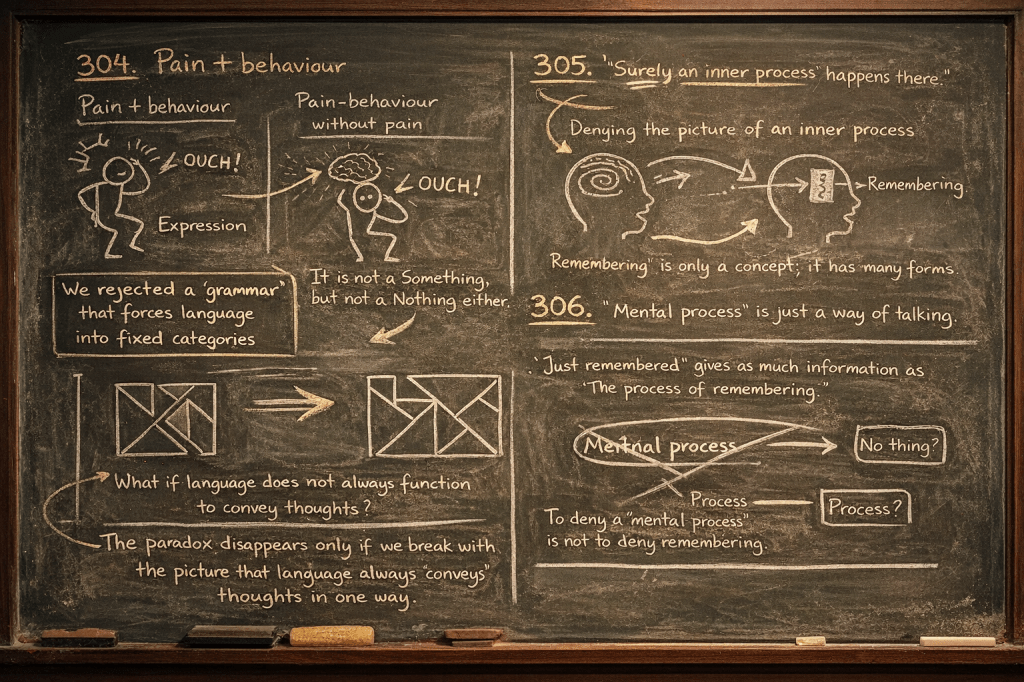
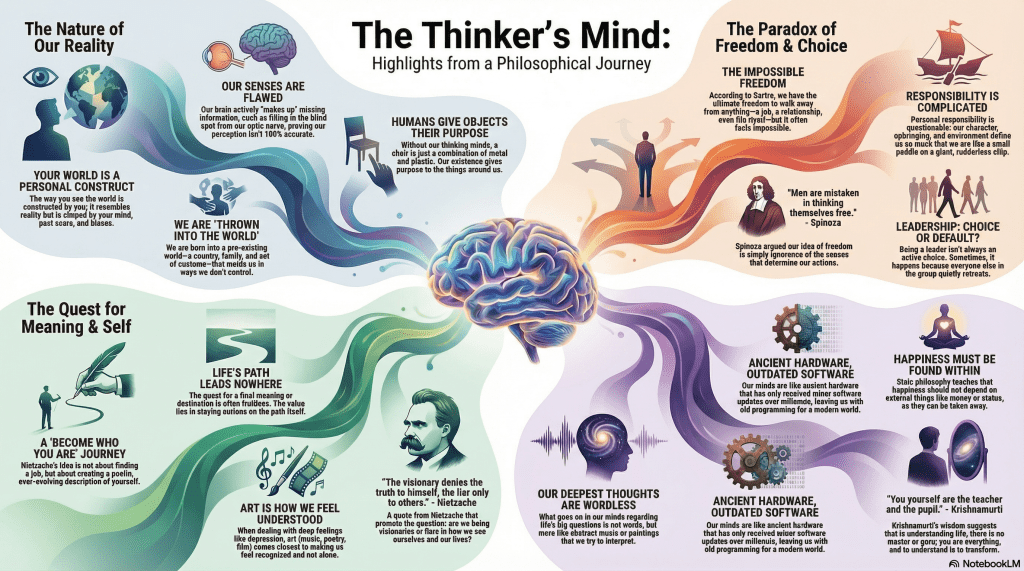
And at the end of the course, we also learned what you can do with Google NotebookLM, and it is even a greater tool—or toy. I put 20 pages of my writing into it, and it created the picture you see above and a podcast. The podcast sounds like a gymmic, but it brings me back to the old thoughts I wrote down years ago.
AI’s interpretation of my work brought as a presentation of my not-yet-written book.
Ladies and gentlemen,
After reading this remarkable body of writing—years of notes, poems, reflections, doubts, and small revelations—I can tell you that the author’s philosophy is not a system. It is a movement. A long, slow arc from certainty toward skepticism, from inherited assumptions toward self-made clarity, from the search for meaning toward the acceptance that meaning is something we make, not something we find.
Across these years the same themes return, grow, and collide. One of the earliest is the idea that life is not about us. The author writes that DNA “only needs a host,” and that humans are simply the best vehicle it has yet found. That shift—from human-centered thinking to a cosmic, indifferent perspective—runs through everything. It’s why religion appears in these pages less as a metaphysical claim and more as a very human attempt to silence the void. “We are all just standing in a big room,” he writes, “proclaiming truths we perceive from the echoes on the walls.”
Another central thread is the fragility of the self. Memory, he reminds us, is a storyteller that constantly rewrites the past to protect the present. The self is a creature of filters: “My two-way filter is partially broken,” he admits, “and I can only fix one side.” Here his philosophy leans toward a kind of grounded humility—an acceptance that what we call “I” is stitched together from sensation, error, upbringing, chemicals, and luck.
And yet, in this humility there is a defiant skepticism. He distrusts authorities, leaders, and movements not because he rejects structure but because he knows how easily people surrender their judgment. He once expected adulthood to be ruled by reason; decades later he observes, wryly, that “the world is a summer camp without supervision.” This is anarchism not as politics but as perception: a refusal to hand the steering wheel of the mind to anyone who claims to know better.
One of the most striking aspects of his philosophy is how deeply it is rooted in the physical world—wood grain, old barns, the curve of a boat plank, mist on a Norwegian morning. The cosmic and the ordinary sit side by side. He can explain stellar expansion in one paragraph and, in the next, describe a forgotten lock rusting into history. This is not contradiction; it is the worldview: life is meaningless on the cosmic scale, and meaningful in every concrete moment we actually live.
Many poems could serve as a doorway into his thinking, but one stands out:
“Reality fades caught by ego’s gravity a depressed black hole.”
This captures the emotional honesty of his philosophy: the willingness to look at the darkness without romanticizing it, to name despair without surrendering to it.
If his work offers any guidance, it is this: We may not control the world, we may not understand ourselves, but we can keep walking through the mist with open eyes—skeptical, curious, and unafraid to admit that we know far less than we pretend.
Does all this strife and talk, all these opinions and countless books, lead to anything? Is there progress? Let’s take our healthcare as an example, something so much more advanced than even 60 years ago, let alone 50000 years ago.
It’s safe to assume that we are kept alive longer because of modern medical advances, but it’s harder to say that we live healthier or significantly longer because of it. People also lived to eighty or older in the Middle Ages, just not as many; the average lifespan was much lower because a large percentage of children never reached adulthood.
Some say that hunter-gatherers were healthier because they had a more varied diet; they probably ate more nutritionally than most of us do now, but they also died earlier from diseases we can now easily treat. It seems that the constant search for answers has benefited our health; we eat less varied, but live longer because of our knowledge.
But living healthily is one thing; for most, it’s important, but many accept life as it is and are blessed with a positive attitude. Ignorance can also be a blessing. The loss of your health, a newborn, or a brother was also felt 50000 years ago, and the feeling of grief probably wasn’t much different from what we would feel today. However, for them, it was primarily unexplained, and the idea of living healthier and eating less red meat would never have come up. They probably worried about why they died, but not in a way that we can imagine, though they imagine in the same way.
I believe it’s essential for a percentage of the smartest people to research how diseases work and how we can prevent and cure them, not because it will make us happier, but because we are capable of doing so. This “because we can do it” research is important in many fields, but you can probably think of some areas where it is not.
So, strife and talk are important, but only in themselves, not because there’s a specific goal we can reach. In other words, progress can occur on the edges of our existence, but our fundamental experience will stay the same.
For many years, I’ve wanted to write a book. I started, had many ideas, but soon my motivation moved on. The motivation I need is the belief that what I write makes a difference, either for the people who read it or in society. These goals seem too lofty because even highly skilled, well-known writers accomplish little; there has never been a book with ‘The answers,’ otherwise we would all know about it. I write daily on my blog, but I only reach a handful of people. This writing is more of a personal exercise and challenge rather than a serious effort to reach anyone, let alone change the world.
One reason my writing needs to be meaningful is because there are already too many opinions about life, how it works, and why it exists. The problem is that too many people are overly confident in the truth of their own views. I don’t even trust most of my own opinions, and I try to live my life so that each step I take is one into the unknown. And my character makes this harder; I like to cling to my current views and even know how to sell, even to myself, all the while knowing that it all means very little.
In that sense, I am like a scientist, defending my theories while knowing that only the knowledge I have just gathered keeps this entire structure afloat. One new finding or contradiction, and it might collapse.
I live this life in my job as a manager. Answering questions with responses that I deliver like a mediocre stage performer, convincing enough when seen from the balcony, and with a bit of luck, it persuades the people in the front row, but my fellow performers see right through me. It is not all a lie, of course, some buttons have to be pressed at the right time, or rules that we agreed on have to be followed without debate, but an overconfident manager is never a good manager in my book.
Imagine a world where all managers, politicians, and religious leaders would say, ‘I don’t know,’ more than convey their convictions. Maybe we should rule more by committee; it might take longer, but what is the rush? Who has ever decided that we should get there sooner rather than later?
David Hume wrote in his famous book, “An Enquiry Concerning Human Understanding,” that our thoughts are based on what we have seen before. Like imagining the golden mountain, it’s made of gold and the mountain we’ve seen before. The book goes much deeper and is considered a key work in philosophy. I don’t do it justice by highlighting this idea out of context, but still, I do.
Have you ever wondered where your thoughts come from? Do they just pop up out of nowhere? Is there something inside you that creates these thoughts from nothing? Where were your current thoughts when you were 5 years old? Do we piece our thoughts together over time? Are we just combining bits of what we’ve collected into our thoughts? Are we like the modern AI, stringing words together because they have fitted together before in our memories?
I think it’s not easy to be an original thinker. No matter what we do, we must use what we’ve learned to develop our own ideas, and only exceptional people can combine their knowledge into something truly original. It’s no coincidence that thinkers like Plato or Aristotle are still studied. They drew such deep conclusions from their experiences that hardly anyone since has matched them; we can at best follow their path and see if we can reach similar conclusions.
Imagine browsing a bookstore or social media. It seems everyone has an opinion, often equating it with that of someone who has dedicated their life to developing their views—someone who has faced all the dead ends and moved on. Climate change is a good example of an issue where many seem to have a clear understanding, even though experts struggle to fully grasp it and find solutions. As if they, the modern opinionated citizen, know the answer without the necessary experience.
We can’t imagine a golden mountain without first having seen a mountain and gold. The opinionated person can dismiss climate change without studying biogeochemical cycles, ecological and agricultural systems, or human-environment interactions. Do they question their dentist or mechanic with the same confidence?
It’s humility we need. I don’t know much about climate change, so I trust the experts—just like I listen to my doctor or trust Hume more than myself when he talks about our mind.
What a peculiar privilege has this little agitation of the brain which we call ‘thought’. David Hume
It is both easy and difficult for us humans to admit when we are wrong. We often recognize that we are wrong, if we do not already know that, when confronted with opposing truths, but you keep on focusing on every piece of the story supporting your side, even though you know deep down you are mistaken. When you hold on to your story for too long, you will likely lose sight of where your story started and where reality was left behind; you are now lost in your own lie.
Why do we do this? It’s hard to say, but here is a thought. We don’t like to “lose face” when confronted by someone else’s more convincing reasoning. We don’t want to be seen as incompetent after we’ve defended our truth for too long, only to be confronted by damning facts.
Even the wisest people in the world acknowledge that their understanding represents only a small fraction of the vast pool of knowledge available. This echoes the wisdom of Socrates, who famously stated, “The only true wisdom is in knowing you know nothing.” In recognizing that knowing more often reveals how little we actually understand. Not knowing is humanity’s default state, yet we often feel shame at admitting our ignorance. Embracing this uncertainty can open doors to greater wisdom and understanding.
People identify as scientists, Buddhists, religious, capitalists, and cling to many other kinds of truths because our inner truth is weak. Most often, we inherit these truths from our family, immediate surroundings, and the larger culture we live in. Sometimes we feel we make a choice, but one way or another, all these structures and systems are there for us to cling to and use as shields to hide our insecurities.
As human beings, we can easily feel overwhelmed. For example, you might go on a date with someone, and everything seems to click, making it feel as though you’ve known each other for a long time. Then, suddenly, they snap at the waiter. Or consider that new phone you’ve wanted for ages; after setting it up and trying it out, the excitement fades away in just three days, leaving you with just another phone.
Our expectations act like the bright sun, illuminating certain things while casting everything else into shadow, making the good seem overwhelming. That person or item feels so alluring that we desire them so badly, which can cloud our judgment and make it hard to think clearly. This realization can hit us quickly, as it does with the rude date, or it may take a few days, like with the phone.
We all understand this phenomenon; there are plenty of sayings that illustrate it, such as “blinded by love.” This isn’t necessarily a bad thing. Approaching any date with the mindset that they are likely flawed, which is often true, isn’t conducive to a pleasant date, a fulfilling love life, or even the potential for building a family—the cornerstone of our existence. In a way, evolution has wired us to be less skeptical when choosing a mate. This skepticism often arises only after time has passed, when good memories are replaced by reality.
While a bit of drama can make life more interesting, the downside of our impulsive behaviors is evident in the unnecessary purchases we make—like the telephone I just bought, which I didn’t even need. This irrational tendency within us fuels our lifestyle and the capitalist system we live in. If we all acted as responsible consumers, our economic system would come to a halt, which poses a problem for those who appreciate it. Personally, I wouldn’t mind finding a more responsible alternative.
The primary concern is the potential destruction of our environment. The excessive production of goods, the energy consumed in that process, and the waste generated. However, for now, we seem blinded by our desires and are unable to see the consequences lurking beneath the surface.
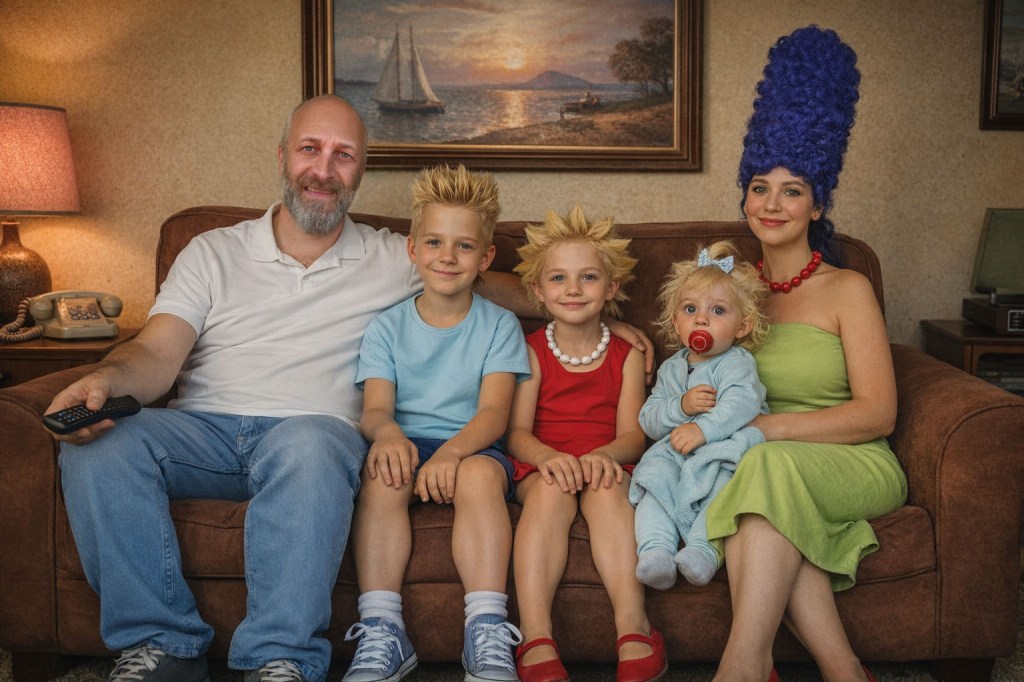
We don’t know much about ourselves, besides the story we have to tell. One thing in my life that stuck, and is not only remembered by me, is the idea that I thought, when I turned eighteen, that I would arrive in a world where finally rationality would rule. 35 years later, and I know by now that that was an illusion. I probably knew that already when I picked the candles of the cake, but now I am at a stage where I see rationality as a trade. It’s almost like something we do when it suits us. We can be rational, but we are not rational. The table underneath is a nice illustration of how we often feel as adults, but also how we often really are as adults. Look at the “leaders” who are in the news most often right now. They are not the strong figures we imagine they should be; they are little children who want what they cannot get, don’t care about the others, and feel themselves to be the centre of the world. I always had some sort of respect for people who enter the last quarter of their lives, but from what I see now, and maybe I will learn something new before I join that club that changes my mind, but till that happens, I will have no respect for age and so-called wisdom.
I predict that in 100,000 years, the historians will write about the period of the Sumerians til now only in a small note for the chapter about homo stupitites. I have to say that that idea gives me hope, that we all one day will be forgotten. I also wish I could have a sneak peek into that future society. I hope they’ve addressed the issue of the pressure we all feel to conform to “invisible” social norms, as most people are friendly and helpful when they’re not part of a group. Imagine if we ignored the world leaders we have today; they’d likely end up walking alone in a forest, shouting at squirrels.
































































 Nochrisis