Education and Communication. So obvious, indeed, is the necessity of teaching and learning for the continued existence of a society that we may seem to be dwelling unduly on a truism. But justification is found in the fact that such emphasis is a means of getting us away from an unduly scholastic and formal notion of education. Schools are, indeed, one important method of the transmission which forms the dispositions of the immature; but it is only one means, and, compared with other agencies, a relatively superficial means. Only as we have grasped the necessity of more fundamental and persistent modes of tuition can we make sure of placing the scholastic methods in their true context. Society not only continues to exist by transmission, by communication, but it may fairly be said to exist in transmission, in communication. There is more than a verbal tie between the words common, community, and communication. Men live in a community in virtue of the things which they have in common; and
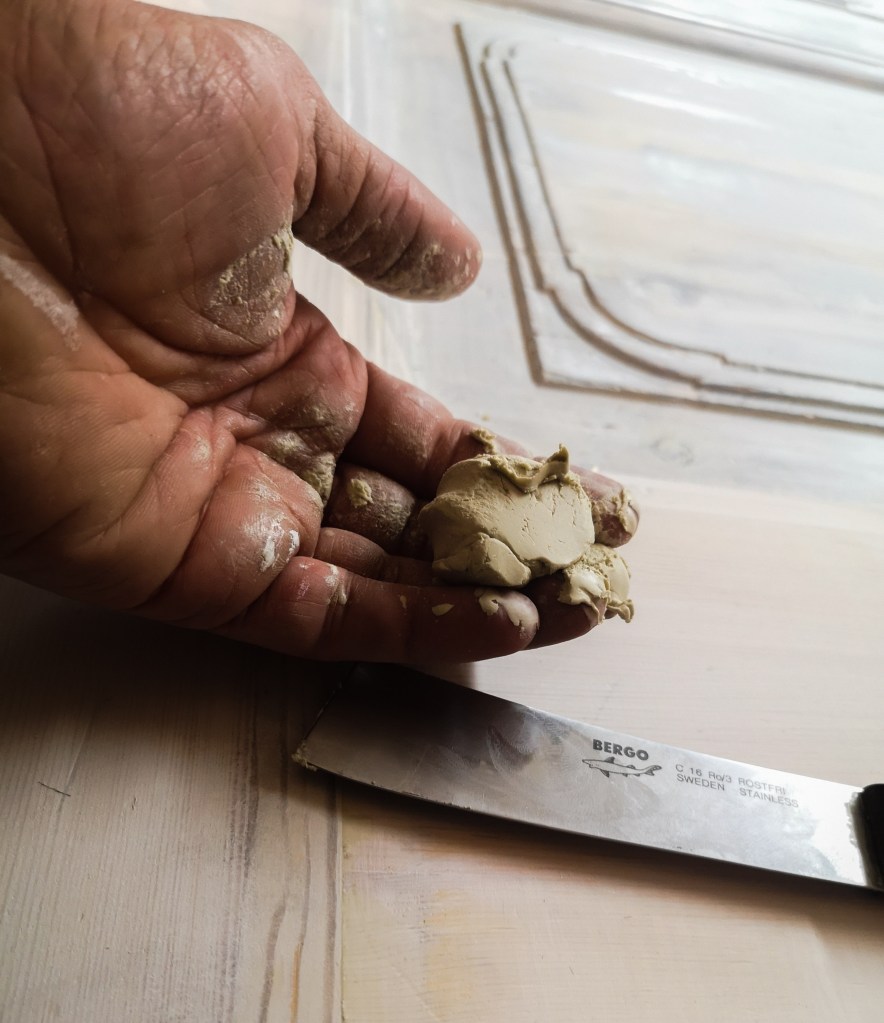
Yesterday I wrote about philosophers and how seriously they can take their task. You can widen this, of course, to all kinds of professions. Today I listened to a podcast where some biologists talked about the history of the crocodile. One thing they have done the last ten years is scanning fossils with all sorts of equipment to see how many different kinds of crocodiles there were 200 million years ago. It’s fascinating and cool to spend your day doing that, and it probably has some purpose down the line. I myself restore old wooden buildings and boats, and I can tell you precisely why it is important but, as I do now, I can tell you also why it is not that important. This finding meaning in what we do is something we all do. That’s why I called it “playtime” for grownups yesterday, and that sounds all jolly, but there is also a downside. We are so rich that we can do all of these fun but unnecessary jobs and produce so much stuff that we don’t need, and this pollutes the world and maybe even cynical.
This week I watched a documentary called “5 broken cameras” from 2012 in a local theater. Before I talk about this, I have to say that now the Corona restrictions are loosened it is nice to meet people again. I know that a lot of people have problems with these restrictions or don’t even believe that Corona is real but please respect the people that take it seriously. I am happy to live in a country where mask mandates are lifted but people still wear them because it is recommended. Another reason I mention this is because of the subject matter of the documentary I want to talk about, it goes about the conflict between the Israeli state and the Palestinians. People that have a problem with Corona restrictions should realize that living in fear in Gaza is a problem, not doing what you want to do to protect vulnerable fellow citizens is NOT a real problem.
The documentary 5 broken cameras is a film about a small town, where people live their lives as good as possible and then they get confronted with Israeli settlers that slowly eat away the farm land they have used for generations. Emad Burnat was one of these farmers that had a chance to film the birth of his latest son and he discovered that he couldn’t let go of the camera. He took it with him wherever he went, also when the villagers started demonstrating against the barriers that were put In front of them. The protest looked no different then any protest you might see in your own country, and were more or less tolerated in the beginning by the occupying forces (I use occupation as a statement, it is heavily debated and in theory you can go both ways but in practice it is clear who is in charge). The reaction of the Israeli forces, they don’t look like police in riot gear, become more extreme the longer these protests go on. That it becomes more extreme you can tell by exceedingly violent methods his 5 consecutive cameras are being destroyed, at the end you see him filming a sniper in the distance aiming at his camera (or him?) before the camera goes black again.
I think it was somewhere in my early twenties that I for the first time red something of/about Jiddu Krishnamurti. I think I got to him through my interest, back then, in Annie Besant, she’s quite a character, though she has some strange religious ideas. Krishnamurti is for me someone that represents both an eastern and western approach to philosophy. I often recommend people that are interested in life’s question and/or struggling with these questions to read some Buddhist texts. When you read them superficially, they can often uplift you and help you to relativize your problems. If they like reading these Buddhist texts I will make sure that they hop over to Krishnamurti before they go to deep into Buddhism, because at the end Buddhism is not much more than a doctrinal religion like Christendom or Islam, a “do this, than that will happen” religion.
Krishnamurti is a critical thinker with a deep and personal history with eastern philosophy, religion and mysticism. I see him as a good bridge to western philosophy when your interest is mainly eastern philosophy. A lot of western, mainly young people, gravitate to eastern ideas because western ideas seem to them “dirty” and the cause of…I don’t really understand this, as if there are no “problems” in the east, but a bigger problem is that these people that are looking for a solution…are looking for a solution. They look for some kind of overarching system that would solve their problems, as if you are not responsible for that yourself. This is in short, the philosophy of Krishnamurti and a good gateway to western philosophy, a philosophy that is more rooted in critical thinking, questioning why and not telling how.
“You know, if we understand one question rightly, all questions are answered. But we don’t know how to ask the right question. To ask the right question demands a great deal of intelligence and sensitivity. Here is a question, a fundamental question: is life a torture? It is, as it is; and man has lived in this torture centuries upon centuries, from ancient history to the present day, in agony, in despair, in sorrow; and he doesn’t find a way out of it. Therefore he invents gods, churches, all the rituals, and all that nonsense, or he escapes in different ways. What we are trying to do, during all these discussions and talks here, is to see if we cannot radically bring about a transformation of the mind, not accept things as they are, nor revolt against them. Revolt doesn’t answer a thing. You must understand it, go into it, examine it, give your heart and your mind, with everything that you have, to find out a way of living differently. That depends on you, and not on someone else, because in this there is no teacher, no pupil; there is no leader; there is no guru; there is no Master, no savior. You yourself are the teacher and the pupil; you are the Master; you are the guru; you are the leader; you are everything. And to understand is to transform what is.
Beyond good and evil, prelude to a philosophy of the future
By Friedrich Nietzsche
First chapter.
PREJUDICES OF PHILOSOPHERS.
3.
Having kept a sharp eye on philosophers, and having read between their lines long enough, I now say to myself that the greater part of conscious thinking must be counted amongst the instinctive functions, and it is so even in the case of philosophical thinking; one has here to learn anew, as one learned anew about heredity and “innateness.” As little as the act of birth comes into consideration in the whole process and continuation of heredity, just as little is ” being-conscious ” opposed to the instinctive in any decisive sense; the greater part of the conscious thinking of a philosopher is secretly influenced by his instincts, and forced into definite channels. And behind all logic and its seeming sovereignty of movement, there are valuations, or to speak more plainly, physiological demands, for the maintenance of a definite mode of life. For example, that the certain is worth more than the uncertain, that illusion is less valuable than “truth”: such valuations, in spite of their regulative importance for us, might notwithstanding be only superficial valuations, special kinds of niaiserie*, such as may be necessary for the maintenance of beings such as ourselves. Supposing, in effect, that man is not just the “measure of things.” . . .
There were elections in Holland last week, and though I don’t live there anymore I still follow the news with interest. The parties on the right side of the right have won a few seats in the parliament, and that was disappointing. I did learned recently that in a country like Holland you always have around 20% of the people that vote way to the right or populist. This knowledge makes it a little bit easier to have peace with what’s happening, but it doesn’t make me want to move back. I left Holland for all kinds of reasons but one of them was the hardening of society. Here in Norway things are probably not all that rosy to, but even after 15 years, there is still a buffer between me and whats going on here. I make sure of this by not reading the Norwegian news and the character of the Norwegians helps to, they don’t talk about politics with you if you don’t ask them. In Holland it is all much clearer how someone looks at life, they tell you.
Democracy is important, it brought us all a lot of good. Democracy can also steer a country into ruins if a majority, and that is not always necessary, get a chance. Look at Nazi Germany, Trump’s America or Brazil. In Holland the mainstream parties ignore the brown-shirts but you never know what’s gonna happen in the future. I thought 15 years ago that it all would blow over but the parties of resentment only got stronger. It frustrates me, I just wish we had a democracy where we voted for people because we appreciate their competence as a human being and a leader. I have so much to say about this but don’t know how, for now I try it is some kind of short poem that highlights one aspect of the popular leader.
I moved to a new house, city, or country on average every two, to three years I think. I don’t know why, I can always point to a reason, but if you do it so regular, you might as well assume that it’s just in my character. I am easy satisfied, but after a while, I will still pretend to be satisfied, but jump at the first chance to close the door behind me.
Some people like to find out where their little quirks come from. Where the first seed is sown, a little bit to far from the center. There have been made some attempts, by professionals, as well as the not so, to find the origin and, if necessary, a cure. I later found out, or concluded for my self, that all that doctors can do is to postpone the inevitable, and if they are good they, will help you dealing with that fact.
It is really easy to start digging in your past for the root of it all. The problem is that if you find a root, you tend to see where that one is going, all the while forgetting that an average tree has more than one root. All the roots are important for a tree to stand tall, and some of them might be rotten, butt even the roots that are rotten might keep you upright, when the wind is coming from that specific direction.
The poem for today is from Day 1425
Don’t stare
to long
at the door
~
it might
slowly
disappear
in the wall
I don’t have this problem, some might say that that’s the problem with me. For me it’s the norm, and I always wonder how people can live in the same place, with the same job, for years and years. In my world, there is something “wrong” with them, maybe they just stare to long at opportunities, wondering if they want to, or dare.










 Nochrisis