
I like to see where I can't reach
it gives me something
that I don't want
I like to see where I can't reach
it gives me something
that I don't want

A bridge to some other side
those are the ones I like to take

at least halfway

I was standing here
where I actually wanted to sit

to watch the view

When something is complex
get closer from a different angle
to get more confused

you see it or you don't

If people set out towards their opinion, what they believe or think to know, do they know where to go? Or do you believe that your opinion comes from within you, arising from somewhere deep?
Some observations
Understanding where our knowledge comes from is important in our highly opinionated world. When and when not to trust our knowledge, opinions, and beliefs is important, in my opinion.
We all can live with our truths and go as far as to say that we all have “a right to our own truths.” If you say that the sky is blue, you will be right because most of us will agree, but if you say that that particular person is the best person for that job, you might find out that others disagree. You still have your truth, but it might be wise to find out what qualities you rank high and which ones the others do. If you like the character and attitude of the person you prefer, but the others point out the lack of qualification, you might have a starting point from where you can find out what is more important instead of just stating your opinion. It is often not enough to state your opinion, so finding out the reason why you have these opinions can also be important.
There is a possibility that you end up endlessly questioning your beliefs. If the question is, like in the example above, if personality or adjudication is more important, you might have anecdotal stories where an uneducated new employee lifted a company’s morals. Still, the other might use common sense that education is usually used to decide who to hire. Anecdotal evidence needs more scrutiny, but what is expected is not always the road to follow, especially when change is needed. In this example, the two sides might have discovered that one side thought that change was needed, and the other just wanted a new employee. Now you’re on the road to finding out what the reasons are that part of the company wants to change and the other part does not. From here, you can only go deeper, and maybe you will find out that you didn’t even know what you wanted or what the question was.
You say the sky is blue, but it is more correct to say that the sky looks blue. This is what my friendly AI minion says about it: The sky appears blue due to a phenomenon called Rayleigh scattering. When sunlight enters the Earth’s atmosphere, it collides with molecules and small particles, scattering the shorter blue wavelengths of light more than the longer red wavelengths. This scattering causes us to perceive the sky as blue during the day.
This is what NASA’s Space Place tells us: Sunlight reaches Earth’s atmosphere and is scattered in all directions by all the gases and particles in the air. Blue light is scattered more than the other colors because it travels as shorter, smaller waves. This is why we see a blue sky most of the time.
And here is a Quote from the scientist who wrote all of this down for the first time in 1871, John William strutt, 3rd Baron Rayleigh:
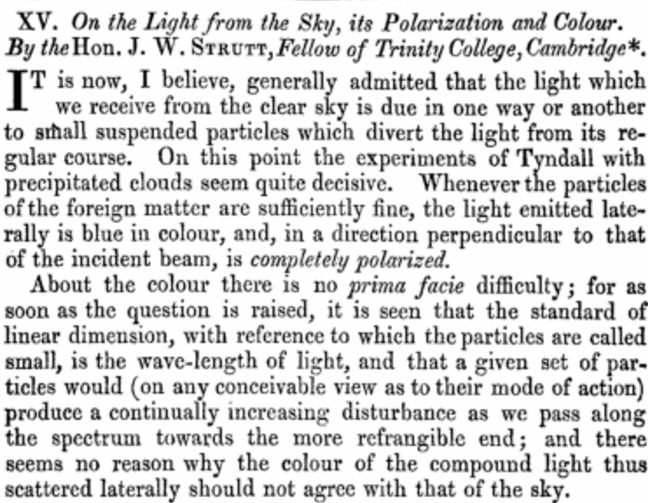
This was just a 10-minute search on the internet to “debunk” something that most of us take for granted. It is, of course, enough to say that the sky is blue, but say at least to the younger people that there is a but after you stated the obvious because for young people, there is still hope.
6 Against visionaries. -The visionary denies the truth to himself, the liar only to others.
261 One weapon twice as good as two. -It is an unequal battle when one person speaks for his position with head and heart, the other only with his head: the first has the sun and wind against him, as it were, and his two weapons interfere with each other: he loses the prize-in the eyes of truth. Admittedly, the victory of the second with his one weapon is seldom a victory according to the heart of all the other spectators and costs him his popularity among them.
270 The eternal child. -We believe that fairy tales and games belong to childhood: shortsighted as we are! As if we would like to live without fairy tales and games at any age! Admittedly, we call it something else and experience it differently, but this is precisely what speaks for it being exactly the same thing – for the child, too, feels that games are his work and fairy tales his truth. The brevity of life should preserve us from pedantically separating the ages oflife – as if each one brought something new – and a poet should sometime present to us a human being two hundred years old who really does live without fairy tales and games.

The lines don't come together
but close by
they mesmerize
the place between the world
and me

21 Observance of the law‘. – If obedience to a moral precept produces a result different from the one promised and expected, and instead of the promised good fortune the moral man unexpectedly encounters ill fortune and misery, the conscientious and fearful will always be able to recourse to saying: ‘ something was overlooked in the way it was performed’. In the worst event, a profoundly sorrowful and crushed mankind will even decree: ‘ it is impossible to perform the precept properly, we are weak and sinful through and through and in the depths of us incapable of morality, consequently we can lay no claim to success and good fonune. Moral precepts and promises are for better beings than we are.
35 Feelings and their origination in judgments. – ‘Trust your feelings!’ – But feelings are nothing final or original; behind feelings there stand judgments and evaluations which we inherit in the form of feelings ( inclinations, aversions). The inspiration born of a feeling is the grandchild of a judgment – and often of a false judgment! – and in any event not a child of your own! To trust one’s feelings – means to give more obedience to one’s grandfather and grandmother and their grandparents than to the gods which are in us: our reason and our experience.

Not every day is the same as the day before
well
none of them are the same in reality
but it feels like
they are

but I remember the ones that stood out
like fresh air that hits you

but I feel all those other days
more
heavier
It is what I am made off
day by day
cemented by forgotten time

I don't think they are colorless
It is definitely not the opposite
but something is missing
that is normal
though they do the same as us

When a straight line goes up
the world distorts

There have been times in my life when I hit rock bottom. After the first few times, I learned how to brace myself when I found myself on a familiar trajectory. Being curious by nature, I never really judged the place; I also observed the joyous times in my life from an appropriate distance. I don’t try to judge. In some sense, all strong emotions have something in common, and that is that they are strong.
But man has such a predilection for systems and abstract deductions that he is ready to distort the truth intentionally, he is ready to deny the evidence of his senses only to justify his logic. Fyodor Dostoyevsky, Notes from the Underground
But are strong emotions of love, wonder, or winning not better than feelings of loss and depression, you might ask? Yes, of course, at first glance. What do all these emotions have in common? They are all finite; they start at a certain point and end eventually. The more a certain feeling repeats itself in your life, the more you get used to it, and its impact will slowly diminish. The reason why you feel that first strong emotion of love or loss that strong, is because you don’t know what follows; it might never end, is what you want to believe. The reason you feel it is so strong is unfamiliarity.
Feeling love is, at first glance, a more positive feeling than loss, but as we all know, after love, the break up comes eventually, even if it takes many years when death finally demands its toll. Loss, on the other hand, starts on a down note, but how good is the feeling of finding what was lost back? My point is that feelings have a whole spectrum that, on average, evens out. Emotions are there; in some sense, you should feel the joy and negativity; just feel them without too much judgment.
I do and have done this kind of rationalization whenever I am down, but also when I am up, and I can tell you when you are up and think about this stuff…then it doesn’t always help. But jokes aside, rationalizing your feelings does help you stay somewhat calm during a surge of emotions, but you have to be lucky to have that ability. I don’t know if it can be taught.
One ought to hold on to one’s heart; for if one lets it go, one soon loses control of the head too. Friedrich Nietzsche

You see in me
nature reflecting

We have this story
not made by ourselves
but by the time we have been here
consciously

it is our story
of how we see this world
that might as well not exist

we are part of this real world
but live in our own
and when two worlds touch
one of them dilutes
31 Pride in the spirit. – The pride of mankind, which resists the theory of descent from the animals and establishes the great gulf between man and nature – this pride has its basis in a prejudice as to what spirit is: and this prejudice is relatively young. During the great prehistoric age of mankind, spirit was presumed to exist everywhere and was not held in honour as a privilege of man. Because, on the contrary, the spiritual (together with all drives, wickedness, inclinations) had been rendered common property, and thus common, one was not ashamed to have descended from animals or trees (the noble races thought themselves honoured by such fables), and saw in the spirit that which unites us with nature, not that which sunders us from it. Thus one schooled oneself in modesty – and likewise in consequence of a prejudice.

I stick my nose
into your business
I look around
I like it

the looking around

All these thoughts
this heavy weight
finally supports me
in lifting the bridge
to you
my past

Did you know that between 25 and 50 percent of the people of voting age living in the Netherlands and the USA think it is a good idea to deport people to wherever they can dump them? Two of the wealthiest countries in the world are too greedy to share some of their wealth: we want more, is what these people think, and I don’t care that you come from a war-torn country; we don’t want to give you a place where you can rest and start a new life. We want more stuff, and you mean nothing to me.
I guess education is not the solution to a better character. First, religion fails to make people care for each other, and now education. What now. Internet was supposed to share knowledge, you say. I guess that didn’t work either. Disappointing.
 Nochrisis