Day 3481, is it possible.

anarchism, Daily picture, My thoughts

Is it possible to organize a society on anarchist principles now? My short answer is no, and my long answer in short is maybe in a future far, far away. I enjoy reading about Anarchism and the ideas about it. So what is the problem? I believe that in an Anarchist society, it should be possible to have no locks, no money, and no police. Can you imagine that now? Many anarchists believe that the material possessions we have now have no real value, and that no one should want them from you because they have for themselves all they really need. An Anarchist knows that the value is made up and created over time; we made it all up. 

As an Anarchist, living in a society that follows Anarchistic ideas demands a lot of discipline and restraint. It has to be clear to such an individual that life is limited and without purpose besides the beauty we can clearly see and produce. This beauty is as limited as our own lives, but we can imagine that the reason we can think, see, listen, and create is simply to do these things. The stars can guide our path and tell us what to do, or we launch the Hubble telescope into an orbit around the Earth and enjoy the spectacle without looking for a meaning in it. No star is there for you.

If you cannot live solely on the beauty of your own art, your mind will seek other nourishment. In most societies around the world, the dishes that are served for the hungry are traditional, with recipes from the past or given by new masters. Is it the fault of the hungry that they cannot create? In our current society, that is most certainly not the case because even if you have hidden talents, very little that motivates us, motivates us to create. Most people have learned to consume not only what we can easily throw away, but also the thoughts we are supposed to think. Creation is dangerous, says the dictator, because it is incapable of doing so.

And who, besides some artists, writers, philosophers, and all those quiet people sitting in the corner, really believe that life is not much more than art and creating art? Art is saying what can’t be said and hoping it finds an ear. We can only hope when we meet, when looking into each other’s eyes, that we both know this…truth?

Day 3480, so little is sharp.

anarchism, Daily picture, Poetry

Yesterday, I posted the “Why I am an Anarchist” manifesto from Nikolai Pavlov, written in 1917. This was written during the Russian Revolution, and as an Anarchist, Pavlov still had a small hope that the revolution would succeed and not end in a dictatorship, as he probably suspected it would. I don’t know this, of course, I don’t know what went through his mind when the communists arrested him, and I have never been close to an ongoing revolution. We don’t share the same world; however, we do share the same power scale. 

It is hard to imagine what it is like to live in another time. I am old enough to have lived without the internet for my first 25 years, and the first 15 years that we had internet were relatively tame compared to the bombardment you have now if you let it in. In 1917, most people in Russia were aware of the events unfolding: a war with Germany and a revolution in the western part of the empire. However, most people who were not directly involved in the war, for instance, because they lived too far from the front, led their lives as they always did, with an occasional news bulletin or stories from travelers as the only source of news.

Day 3479, Why I am.

anarchism, Daily picture, Quotes

Why I am an Anarchist

Nikolai Pavlov

I am an anarchist because contemporary society is divided into two opposing classes: the impoverished and dispossessed workers and peasants who have created with their own hands and their own enormous toil all the riches of this earth; and the rich men, kings and presidents who have confiscated all these riches for themselves. Towards these parasitic capitalists and ruling kings and presidents there rose in me a feeling of outrage, indignation, and loathing, while at the same time I felt sorrow and compassion for the labouring proletariat who have been eternal slaves in the vice- like grip of the world wide bourgeoisie.

I am an anarchist because I scorn and detest all authority, since all authority is founded on injustice, exploitation and compulsion over the human personality. Authority dehumanises the individual and makes him a slave.

Day 3310, fundamentals of Anarchism.

anarchism, Daily picture

FUNDAMENTALS OF ANARCHISM Free Association & Freedom

You can find the text here: https://ia802307.us.archive.org/33/items/zinelibrary-torrent/associat.pdf, and also here and more: https://theanarchistlibrary.org/special/index 

Free Association is the idea that we cannot be free as individuals without having free relationships with others, that no one person can be free unless we are all free and that for each of us to be free we must work together to insure that everyone else is free. In an Anarchist society people would cooperate with each other to achieve the following:

Complete Social Freedom Including Sexual Freedom and Reproductive Freedom: People associate because all participants want to.

Freedom of Speech, Press and Information to include all forms of communication and education.

Complete Cultural Freedom including the freedom of individual tastes, lifestyle, entertainment and other preferences.

Freedom of Movement: All people must be allowed to live where they chose, travel where they chose, shop where they chose (e.g. do business where you chose), recreate where you chose, etc.. This includes the freedom to migrate and immigrate without being restricted or discriminated upon because of your place of birth or the place of birth of your ancestors.

Day 2228, liberty.

anarchism, Day's pictures

Mikhail Bakunin

Federalism, socialism, anti-theologism (speach 1867)

Federalism

We are happy to be able to report that the principle of federalism has been unanimously acclaimed by the Congress of Geneva…. Unfortunately, this principle has been poorly formulated in the resolutions of the congress. It has not even been mentioned except indirectly. . . while in our opinion, it should have taken first place in our declaration of principles.

This is a most regrettable gap which we should hasten to fill. In accordance with the unanimous sense of the Congress of Geneva, we should proclaim:

  1. That there is but one way to bring about the triumph of liberty, of justice, and of peace in Europe’s international relations, to make civil war impossible between the different peoples who make up the European family; and that is the formation of the United States of Europe.
  2. That the United States of Europe can never be formed from the states as they are now constituted, considering the monstrous inequality which exists between their respective forces.
  3. That the example of the now defunct Germanic Confederation has proved once and for all that a confederation of monarchies is a mockery, powerless to guarantee either the peace or the liberty of populations.
  4. That no centralized state, being of necessity bureaucratic and militarist, even if it were to call itself republican, will be able to enter an international confederation with a firm resolve and in good faith. Its very constitution, which must always be an overt or covert negation of enduring liberty, would necessarily remain a declaration of permanent warfare, a threat to the existence of its neighbors. Since the State is essentially founded upon an act of violence, of conquest, what in private life goes under the name of housebreaking—an act blessed by all institutionalized religions whatsoever, eventually consecrated by time until it is even regarded as an historic right—and supported by such divine consecration of triumphant violence as an exclusive and supreme right, every centralized State therefore stands as an absolute negation of the rights of all other States, though recognizing them in the treaties it may conclude with them for its own political interest….

That all members of the League should therefore bend all their efforts toward reconstituting their respective countries, in order to replace their old constitution—founded from top to bottom on violence and the principle of authority—with a new organization based solely upon the interests, the needs, and the natural preferences of their populations—having no other principle but the free federation of individuals into communes, of communes into provinces, of the provinces into nations, and, finally, of the nations into the United States of Europe first, and of the entire world eventually.

You can read the rest here: https://www.marxists.org/reference/archive/bakunin/works/various/reasons-of-state.htm

And about Michael Bakunin here: https://en.wikipedia.org/wiki/Mikhail_Bakunin


Day 2180, cultivation.

anarchism, Day's pictures

Josiah Warren

True Civilisation (1863), Chapter II, self-preservation

91. Before we begin to probe the festering mass now called “civilization,” let us prepare ourselves with all the spirit of forbearance which the case allows, that we need not add any unnecessary pangs to the already exhausted and dying patient.

92.” I know,” says B., ” that you do not admit analogies as proof, but is there not some indication of the Divine Law in the large fishes eating up the little ones, and in spiders spinning webs to entrap flies?

Day 2032, idea.

anarchism, Daily picture, Poetry

the lights were moving

with me

when I entered the tunnel

it was dark

I am still looking for a subject I can put my teeth in and write about. Today I had another idea; it cam while I was making a fancy molding. I do this on a milling machine, for these complicated moldings, you have to use several differently shaped cutters and figure out when and how to use them. It can be challenging which one to use first, and we have almost 100 different cutters, but it is not always clear if we have the one we need. Knowing this, you can do this job in different ways; you can try to figure out precisely which ones to use and in what order and make sure you have all the cutters. This takes a lot of preparation, and the end result is not guaranteed; there are almost always surprises down the road. I usually work by finding one cutter that cuts out one part of the shape I need and then look for the next cutter when I am done with the first. This is committing to a road without knowing where it leads.

Day 1934, diss order.

anarchism, Daily picture, Poetry

The barrier we lean against

comforts us


After almost 15 years of seclusion from much of society our move to the city was both a welcome surprise and change. Before I moved to North Norway I lived in Holland where you can meet all kinds of people if you want to, and I did. I have had a lot of good conversations, I was already interested in philosophy, psychology and more and I always tried to talk about these subjects but with little success overall. Most people have some interest in for example philosophy but up till a certain level. Its like talking about your train collection, at first people indulge your enthusiasm but if you still talk about the different train tracks you can buy after 20 minutes you start to see in their faces that you went to far. So, my move to Norway, and thus lack of social contact, was not a big problem because I could do without the disappointment of people losing their interest when I wanted to dive deeper.

Crass.

anarchism

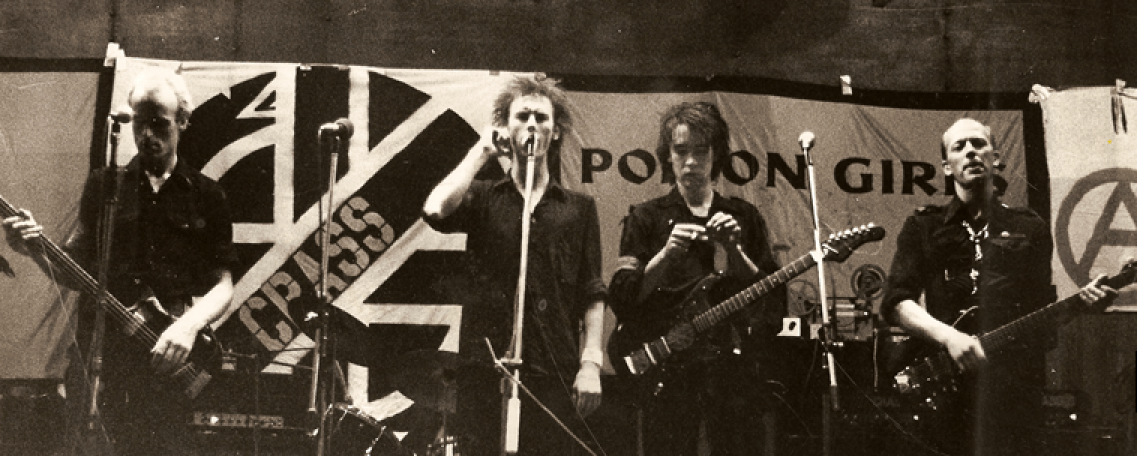
crass-picture-13-1200x480I you think about anarchism and music you think about punk, if I think about punk I think about Crass.

The lyrics might not always be refined  but they come straight from the heard and are in essence not different than a pamphlet from a revolutionary anarchist from the 19th century or more learned books from the twentieth century.

I will show here parts of some lyrics that speak to me with links to youtube if you like to listen to it.

James C. Scott – Two Cheers for Anarchism

anarchism, Books

James C. Scott.jpgTwo Cheers for Anarchism is a book written by James C Scott a political scientist and anthropologist.. It’s a collection of examples of “anarchistic” behavior in daily life and other stories related to the movement. While writing this I almost finished the book and so far I can recommend it but don’t take my word for it.

Excerpt:

Preface

The arguments found here have been gestating for a long time, as I wrote about peasants, class conflict, resistance, development projects, and marginal peoples in the hills of Southeast Asia. Again and again over three decades, I found myself having said something in a seminar discussion or having written

Max Sterner, the ego and its own.

anarchism, Society

Max Sterner, the ego and its own.

max-stirner.jpgI know about Max Sterner for many years now, mainly as a predecessor of Nietzsche philosophy but I never read anything from him, till yesterday when I started on his most famous book The ego and its own. There is lots of information to find on the internet but Wikipedia says the following about this book:
The Ego and Its Own (German: Der Einzige und sein Eigentum; meaningfully translated as The Individual and his Property, literally as The Unique and His Property) is an 1844 work by German philosopher Max Stirner. It presents a radically nominalist and individualist critique of Christianity, nationalism, and traditional morality on one hand; and on the other, humanism, utilitarianism, liberalism, and much of the then-burgeoning socialist movement, advocating instead an amoral (although importantly not inherently immoral or antisocial) egoism. It is considered a major influence on the development of anarchism, existentialism, nihilism, and postmodernism. Read the rest here.


Excerpt:

Translated from the German by Steven T. Byington. 1907

  1. A Human Life

From the moment when he catches sight of the light of the world a man seeks to find out himself and get hold of himself out of its confusion, in which he, with everything else, is tossed about in motley mixture.

Slavoj Žižek.

anarchism, Society

Slavoj Zizek.jpg

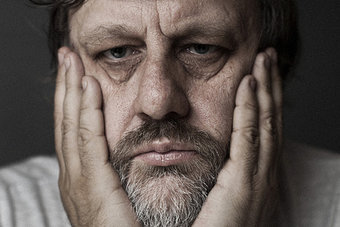
I like watching video’s with Slavoj Zizek in it and it fits well with my quest to understand more of the progressive political and philosophical world now and in the past. He is not an anarchist per se but he has little pretensions and is not afraid to be provocative. The truth is mush harsher then we are used to consume it in our world of “bread and circuses”.

Emma Goldman, Anarchism and Other Essays

anarchism, Society

Emma Goldman, Anarchism and Other Essays

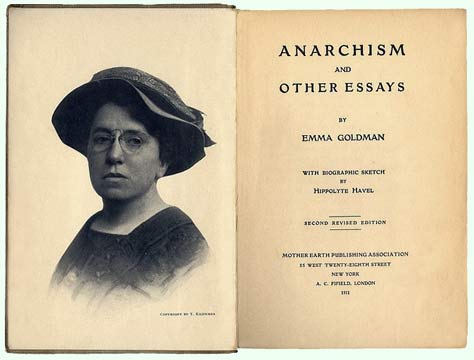
Anarchism and Other Essays is a 1910 essay collection by Emma Goldman, first published by Mother Earth Publishing. The essays outline Goldman’s anarchist views on a number of subjects, most notably the oppression of women and perceived shortcomings of first wave feminism, but also prisons, political violence, sexuality, religion, nationalism and art theory. More on Wikpedia here

goldman_anarchism.jpg

Excerpt:

PREFACE – Some twenty-one years ago I heard the first great Anarchist speaker—^the inimitable John Most. It seemed to me then^ and for many years after, that the spoken word hurled forth among the masses with such wonderful eloquence, such enthusiasm and fire, could

Peter Kropotkin, The Conquest of Bread.

., anarchism, Books, History

The Conquest of Bread

This is the first short introduction of famous anarchist and anarchism in general i post. It just happens that I started listening to this specific book today so that’s why it will be the first. My intentions are to write about anarchism regularly as a way for me to categorize it, something I would do any way, collecting links, names, books etc.

Peter_Kropotkin_circa_1900.jpg

It’s like a shared adventure into the world of anarchism, a world that is misunderstood by most but it might surprise you how mush we have to thank those pioneers for the things we take for granted now. My starting premise is that anarchistic ideas where often so explosive that it changed the trajectory of the society in witch it exploded, afterward the speed of change dropped fast and conservative forces took control but they where not able to turn back the clock on everything.