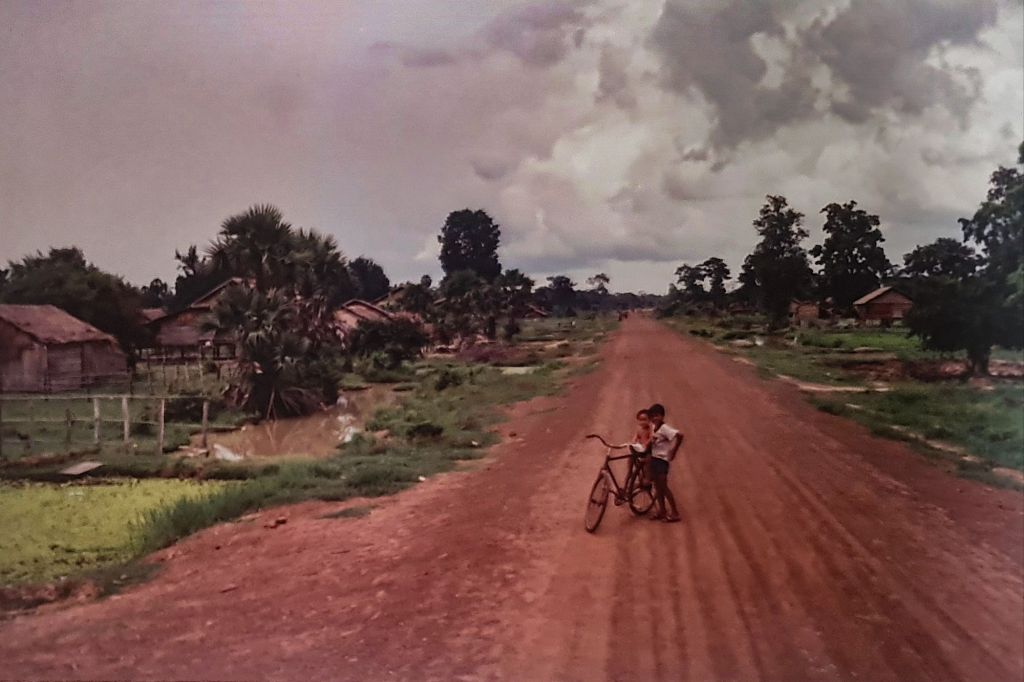
We were probably standing still here, not to give the kids a chance to pose for me, but still, they did. I was almost always in the last car, looking back at what came towards us and my camera was never far away. We were for those kids, probably what the police or firefighters were to us when we were that young. I was stationed in an area of Cambodia bordering Thailand. It was an erea that was abandoned for many years because the Kmehr Rouge was holding out there to the last moment. After the first UN soldiers arrived, the people living in the refugee camps in Thailand came slowly back. Most of them were born in refugee camps in Cambodia’s neighboring country and had no bond with the area aside from some sparse stories of the elders who survived the killings. These kids you see here are most likely not aware of what happened to the place they soon started calling home; by now, they probably know what they live there.
There are a few moments from my time in Cambodia that I still remember. One of them was captured in this picture. A couple of times per week we went on patrol, most of the time we drove the same routes but not this time. On this picture you can see a street and a wagon and a row of trees, the reason why this is so memorable for me is because of the settlement behind the tree’s. The little village close to our camp was small, maybe 10 huts and nothing else. The village we drove past this day had some stone buildings and some sort of centrum. It was the first sign that people lived here before all the problems started in Cambodia. For some reason this moved me and this picture captures civilization for me.
Man is a mystery. It needs to be unravelled, and if you spend your whole life unravelling it, don't say that you've wasted time. I am studying that mystery because I want to be a human being.
Fyodor Dostoevsky
Yesterday I wrote about free will and that we don’t have it. Now, I have very few visitors who read my blog, but there are always a handful of people who do and even like it. Yesterday was the first time in 2881 days that no one liked what I had written. It is understandable, even amongst people who study us people professionally or in their free time, and even philosophers are, on the whole, defenders of some sort of free will. Almost everybody among these thinkers knows that we are determined by where we grow up and that minor damages in the brain we have, but most of them don’t want to go all the way and call in the help of some kind of mysterious force that is not connected to our material body but can act separate from that. It is like what believers in God do when they say that God is responsible when the scientists say that they don’t know what caused, for instance, the Big Bang. It is called the God of the gaps, and that is what most people do when there is uncertainty about what the last cause is of our behavior.
Some quotes from people who have written about our lack of free will.
Those with free will, a wonderful illusion whereby the human being has made himself into a higher being; the highest nobility, noticeable in good as in bad. Yet already bestial. Anyone who raises himself above it, raises himself above the animal and becomes a conscious plant. The act of free will would be the miracle, the break in the chain of nature. Humans would be miracle-doers. The consciousness of a motive brings deception along with it-the intellect {is} the primeval and sole liar. Friedrich Nietzsche in The Will To Power
Take a moment to think about the context in which your next decision will occur: You did not pick your parents or the time and place of your birth. You didn’t choose your gender or most of your life experiences. You had no control whatsoever over your genome or the development of your brain. And now your brain is making choices on the basis of preferences and beliefs that have been hammered into it over a lifetime – by your genes, your physical development since the moment you were conceived, and the interactions you have had with other people, events, and ideas. Where is the freedom in this? Yes, you are free to do what you want even now. But where did your desires come from?Sam Harris in Free Will
In order to prove there’s free will, you have to show that some behavior just happened out of thin air in the sense of considering all these biological precursors. It may be possible to sidestep that with some subtle philosophical arguments, but you can’t with anything known to science.Robert M. Sapolsky in Determined: A Science of Life without Free Will
Man can do what he wills but he cannot will what he wills. In Arthur Schopenhauer, Essays and Aphorisms
Man’s life is a line that nature commands him to describe upon the surface of the earth, without his ever being able to swerve from it, even for an instant. He is born without his own consent; his organization does in nowise depend upon himself; his ideas come to him involuntarily; his habits are in the power of those who cause him to contract them; he is unceasingly modified by causes, whether visible or concealed, over which he has no control, which necessarily regulate his mode of existence, give the hue to his way of thinking, and determine his manner of acting. He is good or bad, happy or miserable, wise or foolish, reasonable or irrational, without his will being for any thing in these various states. Baron d’Holbach
Not only are there meaningless questions, but many of the problems with which the human intellect has tortured itself turn out to be only ‘pseudo problems,’ because they can be formulated only in terms of questions which are meaningless. Many of the traditional problems of philosophy, of religion, or of ethics, are of this character. Consider, for example, the problem of the freedom of the will. You maintain that you are free to take either the right- or the left-hand fork in the road. I defy you to set up a single objective criterion by which you can prove after you have made the turn that you might have made the other. The problem has no meaning in the sphere of objective activity; it only relates to my personal subjective feelings while making the decision. Percy Williams Bridgman, The Nature of Physical Theory
Which do you think is more valuable to humanity? a. Finding ways to tell humans that they have free will despite the incontrovertible fact that their actions are completely dictated by the laws of physics as instantiated in our bodies, brains and environments? That is, engaging in the honored philosophical practice of showing that our notion of “free will” can be compatible with determinism? or b. Telling people, based on our scientific knowledge of physics, neurology, and behavior, that our actions are predetermined rather than dictated by some ghost in our brains, and then sussing out the consequences of that conclusion and applying them to society? Of course my answer is b). Jerry A. Coyne
People erroneously jump to the conclusions that if I want to press it, I choose to want to. This is of course false. I don’t choose my desires. I only feel them, and act accordingly. Yuval Noah Harari in Homo Deus: A History of Tomorrow
Our flesh shrinks from what it dreads and responds to the stimulus of what it desires by a purely reflex action of the nervous system. Our eyelid closes before we are aware that the fly is about to enter our eye.James Joyce in A Portrait of the Artist as a Young Man
The conviction that a law of necessity governs human activities introduces into our conception of man and life a mildness, a reverence and an excellence, such as would be unattainable without this conviction.Albert Einstein
The evidence that we don’t have free will is overwhelming but also hard to believe. But maybe you can imagine a world where we don’t blame each other for our behavior but at most contain people that are dangerous to others like someone with a contagious disease.
Just look into yourself. Have you ever chosen in the past to be the person you are now? Did you choose to eat too much chocolate or have a short temper? Did you decide not to understand math or be good at playing the piano? There is nothing in our life we actively choose to be (good or bad at), and even if you learned a new trade, you didn’t choose to have the perseverance and drive to learn it.
We are born in a body with its own limits and possibilities in a family and country that further restricts us or gives us chances to grow. The circumstances of your life form you as well as restrict you, and most of us know that but where is the fun of receiving praise for your achievements if you know that it comes naturally. We all feel something when we get compliments for our beautiful eyes because we did so much to get them that way.
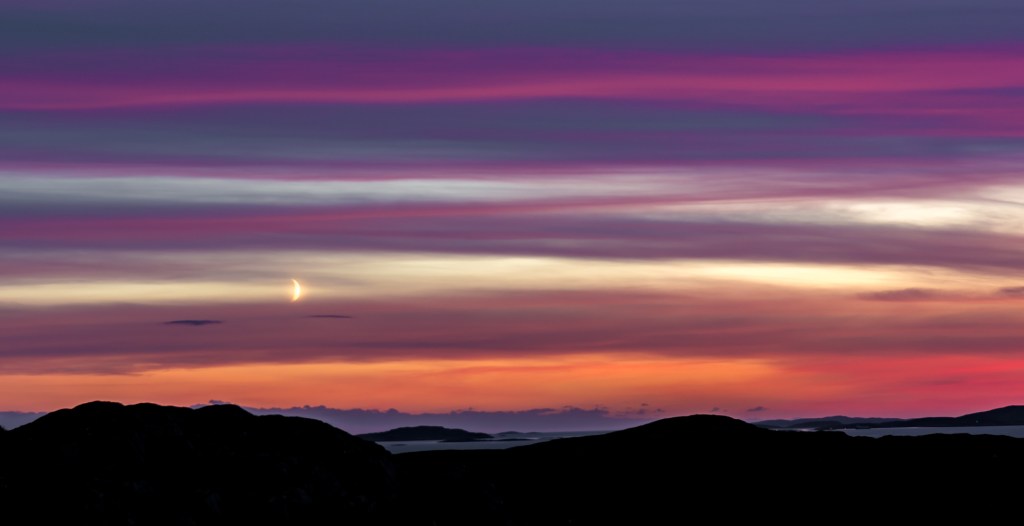
This morning I was enjoying a beautiful sunrise. In a world where the news is filled with a lot of negativity, these sunrises remind me that most people probably have a normal day, with normal day problems and joys like seeing a sunrise and that all that negativity will never touch us directly. How we cope with our daily foibles depends in a great part on who we are, but these problems are, for the most part, and often only in our heads.
It is not hard to imagine what terrible things we do to each other. You probably never witness it but you have seen it on the news or read about it in the newspaper or a good book. For most of us these problems, all these wars and negativity are just stories, they might as well be specially made for you like in the movie The Truman Show. Are you going to check if it all is real? Of course, it is real, but as real as a thunderstorm in western Africa is real for you. We know that innocent people die, that is what we humans do. Trump might become the next president and destroy America, but that is also old news. I think that it is hubris of us so called modern people to think that this thin layer of sophistication and scientific inside we feel lately makes us behave any different than we did a thousand years ago or even three thousand years ago.
Ten thousand people fear for their lives this morning because of the bombs that might fall. A man who was chosen by their people to do that job cannot be stopped by other governments let alone by us. There is no rationale in it, hence the frustration we feel, like the frustration you feel when you walk into a thunderstorm on your way home. The world is not bad because it rains when inconvenient, the world is just the world, and we are all subject to the forces that rule nature because we are part of nature. And who do you blame, that one politician? While thousands of soldiers do what they are told to do and millions cheer them on. How can you ever punish a whole group of people, a whole country? Do you punish yourself because the money you give to your government is used to buy bombs that most likely have killed? There is no hiding and blaming because we are all the same and are all at least guilty by association. We are as guilty as the crocodile is when chewing on your leg when given the chance.
Just enjoy the sunrise and go outside when dark clouds move above and forget your rain jacket.
I watched this interesting video after I read Robert Sapolsky’s latest book, Determined. In a world where there is so much nonsense being proclaimed by people with little knowledge and humility in regard to what they know this video is a breath of fresh air.
259 Insight: all evaluation is made from a definite perspective: that of the preservation of the individual, a community, a race, a state, a church, a faith, a culture.- Because we forget that valuation is always from a perspective, a single individual contains within him a vast confusion of contradictory valuations and consequently of contradictory drives. This is the expression of the diseased condition in man, in contrast to the animals in which all existing instincts answer to quite definite tasks.







 Nochrisis