Friedrich Nietzsche
Daybreak
Book IV
283 Domestic peace and peace of soul. – The mood in which we usually exist depends upon the mood in which we maintain our environment.
283 Domestic peace and peace of soul. – The mood in which we usually exist depends upon the mood in which we maintain our environment.

Do I tell you
I sometimes wonder
what is wrong with what you see

the situation
you are aware
can be explained
but also
in different ways

and there is no perspective
or a place for opinion
the truth is there
in a real world

and not between us

I see them sometimes while I walk through the city
they give me an urge to climb
a fear of falling
and the strange feeling
of the moment just before I hit
the ground

I am happy that I am not aloud
near them

I recognize that shape from the past
it looks like stairs going up
but I am fooled before
and wonder if I ever
should even go there
The former Dutch prime minister is now the boss of NATO. He is warning everyone that we have to prepare for the next war. He is doing that because the warmongers in Washington told him to. Russia is doing the same, and China has joined the party too. I am pretty sure that most people don’t want war, especially not the one these so-called world leaders wish for, because the next war will probably cost half a billion people their lives. We, as outsiders, can do very little because a couple of thousand people, at most, decide our destiny. In the USA, there is a democracy, Russia has a strong leader and a very weak democracy, and China is a dictatorship. It does not really matter what kind of government there is; in the end, a handful of people always decide the destiny of the rest. It is frustrating, and it can make you angry. As an Anarchist, I just hope that in the distant future, we all live in small communities, so small that even if one produces a little dictator, he or she could do little harm to the communities around him let alone the world.
Governments are hiding places for people who wanna play Risk with real people; we are and always will be children, only our toys change. I never took any active part in our so-called democracy and hope no one does in the future.
My feet know how to walk the stairs
up and down
when it is light
or in the darkness

only when I think about it
I will stumble

I also know how to live
going up or down
when in the light
or darkness

only when I think about it
I will stumble

I looked up
between all the buildings
in a corner
I saw your windows reflection
colored by what reflected it

I thought about going up
but I lost sight of it
when I moved on
I am not too far away
from where I walk

but I don’t really see
where I go

I am listening to myself again
whining about the same

spending all this time with me
with habits I don’t like
that fit me so well
so strange

I walk on
knowing that my feet will land
without knowing

Can you imagine that you lived a hundred thousand years ago? On a calm morning, you walk to the lake and look down into the dark water just before you put your hands in it to scoop so you can drink. You see a face, reflected, we might say now, a face like all the others you see around you, but this one is unknown.
These days, you see yourself more often. In the morning, in the mirror, and on pictures you have hanging around or on your phone. I am not sure if we really look at ourselves, but we know it is us that we see, though we probably have a hard time describing ourselves if we have to.
I have to be careful when discussing how important your looks are and how much it contributes to your self-image. I have had the same haircut and beard lengths for half my life. It was never a choice out of style but out of laziness and practicality. I can trim my hair and beard once a month and be done with it. It is a style I am used to, and it bothers me when my hair gets too long, partly because of how it looks, I have to admit, but also because I don’t like to trim it. I know enough people who pay more attention to their appearance; maybe because I have little to work with, I never really developed that urge.
Maybe because I was already partly bold and grey when I was twenty-five, I stopped seeing myself in the mirror as any competition in the particular world I was living in; there are standards, no matter where you live, and I didn’t meet them hair wise and didn’t care. Maybe not entirely because of this, but I started paying more attention to how I looked on the inside. To understand what beauty is inside, I started reading books that talk about this, and though beauty in this realm is also in the eyes of the beholder, we can all agree on what is ugly and what is not, even if it is not fashionable and politically correct.
The mirror in this inner world can be your consciousness. And just like in the real world, we often don’t look deep enough into the eyes we see reflected in the mirror. Maybe this is because of the attention you don’t give it or because you see the look you want to see, the one that is in fashion; the world’s approval is enough for you. Perhaps you are like that person who lived a hundred thousand years ago, and you never had a clear, calm morning when you looked down into a deep lake to see your reflection for the first time.
Disclaimer: these words are a work in progress, and I know from experience that I would write them differently tomorrow, but we live now, and this is how I say it now.
Is it possible that we are a mere caricature
of our possibilities

To get into you
I have to push buttons
far away from the entrance

I wonder what that is about

Today
my thoughts were trapt
inside me

I had to live with them
There is so much color in the city
but in my mind
looking back
I see grey

except
when I met you
my wall
standing still in front of you

I do remember
your color

I watched a documentary about organized warfare’s origins the other day. There was not much news, but it got me thinking about it again. We have a cat, and when she meets another cat, she would often sit down and observe, or the other cat would act aggressively and she run away, or when she felt she had a chance, she would act aggressively back. It is a wordless, instinctive reaction from an animal to a situation, something we often also do. The documentary distinguished between organized warfare or a fight between two groups of people who don’t know each other but meet on contested land and organized warfare. For this last one, you need a more sophisticated language to organize a clearer hierarchy and streamline these aggressive feelings towards the other (who you don’t know and just met) in a better way. The first, much older group lived thousands of years before a recognizable language existed. These early humans communicated more sophisticatedly than other animals, but no one had yet written a thesis on the art of war. It was only around 5 thousand years ago that we see the first thoughts about life and war written down; since then, some people have spent their lives thinking about it. But we are all still animals, and it is hard to deny that most people don’t read a book about philosophy or are otherwise critical of what we are capable of as humans and never wonder why and how we can think. I suspect that most people are like our cat; we are not aggressive per se but also are not in control of our reactions when meeting another cat or, in our case, another human. We are also conditioned by nature, like the cat. The only difference is that we can think about it after the fact…of our reaction.
I have no real attachment to celebrating the new year. When I was young, it was exciting to buy fireworks and search for leftovers long into the night. Later, I had work where I had to work on those days, and as an anarchist, I can’t help but see the relativism of all these celebrations. And I don’t know why that one day a year is chosen as some kind of turning point, mainly because most of the time, maybe all of the time, real changes happen on entirely arbitrary days. All these traditions come from your surroundings and are fed and seen mostly uncritically, the same traditions that make us anxious about foreigners and let us see women as something other than men, to name just two of the more nasty ones. Traditions are fascinating when you read about them in a history book.
A part of relativizing your own (made-up) culture is realizing that what is normal for you is not normal for others.

From down here
those guardrails look nice

luckily
down here
I can't fall far
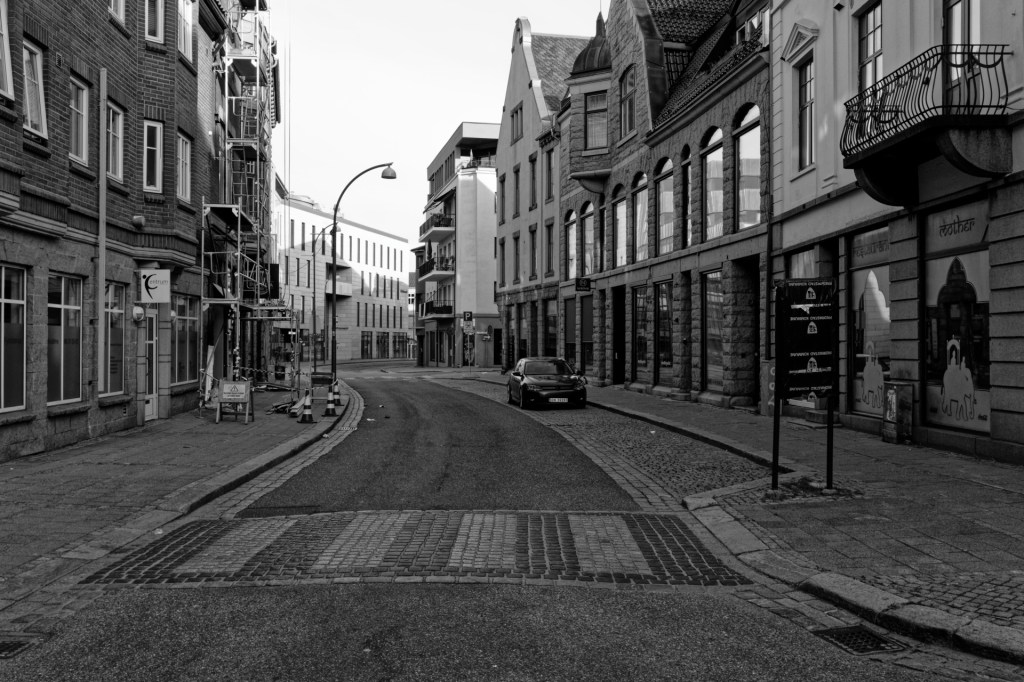
I love standing in the middle of a crossroad
when it is quiet
 Nochrisis