
People who don't know the whole story are often eager to fill in the details with added reasoning for the part they know. For most, having a partial opinion is more important than having no opinion.
People who don't know the whole story are often eager to fill in the details with added reasoning for the part they know. For most, having a partial opinion is more important than having no opinion.

Mirrors that don’t reflect
What would happen to a person born today where it is possible to make a monitor into a mirror that, through clever manipulation, shows all your movements but as another person? What if that reflection was the image of you with another gender or ethnicity?
What would our lives be like if this was done?
What do our reflections teach us?
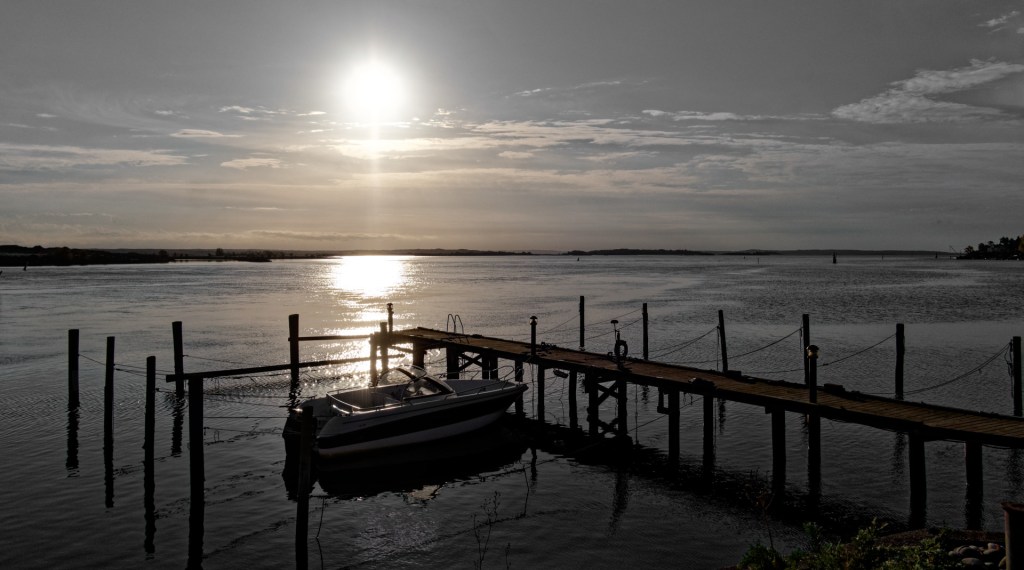
If people set out towards their opinion, what they believe or think to know, do they know where to go? Or do you believe that your opinion comes from within you, arising from somewhere deep?
Some observations
Understanding where our knowledge comes from is important in our highly opinionated world. When and when not to trust our knowledge, opinions, and beliefs is important, in my opinion.
We all can live with our truths and go as far as to say that we all have “a right to our own truths.” If you say that the sky is blue, you will be right because most of us will agree, but if you say that that particular person is the best person for that job, you might find out that others disagree. You still have your truth, but it might be wise to find out what qualities you rank high and which ones the others do. If you like the character and attitude of the person you prefer, but the others point out the lack of qualification, you might have a starting point from where you can find out what is more important instead of just stating your opinion. It is often not enough to state your opinion, so finding out the reason why you have these opinions can also be important.
There is a possibility that you end up endlessly questioning your beliefs. If the question is, like in the example above, if personality or adjudication is more important, you might have anecdotal stories where an uneducated new employee lifted a company’s morals. Still, the other might use common sense that education is usually used to decide who to hire. Anecdotal evidence needs more scrutiny, but what is expected is not always the road to follow, especially when change is needed. In this example, the two sides might have discovered that one side thought that change was needed, and the other just wanted a new employee. Now you’re on the road to finding out what the reasons are that part of the company wants to change and the other part does not. From here, you can only go deeper, and maybe you will find out that you didn’t even know what you wanted or what the question was.
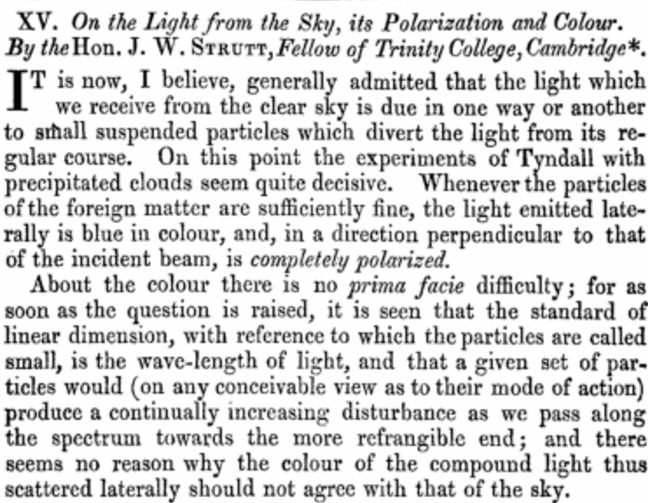
You say the sky is blue, but it is more correct to say that the sky looks blue. This is what my friendly AI minion says about it: The sky appears blue due to a phenomenon called Rayleigh scattering. When sunlight enters the Earth’s atmosphere, it collides with molecules and small particles, scattering the shorter blue wavelengths of light more than the longer red wavelengths. This scattering causes us to perceive the sky as blue during the day.
This is what NASA’s Space Place tells us: Sunlight reaches Earth’s atmosphere and is scattered in all directions by all the gases and particles in the air. Blue light is scattered more than the other colors because it travels as shorter, smaller waves. This is why we see a blue sky most of the time.
And here is a Quote from the scientist who wrote all of this down for the first time in 1871, John William strutt, 3rd Baron Rayleigh:
This was just a 10-minute search on the internet to “debunk” something that most of us take for granted. It is, of course, enough to say that the sky is blue, but say at least to the younger people that there is a but after you stated the obvious because for young people, there is still hope.
6 Against visionaries. -The visionary denies the truth to himself, the liar only to others.
261 One weapon twice as good as two. -It is an unequal battle when one person speaks for his position with head and heart, the other only with his head: the first has the sun and wind against him, as it were, and his two weapons interfere with each other: he loses the prize-in the eyes of truth. Admittedly, the victory of the second with his one weapon is seldom a victory according to the heart of all the other spectators and costs him his popularity among them.
270 The eternal child. -We believe that fairy tales and games belong to childhood: shortsighted as we are! As if we would like to live without fairy tales and games at any age! Admittedly, we call it something else and experience it differently, but this is precisely what speaks for it being exactly the same thing – for the child, too, feels that games are his work and fairy tales his truth. The brevity of life should preserve us from pedantically separating the ages oflife – as if each one brought something new – and a poet should sometime present to us a human being two hundred years old who really does live without fairy tales and games.

There have been times in my life when I hit rock bottom. After the first few times, I learned how to brace myself when I found myself on a familiar trajectory. Being curious by nature, I never really judged the place; I also observed the joyous times in my life from an appropriate distance. I don’t try to judge. In some sense, all strong emotions have something in common, and that is that they are strong.
But man has such a predilection for systems and abstract deductions that he is ready to distort the truth intentionally, he is ready to deny the evidence of his senses only to justify his logic. Fyodor Dostoyevsky, Notes from the Underground
But are strong emotions of love, wonder, or winning not better than feelings of loss and depression, you might ask? Yes, of course, at first glance. What do all these emotions have in common? They are all finite; they start at a certain point and end eventually. The more a certain feeling repeats itself in your life, the more you get used to it, and its impact will slowly diminish. The reason why you feel that first strong emotion of love or loss that strong, is because you don’t know what follows; it might never end, is what you want to believe. The reason you feel it is so strong is unfamiliarity.
Feeling love is, at first glance, a more positive feeling than loss, but as we all know, after love, the break up comes eventually, even if it takes many years when death finally demands its toll. Loss, on the other hand, starts on a down note, but how good is the feeling of finding what was lost back? My point is that feelings have a whole spectrum that, on average, evens out. Emotions are there; in some sense, you should feel the joy and negativity; just feel them without too much judgment.
I do and have done this kind of rationalization whenever I am down, but also when I am up, and I can tell you when you are up and think about this stuff…then it doesn’t always help. But jokes aside, rationalizing your feelings does help you stay somewhat calm during a surge of emotions, but you have to be lucky to have that ability. I don’t know if it can be taught.
One ought to hold on to one’s heart; for if one lets it go, one soon loses control of the head too. Friedrich Nietzsche

Did you know that between 25 and 50 percent of the people of voting age living in the Netherlands and the USA think it is a good idea to deport people to wherever they can dump them? Two of the wealthiest countries in the world are too greedy to share some of their wealth: we want more, is what these people think, and I don’t care that you come from a war-torn country; we don’t want to give you a place where you can rest and start a new life. We want more stuff, and you mean nothing to me.
I guess education is not the solution to a better character. First, religion fails to make people care for each other, and now education. What now. Internet was supposed to share knowledge, you say. I guess that didn’t work either. Disappointing.

I’ve been a Dutch Marine for 3 years. Thirty years ago, and I still feel it. I still feel it, but not in a negative way. If I talk to an old colleague about the old days, we often also talk about what we do now and how we both miss the time when teamwork meant teamwork. As a Marine, you don’t have to tell your buddy to cover your ass; you know he does, just like any other member of the team; they all know what to do and what is expected.
The reason why we trained so hard to reach that level of cooperation is, of course, the danger that can be part of the job. I understand that, but I feel it is still part of me after 30 years. I often had and have too high of an expectation of the teams I worked in or led. I know that danger is not coming from the door in the corner of the office, but why don’t they close it when they know it’s a fire door? It sounds like a tiny thing, but for me, it is still a principle: attention to detail; in a combat situation, neglecting what is expected can harm you and others. I also understand the people who wonder why I bother; they have probably never bothered about things just outside of their reach. I have learned over the years to care less, but it eats at me.

Is it possible to ever let go? To untie yourself from yourself. To not think the way you always do. Turn a switch and change, even if only for a second or two.
Of course not. Every reaction has an action before it; change in your life does not happen in a vacuum and can not be commanded. It is impossible not to be yourself, and even if you take a leap, you will most certainly land on the other side as yourself again.
If you want to change, you could change your surroundings. Meeting new people is often an excellent way to confirm your choices or to get infected by new ones. And when you’re stuck in one place, alone, then read a book, one you wouldn’t usually choose, one recommended by someone you respect or who rubs you the wrong way.
Changing your mind takes work. When you are 16, you do it every week; when you are old, maybe just the second before you die. And if it is not your age that holds you from changing or changing too much, it might be your family, friends, the person sleeping next to you, or the country you live in.
But just moving to another country or divorcing is not the cure that brings you change. The things around you might change, but do they change enough? Do you fall in love again with that person you imagined you had met before? Do you wake up next to the same person because you see all of them like that? A thing.
Change is difficult, even if you want it. Not many people want to put in the effort, and we expect change to happen by demanding it from others or through shortcuts we want to believe. They say that we are formed for a large part in our early years. When you are three, change is happening all the time, and it just happened. You get moved around, presented with food you don’t know, and wear clothes you have never seen before. All this change was forced upon you and hopefully done with love, making you feel good. Now, you have to do it all alone, and you don’t know how and stick with what you know. Longing for someone who tells you, but most of the time, that is you; the choice is often between what you already know all too well.
It is like the free will problem. If we had it, we could all just change our minds and change. We are all stuck in a particular past and body, and these two determine for the most who we are. Making unexpected friends or reading a new book might notch you off, off your trajectory, but knowing that you encounter something new is the big challenge. You have to learn to recognize what is new, and the best way to do that is to keep it close and not at a distance.

It’s a shame that we all see it so differently,
or is it?
Is this proof that there is no truth, no god?
That is what I think, but you probably not.

I don’t think that we have a free will. I believe it is essential that we act like we have one, and our nature and evolution have made it so that we all have the illusion that we have free will. There are many arguments against this idea, and as many in favor, I just ask you to look around and in yourself. If you look at us as a collection of inherited traits, the parts in you that come from your mother, father, and the rest of the family before them. That’s the “mechanical” part of you, including the brain, that will do most of the work once you start living. During this living, you will be exposed to your culture and the values and morals of your surroundings. You can have a wide range of influences, but you will never be influenced by everything. You will be unique but, at the same time, a unique representation of your experiences. Your experiences will make you react to what the world will throw at you. You feel that you have decided to vote left or right, but your past, the clothes you wear, and the friends you have have already decided your path, your choice. Your choices are your surroundings reflecting in you and who you are without conscious interference.
All the arguments going around inside you for why you choose the way you do are no explanations for why you consciously choose but for why you seem to have chosen. Think about what you do when you lift your arm. You only see it move, but many decisions are made hidden from you. All the muscles and different signals have to start moving without your conscious awareness. You think you move your arm, but at most, you have given it an order. The thoughts you have and the words you speak are more or less like that. You only become aware of what you think after your brain has done a lot of unconscious processing. You might order your brain to think but it does most of the work for you, without you.
We’re a government that believes in everybody having the illusion of free will.

Is it bad to be hopeful? While standings frozen and looking to the other side on a screen*.
I have written before that American politics is more important to me than the politics of any other country. I always say: if America farts, we all have to smell the stink. That said, politics over there is not left enough for my taste, but I am still happy that the wannabe Führer will have a hard time and the centrists are hopefully winning, that is at least a tiny step in the right direction.
*We had a band in the Netherlands, Het Goede Doel, that made a song about Belgie. One of the lyrics is about America: And when it comes to America, that country doesn’t really exist. I’ve been on a plane there, but maybe we landed in the Truman Show, and who knows, maybe all we see about America is what we see on the screens. It’s there to scare us. One thing I know for sure, it is definitely a show they perform for us.

There are many factors why there seems to be a resurgence of fascist-like sentiments. By fascism, I mean the tendency of large groups of people to walk behind a “strong” leader, like rats that follow the Pied Piper of Hamelin. Reading about colonialism and capitalism has something to do with it, but one of the better books to read is Escape from Freedom, also known as The Fear of Freedom, by Erich Fromm. In short, the book talks about the problems we humans have with freedom, or maybe better said, what we do to fill that void we feel when answers are absent.
The book was written in 1941, but as the following text shows, it could be written for our time where in America, half the population follows their dear leader blindly, but also in the Netherlands, where I come from where the word fascist might be a little bit to strong but following blindly of the leader not.
If we want to fight Fascism, we must understand it. Wishful thinking will not help us. And reciting optimistic formulae will prove to be as inadequate and useless as the ritual of an Indian rain dance. In addition to the problem of the economic and social conditions which have given rise to Fascism, there is a human problem which needs to be understood.
We forget that, although freedom of speech constitutes an important victory in the battle against old restraints, modern man is in a position where much of what “he” thinks and says are the things that everybody else thinks and says; that he has not acquired the ability to think originally – that is, for himself – which alone gives meaning to his claim that nobody can interfere with the expression of his thoughts.
Man represses the irrational passions of destructiveness, hate, envy, revenge; he worships power, money, the sovereign state, the nation; while he pays lip service to the teachings of the great spiritual leaders of the human race, those of Buddha, the prophets, Socrates, Jesus, Mohammed—he has transformed these teachings into a jungle of superstition and idol-worship. How can mankind save itself from destroying itself by this discrepancy between intellectual-technical overmaturity and emotional backwardness?
You can read the book here: https://pescanik.net/wp-content/uploads/2016/11/erich-fromm-the-fear-of-freedom-escape-from-freedom.pdf
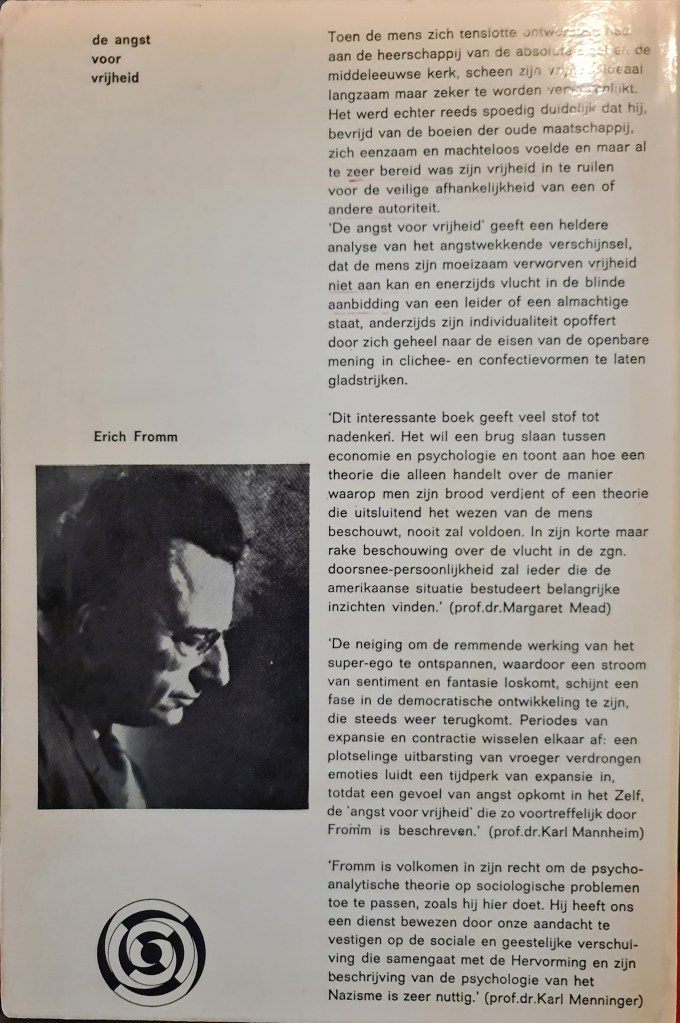
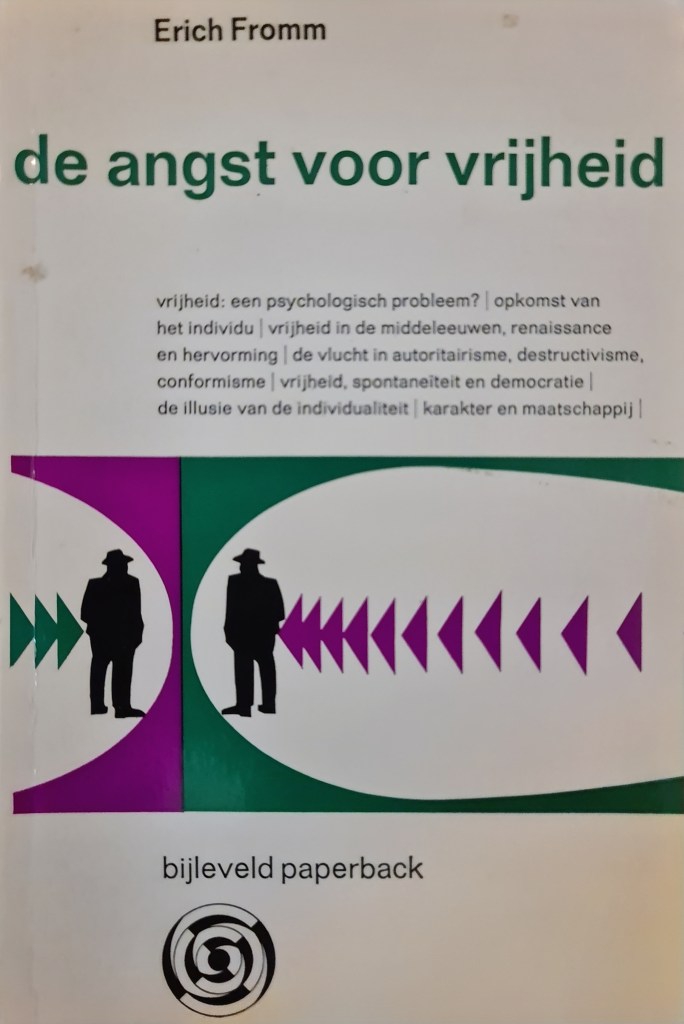
The following is a translation from the back cover of my Dutch copy of the book:
When man finally freed himself from the rule of the absolute state the medieval church, his ambition for freedom seemed to be realized slowly but surely. However, it soon became clear that, freed from the shackles of the old society, he felt lonely and powerless and was only too willing to exchange his freedom for the secure dependence of some authority.
‘The fear of freedom’ provides a clear analysis of the frightening phenomenon that man cannot cope with his hard-won freedom and on the one hand flees into the blind worship of a leader or an all-powerful state, and on the other hand sacrifices his individuality by allowing himself to be smoothed out in cliché and ready-made forms according to the demands of public opinion. “This interesting book gives much food for thought. It aims to bridge the gap between economics and psychology and shows how a theory that only deals with the way in which one earns one’s bread or a theory that only considers the essence of man will never suffice. In his short but pertinent consideration of the escape into the so-called average personality, anyone who studies the American situation will find important insights.’ (Prof. Dr. Margaret Mead)
‘The tendency to relax the inhibiting effect of the super-ego*, whereby a stream of sentiment and fantasy is released, seems to be a phase in democratic development that recurs again and again. Periods of expansion and contraction alternate: a sudden outburst of previously repressed emotions heralds an era of expansion, until a feeling of fear arises in the Self, ‘the fear of freedom’ that is so excellently described by Fromm.’ (Prof. Dr. Karl Mannheim)
‘Fromm is perfectly within his rights to apply psychoanalytic theory to sociological problems, as he does here. He has done us a service by drawing our attention to the social and spiritual shift that accompanied the Reformation, and his description of the psychology of Nazism is very useful.’ (Prof. Dr. Karl Menninger)
* The superego reflects the internalization of cultural rules, mainly as absorbed from parents, but also other authority figures, and the general cultural ethos. (https://en.wikipedia.org/wiki/Id,_ego_and_superego)
I try to understand what colonialism and imperialism have done to the world. These days, it’s mostly understood as something bad, and politicians condemn it in many polished speeches, speeches that are carefully checked by a room full of lawyers, afraid as they are that their words can be misunderstood as an admittance of guild. The problem is that in the 16th and 17th centuries, the intentions might have been good, trading with the locals on whatever strange coast you found them, but the many differences in customs made it often easy for the Europeans to take advantage and slowly take over their society. The result is, hundreds of years later, that we have taken away the chance of these societies to find their own way into the future.
I thought about this when I heard a story yesterday from someone who heard that same story from his grandfather. It goes about their forefather’s village somewhere in Indonesia, around the time that the first Dutch merchant/war ships arrived. The people on that Island were Muslims, and it was customary to give land to visitors if they wanted to stay, so they gave some land to the Dutch, and they gave more and more… He also describes that there were already vast commercial contacts with Japan, China, India, and the Arabic world. These contacts existed already for hundreds of years, and there were no monopolies; there was, more or less, free trade. This all changed in the next centuries, and part of the Dutch golden age was possible because the Dutch divided and conquered huge parts of Indonesia, and most of the trade was monopolized by the Dutch.
There are many reasons why there are poor and wealthy countries, and the literature about it goes from left to right with no consensus in the middle. The former colonies were not as technically advanced as the European countries, but their moral systems might have been more mature because of longer, uninterrupted growth. We will never know how these former colonies would have developed if the Europeans hadn’t interfered. There was violence in ancient times and through the ages till now. The Indonesian archipelago was littered with small kingdoms that also fought with each other and tried to steal each other’s land, but we have to remember that we think with Western minds, and for centuries, we have learned, we have been told, that the people who don’t live as we do are barbarians and are less than us. We cannot trust our forefather’s stories, we also have to learn the stories from the people that already lived there. It will take a lot of effort to shake off these prejudices and see ancient and unknown civilizations with the same eyes as we do our own, not good or bad but full of people who, for more than 40000 years, already knew what was good and bad, and they often knew that better than we know that now.
Until the lions have their own historians, the history of the hunt will always glorify the hunter.
I hate imperialism. I detest colonialism. And I fear the consequences of their last bitter struggle for life. We are determined, that our nation, and the world as a whole, shall not be the play thing of one small corner of the world
Do you know why people like me are shy about being capitalists? Well, its because we, for as long as we have known you, were capital, like bales of cotton and sacks of sugar, and you were commanding, cruel capitalists, and the memory of this so strong, the experience so recent, that we can’t quite bring ourselves to embrace this idea that you think so much of. As for hat we were like before we met you, I no longer care. No periods of time over which my ancestors held sway, no documentation of complex civilisations, is any comfort to me. Even if I really came from people who were living like monkeys in trees, it was better to be that than what happened to me, what I became after I met you.
A Small Place

I bought a book about Indonesia this summer. It was written in 1942, when Indonesia was still a Dutch colony, though Holland was occupied by the Germans, the irony. I am interested in the history of colonization, especially in the former Dutch colonies. There are many books written about that period, but I liked this one because it was written at a time when people still openly thought it was a good idea to colonise other countries. So far, the book is interesting, but that’s mainly because of how the writer writes about how people traveled to the East over the centuries in the first few pages. After that, he brushes over a lot of wars and conquering. To fact-check, I ended up looking at several discussions on YouTube about Dutch history, and I learned a lot. I won’t border you with the details; they are 2-hour-long roundtable discussions in Dutch, easy to find if you are interested. It’s not that I didn’t know these things, but the details fill in many interesting gaps.
If it were necessary to give the briefest possible definition of imperialism, we should have to say that imperialism is the monopoly stage of capitalism. Vladimir Lenin

Reading about cults again. I think we all believe in our little world, but why you would surrender yourself to the world that another person paints for you is a mystery to me. Sadly, you also see this in politics, where many people follow the one with the smile they like the most. I think this proves, more or less, that life is not easy to navigate without a guide, some rules you learned while growing up, or a pointing hand while you were searching your way.
I’ve learned somewhere, on my travels, not to trust myself or others but to trust that if you set one foot, the other will follow without you thinking about it and contemplating why. Thinking as a means to get somewhere in life is fruitless; it is, at most, a fun exercise. You can learn a lot from critical thinkers and hope their wisdom will turn into the right “automatic” choices. It is like learning to play an instrument; after many years of training, you know how to play without knowing exactly how to play; your fingers do the things they have to do without you guiding them all the way.
So think about all the different choices you can make in life, but don’t make them or let them be made for you; just trust that you will react the right way when a choice has to be made. This might be written as advice, but it is not; it’s just my way.
All ideologies are idiotic, whether religious or political, for it is conceptual thinking, the conceptual word, which has so unfortunately divided man. Jiddu Krishnamurti
I don’t have any beliefs or allegiances. I don’t believe in this country, I don’t believe in religion, or a god, and I don’t believe in all these man-made institutional ideas. George Carlin
Take a chance on faith – not religion, but faith. Not hope, but faith. I don’t believe in hope. Hope is a beggar. Hope walks through the fire. Faith leaps over it. Jim Carrey

Is there observable progress in society?

Or do we just do things differently
look differently

 Nochrisis