21. Conjectural victory of scepticism

Human all too human

Reading Friedrich Nietzsche’s Human all too human

Read the introduction here

You can read the aphorism I discuss here in English and German below the main article.

Synopsis, quote from the translation by Helen Zimmern and my take on it.

Let’s use the skeptical mindset and accept that there is no metaphysical world, and that metaphysical explanations of our world are useless, how would we look at man and world. You can imagine this even if you dismiss the question if Kant and Schopenhauer have any scientific proof. For it is quite possible, according to historical probability, that some time or other man, as a general rule, may grow skeptical; the question will then be this: What form will human society take under the influence of such a mode of thought? Maybe mankind distrust scientific proof of a metaphysical world, and when there is this distrust it will have the same result as if it was outright refuted and could no longer be believed in. The historical question with regard to an unmetaphysical frame of mind in mankind remains the same in both cases.

In one sentence:

It is historically possible that metaphysics will be refuted no matter what.

.


Human, all too human a book for free spirits Part I translated by Helen Zimmern 1909

  1. CONJECTURAL VICTORY OF SCEPTICISM.—For once let the sceptical starting-point be accepted, —granted that there were no other metaphysical world, and all explanations drawn from meta- physics about the only world we know were useless to us, in what light should we then look upon men and things? We can think this out for ourselves, it is useful, even though the question whether anything metaphysical has been scientifically proved by Kant and Schopenhauer were altogether set aside. For it is quite possible, according to historical probability, that some time or other man, as a general rule, may grow sceptical ; the question will then be this : What form will human society take under the influence of such a mode of thought ? Perhaps the scientific proof of some metaphysical world or other is already so difficult that mankind will never get rid of a certain distrust of it. And when there is distrust of metaphysics, there are on the whole the same results as if it had been directly refuted and could no longer be believed in. The historical question with regard to an unmetaphysical frame of mind in mankind remains the same in both cases.

Menschliches allzu menschlich 1878/80

  1. Muthmaasslicher Sieg der Skepsis. – Man lasse einmal den skeptischen Ausgangspunct gelten: gesetzt, es gäbe keine andere, metaphysische Welt und alle aus der Metaphysik genommenen Erklärungen der uns einzig bekannten Welt wären unbrauchbar für uns, mit welchem Blick würden wir dann auf Menschen und Dinge sehen? Diess kann man sich ausdenken, es ist nützlich, selbst wenn die Frage, ob etwas Metaphysisches wissenschaftlich durch Kant und Schopenhauer bewiesen sei, einmal abgelehnt würde. Denn es ist, nach historischer Wahrscheinlichkeit, sehr gut möglich, dass die Menschen einmal in dieser Beziehung im Ganzen und Allgemeinen skeptisch werden; da lautet also die Frage: wie wird sich dann die menschliche Gesellschaft, unter dem Einfluss einer solchen Gesinnung, gestalten? Vielleicht ist der wissenschaftliche Beweis irgend einer metaphysischen Welt schon so schwierig, dass die Menschheit ein Misstrauen gegen ihn nicht mehr los wird. Und wenn man gegen die Metaphysik Misstrauen hat, so giebt es im Ganzen und Grossen die selben Folgen, wie wenn sie direct widerlegt wäre und man nicht mehr an sie glauben dürfte. Die historische Frage in Betreff einer unmetaphysischen Gesinnung der Menschheit bleibt in beiden Fällen die selbe.

Sources:

I will read a Dutch translation that is based on the work of researchers Colli and Montinari. I also use a translation from R.J.Hollingdale and the Gary Handwerk translation from the Colli-Montinari edition. Both are more modern than the copyright free translation I use here. This is a translation from 1909 by Helen Zimmern, who knew Nietzsche personally, but there was no critical study of Nietzsche’s work done back then and this translation suffers from that. The same goes for the translation from Alexander Harvey. My German is not good enough to pretend that I can translate it better than the professionals do but I will use the original as a referee.

  1. Menselijk al te menselijk een boek voor vrije geesten, translated by Thomas Graftdijk, 2000. Buy it here
  2. Human, all too human a book for free spirits, translated by R.J.Hollingdale, 1986
  3. Human, all too human a book for free spirits I V3, translated by Gary handwerk 1997
  4. Human, all too human a book for free spirits Part I, translated by Helen Zimmern 1909. Read it  here
  5. Human, all too human a book for free spirits, translated by Alexander Harvey, 1908. Read it here
  6. Menschliches allzu menschlich 1878/80. Read it here
 

20. A few steps back

Human all too human

Reading Friedrich Nietzsche’s Human all too human

Read the introduction here

You can read the aphorism I discuss here in English and German below the main article.

Synopsis, quote from the translation by Helen Zimmern and my take on it.

A few steps back1 back A high culture is attained when man rises above superstitious and religious notions and fears. If he has attained to this degree of freedom, he has still also to overcome metaphysics with the greatest exertion of his intelligence. Man has to overcome explanations that they got with the help of metaphysics, the unseen or not material world, after he rises above superstitious believes After this he has to look back and understand the historical and psychological basis of these mindsets. He must recognize how the greatest advancement of humanity has come therefrom, and how man would rob itself from the greatest achievements if it doesn’t look back. After this, man has to look back and realize that the greatest advancements of man came from this period,  With regard to philosophical metaphysics, I see more people that attained the negative goal of thinking that even positive metaphysics is an error, but more people think that positive2 metaphysics is bad. but few that take a few steps back on the ladder. one ought to look out, perhaps, over the last steps of the ladder, but not try to stand upon them. It is advised to remind yourself of the positive achievement of metaphysics, The most enlightened only succeed so far as to free themselves from metaphysics and look back upon it with superiority, while it is necessary here, too, as in the hippodrome, to turn around the end of the course. even the most enlightened, must turn around and acknowledge this fact.

In one sentence:

Don’t dismiss positive metaphysics to fast.

1The German word “Einige sprossen zurück” is normally translated in English as “some/a few rungs back. Zimmern, Harvey and Hollindale translated it as “A few steps back, Handwerk and Graftdijk as “A few rungs back/Een paar sporten terug”. It is probably not wrong, but I associate “steps back” more with a step backwards and not downwards on a ladder, and that is what Nietzsche uses in this aphorism, he probably meant seeing more or les depending on where you are on the ladder, “but as yet few who climb a few rungs backwards; one ought to look out, perhaps, over the last steps of the ladder”.

2Don’t know what Nietzsche meant with “positive metaphysics” other than metaphysics that has a positive effect. Don’t know what he counted as such.

Human, all too human a book for free spirits Part I translated by Helen Zimmern 1909

  1. A FEW STEPS BACK.—A degree of culture, and assuredly a very high one, is attained when man rises above superstitious and religious notions and fears, and, for instance, no longer believes in guardian angels or in original sin, and has also ceased to talk of the salvation of his soul,—if he has attained to this degree of freedom, he has still also to overcome metaphysics with the greatest exertion of his intelligence. Then, however, a retrogressive movement is necessary ; he must understand the historical justification as well as the psychological in such representations, he must recognise how the greatest advancement of humanity has come therefrom, and how, without such a retrocursive movement, we should have been robbed of the best products of hitherto existing mankind. With regard to philosophical metaphysics, I always see increasing numbers who have attained to the negative goal (that all positive metaphysics is error), but as yet few who climb a few rungs backwards ; one ought to look out, perhaps, over the last steps of the ladder, but not try to stand upon them. The most enlightened only succeed so far as to free themselves from metaphysics and look back upon it with superiority, while it is necessary here, too, as in the hippodrome, to turn round the end of the course.

Menschliches allzu menschlich 1878/80

  1. Einige Sprossen zurück. – Die eine, gewiss sehr hohe Stufe der Bildung ist erreicht, wenn der Mensch über abergläubische und religiöse Begriffe und Aengste hinauskommt und zum Beispiel nicht mehr an die lieben Englein oder die Erbsünde glaubt, auch vom Heil der Seelen zu reden verlernt hat: ist er auf dieser Stufe der Befreiung, so hat er auch noch mit höchster Anspannung seiner Besonnenheit die Metaphysik zu überwinden. Dann aber ist eine rückläufige Bewegung nöthig: er muss die historische Berechtigung, ebenso die psychologische in solchen Vorstellungen begreifen, er muss erkennen, wie die grösste Förderung der Menschheit von dorther gekommen sei und wie man sich, ohne eine solche rückläufige Bewegung, der besten Ergebnisse der bisherigen Menschheit berauben würde. – In Betreff der philosophischen Metaphysik sehe ich jetzt immer Mehrere, welche an das negative Ziel (dass jede positive Metaphysik Irrthum ist) gelangt sind, aber noch Wenige, welche einige Sprossen rückwärts steigen; man soll nämlich über die letzte Sprosse der Leiter wohl hinausschauen, aber nicht auf ihr stehen wollen. Die Aufgeklärtesten bringen es nur so weit, sich von der Metaphysik zu befreien und mit Ueberlegenheit auf sie zurückzusehen: während es doch auch hier, wie im Hippodrom, noth thut, um das Ende der Bahn herumzubiegen.

Sources:

I will read a Dutch translation that is based on the work of researchers Colli and Montinari. I also use a translation from R.J.Hollingdale and the Gary Handwerk translation from the Colli-Montinari edition. Both are more modern than the copyright free translation I use here. This is a translation from 1909 by Helen Zimmern, who knew Nietzsche personally, but there was no critical study of Nietzsche’s work done back then and this translation suffers from that. The same goes for the translation from Alexander Harvey. My German is not good enough to pretend that I can translate it better than the professionals do but I will use the original as a referee.

  1. Menselijk al te menselijk een boek voor vrije geesten, translated by Thomas Graftdijk, 2000. Buy it here
  2. Human, all too human a book for free spirits, translated by R.J.Hollingdale, 1986
  3. Human, all too human a book for free spirits I V3, translated by Gary handwerk 1997
  4. Human, all too human a book for free spirits Part I, translated by Helen Zimmern 1909. Read it  here
  5. Human, all too human a book for free spirits, translated by Alexander Harvey, 1908. Read it here
  6. Menschliches allzu menschlich 1878/80. Read it here


19. Number

Human all too human

Reading Friedrich Nietzsche’s Human all too human

Read the introduction here

You can read the aphorism I discuss here in English, German and Dutch below the main article.

Synopsis, quote from the translation by Helen Zimmern and my take on it.

The discovery of the laws of numbers is made upon the ground of the original, already prevailing error, that there are many similar things (but in reality there is nothing similar), at least, that there are things (but there is no “thing”). The law of numbers is based on the (mistaken) belief in similarity and that there are things When you assume there is variety, you assume there are more things of one, but here we are mistaken and invent things that are not there. We see lots of different things and assume there are more of each Our sensations of space and time are false, for they lead consistently1 to logical contradictions. In science we know there are false quantities but as these quantities are at least constant, as, for instance, our sensation of time and space, the conclusions of science have still perfect accuracy and certainty in their connection with one another; Science works with false premises, but they work for specific questions like Newtonian and quantum physics one may continue to build upon them. Up to the point where our assumptions, the constant errors, no longer work with our conclusions like in the theory of atoms. You can work with these theories up to the point that they don’t work anymore There still we always feel ourselves compelled to the acceptance of a ” thing ” or material ” substratum”2 that is moved, Like with a theory of atoms, were our believe in numbers no longer works, we still belief in things whilst the whole scientific procedure has pursued the very task of resolving everything substantial (material) into motion ; here, too, we still separate with our sensation the mover and the moved and cannot get out of this circle, because the belief in things has from immemorial times been bound up with our being. We still separate the mover from the moved, there is no specific movement without our observation When Kant3 says, ” The understanding does not derive its laws from Nature, but dictates them to her, Nature has no order besides the order we give it to her” it is perfectly true with regard to the idea of Nature which we are compelled to associate with her (Nature = World as representation, that is to say as error), but which is the summing up of a number of errors of the understanding. The laws of numbers are entirely inapplicable to a world which is not our representation—these laws obtain only in the human world. Number work only for a world seen thru our eyes, a world created by our way of looking to the world, made of things, similarity, numbers.

In one sentence:

We exist but live in a man made world

1Zimmern translate the German “consequent” (konsequent) as “examined in sequence” is better translated as consequent or consistently.

2substratum” A foundation or basis of something.

3 In the Dutch translation is a note pointing to this quote of Kant from his book: Prolegomena zu einer jeden künftigen Metaphysik die als Wissenschaft wird auftreten können. Page 320 (82) 36 here you can read it.


Human, all too human a book for free spirits Part I translated by Helen Zimmern 1909

  1. NUMBER.—The discovery of the laws of numbers is made upon the ground of the original, already prevailing error, that there are many similar things (but in reality there is nothing similar), at least, that there are things (but there is no “thing”). The supposition of plurality always presumes that there is something which appears frequently,—but here already error reigns, already we imagine beings, unities, which do not exist. Our sensations of space and time are false, for they lead—examined in sequence—to logical contradictions. In all scientific determinations we always reckon inevitably with certain false quantities, but as these quantities are at least constant, as, for instance, our sensation of time and space, the conclusions of science have still perfect accuracy and certainty in their connection with one another; one may continue to build upon them—until that final limit where the erroneous original suppositions, those constant faults, come into conflict with the conclusions, for instance in the doctrine of atoms. There still we always feel ourselves compelled to the acceptance of a ” thing ” or material ” substratum ” that is moved, whilst the whole scientific procedure has pursued the very task of resolving everything substantial (material) into motion ; here, too, we still separate with our sensation the mover and the moved and cannot get out of this circle, because the belief in things has from immemorial times been bound up with our being. When Kant says, ” The understanding does not derive its laws from Nature, but dictates them to her,” it is perfectly true with regard to the idea of Nature which we are compelled to associate with her (Nature = World as representation, that is to say as error), but which is the summing up of a number of errors of the understanding. The laws of numbers are entirely inapplicable to a world which is not our representation—these laws obtain only in the human world.

Menschliches allzu menschlich 1878/80

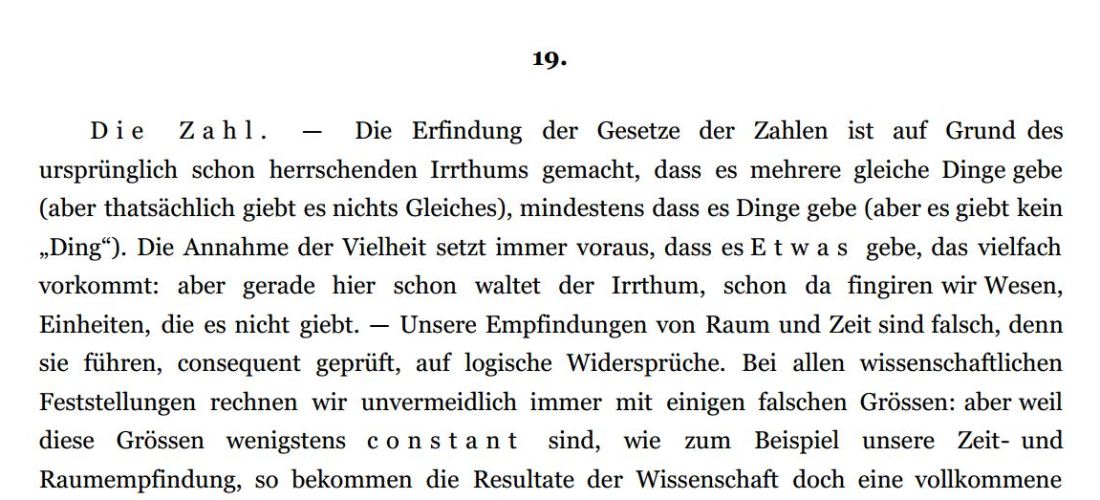
  1. Die Zahl. – Die Erfindung der Gesetze der Zahlen ist auf Grund des ursprünglich schon herrschenden Irrthums gemacht, dass es mehrere gleiche Dinge gebe (aber thatsächlich giebt es nichts Gleiches), mindestens dass es Dinge gebe (aber es giebt kein “Ding”). Die Annahme der Vielheit setzt immer voraus, dass es Etwas gebe, das vielfach vorkommt: aber gerade hier schon waltet der Irrthum, schon da fingiren wir Wesen, Einheiten, die es nicht giebt. – Unsere Empfindungen von Raum und Zeit sind falsch, denn sie führen, consequent geprüft, auf logische Widersprüche. Bei allen wissenschaftlichen Feststellungen rechnen wir unvermeidlich immer mit einigen falschen Grössen: aber weil diese Grössen wenigstens constant sind, wie zum Beispiel unsere Zeit- und Raumempfindung, so bekommen die Resultate der Wissenschaft doch eine vollkommene Strenge und Sicherheit in ihrem Zusammenhange mit einander; man kann auf ihnen fortbauen – bis an jenes letzte Ende, wo die irrthümliche Grundannahme, jene constanten Fehler, in Widerspruch mit den Resultaten treten, zum Beispiel in der Atomenlehre. Da fühlen wir uns immer noch zur Annahme eines “Dinges” oder stofflichen “Substrats”, das bewegt wird, gezwungen, während die ganze wissenschaftliche Procedur eben die Aufgabe verfolgt hat, alles Dingartige (Stoffliche) in Bewegungen aufzulösen: wir scheiden auch hier noch mit unserer Empfindung Bewegendes und Bewegtes und kommen aus diesem Zirkel nicht heraus, weil der Glaube an Dinge mit unserem Wesen von Alters her verknotet ist. – Wenn Kant sagt “der Verstand schöpft seine Gesetze nicht aus der Natur, sondern schreibt sie dieser vor”, so ist diess in Hinsicht auf den Begriff der Natur völlig wahr, welchen wir genöthigt sind, mit ihr zu verbinden (Natur = Welt als Vorstellung, das heisst als Irrthum), welcher aber die Aufsummirung einer Menge von Irrthümern des Verstandes ist. – Auf eine Welt, welche nicht unsere Vorstellung ist, sind die Gesetze der Zahlen gänzlich unanwendbar: diese gelten allein in der Menschen-Welt.

19. Het getal. – De uitvinding van de getallenwetten is gedaan op grond van de oorspronkelijk al heersende dwaling dat er verschillende identieke dingen zijn (maar in feite is er niets identieks), of althans dat er dingen zijn (maar er is geen ‘ding’). De veronderstelling van de veelheid gaat er altijd al van uit dat eriets is wat veelvuldig voorkomt: maar juist hier regeert de dwaling al, reeds hier fingeren wij wezenheden, eenheden die niet bestaan. – Onze gewaarwordingen van ruimte en tijd zijn vals, want bij consequent onderzoek blijken zij tot logische tegenstrijdigheden te leiden. Bij al onze wetenschappelijke bevindingen rekenen we onvermijdelijk altijd met enkele valse grootheden: maar omdat deze grootheden ten minste constant zijn, zoals bijvoorbeeld onze gewaarwording van tijd en ruimte, krijgen de resultaten van de wetenschap toch een volmaakte strengheid en zekerheid in hun onderlinge samenhang: men kan erop voortbouwen – tot aan dat uiterste punt, waarop de verkeerde basisveronderstellingen, de genoemde constante fouten, in conflict komen met de resultaten, bijvoorbeeld in de atomenleer. We voelen ons hier nog steeds gedwongen uit te gaan van een ‘ding’ of stoffelijk ‘substraat’ dat bewogen wordt, terwijl de hele wetenschappelijke procedure juist heeft gepoogd al het dingachtige (stoffelijke) tot bewegingen te ontleden: ook hier blijven we ten slotte zitten met onze gewaarwording van iets wat beweegt en iets wat bewogen wordt en we komen deze tovercirkel niet uit omdat het geloof aan dingen van oudsher met onze natuur verweven is. – Als Kant zegt ‘het verstand put zijn wetten niet uit de natuur, maar schrijft ze haar voor’ dan is dit volledig waar ten aanzien van het begrip van de natuur dat wij genoodzaakt zijn met haar te verbinden (natuur = wereld als voorstelling, dat wil zeggen als dwaling), maar dat de optelsom is van een grote hoeveelheid dwalingen van het verstand. – Op een wereld die niet onze voorstelling is zijn de getallenwetten in het geheel niet toepasbaar: zij gelden alleen in de mensenwereld.


Sources:

I will read a Dutch translation that is based on the work of researchers Colli and Montinari. I also use a translation from R.J.Hollingdale and the Gary Handwerk translation from the Colli-Montinari edition. Both are more modern than the copyright free translation I use here. This is a translation from 1909 by Helen Zimmern, who knew Nietzsche personally, but there was no critical study of Nietzsche’s work done back then and this translation suffers from that. The same goes for the translation from Alexander Harvey. My German is not good enough to pretend that I can translate it better than the professionals do but I will use the original as a referee.

  1. Menselijk al te menselijk een boek voor vrije geesten, translated by Thomas Graftdijk, 2000. Buy it here
  2. Human, all too human a book for free spirits, translated by R.J.Hollingdale, 1986
  3. Human, all too human a book for free spirits I V3, translated by Gary handwerk 1997
  4. Human, all too human a book for free spirits Part I, translated by Helen Zimmern 1909. Read it  here
  5. Human, all too human a book for free spirits, translated by Alexander Harvey, 1908. Read it here
  6. Menschliches allzu menschlich 1878/80. Read it here
 

18.Fundamental questions of metaphysics

Human all too human

Reading Friedrich Nietzsche’s Human all too human

Read the introduction here

You can read the aphorism I discuss here in English an German below the main article.

Synopsis, quote from the translation by Helen Zimmern and my take on it.

The history of thoughts will contain a statement by a famous logician1 and it will be seen in new light: “The primordial general law of the cognizant knowing subject consists in the inner necessity of recognizing every object in itself in its own nature, as a thing identical with itself, consequently self-existing and at bottom remaining ever the same and unchangeable: in short, in recognizing everything as a substance.” Everything that thinks needs to see the others whole, not changing, its identity from itself.  Even this law came from somewhere and one day it will be shown how in lower organisms this came to be. These organisms see first one thing and then they see more but only with one quality at a time or one relation to it. Our ancestors see only one, stand alone, quality at a time The first step in logic is the judgment, the nature of which, according to the decision of the best logicians, consists in belief. At the bottom of all belief lies the sensation of the pleasant or the painful in relation to the sentient subject. In logic you first have judgment which comes from belief which comes from pleasant or painful sensations. We organic beings have originally no interest in anything but its relation to us in connection with pleasure and pain. We are interested in the feelings our interactions with others bring, we are not interested in the other.  Between moments we have a feeling and notice this, lie moments of rest, of non-feeling; the world and everything is then without interest for us, we notice no change in it (as even now a deeply interested person does not notice when any one passes him). When we have a feeling, and are aware of it, all other inputs are blocked. From the period of the lower organism’s man has inherited the belief that similar things exist (this theory is only contradicted by the matured experience of the most advanced science). Humans inherited from lower beings the belief that similar things exist2. The primordial belief of everything organic from the beginning is perhaps even this, that all the rest of the world is one and immovable. From the believe in similar thing stems the believe that the world is one and never changing. The point furthest removed from those early beginnings of logic is the idea of Causality, In those early days of logical thinking there was no notion of causality3. indeed we still really think that all sensations and activities are acts of the free will4 Our idea of a free will comes from those early “logical” days. when the sentient individual contemplates himself, he regards every sensation, every alteration as something isolated, that is to say, unconditioned and disconnected,—it rises up in us without connection with anything foregoing or following. If we think about ourselves, we look at everything that happens to us as something that stands on its own. Therefore, belief in the freedom of the will is an original error of everything organic, as old as the existence of the awakenings of logic in it Without a notion of causality, the sensations we have stands on their own, and feel to originate from themselves. Our thoughts and actions can be seen as originating from ourselves instead of being caused by something else. But inasmuch as all metaphysics has concerned itself chiefly with substance and the freedom of will, it may be designated as the science which treats of the fundamental errors of mankind, but treats of them as if they were fundamental truths.

In one sentence:

From the beginning we thought “in boxes” and our free will saw no causes.

1Note from the Dutch translation point’s to the Russian philosopher Afrikan Spir, Denken und wirklichkeit, p177 “So sehr hat sich dem menschlichen Bewusstsein der Gedanke unbedingter, von dem Subjecte unabhängig existirender Gegenstände eingeprägt, dass der Begriff des Objects überhaupt mit dem des Unbedingten geradezu als identificirt oder verschmolzen erscheint. Nicht allein gewöhnlichen Leuten, sondern selbst philosophischen Männern ist dieser Begriff des Objects .am geläufigsten. Das lehrt uns die Geschichte der Philosophie. Das Bewusstsein, dass die Objecte des Erkennens von diesem letzteren selbst abhängig sind“ (Read more)

2 “gleiche Dinge“ or same things. The belief that there are same things, my take on that is that for example a spider with a red cross wil bring a similar reaction as the next spider with a red cross even if there are small differences. Our ancestors believed in similar thing, otherwise it would be to dangerous if they examine every spider with a red cross they encounter.

3“Causality (also referred to as causation,[1] or cause and effect) is the natural or worldly agency or efficacy that connects one process (the cause) with another process or state (the effect), where the first is partly responsible for the second, and the second is partly dependent on the first. In general, a process has many causes, which are said to be causal factors for it, and all lie in its past. An effect can in turn be a cause of, or causal factor for, many other effects, which all lie in its future. Causality is metaphysically prior to notions of time and space.” (Read more)

4 Free will is the ability to choose between different possible courses of action unimpeded. (Read more)


Human, all too human a book for free spirits Part I translated by Helen Zimmern 1909

  1. FUNDAMENTAL QUESTIONS OF METAPHYSICS.—When the history of the rise of thought comes to be written, a new light will be thrown on the following statement of a distinguished logician :— “The primordial general law of the cognisant subject consists in the inner necessity of recognising every object in itself in its own nature, as a thing identical with itself, consequently self-existing and at bottom remaining ever the same and unchangeable : in short, in recognising everything as a substance.” Even this law, which is here called ” primordial,” has evolved: it will some day be shown how gradually this tendency arises in the lower organisms, how the feeble mole-eyes of their organisations at first see only the same thing,—how then, when the various awakenings of pleasure and displeasure become noticeable, various substances are gradually distinguished, but each with one attribute, i.e. one single relation to such an organism. The first step in logic is the judgment,—the nature of which, according to the decision of the best logicians, consists in belief. At the bottom of all belief lies the sensation of the pleasant or the painful in relation to the sentient subject. A new third sensation as the result of two previous single sensations is the judgment in its simplest form. We organic beings have originally no interest in anything but its relation to us in connection with pleasure and pain. Between the moments (the states of feeling) when we become conscious of this connection, lie moments of rest, of non-feeling ; the world and everything is then without interest for us, we notice no change in it (as even now a deeply interested person does not notice when any one passes him). To the plant, things are as a rule tranquil and eternal, everything like itself. From the period of the lower organisms man has inherited the belief that similar things exist (this theory is only contradicted by the matured experience of the most advanced science). The primordial belief of everything organic from the beginning is perhaps even this, that all the rest of the world is one and immovable. The point furthest removed from those early beginnings of logic is the idea of Causality,—indeed we still really think that all sensations and activities are acts of the free will ; when the sentient individual contemplates himself, he regards every sensation, every alteration as something isolated, that is to say, unconditioned and disconnected,—it rises up in us without connection with anything foregoing or following. We are hungry, but do not originally think that the organism must be nourished ; the feeling seems to make itself felt without cause and purpose, it isolates itself and regards itself as arbitrary. Therefore, belief in the freedom of the will is an original error of everything organic, as old as the existence of the awakenings of logic in it ; the belief in unconditioned substances and similar things is equally a primordial as well as an old error of everything organic. But inasmuch as all metaphysics has concerned itself chiefly with substance and the freedom of will, it may be designated as the science which treats of the fundamental errors of mankind, but treats of them as if they were fundamental truths.

Menschliches allzu menschlich 1878/80

  1. Grundfragen der Metaphysik. – Wenn einmal die Entstehungsgeschichte des denkens geschrieben ist, so wird auch der folgende Satz eines ausgezeichneten Logikers von einem neuen Lichte erhellt dastehen: “Das ursprüngliche allgemeine Gesetz des erkennenden Subjects besteht in der inneren Nothwendigkeit, jeden Gegenstand an sich, in seinem eigenen Wesen als einen mit sich selbst identischen, also selbstexistirenden und im Grunde stets gleichbleibenden und unwandelbaren, kurz als eine Substanz zu erkennen.” Auch dieses Gesetz, welches hier “ursprünglich” genannt wird, ist geworden: es wird einmal gezeigt werden, wie allmählich, in den niederen Organismen, dieser Hang entsteht, wie die blöden Maulwurfsaugen dieser Organisationen zuerst Nichts als immer das Gleiche sehen, wie dann, wenn die verschiedenen Erregungen von Lust und Unlust bemerkbarer werden, allmählich verschiedene Substanzen unterschieden werden, aber jede mit Einem Attribut, das heisst einer einzigen Beziehung zu einem solchen Organismus. – Die erste Stufe des Logischen ist das Urtheil; dessen Wesen besteht, nach der Feststellung der besten Logiker, im Glauben. Allem Glauben zu Grunde liegt die Empfindung des Angenehmen oder Schmerzhaften in Bezug auf das empfindende Subject. Eine neue dritte Empfindung als Resultat zweier vorangegangenen einzelnen Empfindungen ist das Urtheil in seiner niedrigsten Form. – Uns organische Wesen interessirt ursprünglich Nichts an jedem Dinge, als sein Verhältniss zu uns in Bezug auf Lust und Schmerz. Zwischen den Momenten, in welchen wir uns dieser Beziehung bewusst werden, den Zuständen des Empfindens, liegen solche der Ruhe, des Nichtempfindens: da ist die Welt und jedes Ding für uns interesselos, wir bemerken keine Veränderung an ihm (wie jetzt noch ein heftig Interessirter nicht merkt, dass jemand an ihm vorbeigeht). Für die Pflanze sind gewöhnlich alle Dinge ruhig, ewig, jedes Ding sich selbst gleich. Aus der Periode der niederen Organismen her ist dem Menschen der Glaube vererbt, dass es gleiche Dinge giebt (erst die durch höchste Wissenschaft ausgebildete Erfahrung widerspricht diesem Satze). Der Urglaube alles Organischen von Anfang an ist vielleicht sogar, dass die ganze übrige Welt Eins und unbewegt ist. – Am fernsten liegt für jene Urstufe des Logischen der Gedanke an Causalität: ja jetzt noch meinen wir im Grunde, alle Empfindungen und Handlungen seien Acte des freien Willens; wenn das fühlende Individuum sich selbst betrachtet, so hält es jede Empfindung, jede Veränderung für etwas Isolirtes, das heisst Unbedingtes, Zusammenhangloses: es taucht aus uns auf, ohne Verbindung mit Früherem oder Späterem. Wir haben Hunger, aber meinen ursprünglich nicht, dass der Organismus erhalten werden will, sondern jenes Gefühl scheint sich ohne Grund und Zweck geltend zu machen, es isolirt sich und hält sich für willkürlich. Also: der Glaube an die Freiheit des Willens ist ein ursprünglicher Irrthum alles Organischen, so alt, als die Regungen des Logischen in ihm existiren; der Glaube an unbedingte Substanzen und an gleiche Dinge ist ebenfalls ein ursprünglicher, ebenso alter Irrthum alles Organischen. Insofern aber alle Metaphysik sich vornehmlich mit Substanz und Freiheit des Willens abgegeben hat, so darf man sie als die Wissenschaft bezeichnen, welche von den Grundirrthümern des Menschen handelt, doch so, als wären es Grundwahrheiten.

Sources:

I will read a Dutch translation that is based on the work of researchers Colli and Montinari. I also use a translation from R.J.Hollingdale and the Gary Handwerk translation from the Colli-Montinari edition. Both are more modern than the copyright free translation I use here. This is a translation from 1909 by Helen Zimmern, who knew Nietzsche personally, but there was no critical study of Nietzsche’s work done back then and this translation suffers from that. The same goes for the translation from Alexander Harvey. My German is not good enough to pretend that I can translate it better than the professionals do but I will use the original as a referee.

  1. Menselijk al te menselijk een boek voor vrije geesten, translated by Thomas Graftdijk, 2000. Buy it here
  2. Human, all too human a book for free spirits, translated by R.J.Hollingdale, 1986
  3. Human, all too human a book for free spirits I V3, translated by Gary handwerk 1997
  4. Human, all too human a book for free spirits Part I, translated by Helen Zimmern 1909. Read it  here
  5. Human, all too human a book for free spirits, translated by Alexander Harvey, 1908. Read it here
  6. Menschliches allzu menschlich 1878/80. Read it here
 

17. metaphysical explanations

Human all too human

Reading Friedrich Nietzsche’s Human all too human

Read the introduction here

You can read the aphorism I discuss here in English an German below the main article.

Synopsis, quote from the translation by Helen Zimmern and my take on it.

The young person appreciates answers coming from the unseen world because they show him something highly significant in things that are unpleasant to him, and if he is dissatisfied with himself it will be easier when he finds likeness between his misery and that of the unseen world. This makes him feel less responsible and in makes it more interesting. Later he will get distrustful of the whole metaphysical method of explanation; then perhaps it grows clear to him that those results can be obtained equally well and more scientifically in another way: that physical and historical explanations produce the feeling of personal relief to at least the same extent as the metaphysical, and that the interest in life and its problems is perhaps still more aroused thereby.

In one sentence:

Answers from the unseen world are less fulfilling than answers from the seen world


Human, all too human a book for free spirits Part I translated by Helen Zimmern 1909

17.METAPHYSICAL EXPLANATIONS.—The young man values metaphysical explanations, because they show him something highly significant in things which he found unpleasant or despicable, and if he is dissatisfied with himself, the feeling becomes lighter when he recognises the innermost world-puzzle or world-misery in that which he so strongly disapproves of in himself. To feel himself less responsible and at the same time to find things more interesting—that seems to him a double benefit for which he has to thank metaphysics. Later on, certainly, he gets distrustful of the whole metaphysical method of explanation ; then perhaps it grows clear to him that those results can be obtained equally well and more scientifically in another way : that physical and historical explanations produce the feeling of personal relief to at least the same extent, and that the interest in life and its problems is perhaps still more aroused thereby.

Menschliches allzu menschlich 1878/80

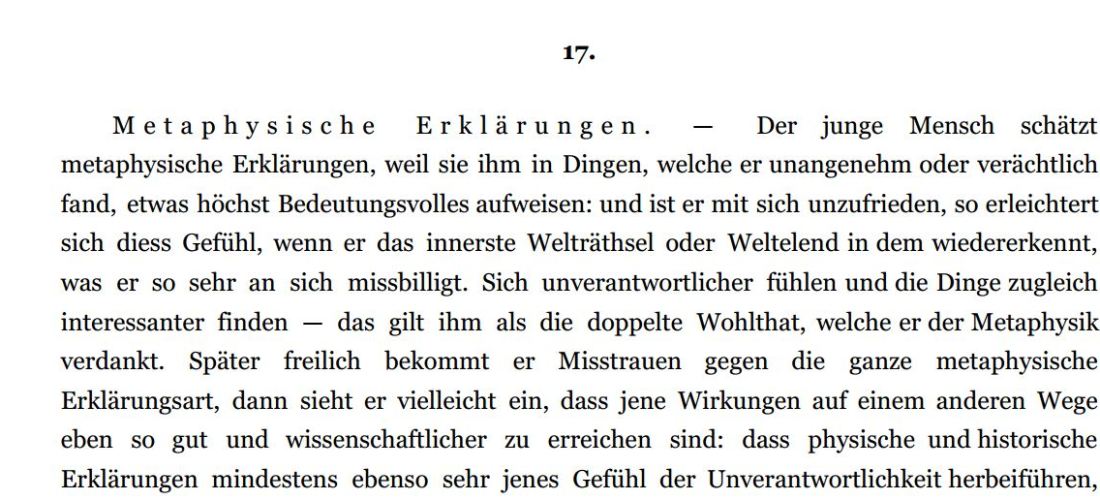
  1. Metaphysische Erklärungen. – Der junge Mensch schätzt metaphysische Erklärungen, weil sie ihm in Dingen, welche er unangenehm oder verächtlich fand, etwas höchst Bedeutungsvolles aufweisen: und ist er mit sich unzufrieden, so erleichtert sich diess Gefühl, wenn er das innerste Welträthsel oder Weltelend in dem wiedererkennt, was er so sehr an sich missbilligt. Sich unverantwortlicher fühlen und die Dinge zugleich interessanter finden – das gilt ihm als die doppelte Wohlthat, welche er der Metaphysik verdankt. Später freilich bekommt er Misstrauen gegen die ganze metaphysische Erklärungsart, dann sieht er vielleicht ein, dass jene Wirkungen auf einem anderen Wege eben so gut und wissenschaftlicher zu erreichen sind: dass physische und historische Erklärungen mindestens ebenso sehr jenes Gefühl der Unverantwortlichkeit herbeiführen, und dass jenes Interesse am Leben und seinen Problemen vielleicht noch mehr dabei entflammt wird.

Sources:

I will read a Dutch translation that is based on the work of researchers Colli and Montinari. I also use a translation from R.J.Hollingdale and the Gary Handwerk translation from the Colli-Montinari edition. Both are more modern than the copyright free translation I use here. This is a translation from 1909 by Helen Zimmern, who knew Nietzsche personally, but there was no critical study of Nietzsche’s work done back then and this translation suffers from that. The same goes for the translation from Alexander Harvey. My German is not good enough to pretend that I can translate it better than the professionals do but I will use the original as a referee.

  1. Menselijk al te menselijk een boek voor vrije geesten, translated by Thomas Graftdijk, 2000. Buy it here
  2. Human, all too human a book for free spirits, translated by R.J.Hollingdale, 1986
  3. Human, all too human a book for free spirits I V3, translated by Gary handwerk 1997
  4. Human, all too human a book for free spirits Part I, translated by Helen Zimmern 1909. Read it  here
  5. Human, all too human a book for free spirits, translated by Alexander Harvey, 1908. Read it here
  6. Menschliches allzu menschlich 1878/80. Read it here


16. Phenomenon and thing-in-itself

Human all too human

Reading Friedrich Nietzsche’s Human all too human

Read the introduction here

You can read the aphorism I discuss here in English an German below the main article.

Synopsis, quote from the translation by Helen Zimmern and my take on it

Philosophers see life and experiences as a picture that never changes. This picture must be correctly interpreted in order to come to a conclusion about the being that produced the picture or about the thing-in-itself1 what is regarded as sufficient ground for the world that appears to us. Philosophers see life as not changing Opposite to this, more logical minded people, after they described the metaphysical or unseen world as without a cause, have concluded that there was no connection between unseen world and the world which is known to us. Scientist see no connection between unseen and seen world So that the thing-in-itself should most certainly not appear in the phenomenon, (existing thing) and every conclusion from the former as regards the latter is to be rejected. Both sides forget that this painting of our life and experiences is still growing and cannot be used to look for a conclusion for the cause of it or deny one. (the sufficing cause)2 Our life and experiences are growing and cannot be used to predicts its cause. For ages we looked into the worlds pretentions, with blind inclination, passion, or fear, and illogical thoughts that this world has gradually become so terrible, full of meaning and of soul, it has acquired color—but we were the colorists. Our subjective eyes colored the world It is the intellect that has made this picture of life and experiences appear and put its mistaken fundamental conceptions into things. Later the philosophers started to see that the world we experience and the thing-in-itself are completely different and stopped drawing conclusions from our experiences out of the thing-in-itself, the philosophers will finely see that you cannot draw experience out of the thing-in-itself And in the worst case they will demand that we reject our personal will, so we can reach that what is real, that one may become real. Don’t know what F.N. meant with this Others have collected all the characteristic features of our world of appearance that is, the idea of the world spun out of intellectual errors and inherited by us, instead of blaming the intellect, they blamed the world-in-itself as the cause of the fact of this very sinister character of the world. Others blamed the world-in-itself and not the interpreter.  With all these opinions, the thorough process of science, that one day will celebrate its place in a history of thought, will deal with maybe as follows: That which we now call the world is the result of a mass of errors and fantasies which arose gradually in the general development of organic being, which are inter-grown with each other, and are now inherited by us as the accumulated treasure of all the past and it is a treasure, for the value of our humanity depends upon it. From this world of representation strict science is really only able to liberate us to a very slight extent—as it is also not at all desirable—inasmuch as it cannot essentially break the power of primitive habits of feeling; but it can gradually clarify the history of the rise of that world as representation,—and lift us, at least for moments, above and beyond the whole process. Perhaps we shall then recognize that the thing in itself is worth a Homeric laugh; that it seemed so much, indeed everything, and is really empty, namely, empty of meaning.”

Maybe it was not my day but I had a hard time with this aphorism, as if the different parts not really fitted with each other.

In one sentence:

Science will overcome the mistakes made by interpreting  life and experiences.

1 Objects as they are independent of observation (Read more)

2The Principle of Sufficient Reason is a powerful and controversial philosophical principle stipulating that everything must have a reason, cause, or ground. (Read more)


Human, all too human a book for free spirits Part I translated by Helen Zimmern 1909

  1. PHENOMENON AND THING-IN-ITSELF.—Philosophers are in the habit of setting themselves before life and experience—before that which they call the world of appearance—as before a picture that is once for all unrolled and exhibits unchangeably fixed the same process,—this process, they think, must be rightly interpreted in order to come to a conclusion about the being that produced the picture : about the thing-in-itself, therefore, which is always accustomed to be regarded as sufficient ground for the world of phenomenon. On the other hand, since one always makes the idea of the metaphysical stand definitely as that of the unconditioned, consequently also unconditioning, one must directly disown all connection between the unconditioned (the metaphysical world) and the world which is known to us ; so that the thing-in-itself should most certainly not appear in the phenomenon, and every conclusion from the former as regards the latter is to be rejected. Both sides overlook the fact that that picture—that which we now call human life and experience—has gradually evolved,—nay, is still in the full process of evolving,—and therefore should not be regarded as a fixed magnitude from which a conclusion about its originator might be deduced (the sufficing cause) or even merely neglected. It is because for thousands of years we have looked into the world with moral, æsthetic, and religious pretensions, with blind inclination, passion, or fear, and have surfeited ourselves in the vices of illogical thought, that this world has gradually become so marvellously motley, terrible, full of meaning and of soul, it has acquired colour—but we were the colourists; the human intellect, on the basis of human needs, of human emotions, has caused this ” phenomenon ” to appear and has carried its erroneous fundamental conceptions into things. Late, very late, it takes to thinking, and now the world of experience and the thing-in-itself seem to it so extraordinarily different and separated, that it gives up drawing conclusions from the former to the latter—or in a terribly mysterious manner demands the renunciation of our intellect, of our personal will, in order thereby to reach the essential, that one may become essential. Again, others have collected all the characteristic features of our world of phenomenon,—that is, the idea of the world spun out of intellectual errors and inherited by us,—and instead of accusing the intellect as the offenders, they have laid the blame on the nature of things as being the cause of the hard fact of this very sinister character of the world, and have preached the deliverance from Being. With all these conceptions the constant and laborious process of science (which at last celebrates its greatest triumph in a history of the origin of thought) becomes completed in various ways, the result of which might perhaps run as follows :—”That which we now call the world is the result of a mass of errors and fantasies which arose gradually in the general development of organic being, which are inter-grown with each other, and are now inherited by us as the accumulated treasure of all the past —as a treasure, for the value of our humanity depends upon it. From this world of representation strict science is really only able to liberate us to a very slight extent—as it is also not at all desirable—inasmuch as it cannot essentially break the power of primitive habits of feeling ; but it can gradually elucidate the history of the rise of that world as representation,—and lift us, at least for moments, above and beyond the whole process. Perhaps we shall then recognise that the thing in itself is worth a Homeric laugh ; that it seemed so much, indeed everything, and is really empty, namely, empty of meaning.”

Menschliches allzu menschlich 1878/80

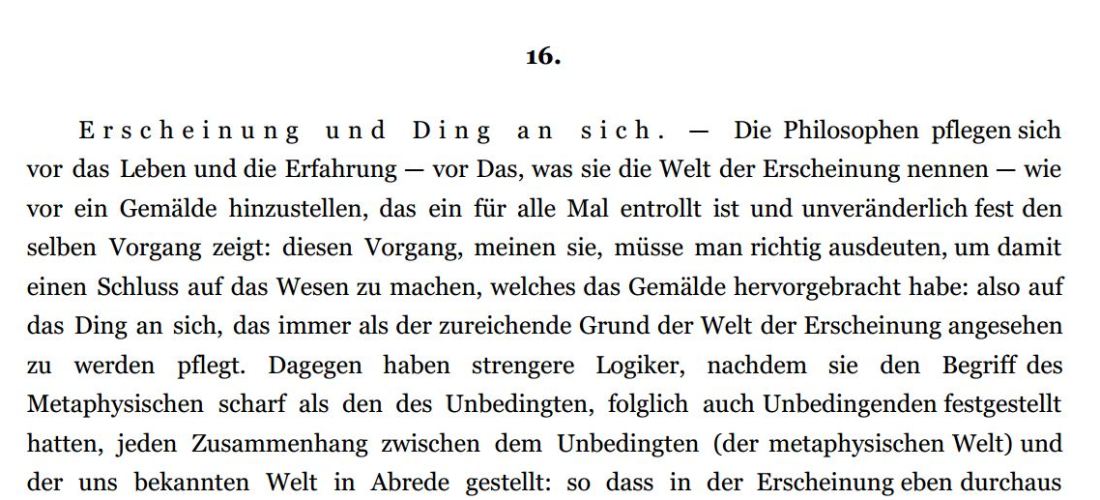
  1. Erscheinung und Ding an sich. – Die Philosophen pflegen sich vor das Leben und die Erfahrung – vor Das, was sie die Welt der Erscheinung nennen – wie vor ein Gemälde hinzustellen, das ein für alle Mal entrollt ist und unveränderlich fest den selben Vorgang zeigt: diesen Vorgang, meinen sie, müsse man richtig ausdeuten, um damit einen Schluss auf das Wesen zu machen, welches das Gemälde hervorgebracht habe: also auf das Ding an sich, das immer als der zureichende Grund der Welt der Erscheinung angesehen zu werden pflegt. Dagegen haben strengere Logiker, nachdem sie den Begriff des Metaphysischen scharf als den des Unbedingten, folglich auch Unbedingenden festgestellt hatten, jeden Zusammenhang zwischen dem Unbedingten (der metaphysischen Welt) und der uns bekannten Welt in Abrede gestellt: so dass in der Erscheinung eben durchaus nicht das Ding an sich erscheine, und von jener auf dieses jeder Schluss abzulehnen sei. Von beiden Seiten ist aber die Möglichkeit übersehen, dass jenes Gemälde – Das, was jetzt uns Menschen Leben und Erfahrung heisst – allmählich geworden ist, ja noch völlig im Werden ist und desshalb nicht als feste Grösse betrachtet werden soll, von welcher aus man einen Schluss über den Urheber (den zureichenden Grund) machen oder auch nur ablehnen dürfte. Dadurch, dass wir seit Jahrtausenden mit moralischen, ästhetischen, religiösen Ansprüchen, mit blinder Neigung, Leidenschaft oder Furcht in die Welt geblickt und uns in den Unarten des unlogischen Denkens recht ausgeschwelgt haben, ist diese Welt allmählich so wundersam bunt, schrecklich, bedeutungstief, seelenvoll geworden, sie hat Farbe bekommen, – aber wir sind die Coloristen gewesen: der menschliche Intellect hat die Erscheinung erscheinen lassen und seine irrthümlichen Grundauffassungen in die Dinge hineingetragen. Spät, sehr spät – besinnt er sich: und jetzt scheinen ihm die Welt der Erfahrung und das Ding an sich so ausserordentlich verschieden und getrennt, dass er den Schluss von jener auf dieses ablehnt – oder auf eine schauerlich geheimnissvolle Weise zum Aufgeben unsers Intellectes, unsers persönlichen Willens auffordert: um dadurch zum Wesenhaften zu kommen, dass man wesenhaft werde. Wiederum haben Andere alle charakteristischen Züge unserer Welt der Erscheinung – das heisst der aus intellectuellen Irrthümern herausgesponnenen und uns angeerbten Vorstellung von der Welt – zusammengelesen und anstatt den Intellect als Schuldigen anzuklagen, das Wesen der Dinge als Ursache dieses thatsächlichen, sehr unheimlichen Weltcharakters angeschuldigt und die Erlösung vom Sein gepredigt. – Mit all diesen Auffassungen wird der stetige und mühsame Process der Wissenschaft, welcher zuletzt einmal in einer Entstehungsgeschichte des Denkens seinen höchsten Triumph feiert, in entscheidender Weise fertig werden, dessen Resultat vielleicht auf diesen Satz hinauslaufen dürfte: Das, was wir jetzt die Welt nennen, ist das Resultat einer Menge von Irrthümern und Phantasien, welche in der gesammten Entwickelung der organischen Wesen allmählich entstanden, in einander verwachsen [sind] und uns jetzt als aufgesammelter Schatz der ganzen Vergangenheit vererbt werden, – als Schatz: denn der Werth unseres Menschenthums ruht darauf. Von dieser Welt der Vorstellung vermag uns die strenge Wissenschaft thatsächlich nur in geringem Maasse zu lösen – wie es auch gar nicht zu wünschen ist -, insofern sie die Gewalt uralter Gewohnheiten der Empfindung nicht wesentlich zu brechen vermag: aber sie kann die Geschichte der Entstehung jener Welt als Vorstellung ganz allmählich und schrittweise aufhellen – und uns wenigstens für Augenblicke über den ganzen Vorgang hinausheben. Vielleicht erkennen wir dann, dass das Ding an sich eines homerischen Gelächters werth ist: dass es so viel, ja Alles schien und eigentlich leer, nämlich bedeutungsleer ist.

Sources:

I will read a Dutch translation that is based on the work of researchers Colli and Montinari. I also use a translation from R.J.Hollingdale and the Gary Handwerk translation from the Colli-Montinari edition. Both are more modern than the copyright free translation I use here. This is a translation from 1909 by Helen Zimmern, who knew Nietzsche personally, but there was no critical study of Nietzsche’s work done back then and this translation suffers from that. The same goes for the translation from Alexander Harvey. My German is not good enough to pretend that I can translate it better than the professionals do but I will use the original as a referee.

  1. Menselijk al te menselijk een boek voor vrije geesten, translated by Thomas Graftdijk, 2000. Buy it here
  2. Human, all too human a book for free spirits, translated by R.J.Hollingdale, 1986
  3. Human, all too human a book for free spirits I V3, translated by Gary handwerk 1997
  4. Human, all too human a book for free spirits Part I, translated by Helen Zimmern 1909. Read it  here
  5. Human, all too human a book for free spirits, translated by Alexander Harvey, 1908. Read it here
  6. Menschliches allzu menschlich 1878/80. Read it here
 

15. No internal and external in the world

Human all too human

Reading Friedrich Nietzsche’s Human all too human

Read the introduction here

You can read the aphorism I discuss here in English an German below the main article.

Synopsis, quote from the translation by Helen Zimmern (1909) and my take on it

As Democritus1 transferred applied2 the concepts ” above ” and ” below ” to endless space where they have no sense, so philosophers in general have transferred Applied the concepts ” Internal ” and ” External ” to the essence and appearance of the world; Philosophers think that with deep internal feelings you can reach the “essence” of our nature. But these deep feelings are only deep if they are accompanied by hardly noticeable thoughts that we call “deep thoughts”, a feeling is deep because we think that the accompanying thought is deep. But these deep thoughts can be far from the truth for instance, every metaphysical one. If we take away the thoughts or words from the deep feeling we had, we are left with this deep feeling without any insight.  as strong faith proves only its strength and not the truth of what is believed in.

In one sentence:

Deep feelings are empty without words that are often empty to.

1Democritus was born in Abdera, Thrace, around 460 BC, although some thought it was 490 BC. His exact contributions are difficult to disentangle from those of his mentor Leucippus, as they are often mentioned together in texts. Their speculation on atoms, taken from Leucippus, bears a passing and partial resemblance to the 19th-century understanding of atomic structure that has led some to regard Democritus as more of a scientist than other Greek philosophers; however, their ideas rested on very different bases. Largely ignored in ancient Athens, Democritus is said to have been disliked so much by Plato that the latter wished all of his books burned. He was nevertheless well known to his fellow northern-born philosopher Aristotle. Many consider Democritus to be the “father of modern science”. None of his writings have survived; only fragments are known from his vast body of work. (Wikipedia)

2The German word “übertrug“ is in most translations translated as transferred but Handwerk translated it as extended and the Dutch version as “toepaste” that you translate in English as applied. It’s just a small difference between transferring, extending and applying and it has little influence on the whole aphorism. English is not my first languish, so I don’t know the full extent of the word transferred but it sounds like moved. In the second part of this first sentence: “transferred the concepts ” Internal ” and ” External ” to the essence and appearance of the world” I much rather use the word applied or extend.


Human, all too human a book for free spirits Part I translated by Helen Zimmern 1909

  1. NO INTERNAL AND EXTERNAL IN THE WORLD.—As Democritus transferred the concepts ” above ” and ” below ” to endless space where they have no sense, so philosophers in general have transferred the concepts ” Internal ” and ” External ” to the essence and appearance of the world ; they think that with deep feelings one can penetrate deeply into the internal and approach the heart of Nature. But these feelings are only deep in so far as along with them, barely noticeable, certain complicated groups of thoughts, which we call deep, are regularly excited ; a feeling is deep because we think that the accompanying thought is deep. But the ” deep ” thought can nevertheless be very far from the truth, as, for instance, every metaphysical one ; if one take away from the deep feeling the commingled elements of thought, then the strong feeling remains, and this guarantees nothing for knowledge but itself, just as strong faith proves only its strength and not the truth of what is believed in.

Menschliches allzu menschlich 1878/80

  1. Kein Innen und Aussen in der Welt. – Wie Demokrit die Begriffe Oben und Unten auf den unendlichen Raum übertrug, wo sie keinen Sinn haben, so die Philosophen überhaupt den Begriff “Innen und Aussen” auf Wesen und Erscheinung der Welt; sie meinen, mit tiefen Gefühlen komme man tief in’s Innere, nahe man sich dem Herzen der Natur. Aber diese Gefühle sind nur insofern tief, als mit ihnen, kaum bemerkbar, gewisse complicirte Gedankengruppen regelmässig erregt werden, welche wir tief nennen; ein Gefühl ist tief, weil wir den begleitenden Gedanken für tief halten. Aber der tiefe Gedanke kann dennoch der Wahrheit sehr fern sein, wie zum Beispiel jeder metaphysische; rechnet man vom tiefen Gefühle die beigemischten Gedankenelemente ab, so bleibt das starke Gefühl übrig, und dieses verbürgt Nichts für die Erkenntniss, als sich selbst, ebenso wie der starke Glaube nur seine Stärke, nicht die Wahrheit des Geglaubten beweist.

Sources:

I will read a Dutch translation that is based on the work of researchers Colli and Montinari. I also use a translation from R.J.Hollingdale and the Gary Handwerk translation from the Colli-Montinari edition. Both are more modern than the copyright free translation I use here. This is a translation from 1909 by Helen Zimmern, who knew Nietzsche personally, but there was no critical study of Nietzsche’s work done back then and this translation suffers from that. The same goes for the translation from Alexander Harvey. My German is not good enough to pretend that I can translate it better than the professionals do but I will use the original as a referee.

  1. Menselijk al te menselijk een boek voor vrije geesten, translated by Thomas Graftdijk, 2000. Buy it here
  2. Human, all too human a book for free spirits, translated by R.J.Hollingdale, 1986
  3. Human, all too human a book for free spirits I V3, translated by Gary handwerk 1997
  4. Human, all too human a book for free spirits Part I, translated by Helen Zimmern 1909. Read it  here
  5. Human, all too human a book for free spirits, translated by Alexander Harvey, 1908. Read it here
  6. Menschliches allzu menschlich 1878/80. Read it here


14. Co-echoing

Human all too human

Reading Friedrich Nietzsche’s Human all too human

Read the introduction here

You can read the aphorism I discuss here below the main article.

Note:

The German word Miterklingen, the title of this aphorism, is not a real German word as far as I can find out. In the English translation by Alexander Harvey he had a note:  “Miterklingen: to sound simultaneously with”  I agree with that, in one word it would be something like: withsounds. I don’t know why the translators didn’t took the freedom to invent a word like Nietzsche did.

For this aphorism I also included the other 3 translation that I use from Harvey (1909), Hollingdale (1986) and Handwerk (1997). For convenience, and the interested, I put every sentence side by side, so you can compare the different translations easier. There are no big surprises that influences the message  of this aphorism, besides the last word “thing” but it is interesting to see the differences and the freedom the translators took.

Synopsis and my take on it:

Al strong moods bring ripples of similar moods with them, they mix up your memory. In the mix you recognize “similar conditions and their origin”, there are quick connections made of “feelings and thoughts” and are felt as one and not separate. “In this sense one speaks of the moral feeling, of the religious feeling, as if they were absolute unities: in reality they are streams with a hundred sources and tributaries.”. “Here also, as so often happens, the unity of the word is no security for the unity of the thing1.”  With this last sentence Nietzsche puts the aphorism a little bit on its head but I think he meant: The “word” is like the mood, also accompanied by other similar words and meanings, when describing an “thing” with words that also are blurred by their meaning the “thing”  itself gets blurred.

In one sentence:

Complex moods feel like one, but are not, like words.

1The German word “sache” is translated by all four as “thing” but I think it’s more a word between a “thing” and a “case”, maybe entity.  In the Dutch translation it is translated as “zaak” and that can mean  a thing, but also a case but also a cross between the two.


13

Download the word document here: CO-ECHOING


Human, all too human a book for free spirits Part I translated by Helen Zimmern 1909

  1. CO-ECHOING.—All stronger moods bring with them a co-echoing of kindred sensations and moods, they grub up the memory, so to speak. Along with them something within us remembers and becomes conscious of similar conditions and their origin. Thus there are formed quick habitual connections of feelings and thoughts, which eventually, when they follow each other with lightning speed, are no longer felt as complexes but as unities. In this sense one speaks of the moral feeling, of the religious feeling, as if they were absolute unities : in reality they are streams with a hundred sources and tributaries. Here also, as so often happens, the unity of the word is no security for the unity of the thing.

Human, all too human a book for free spirits, translated by Alexander Harvey, 1908

Association.—All strong feelings are associated with a variety of allied sentiments and emotions. They stir up the memory at the same time. When we are under their influence we are reminded of similar states and we feel a renewal of them within us. Thus are formed habitual successions of feelings and notions, which, at last, when they follow one another with lightning rapidity are no longer felt as complexities but as unities. In this sense we hear of moral feelings, of religious feelings, as if they were absolute unities. In reality they are streams with a hundred sources and tributaries. Here again, the unity of the word speaks nothing for the unity of the thing.

Human, all too human a book for free spirits, translated by R.J.Hollingdale, 1986

14 Sympathetic resonance. – All stronger moods bring with them a sympathetic resonance on the part of related sensations and moods: they as it were root up the memory. Something in us is provoked to recollection and becomes aware of similar states and their origins. Thus there come to be constructed habitual rapid connections between feelings and thoughts which, if they succeed one another with lightning speed, are in the end no longer experienced as complexes but as unities. It is in this sense that one speaks of the moral feelings, of the religious feelings, as though these were simple unities: in truth, however, they are rivers with a hundred tributaries and sources. Here too, as so often, the unity of the word is no guarantee of the unity of the thing.

Human, all too human a book for free spirits I V3, translated by Gary Handwerk 1997

Resonances, – All stronger moods bring along with them a resonance of related sensations and moods; they churn up our memory, as it were. They bring something to mind, making us conscious of similar states and their origins. In this way habitual, rapid associations of feelings and thoughts are formed, which finally, when they follow after one another with lightning speed, are no longer even sensed as complex, but rather as unities. In this sense, we speak of moral feelings, of religious feelings, as if these were nothing but unities: in truth, they are streams with a hundred sources and tributaries. Here, too, as so often, the unity of the word guarantees nothing about the unity of the thing.


Menschliches allzu menschlich 1878/80

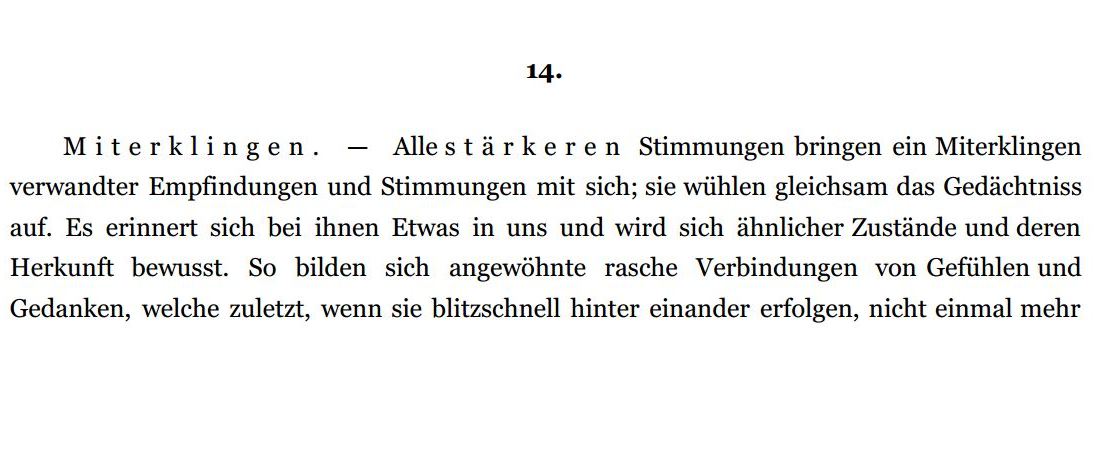
  1. Miterklingen. – Alle stärkeren Stimmungen bringen ein Miterklingen verwandter Empfindungen und Stimmungen mit sich; sie wühlen gleichsam das Gedächtniss auf. Es erinnert sich bei ihnen Etwas in uns und wird sich ähnlicher Zustände und deren Herkunft bewusst. So bilden sich angewöhnte rasche Verbindungen von Gefühlen und Gedanken, welche zuletzt, wenn sie blitzschnell hinter einander erfolgen, nicht einmal mehr als Complexe, sondern als Einheiten empfunden werden. In diesem Sinne redet man vom moralischen Gefühle, vom religiösen Gefühle, wie als ob diess lauter Einheiten seien: in Wahrheit sind sie Ströme mit hundert Quellen und Zuflüssen. Auch hier, wie so oft, verbürgt die Einheit des Wortes Nichts für die Einheit der Sache.

Sources:

I will read a Dutch translation that is based on the work of researchers Colli and Montinari. I also use a translation from R.J.Hollingdale and the Gary Handwerk translation from the Colli-Montinari edition. Both are more modern than the copyright free translation I use here. This is a translation from 1909 by Helen Zimmern, who knew Nietzsche personally, but there was no critical study of Nietzsche’s work done back then and this translation suffers from that. The same goes for the translation from Alexander Harvey. My German is not good enough to pretend that I can translate it better than the professionals do but I will use the original as a referee.

  1. Menselijk al te menselijk een boek voor vrije geesten, translated by Thomas Graftdijk, 2000. Buy it here
  2. Human, all too human a book for free spirits, translated by R.J.Hollingdale, 1986
  3. Human, all too human a book for free spirits I V3, translated by Gary handwerk 1997
  4. Human, all too human a book for free spirits Part I, translated by Helen Zimmern 1909. Read it  here
  5. Human, all too human a book for free spirits, translated by Alexander Harvey, 1908. Read it here
  6. Menschliches allzu menschlich 1878/80. Read it here
 

13. The logic of dreams

Human all too human

Reading Friedrich Nietzsche’s Human all too human

Read the introduction here

You can read the aphorism I discuss here below the main article.

Synopsis and my take on it:

Nietzsche writes that many different “inner occurrences” brings to the dreamer “hundred occasions for the spirit to be surprised and to seek for the reasons of this excitation”. The dreamer will interpret the influences on his body in his dream. “A person who, for instance, binds his feet with two straps will perhaps dream that two serpents are coiling round his feet”. The sleeper thinks and imagines that “These serpents must be the causa of those sensations which I, the sleeper, experience,”—so decides the mind of the sleeper. The dreamer weaves external influences into his dreams. “But how does it happen that the mind of the dreamer is always so mistaken, while the same mind when awake is accustomed to be so temperate, careful, and skeptical with regard to its hypotheses?” “I hold, that as man now still reasons in dreams, so men reasoned also when awake through thousands of years” Humans treated unseen influences in the past as we still do in our dreams. “the first causa which occurred to the mind to explain anything that required an explanation, was sufficient and stood for truth.” We still develop on that dream thinking our higher reasoning. During our development this explaining thru what comes first into your mind like in the dream state  ”dreaming is a recreation for the brain, which by day has to satisfy the stern demands of thought, as they are laid down by the higher culture”

Now Nietzsche explains what in his view the dreams are made of, from light and colors you collected during the day. “The actual accompanying process thereby is again a kind of conclusion from the effect to the cause: since the mind asks, ” Whence come these impressions of light and colour? ” it supposes those figures and forms as causes; it takes them for the origin of those colours and lights, because in the daytime, with open eyes, it is accustomed to find a producing cause for every colour, every effect of light. Here, therefore, the imagination constantly places pictures before the mind, since it supports itself on the visual impressions of the day in their production, and the dream-imagination does just the same thing, —that is, the supposed cause is deduced from the effect and represented after the effect” Because this al goes fast and “a sequence may look like something simultaneous, or even like a reversed sequence” you can understand why I took so long for “the strict discrimination of cause and effect” to develop “when our reasoning and understanding faculties still involuntarily hark back to those primitive forms of deduction, and when we pass about half our life in this condition. The poet, too, and the artist assign causes for their moods and conditions which are by no means the true ones; in this they recall an older humanity and can assist us to the understanding of it.

In one sentence:

The way we make a dream is the basis of our thinking


Human, all too human a book for free spirits Part I translated by Helen Zimmern 1909

  1. THE LOGIC OF DREAMS.—In sleep our nervous system is perpetually excited by numerous inner occurrences ; nearly all the organs are disjointed and in a state of activity, the blood runs its turbulent course, the position of the sleeper causes pressure on certain limbs, his coverings influence his sensations in various ways, the stomach digests and by its movements it disturbs other organs, the intestines writhe, the position of the head occasions unaccustomed play of muscles, the feet, unshod, not pressing upon the floor with the soles, occasion the feeling of the unaccustomed just as does the different clothing of the whole body: all this, according to its daily change and extent, excites by its extraordinariness the entire system to the very functions of the brain, and thus there are a hundred occasions for the spirit to be surprised and to seek for the reasons of this excitation ;—the dream, however, is the seeking and representing of the causes of those excited sensations,—that is, of the supposed causes. A person who, for instance, binds his feet with two straps will perhaps dream that two serpents are coiling round his feet; this is first hypothesis, then a belief, with an accompanying mental picture and interpretation—” These serpents must be the causa of those sensations which I, the sleeper, experience,”—so decides the mind of the sleeper. The immediate past, so disclosed, becomes to him the present through his excited imagination. Thus every one knows from experience how quickly the dreamer weaves into his dream a loud sound that he hears, such as the ringing of bells or the firing of cannon, that is to say, explains it from afterwards so that he first thinks he experiences the producing circumstances and then that sound. But how does it happen that the mind of the dreamer is always so mistaken, while the same mind when awake is accustomed to be so temperate, careful, and sceptical with regard to its hypotheses? so that the first random hypothesis for the explanation of a feeling suffices for him to believe immediately in its truth ? (For in dreaming we believe in the dream as if it were a reality, i.e. we think our hypothesis completely proved.) I hold, that as man now still reasons in dreams, so men reasoned also when awake through thousands of years ; the first causa which occurred to the mind to explain anything that required an explanation, was sufficient and stood for truth. (Thus, according to travellers’ tales, savages still do to this very day.) This ancient element in human nature still manifests itself in our dreams, for it is the foundation upon which the higher reason has developed and still develops in every individual ; the dream carries us back into remote conditions of human culture, and provides a ready means of understanding them better. Dream-thinking is now so easy to us because during immense periods of human development we have been so well drilled in this form of fantastic and cheap explanation, by means of the first agreeable notions. In so far, dreaming is a recreation for the brain, which by day has to satisfy the stern demands of thought, as they are laid down by the higher culture. We can at once discern an allied process even in our awakened state, as the door and ante-room of the dream. If we shut our eyes, the brain produces a number of impressions of light and colour, probably as a kind of after-play and echo of all those effects of light which crowd in upon it by day. Now, however, the understanding, together with the imagination, instantly works up this play of colour, shapeless in itself, into definite figures, forms, landscapes, and animated groups. The actual accompanying process thereby is again a kind of conclusion from the effect to the cause : since the mind asks, ” Whence come these impressions of light and colour ? ” it supposes those figures and forms as causes ; it takes them for the origin of those colours and lights, because in the daytime, with open eyes, it is accustomed to find a producing cause for every colour, every effect of light. Here, therefore, the imagination constantly places pictures before the mind, since it supports itself on the visual impressions of the day in their production, and the dream-imagination does just the same thing,—that is, the supposed cause is deduced from the effect and represented after the effect ; all this happens with extraordinary rapidity, so that here, as with the conjuror, a confusion of judgment may arise and a sequence may look like something simultaneous, or even like a reversed sequence. From these circumstances we may gather how lately the more acute logical thinking, the strict discrimination of cause and effect has been developed, when our reasoning and understanding faculties still involuntarily hark back to those primitive forms of deduction, and when we pass about half our life in this condition. The poet, too, and the artist assign causes for their moods and conditions which are by no means the true ones ; in this they recall an older humanity and can assist us to the understanding of it.

Menschliches allzu menschlich 1878/80

  1. Logik des Traumes. – Im Schlafe ist fortwährend unser Nervensystem durch mannichfache innere Anlässe in Erregung, fast alle Organe secerniren und sind in Thätigkeit, das Blut macht seinen ungestümen Kreislauf, die Lage des Schlafenden drückt einzelne Glieder, seine Decken beeinflussen die Empfindung verschiedenartig, der Magen verdaut und beunruhigt mit seinen Bewegungen andere Organe, die Gedärme winden sich, die Stellung des Kopfes bringt ungewöhnliche Muskellagen mit sich, die Füsse, unbeschuht, nicht mit den Sohlen den Boden drückend, verursachen das Gefühl des Ungewöhnlichen ebenso wie die andersartige Bekleidung des ganzen Körpers, – alles diess nach seinem täglichen Wechsel und Grade erregt durch seine Aussergewöhnlichkeit das gesammte System bis in die Gehirnfunction hinein: und so giebt es hundert Anlässe für den Geist, um sich zu verwundern und nach Gründen dieser Erregung zu suchen: der Traum aber ist das Suchen und Vorstellen der Ursachen für jene erregten Empfindungen, das heisst der vermeintlichen Ursachen. Wer zum Beispiel seine Füsse mit zwei Riemen umgürtet, träumt wohl, dass zwei Schlangen seine Füsse umringeln: diess ist zuerst eine Hypothese, sodann ein Glaube, mit einer begleitenden bildlichen Vorstellung und Ausdichtung: “diese Schlangen müssen die causa jener Empfindung sein, welche ich, der Schlafende, habe”, – so urtheilt der Geist des Schlafenden. Die so erschlossene nächste Vergangenheit wird durch die erregte Phantasie ihm zur Gegenwart. So weiss jeder aus Erfahrung, wie schnell der Träumende einen starken an ihn dringenden Ton, zum Beispiel Glockenläuten, Kanonenschüsse in seinen Traum verflicht, das heisst aus ihm hinterdrein erklärt, so dass er zuerst die veranlassenden Umstände, dann jenen Ton zu erleben meint. – Wie kommt es aber, dass der Geist des Träumenden immer so fehl greift, während der selbe Geist im Wachen so nüchtern, behutsam und in Bezug auf Hypothesen so skeptisch zu sein pflegt? so dass ihm die erste beste Hypothese zur Erklärung eines Gefühls genügt, um sofort an ihre Wahrheit zu glauben? (denn wir glauben im Traume an den Traum, als sei er Realität, das heisst wir halten unsre Hypothese für völlig erwiesen). – Ich meine: wie jetzt noch der Mensch im Traume schliesst, so schloss die Menschheit auch im Wachen viele Jahrtausende hindurch: die erste causa, die dem Geiste einfiel, um irgend Etwas, das der Erklärung bedurfte, zu erklären, genügte ihm und galt als Wahrheit. (So verfahren nach den Erzählungen der Reisenden die Wilden heute noch.) Im Traum übt sich dieses uralte Stück Menschenthum in uns fort, denn es ist die Grundlage, auf der die höhere Vernunft sich entwickelte und in jedem Menschen sich noch entwickelt: der Traum bringt uns in ferne Zustände der menschlichen Cultur wieder zurück und giebt ein Mittel an die Hand, sie besser zu verstehen. Das Traumdenken wird uns jetzt so leicht, weil wir in ungeheuren Entwickelungsstrecken der Menschheit gerade auf diese Form des phantastischen und wohlfeilen Erklärens aus dem ersten beliebigen Einfalle heraus so gut eingedrillt worden sind. Insofern ist der Traum eine Erholung für das Gehirn, welches am Tage den strengeren Anforderungen an das Denken zu genügen hat, wie sie von der höheren Cultur gestellt werden. – Einen verwandten Vorgang können wir geradezu als Pforte und Vorhalle des Traumes noch bei wachem Verstande in Augenschein nehmen. Schliessen wir die Augen, so producirt das Gehirn eine Menge von Lichteindrücken und Farben, wahrscheinlich als eine Art Nachspiel und Echo aller jener Lichtwirkungen, welche am Tage auf dasselbe eindringen. Nun verarbeitet aber der Verstand (mit der Phantasie im Bunde) diese an sich formlosen Farbenspiele sofort zu bestimmten Figuren, Gestalten, Landschaften, belebten Gruppen. Der eigentliche Vorgang dabei ist wiederum eine Art Schluss von der Wirkung auf die Ursache; indem der Geist fragt: woher diese Lichteindrücke und Farben, supponirt er als Ursachen jene Figuren, Gestalten: sie gelten ihm als die Veranlassungen jener Farben und Lichter, weil er, am Tage, bei offenen Augen, gewohnt ist, zu jeder Farbe, jedem Lichteindrucke eine veranlassende Ursache zu finden. Hier also schiebt ihm die Phantasie fortwährend Bilder vor, indem sie an die Gesichtseindrücke des Tages sich in ihrer Production anlehnt, und gerade so macht es die Traumphantasie: – das heisst die vermeintliche Ursache wird aus der Wirkung erschlossen und nach der Wirkung vorgestellt: alles diess mit ausserordentlicher Schnelligkeit, so dass hier wie beim Taschenspieler eine Verwirrung des Urtheils entstehen und ein Nacheinander sich wie etwas Gleichzeitiges, selbst wie ein umgedrehtes Nacheinander ausnehmen kann. – Wir können aus diesen Vorgängen entnehmen, wie spät das schärfere logische Denken, das Strengnehmen von Ursache und Wirkung, entwickelt worden ist, wenn unsere Vernunft- und Verstandesfunctionen jetzt noch unwillkürlich nach jenen primitiven Formen des Schliessens zurückgreifen und wir ziemlich die Hälfte unseres Lebens in diesem Zustande leben. – Auch der Dichter, der Künstler schiebt seinen Stimmungen und Zuständen Ursachen unter, welche durchaus nicht die wahren sind; er erinnert insofern an älteres Menschenthum und kann uns zum Verständnisse desselben verhelfen.

Sources:

I will read a Dutch translation that is based on the work of researchers Colli and Montinari. I also use a translation from R.J.Hollingdale and the Gary Handwerk translation from the Colli-Montinari edition. Both are more modern than the copyright free translation I use here. This is a translation from 1909 by Helen Zimmern, who knew Nietzsche personally, but there was no critical study of Nietzsche’s work done back then and this translation suffers from that. The same goes for the translation from Alexander Harvey. My German is not good enough to pretend that I can translate it better than the professionals do but I will use the original as a referee.

  1. Menselijk al te menselijk een boek voor vrije geesten, translated by Thomas Graftdijk, 2000. Buy it here
  2. Human, all too human a book for free spirits, translated by R.J.Hollingdale, 1986
  3. Human, all too human a book for free spirits I V3, translated by Gary handwerk 1997
  4. Human, all too human a book for free spirits Part I, translated by Helen Zimmern 1909. Read it  here
  5. Human, all too human a book for free spirits, translated by Alexander Harvey, 1908. Read it here
  6. Menschliches allzu menschlich 1878/80. Read it here


12. Dream and culture

Human all too human

Reading Friedrich Nietzsche’s Human all too human

Read the introduction here

You can read the aphorism I discuss, below the main article.

Synopsis and my take on it:

While dreaming our memory is “brought back to a condition of imperfection such as everyone may have experienced in pre-historic times, whether asleep or awake.” The dreams are “arbitrary and confused” like the mythologies they invented. People that visited “savage” people tell of their “short tension of memory, his mind begins to sway here and there from sheer weariness and gives forth lies and nonsense.”  But in dreams we are all like the savage, we misinterpreted our dreams and are alarmed if we recollect the dream clearly. The clarity of the pictures in a dream make us believe that they are real and “recall the conditions that appertain relate to primitive man, in whom hallucination was extraordinarily frequent, and sometimes simultaneously seized entire communities, entire nations. Therefore, in sleep and in dreams we once more carry out the task1 homework of early humanity.2

In one sentence:

Our dreams and myths are from the savages

1Zimmern translated the German word pensum with task and Hollingdale with curriculum. I personally like the definition from Collinsdictionary.com the best: “1. a piece of work or a task to be completed, esp a school exercise2. a piece of extra school work set as a form of punishment” I like the added punishment in these definitions. In the Dutch version its translated as “huiswerk” or homework.

2Hollingdale has a note for this aphorism:  In The Interpretation of Dreams, ch. VII (6), Freud writes: ‘We can guess how much to the point is Nietzsche’s assertion that in dreams “some primeval relic of humanity is at work which we can now scarcely reach any longer by a direct path”; and we may expect that the analysis of dreams will lead us to a knowledge of man’s archaic heritage, of what is psychologically innate in him.


Human, all too human a book for free spirits Part I translated by Helen Zimmern 1909

  1. DREAM AND CULTURE.—The function of the brain which is most influenced by sleep is the memory ; not that it entirely ceases ; but it is brought back to a condition of imperfection, such as everyone may have experienced in pre-historic times, whether asleep or awake. Arbitrary and confused as it is, it constantly confounds things on the ground of the most fleeting resemblances; but with the same arbitrariness and confusion the ancients invented their mythologies, and even at the present day travellers are accustomed to remark how prone the savage is to forgetfulness, how, after a short tension of memory, his mind begins to sway here and there from sheer weariness and gives forth lies and nonsense. But in dreams we all resemble the savage ; bad recognition and erroneous comparisons are the reasons of the bad conclusions, of which we are guilty in dreams : so that, when we clearly recollect what we have dreamt, we are alarmed at ourselves at harbouring so much foolishness within us. The perfect distinctness of all dream-representations, which pre-suppose absolute faith in their reality, recall the conditions that appertain to primitive man, in whom hallucination was extraordinarily frequent, and sometimes simultaneously seized entire communities, entire nations. Therefore, in sleep and in dreams we once more carry out the task of early humanity.

Menschliches allzu menschlich 1878/80

  1. Traum und Cultur.- Die Gehirnfunction, welche durch den Schlaf am meisten beeinträchtigt wird, ist das Gedächtniss: nicht dass es ganz pausirte, – aber es ist auf einen Zustand der Unvollkommenheit zurückgebracht, wie es in Urzeiten der Menschheit bei jedermann am Tage und im Wachen gewesen sein mag. Willkürlich und verworren, wie es ist, verwechselt es fortwährend die Dinge auf Grund der flüchtigsten Aehnlichkeiten: aber mit der selben Willkür und Verworrenheit dichteten die Völker ihre Mythologien, und noch jetzt pflegen Reisende zu beobachten, wie sehr der Wilde zur Vergesslichkeit neigt, wie sein Geist nach kurzer Anspannung des Gedächtnisses hin und her zu taumeln beginnt und er, aus blosser Erschlaffung, Lügen und Unsinn hervorbringt. Aber wir Alle gleichen im Traume diesem Wilden; das schlechte Wiedererkennen und irrthümliche Gleichsetzen ist der Grund des schlechten Schliessens, dessen wir uns im Traume schuldig machen: so dass wir, bei deutlicher Vergegenwärtigung eines Traumes, vor uns erschrecken, weil wir so viel Narrheit in uns bergen. – Die vollkommene Deutlichkeit aller Traum-Vorstellungen, welche den unbedingten Glauben an ihre Realität zur Voraussetzung hat, erinnert uns wieder an Zustände früherer Menschheit, in der die Hallucination ausserordentlich häufig war und mitunter ganze Gemeinden, ganze Völker gleichzeitig ergriff. Also: im Schlaf und Traum machen wir das Pensum früheren Menschenthums noch einmal durch.

Sources:

I will read a Dutch translation that is based on the work of researchers Colli and Montinari. I also use a translation from R.J.Hollingdale and the Gary Handwerk translation from the Colli-Montinari edition. Both are more modern than the copyright free translation I use here. This is a translation from 1909 by Helen Zimmern, who knew Nietzsche personally, but there was no critical study of Nietzsche’s work done back then and this translation suffers from that. The same goes for the translation from Alexander Harvey. My German is not good enough to pretend that I can translate it better than the professionals do but I will use the original as a referee.

  1. Menselijk al te menselijk een boek voor vrije geesten, translated by Thomas Graftdijk, 2000. Buy it here
  2. Human, all too human a book for free spirits, translated by R.J.Hollingdale, 1986
  3. Human, all too human a book for free spirits I V3, translated by Gary handwerk 1997
  4. Human, all too human a book for free spirits Part I, translated by Helen Zimmern 1909. Read it  here
  5. Human, all too human a book for free spirits, translated by Alexander Harvey, 1908. Read it here
  6. Menschliches allzu menschlich 1878/80. Read it here


11. Language as a presumptive science

Human all too human

You can read the aphorism I discuss here below the main article.

Synopsis and my take on it:

The importance of language for the development of culture lies in the fact that in language man has placed a world of his own beside the other, Languages describes the world, becomes its own world, but is not the real world  a position which he deemed so fixed that he might therefrom lift the rest of the world off its hinges, and make himself master of it.” Man thought that the construction he made out of language was so stable that he could rule the world with it As far as people believed as “æternæ veritateseternal truthfor a great length of time, he has acquired that pride by which he has raised himself above the animal; he really thought that in language he possessed the knowledge of the world. The maker of language was not modest enough to think that he only gave designations names to things, he believed rather that with his words he expressed the widest knowledge of the things;” Language is the first step towards science. From “which the mightiest sources of strength have flowed” From the belief that science came out of language a strong force came into the worldMuch later—only now—it is dawning upon men that they have propagated a tremendous error1 in their belief in language. Fortunately, it is now too late to reverse the development of reason, which is founded upon that belief. Reason is based on the falls belief that language can be used to name or rule the world  Logic, also, is founded upon suppositions2 to which nothing in the actual world corresponds,” As an example the “supposition2 of the equality of things, and the identity of the same thing at different points of time” But science came out of the world where they thought such things existed In the world of languages things like circles and straight lines exist. “It is the same with mathematics, which would certainly not have arisen if it had been known from the beginning that in Nature there are no exactly straight lines, no real circle, no absolute standard of size.”

In one sentence:

Reason would not exist without our first wrong words.

1In the translation by Hollingdale there is a note at this place that points to the following assay from Nietzsche: On Truth and Lies in a Nonmoral Sense (1973) This is a quote from that book: “Every word immediately becomes a concept, inasmuch as it is not intended to serve as a reminder of the unique and wholly individualized original experience to which it owes its birth, but must at the same time fit innumerable, more or less similar cases—which means, strictly speaking, never equal—in other words, a lot of unequal cases. Every concept originates through our equating what is unequal.” Read more here

2Zimern translates “Voraussetzung“ with supposition (a hypothesis beforehand) and Hollingdale translates it with presupposition (an assumption beforehand). In German the word Voraussetzung is defined as: eine feste Vorstellung, die das weitere Tun oder Denken leitet (a fixed idea that guides further action or thinking). Which correspond better with the English word Presupposition.


Human, all too human a book for free spirits Part I translated by Helen Zimmern 1909

  1. LANGUAGE AS A PRESUMPTIVE SCIENCE.—The importance of language for the development of culture lies in the fact that in language man has placed a world of his own beside the other, a position which he deemed so fixed that he might therefrom lift the rest of the world off its hinges, and make himself master of it. Inasmuch as man has believed in the ideas and names of things as æternæ veritates for a great length of time, he has acquired that pride by which he has raised himself above the animal; he really thought that in language he possessed the knowledge of the world. The maker of language was not modest enough to think that he only gave designations to things, he believed rather that with his words he expressed the widest knowledge of the things ; in reality language is the first step in the endeavour after science. Here also it is belief in ascertained truth, from which the mightiest sources of strength have flowed. Much later—only now—it is dawning upon men that they have propagated a tremendous error in their belief in language. Fortunately it is now too late to reverse the development of reason, which is founded upon that belief. Logic, also, is founded upon suppositions to which nothing in the actual world corresponds,—for instance, on the supposition of the equality of things, and the identity of the same thing at different points of time,—but that particular science arose out of the contrary belief (that such things really existed in the actual world). It is the same with mathematics, which would certainly not have arisen if it had been known from the beginning that in Nature there are no exactly straight lines, no real circle, no absolute standard of size.

Menschliches allzu menschlich 1878/80

11. Die Sprache als vermeintliche Wissenschaft. – Die Bedeutung der Sprache für die Entwickelung der Cultur liegt darin, dass in ihr der Mensch eine eigene Welt neben die andere stellte, einen Ort, welchen er für so fest hielt, um von ihm aus die übrige Welt aus den Angeln zu heben und sich zum Herrn derselben zu machen. Insofern der Mensch an die Begriffe und Namen der Dinge als an aeternae veritates durch lange Zeitstrecken hindurch geglaubt hat, hat er sich jenen Stolz angeeignet, mit dem er sich über das Thier erhob: er meinte wirklich in der Sprache die Erkenntniss der Welt zu haben. Der Sprachbildner war nicht so bescheiden, zu glauben, dass er den Dingen eben nur Bezeichnungen gebe, er drückte vielmehr, wie er wähnte, das höchste Wissen über die Dinge mit den Worten aus; in der That ist die Sprache die erste Stufe der Bemühung um die Wissenschaft. Der Glaube an die gefundene Wahrheit ist es auch hier, aus dem die mächtigsten Kraftquellen geflossen sind. Sehr nachträglich -jetzt erst – dämmert es den Menschen auf, dass sie einen ungeheuren Irrthum in ihrem Glauben an die Sprache propagirt haben. Glücklicherweise ist es zu spät, als dass es die Entwickelung der Vernunft, die auf jenem Glauben beruht, wieder rückgängig machen könnte. – Auch die Logik beruht auf Voraussetzungen, denen Nichts in der wirklichen Welt entspricht, z.B. auf der Voraussetzung der Gleichheit von Dingen, der Identität des selben Dinges in verschiedenen Puncten der Zeit: aber jene Wissenschaft entstand durch den entgegengesetzten Glauben (dass es dergleichen in der wirklichen Welt allerdings gebe). Ebenso steht es mit der Mathematik, welche gewiss nicht entstanden wäre, wenn man von Anfang an gewusst hätte, dass es in der Natur keine exact gerade Linie, keinen wirklichen Kreis, kein absolutes Grössenmaass gebe.


Sources:

I will read a Dutch translation that is based on the work of researchers Colli and Montinari. I also use a translation from R.J.Hollingdale and the Gary Handwerk translation from the Colli-Montinari edition. Both are more modern than the copyright free translation I use here. This is a translation from 1909 by Helen Zimmern, who knew Nietzsche personally, but there was no critical study of Nietzsche’s work done back then and this translation suffers from that. The same goes for the translation from Alexander Harvey. My German is not good enough to pretend that I can translate it better than the professionals do but I will use the original as a referee.

  1. Menselijk al te menselijk een boek voor vrije geesten, translated by Thomas Graftdijk, 2000. Buy it here
  2. Human, all too human a book for free spirits, translated by R.J.Hollingdale, 1986
  3. Human, all too human a book for free spirits I V3, translated by Gary handwerk 1997
  4. Human, all too human a book for free spirits Part I, translated by Helen Zimmern 1909. Read it  here
  5. Human, all too human a book for free spirits, translated by Alexander Harvey, 1908. Read it here
  6. Menschliches allzu menschlich 1878/80. Read it here


10. The harmlessness of metaphysics in the future

Human all too human

You can read the aphorism I discuss here below the main article.


Synopsis and my take on it:

As soon as the origins of “religion, art, and morals” are understood without the use of metaphysical interference or without interference that goes beyond physical nature “at the beginning and in” their progress, the interest in “the ” thing-in-itself ” and the ” phenomenon ” ceases.”  Because with the for mentioned religion, art, and morals we do not touch the “essence of the world in itself we are in the domain of representation or vorstellung1 in German and is translated by Hollingdale as Ideas and I think that’s better …”no ” intuition ” can carry us further.” Than Nietzsche states that the question “as to how our own conception of the world can differ so widely from the revealed essence of the world, to physiology2 and the history of the evolution of organisms and ideas

In one sentence:

With knowledge the “thing in itself” will disappear.

1 Vorstellung, a mental image or idea produced by prior perception of an object, as in memory or imagination, rather than by actual perception. (google)

2 the branch of biology dealing with the functions and activities of living organisms and their parts, including all physical and chemical processes. (dictionary.com)


Human, all too human a book for free spirits Part I translated by Helen Zimmern 1909

  1. THE HARMLESSNESS OF METAPHYSICS IN THE FUTURE.—Directly the origins of religion, art, and morals have been so described that one can perfectly explain them without having recourse to metaphysical concepts at the beginning and in the course of the path, the strongest interest in the purely theoretical problem of the ” thing-in-itself ” and the ” phenomenon ” ceases. For however it may be here, with religion, art, and morals we do not touch the “essence of the world in itself” ; we are in the domain of representation, no ” intuition ” can carry us further. With the greatest calmness we shall leave the question as to how our own conception of the world can differ so widely from the revealed essence of the world, to physiology and the history of the evolution of organisms and ideas.

Menschliches allzu menschlich 1878/80

  1. Harmlosigkeit der Metaphysik in der Zukunft. – Sobald die Religion, Kunst und Moral in ihrer Entstehung so beschrieben sind, dass man sie vollständig sich erklären kann, ohne zur Annahme metaphysischer Eingriffe am Beginn und im Verlaufe der Bahn seine Zuflucht zu nehmen, hört das stärkste Interesse an dem rein theoretischen Problem vom “Ding an sich” und der “Erscheinung” auf. Denn wie es hier auch stehe: mit Religion, Kunst und Moral rühren wir nicht an das “Wesen der Welt an sich”; wir sind im Bereiche der Vorstellung, keine “Ahnung” kann uns weitertragen. Mit voller Ruhe wird man die Frage, wie unser Weltbild so stark sich von dem erschlossenen Wesen der Welt unterscheiden könne, der Physiologie und der Entwickelungsgeschichte der Organismen und Begriffe überlassen.

Sources:

I will read a Dutch translation that is based on the work of researchers Colli and Montinari. I also use a translation from R.J.Hollingdale and the Gary Handwerk translation from the Colli-Montinari edition. Both are more modern than the copyright free translation I use here. This is a translation from 1909 by Helen Zimmern, who knew Nietzsche personally, but there was no critical study of Nietzsche’s work done back then and this translation suffers from that. The same goes for the translation from Alexander Harvey. My German is not good enough to pretend that I can translate it better than the professionals do but I will use the original as a referee.

  1. Menselijk al te menselijk een boek voor vrije geesten, translated by Thomas Graftdijk, 2000. Buy it here
  2. Human, all too human a book for free spirits, translated by R.J.Hollingdale, 1986
  3. Human, all too human a book for free spirits I V3, translated by Gary handwerk 1997
  4. Human, all too human a book for free spirits Part I, translated by Helen Zimmern 1909. Read it  here
  5. Human, all too human a book for free spirits, translated by Alexander Harvey, 1908. Read it here
  6. Menschliches allzu menschlich 1878/80. Read it here


9. The metaphysical world

Human all too human

Synopsis and my take on it:

It is true that there might be a metaphysical world; the absolute possibility of it is hardly (kaum or barely) to be disputed “I think that Nietzsche means the link between the outside world and the thing that perceives it in our “head”. The link is the “metaphysical world, “we look at everything through the human head and cannot cut this head off” Would there be a world without our head. Is N. referring to the famous tree allegory?1 There is not a world as we perceive it outside our human perception, think about colors we see vs the “real” colors2.  But everything that makes metaphysical assumptions “valuable, terrible, delightful for man” is caused by “passion, error, and self-deception;” If people try to explain this link human failure causes the outcome. the worst method of getting knowledge, “not the best” If you find this at the basis of religion and metaphysics than “they (the metaphysical world) have been refuted. Then there still always remains that possibility N refers here to the possibility of a metaphysical world; but there is nothing to be done with it”.  But is “it possible to let happiness, salvation, and life depend on the spider-thread of such a possibility.” This metaphysical world is “incomprehensible to us” It is impossible to envision the link between the real world and what we perceive, it’s like directly seeing gravity.  If it would be proved it would be irrelevant knowledge. “more irrelevant than the knowledge of the chemical analysis of water to the sailor in danger in a storm.” 

In one sentence:

The road to the real world can’t be explained

1 Philosopher George Berkeley, in his work, A Treatise Concerning the Principles of Human Knowledge (1710), proposes, “But, say you, surely there is nothing easier than for me to imagine trees, for instance, in a park […] and nobody by to perceive them […] The objects of sense exist only when they are perceived; the trees therefore are in the garden […] no longer than while there is somebody by to perceive them. (Wikipedia)

2 As we go about our daily lives, we tend to assume that our perceptions—sights, sounds, textures, tastes—are an accurate portrayal of the real world. Sure, when we stop and think about it—or when we find ourselves fooled by a perceptual illusion—we realize with a jolt that what we perceive is never the world directly, but rather our brain’s best guess at what that world is like, a kind of internal simulation of an external reality. (Read more)


Human, all too human a book for free spirits Part I, translated by Helen Zimmern 1909

  1. THE METAPHYSICAL WORLD.—It is true that there might be a metaphysical world ; the absolute possibility of it is hardly to be disputed. We look at everything through the human head and cannot cut this head off; while the question remains, What would be left of the world if it had been cut off ? This is a purely scientific problem, and one not very likely to trouble mankind ; but everything which has hitherto made metaphysical suppositions valuable, terrible, delightful for man, what has produced them, is passion, error, and self-deception ; the very worst methods of knowledge, not the best, have taught belief therein. When these methods have been discovered as the foundation of all existing religions and metaphysics, they have been refuted. Then there still always remains that possibility ; but there is nothing to be done with it, much less is it possible to let happiness, salvation, and life depend on the spider-thread of such a possibility. For nothing could be said of the metaphysical world but that it would be a different condition, a condition inaccessible and incomprehensible to us; it would be a thing of negative qualities. Were the existence of such a world ever so well proved, the fact would nevertheless remain that it would be precisely the most irrelevant of all forms of knowledge: more irrelevant than the knowledge of the chemical analysis of water to the sailor in danger in a storm.

Menschliches allzumenschlich 1878/80

  1. Metaphysische Welt. – Es ist wahr, es könnte eine metaphysische Welt geben; die absolute Möglichkeit davon ist kaum zu bekämpfen. Wir sehen alle Dinge durch den Menschenkopf an und können diesen Kopf nicht abschneiden; während doch die Frage übrig bleibt, was von der Welt noch da wäre, wenn man ihn doch abgeschnitten hätte. Diess ist ein rein wissenschaftliches Problem und nicht sehr geeignet, den Menschen Sorgen zu machen; aber Alles, was ihnen bisher metaphysische Annahmen werthvoll, schreckenvoll, lustvoll gemacht, was sie erzeugt hat, ist Leidenschaft, Irrthum und Selbstbetrug; die allerschlechtesten Methoden der Erkenntniss, nicht die allerbesten, haben daran glauben lehren. Wenn man diese Methoden, als das Fundament aller vorhandenen Religionen und Metaphysiken, aufgedeckt hat, hat man sie widerlegt. Dann bleibt immer noch jene Möglichkeit übrig; aber mit ihr kann man gar Nichts anfangen, geschweige denn, dass man Glück, Heil und Leben von den Spinnenfäden einer solchen Möglichkeit abhängen lassen dürfte. – Denn man könnte von der metaphysischen Welt gar Nichts aussagen, als ein Anderssein, ein uns unzugängliches, unbegreifliches Anderssein; es wäre ein Ding mit negativen Eigenschaften. – Wäre die Existenz einer solchen Welt noch so gut bewiesen, so stünde doch fest, dass die gleichgültigste aller Erkenntnisse eben ihre Erkenntniss wäre: noch gleichgültiger als dem Schiffer in Sturmesgefahr die Erkenntniss von der chemischen Analysis des Wassers sein muss.

Sources:

I will read a Dutch translation that is based on the work of researchers Colli and Montinari. I also use a translation from R.J.Hollingdale and the Gary Handwerk translation from the Colli-Montinari edition. Both are more modern than the copyright free translation I use here. This is a translation from 1909 by Helen Zimmern, who knew Nietzsche personally, but there was no critical study of Nietzsche’s work done back then and this translation suffers from that. The same goes for the translation from Alexander Harvey. My German is not good enough to pretend that I can translate it better than the professionals do but I will use the original as a referee.

  1. Menselijk al te menselijk een boek voor vrije geesten, translated by Thomas Graftdijk, 2000. Buy it here
  2. Human, all too human a book for free spirits, translated by R.J.Hollingdale, 1986
  3. Human, all too human a book for free spirits I V3, translated by Gary handwerk 1997
  4. Human, all too human a book for free spirits Part I, translated by Helen Zimmern 1909. Read it  here
  5. Human, all too human a book for free spirits, translated by Alexander Harvey, 1908. Read it here
  6. Menschliches allzu menschlich 1878/80. Read it here


8. Pneumatic explanation of nature

Human all too human

You can read the aphorism I discuss here below the main article.

Synopsis and my take on it:

Pneumatic 1 explanation of nature. “Metaphysics” 2 In this case Nietzsche means, in my opinion, the study of the relation between mind and matter explains the writing of Nature” (The natural science) Mystically “as the Church and her learned men formerly did with the Bible.” It requires the skill of a philologists 3 to understand the true meaning of a text. But bad interpretation “with regard to books” is not overcome and “one still constantly comes across in developed societies the remains of allegorical 4 and mystic interpretationAnd in the study of nature there is even worse interpretation and mystical thinking

In one sentence:

Nature mistakenly seen by former bible scholars

1 Pneumatology is the study of spiritual beings and phenomena, especially the spiritual aspect of human beings and the interactions between humans and God. (Wikipedia)

2 Stanford Encyclopedia of Philosophy: It is not easy to say what metaphysics is. Ancient and Medieval philosophers might have said that metaphysics was, like chemistry or astrology, to be defined by its subject-matter: metaphysics was the “science” that studied “being as such” or “the first causes of things” or “things that do not change”. It is no longer possible to define metaphysics that way, for two reasons. (Read more)

3 Philology is the study of language in oral and written historical sources; it is a combination of literary criticism, history, and linguistics. It is more commonly defined as the study of literary texts as well as oral and written records, the establishment of their authenticity and their original form, and the determination of their meaning. A person who pursues this kind of study is known as a philologist. (Wikipedia)

4 As a literary device, an allegory is a metaphor whose vehicle may be a character, place or event, representing real-world issues and occurrences. Allegory (in the sense of the practice and use of allegorical devices and works) has occurred widely throughout history in all forms of art, largely because it can readily illustrate or convey complex ideas and concepts in ways that are comprehensible or striking to its viewers, readers, or listeners. (Wikipedia)


Human, all too human a book for free spirits Part I, translated by Helen Zimmern 1909

  1. PNEUMATIC EXPLANATION OF NATURE.—Metaphysics explains the writing of Nature, so to speak, pneumatically, as the Church and her learned men formerly did with the Bible. A great deal of understanding is required to apply to Nature the same method of strict interpretation as the philologists have now established for all books with the intention of clearly understanding what the text means, but not suspecting a double sense or even taking it for granted. Just, however, as with regard to books, the bad art of interpretation is by no means overcome, and in the most cultivated society one still constantly comes across the remains of allegorical and mystic interpretation, so it is also with regard to Nature, indeed it is even much worse.

Menschliches allzumenschlich 1878/80

  1. Pneumatische Erklärung der Natur. – Die Metaphysik erklärt die Schrift der Natur gleichsam pneumatisch, wie die Kirche und ihre Gelehrten es ehemals mit der Bibel thaten. Es gehört sehr viel Verstand dazu, um auf die Natur die selbe Art der strengeren Erklärungskunst anzuwenden, wie jetzt die -Philologen sie für alle Bücher geschaffen haben: mit der Absicht, schlicht zu verstehen, was die Schrift sagen will, aber nicht einen doppelten Sinn zu wittern, ja vorauszusetzen. Wie aber selbst in Betreff der Bücher die schlechte Erklärungskunst keineswegs völlig überwunden ist und man in der besten gebildeten Gesellschaft noch fortwährend auf Ueberreste allegorischer und mystischer Ausdeutung stösst: so steht es auch in Betreff der Natur – ja noch viel schlimmer

Sources:

I will read a Dutch translation that is based on the work of researchers Colli and Montinari. I also use a translation from R.J.Hollingdale and the Gary Handwerk translation from the Colli-Montinari edition. Both are more modern than the copyright free translation I use here. This is a translation from 1909 by Helen Zimmern, who knew Nietzsche personally, but there was no critical study of Nietzsche’s work done back then and this translation suffers from that. The same goes for the translation from Alexander Harvey. My German is not good enough to pretend that I can translate it better than the professionals do but I will use the original as a referee.

  1. Menselijk al te menselijk een boek voor vrije geesten, translated by Thomas Graftdijk, 2000. Buy it here
  2. Human, all too human a book for free spirits, translated by R.J.Hollingdale, 1986
  3. Human, all too human a book for free spirits I V3, translated by Gary handwerk 1997
  4. Human, all too human a book for free spirits Part I, translated by Helen Zimmern 1909. Read it  here
  5. Human, all too human a book for free spirits, translated by Alexander Harvey, 1908. Read it here
  6. Menschliches allzu menschlich 1878/80. Read it here


7. The kill-joy in science

Human all too human

In one sentence:

Socratic search for happiness binds science


Human, all too human a book for free spirits Part I, translated by Helen Zimmern 1914

  1. THE KILL-JOY IN SCIENCE.—Philosophy separated from science when it asked the question, “Which is the knowledge of the world and of life which enables man to live most happily?” This happened in the Socratic schools ; the veins of scientific investigation were bound up by the point of view of happiness,—and are so still.

Menschliches allzumenschlich 1878/80

  1. Der Störenfried in der Wissenschaft. Die Philosophie schied sich von der Wissenschaft, als sie die Frage stellte: welches ist diejenige Erkenntnis der Welt und des Lebens, bei welcher der Mensch am glücklichsten lebt? Dies geschah in den sokratischen Schulen: durch den Gesichtspunkt des Glücks unterband man die Blutadern der wissenschaftlichen Forschung – und tut es heute noch.

Sources:

I will read a Dutch translation that is based on the work of researchers Colli and Montinari. I also use a translation from R.J.Hollingdale that is more modern than the copyright free translation I use here. This is a translation from 1909 by Helen Zimmern, who knew Nietzsche personally, but there was no critical study of Nietzsche’s work done back then and this translation suffers from that. The same goes for the translation from Alexander Harvey. My German is not good enough to pretend that I can translate it better than the professionals do but I will use the original as a referee.

  1. Menselijk al te menselijk een boek voor vrije geesten, translated by Thomas Graftdijk, 2000. Buy it here
  2. Human, all too human a book for free spirits, translated by R.J.Hollingdale, 1996
  3. Human, all too human a book for free spirits I V3, translated by Gary handwerk 1997
  4. Human, all too human a book for free spirits Part I, translated by Helen Zimmern 1909. Read it  here
  5. Human, all too human a book for free spirits, translated by Alexander Harvey, 1908. Read it here
  6. Menschliches allzu menschlich 1878/80. Read it here
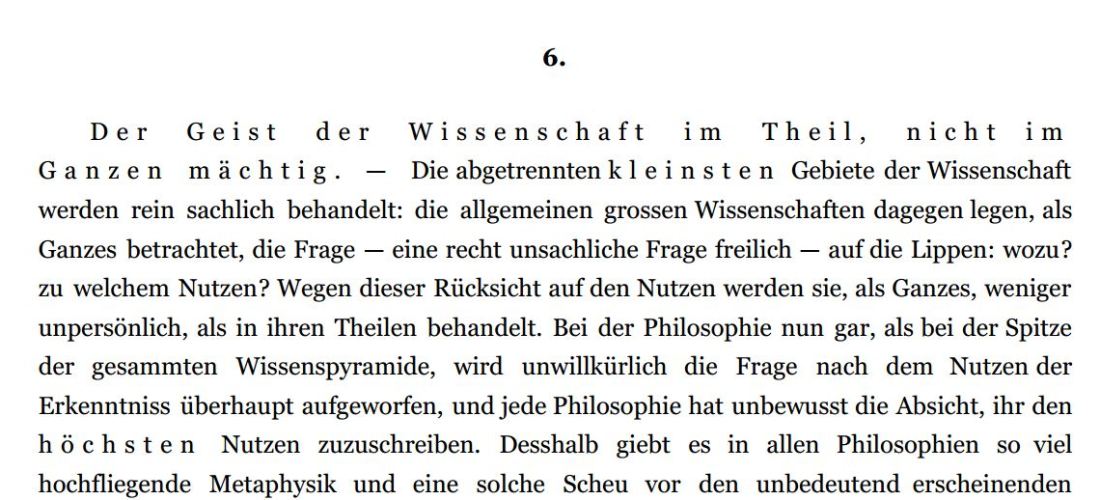
6. The scientific spirit partially but not wholly powerful

Human all too human

You can read the aphorism  I discuss here below the main article.


Synopsis and my take on it:

“The smallest subdivisions of science” are treated objectively but science “as a whole” is not.1  Science as an entity is treated more personally, People take questions about science more personal than question about specific aspects of science like the functioning of a telescope, we can find use in that, compared to the conclusion taken from its observations, what can we do with that kind of knowledge?   In philosophy, “as the apex of the entire pyramid of science” there is the involuntarily questioning of the usefulness of knowledge and as an unconscious intention of the philosophy they give it (knowledge) the highest usefulness. Knowledge is questioned because that’s what philosophers do, but to do this they need knowledge. Nietzsche sees this unconscious reaction to give knowledge the highest usefulness as a reason for the dominance of metaphysics (thoughts2) over physics in philosophy. Because the questioning of knowledge is a thought process, philosophers see little value in solving real world problems.   Philosophy “desires, what art does, to give the greatest possible depth and meaning to life” and science seeks knowledge. “So far there has been no philosopher in whose hands philosophy has not grown into an” defense for knowledge. Both science and philosophy value knowledge because logic dictates it. “They are all tyrannized over by logic, and this is optimism—in its essence.” And Nietzsche throws in at the end the concept of logic and optimism that are both hard to place in the rest of this aphorismand logic is by its nature optimism” (Hollingdale) Maybe it’s logical to search for knowledge and by doing so you assume you find an answer, hence the optimism.

In one sentence:

Philosophers think knowledge, scientist see knowledge.

1The translation by Zimmern translate “…werden rein sachlich behandelt” with “…are dealt with purely in relation to themselves” while the Dutch translation, Hollingdale and I translate it more like “are treated purely objectively”. It might not be of much significance, but it got my attention.

2 …The modern view assumes that the objects studied by metaphysics exist inside the mind of an observer, so the subject becomes a form of introspection and conceptual analysis. … (Wikipedia)


Human, all too human a book for free spirits Part I, translated by Helen Zimmern 1909

  1. THE SCIENTIFIC SPIRIT PARTIALLY BUT NOT WHOLLY POWERFUL.—The smallest subdivisions of science taken separately are dealt with purely in relation to themselves,—the general, great sciences, on the contrary, regarded as a whole, call up the question—certainly a very non-objective one—”Wherefore? To what end?” It is this utilitarian consideration which causes them to be dealt with less impersonally when taken as a whole than when considered in their various parts. In philosophy, above all, as the apex of the entire pyramid of science, the question as to the utility of knowledge is involuntarily brought forward, and every philosophy has the unconscious intention of ascribing to it the greatest usefulness. For this reason there is so much high-flying metaphysics in all philosophies and such a shyness of the apparently unimportant solutions of physics ; for the importance of knowledge for life must appear as great as possible. Here is the antagonism between the separate provinces of science and philosophy. The latter desires, what art does, to give the greatest possible depth and meaning to life and actions ; in the former one seeks knowledge and nothing further, whatever may emerge thereby. So far there has been no philosopher in whose hands philosophy has not grown into an apology for knowledge ; on this point, at least, every one is an optimist, that the greatest usefulness must be ascribed to knowledge. They are all tyrannised over by logic, and this is optimism—in its essence.

Menschliches allzumenschlich 1878/80

  1. Der Geist der Wissenschaft im Theil, nicht im Ganzen mächtig. – Die abgetrennten kleinsten Gebiete der Wissenschaft werden rein sachlich behandelt: die allgemeinen grossen Wissenschaften dagegen legen, als Ganzes betrachtet, die Frage – eine recht unsachliche Frage freilich – auf die Lippen: wozu? zu welchem Nutzen? Wegen dieser Rücksicht auf den Nutzen werden sie, als Ganzes, weniger unpersönlich, als in ihren Theilen behandelt. Bei der Philosophie nun gar, als bei der Spitze der gesammten Wissenspyramide, wird unwillkürlich die Frage nach dem Nutzen der Erkenntniss überhaupt aufgeworfen, und jede Philosophie hat unbewusst die Absicht, ihr den höchsten Nutzen zuzuschreiben. Desshalb giebt es in allen Philosophien so viel hochfliegende Metaphysik und eine solche Scheu vor den unbedeutend erscheinenden Lösungen der Physik; denn die Bedeutsamkeit der Erkenntniss für das Leben soll so gross als möglich erscheinen. Hier ist der Antagonismus zwischen den wissenschaftlichen Einzelgebieten und der Philosophie. Letztere will, was die Kunst will, dem Leben und Handeln möglichste Tiefe und Bedeutung geben; in ersteren sucht man Erkenntniss und Nichts weiter, – was dabei auch herauskomme. Es hat bis jetzt noch keinen Philosophen gegeben, unter dessen Händen die Philosophie nicht zu einer Apologie der Erkenntniss geworden wäre; in diesem Puncte wenigstens ist ein jeder Optimist, dass dieser die höchste Nützlichkeit zugesprochen werden müsse. Sie alle werden von der Logik tyrannisirt: und diese ist ihrem Wesen nach Optimismus.

Sources:

I will read a Dutch translation that is based on the work of researchers Colli and Montinari. I also use a translation from R.J.Hollingdale and the Gary Handwerk translation from the Colli-Montinari edition. Both are more modern than the copyright free translation I use here. This is a translation from 1909 by Helen Zimmern, who knew Nietzsche personally, but there was no critical study of Nietzsche’s work done back then and this translation suffers from that. The same goes for the translation from Alexander Harvey. My German is not good enough to pretend that I can translate it better than the professionals do but I will use the original as a referee.

  1. Menselijk al te menselijk een boek voor vrije geesten, translated by Thomas Graftdijk, 2000. Buy it here
  2. Human, all too human a book for free spirits, translated by R.J.Hollingdale, 1986
  3. Human, all too human a book for free spirits I V3, translated by Gary handwerk 1997
  4. Human, all too human a book for free spirits Part I, translated by Helen Zimmern 1909. Read it  here
  5. Human, all too human a book for free spirits, translated by Alexander Harvey, 1908. Read it here
  6. Menschliches allzu menschlich 1878/80. Read it here