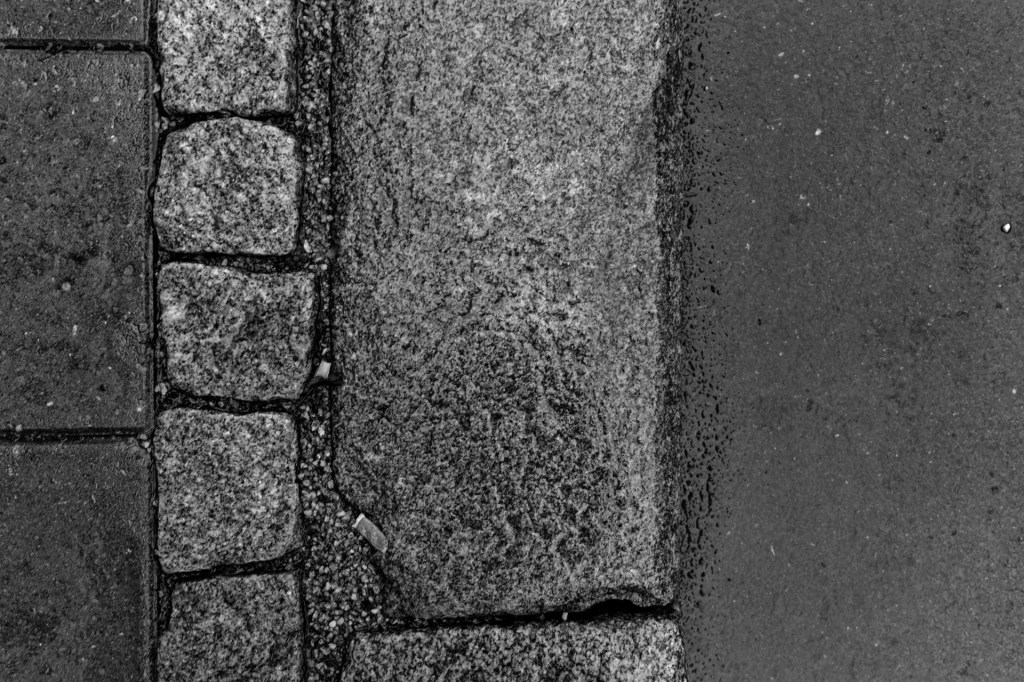


Who ever looks at the road they went on
the one you felt under your feet
it seems to be
that that is almost no one
but the people looking down


Who ever looks at the road they went on
the one you felt under your feet
it seems to be
that that is almost no one
but the people looking down

It is either a force like gravity
or wind
that made the excess water run
it all depends
on how you interpret your perspective

In the future
or further away
the once sharp lines you now draw
begin to show another kind of pattern
one that hypnotizes

I know that there are more people who question life. I read books by people who try to answer at least some of the questions. I watch people on television and the internet who clearly try to do the same, but in real life, it is different. People generally don’t have a title hovering above their heads that cleverly promotes the questions they have and tries to answer. The people you are closest to might give you more insight into what is going on inside, but from my experience, I still have to speculate a lot. I have to admit that I will not open up to a random person, but if they want, they can learn a lot about me from what I have written over the last 20 years. I know that it would be strange if everybody poured their hearts out and started telling you their darkest secrets, but would it not be nice if we could at least admit that we all have questions and insecurities and that shame should not be a brake on going to the next level in your conversations, the level above chitchat. It’s like our naked bodies; we all hide them, though we all know what they look like.

Martin Heidegger’s concept of Dasein (literally “being-there”) is central to his philosophy, particularly in his seminal work, Being and Time (1927). Dasein refers to human existence not merely as a biological entity but as a being that is uniquely aware of and questions its existence. Unlike other entities, humans have a distinct mode of being characterized by self-awareness, temporal existence, and a capacity for meaning-making.
For Heidegger, Dasein is always “thrown” into a world not of its choosing but shaped by its historical and cultural context. This “thrownness” implies that individuals find themselves amidst a pre-given world of relationships, language, and societal norms. At the same time, Dasein is “projective,” meaning it is oriented toward possibilities and can shape its own future through choice.
Crucially, Heidegger emphasizes Dasein’s relationship with time. Human existence is structured by temporality—past, present, and future. Awareness of one’s finite nature, or “being-towards-death,” compels Dasein to confront its potential for authenticity. To live authentically, one must take responsibility for their choices rather than passively conforming to societal expectations (the They).
Thus, Dasein is the ground for exploring the fundamental question of ontology: “What does it mean to be?”
Thank you, ChatGPT, for explaining in 200 words what would have taken me a lot more time. As far as I understand the concept, this seems correct.


And except on a certain kind of winter evening—six-thirty in the Seventies, say, already dark and bitter with a wind off the river, when I would be walking very fast toward a bus and would look in the bright windows of brownstones and see cooks working in clean kitchens and and imagine women lighting candles on the floor above and beautiful children being bathed on the floor above that—except on nights like those, I never felt poor; I had the feeling that if I needed money I could always get it.
Slouching Towards Bethlehem

Trying to get down.

These collected barriers work not only to stop fascism but also to stop anti-fascism.
Martin Niemöller:
First they came for the Communists
And I did not speak out
Because I was not a Communist
Then they came for the Socialists
And I did not speak out
Because I was not a Socialist
Then they came for the trade unionists
And I did not speak out
Because I was not a trade unionist
Then they came for the Jews
And I did not speak out
Because I was not a Jew
Then they came for me
And there was no one left
To speak out for me
Martin Niemöller was a German Lutheran pastor and theologian born in Lippstadt, Germany, in 1892. Niemöller was an anti-Communist and supported Adolf Hitler’s rise to power. But when, after Hitler rose to power and insisted on the supremacy of the state over religion, Niemöller became disillusioned. He became the leader of a group of German clergymen opposed to Hitler. In 1937 he was arrested and eventually confined in Sachsenhausen and Dachau. He was released in 1945 by the Allies. He continued his career in Germany as a cleric and as a leading voice of penance and reconciliation for the German people after World War II. From Wikipedia

Symmetry
natures neuroses

Religious people are abnormal. As a normal person, I don’t understand how you can believe in a certain version of a religion and maintain that you know better which religion is true than the other believers in their particular religion. Why would these religious people think that they have more right to the claim of what is true? Why don’t the others not have that right? Why are religious people so arrogant? Is arrogance not the ultimate abnormality in a world filled with interpretations? Is religion the last convulsion of a humanity moving out of childhood? Is religion that cozy blanket that has kept you safe for so long?
But religion is not the only safety blanket, of course; many behaviors in “adulthood” function as safety blankets. Most of our lives, even the normal ones, are a constant longing for and use of childhood carelessness. Growing up is an art that no one has mastered fully yet. Maybe I am wrong, but I have never met or read about a person who did not have some kind of safety blanket, a belief that is not grounded in reality but just a belief.

Standing on the overpass
I can see the exits
and the road to

For a while you let me air
not always
but when I wanted
and I don’t know if it was the wall that collapsed
or you that fell down
but either way
the opening you left
seems to work too

They say that the grass is always greener somewhere around the corner but how many corners are there to not end up where you are

17 Finding a motive for one ‘s poverty. – There is clearly no trick that enables us to turn a poor virtue into a rich and overflowing one, but we can surely reinterpret its poverty nicely into a necessity, so that its sight no longer offends us and we no longer make reproachful faces at fate on its account. That is what the wise gardener does when he places the poor little stream in his garden in the arms of a nymph and thus finds a motive for its poverty: and who wouldn’t need nymphs as he does?

I sanded away my sorrows and now I have to rip the paper away the machine did its work the paper is filled with dust I am not much lighter but it feels smooth

According to Wikipedia “400 (four hundred) is the natural number following 399 and preceding 401.” just so you know.