381 Knowing one’s ‘individuality’. – We are too prone to forget that in the eyes of people who are seeing us for the first time we are something quite different from what we consider ourselves to be: usually we are nothing more than a single individual trait which leaps to the eye and determines the whole impression we make. Thus the gentlest and most reasonable of men can, if he wears a large moustache, sit as it were in its shade and feel safe there – he will usually be seen as no more than the appurtenance of a large moustache, that is to say a military type, easily angered and occasionally violent – and as such he will be treated.
385 The vain. – We are like shop windows in which we are continually arranging, concealing or illuminating the supposed qualities others ascribe to us- in order to deceive ourselves.
390 Concealing mind. -When we catch someone concealing his mind from us we call him evil: and all the more so, indeed, if we suspect that he has done so out of politeness and philanthropy.
419 Party courage. – The poor sheep say to their shepherd: ‘go on ahead and we shall never lack the courage to follow you’. The poor shepherd, however, thinks to himself: ‘follow me and I shall never lack the courage to lead you’.
Our narrow minds make us believe that we live in strange days. And we are, but not particularly stranger than ever before. With every step we take, we forget the third or praise the ground it had just stepped on. Our world might be destroyed by climate change or nuclear war, but people have lived for thousands of years in worlds no larger than the six houses around them or the small city they inhabited in fear of instant destruction. The theatre we live in now might be as large as the whole world and the angst real, but don’t pretend it’s new.
I don’t have many good reasons for my aversion to this kind of doom-and-gloom. We will always live among nay-sayers and deniers, and the idea of progress is a challenge for many, but don’t forget that these people are also happy to have clean water to drink and to visit a dentist when they have a toothache. Progress does not care what we think; it will move forward, and no one is innocent in this game of who is to blame.
Don’t forget that behind all the nonsense we believe in and are willing to die for are people who bleed when they get cut, mourn their loved ones, and even fall in love for the first time, just like we do, even when these feelings are hidden behind shame and fear. You know for yourself what is hidden inside, we are all afraid to look in the mirror, to look deep in the reflections of our own eyes.
379 Probable and improbable. – A woman was secretly in love with a man, raised him high above her, and said a hundred times in the most secret recesses of her hean: ‘if such a man loved me, it would be something I so little deserve I would have to humble myself in the dust!’- And the man felt in the same way, and in regard to the same woman, and he said the same thing in the most secret recesses of his heart. When at last their tongues were loosed and they told one another everything they had kept hidden, there followed a silence; then, after she had been sunk in thought for a time, the woman said in a cold voice: ‘but everything is now clear! neither of us is what we have loved! If you are that which you say, and no more, I have debased myself and loved you in vain; the demon seduced me, as he did you.’ – This story, which is not at all an improbable one, never happens – why not?
I think, therefore I am is what Descartes famously said. He seems to clarify later that the thinking is undeniable, but that little can yet be concluded about the nature of the thinker. A critique that you can make, and is made, is the “I” in this phrase. How could Descartes concluded thet the “I” he identifies with is the thing that does the thinking?
It is hard to ignore the feeling that there is something in us that does the thinking and that we call I. The reason is that I feel like I think about it. But the I that thinks is also the I that makes bodily sounds, and how much do you control those?
In light of this, “I” seems more like a linguistic tool we use to communicate with others and with ourselves. Our bodies breathe and digest without our intervention, yet we still say that we breathe and digest, just as we say “I think this or that,” even though our control over thinking may not be very different.
But man’s craving for grandiosity is now suffering the third and most bitter blow from present-day psychological research which is endeavouring to prove to the “ ego ” of each one of us that he is not even master in his own house, but that he must remain content with the veriest scraps of information about what is going on unconsciously in his own mind.
Of all that is written I love only that which one writes with his blood. Write with blood, and you will experience that blood is spirit. It is not easily possible to understand the blood of another: I hate the reading idlers.Thus Spoke Zarathustra Whoever knows the reader will do nothing more for the reader. One more century of readers – and the spirit itself will stink. That everyone is allowed to learn to read ruins not only writing in the long run, but thinking too. Once the spirit was God, then it became human and now it is even becoming rabble. Whoever writes in blood and proverbs does not want to be read, but to be learned by heart. In the mountains the shortest way is from peak to peak, but for that one must have long legs. Proverbs should be peaks, and those who are addressed should be great and tall. The air thin and pure, danger near and the spirit full of cheerful spite: these fit together well. I want to have goblins around me, for I am courageous. Courage that scares off ghosts creates its own goblins – courage wants to laugh. I no longer sympathize with you; this cloud beneath me, this black and heavy thing at which I laugh – precisely this is your thundercloud. You look upward when you long for elevation. And I look down because I am elevated. Who among you can laugh and be elevated at the same time? Whoever climbs the highest mountain laughs at all tragic plays and tragic realities. Courageous, unconcerned, sarcastic, violent – thus wisdom wants us: she is a woman and always loves only a warrior. You say to me: “Life is hard to bear.” But why would you have your pride in the morning and your resignation in the evening? Life is hard to bear: but then do not carry on so tenderly! We are all of us handsome, load bearing jack- and jillasses. What have we in common with the rosebud that trembles because a drop of dew lies on its body? It is true: we love life not because we are accustomed to life but because we are accustomed to love. There is always some madness in love. But there is also always some reason in madness. And even to me, one who likes life, it seems butterflies and soap bubbles and whatever is of their kind among human beings know most about happiness. To see these light, foolish, delicate, sensitive little souls fluttering – that seduces Zarathustra to tears and songs. I would only believe in a god who knew how to dance. And when I saw my devil, there I found him earnest, thorough, deep, somber: it was the spirit of gravity – through him all things fall. Not by wrath does one kill, but by laughing. Up, let us kill the spirit of gravity! I learned to walk, since then I let myself run. I learned to fly, since then I do not wait to be pushed to move from the spot. Now I am light, now I fly, now I see myself beneath me, now a god dances through me. Thus spoke Zarathustra.
358 Grounds and their groundlessness. -You dislike him and present many grounds for this dislike – but I believe only in your dislike, not in your grounds! You flatter yourself in your own eyes when you suggest to yourself and to me that what has happened through instinct is the result of a process of reasoning.
330 Not enough! – It is not enough to prove something, one has also to seduce or elevate people to it. That is why the man of knowledge should learn how to speak his wisdom: and often in such a way that it sounds like folly!
342 Beware ofconfusion!– Yes! He considers the matter from all sides, and you think he is a genuine man of knowledge. But he only wants to lower the price – he wants to buy it
312 The forgetful – In outbursts of passion, and in the fantasising of dreams and insanity, a man rediscovers his own and mankind’s prehistory: animality with its savage grimaces; on these occasions his memory goes sufficiently far back, while his civilised condition evolves out of a forgetting of these primal experiences, that is to say out of a relaxation of his memory. He who, as a forgetter on a grand scale, is wholly unfamiliar with all this does not understand man- but it is to the general advantage that there should appear here and there such individuals as ‘do not understand us’ and who are as it were begotten by the seed of the gods and born of reason.
281 The ego wants everything.- It seems that the sole purpose of human action is possession: this idea is, at least, contained in the various languages, which regard all past action as having put us in possession of something (‘I have spoken, struggled, conquered’: that is to say, I am now in possession of my speech, struggle, victory). How greedy man appears here! He does not want to extricate himself even from the past, but wants to continue to have it!
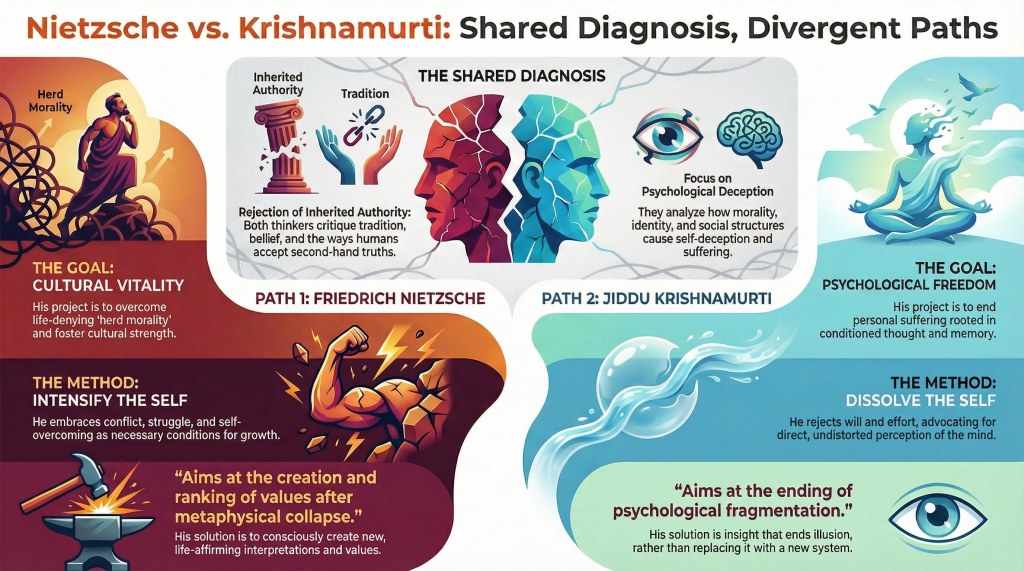
Today I had a long “discussion” with AI. I have tried different versions now and also downloaded some AI models to try them offline. Story short. Some of them know a lot and can present it quite impressively. Here is an AI-generated summary and podcast of our exchange.
Understanding the Great Divide: Nietzsche vs. Krishnamurti
Introduction: Two Rebels, Two Different Paths
Both Friedrich Nietzsche and Jiddu Krishnamurti were radical thinkers who challenged the foundations of human belief and social structures. They saw humanity as trapped in a prison of its own making—a prison built from tradition, morality, and second-hand truths. This document is designed to guide you through their philosophies, starting with the common ground where they tore down the old world and then exploring the vastly different paths they forged. As one analysis puts it, their relationship can be summed up perfectly: “They meet in negation but diverge sharply in direction.”
257 Words present in us. -We always express our thoughts with the words that lie to hand. Or, to express my whole suspicion: we have at any moment only the thought for which we have to hand the words.
254 Anticipators. -The distinguishing, but also perilous quality in poetic natures is their exhaustive imagination: they anticipate, enjoy and suffer in advance that which is to come or could come, so that when it finally does come they are already tired of it. Lord Byron, who was only too familiar with all this, wrote in his diary: ‘If I have a son he shall become something quite prosaic- a lawyer or a pirate.’
249 Who is ever alone? – The timid man does not know what it is to be alone: an enemy is always standing behind his chair.- Oh, if there were someone who could tell us the history of that subtle feeling called solitude!
250 Night and music. – The ear, the organ of fear, could have evolved as greatly as it has only in the night and twilight of obscure caves and woods, in accordance with the mode of life of the age of timidity, that is to say the longest human age there has ever been: in bright daylight the ear is less necessary. That is how music acquired the character of an art of night and twilight.
251 Stoical. -There is a cheerfulness peculiar to the Stoic: he experiences it whenever he feels hemmed in by the formalities he himself has prescribed for his conduct; he then enjoys the sensation of himself as dominator.
243 The two directions. -When we try to examine the mirror in itself we discover in the end nothing but things upon it. If we want to grasp the things we finally get hold of nothing but the mirror.- This, in the most general terms, is the history of knowledge.
219 Deception in self-humiliation. -Through your irrational behaviour you have done your neighbour great harm and destroyed an irrecoverable happiness – and then you subdue your vanity sufficiently to go to him, expose your irrationality to his contempt and believe that after this painful and to you very difficult scene everything has again been put to rights- that your voluntary loss ofhonour compensates for his involuntary loss of happiness: suffused with this feeling you go away uplifted and restored in your virtue. But your neighbour is still as unhappy as he was before, he derives no consolation from the fact that you are irrational and have admitted it, he even remembers the painful sight ofyou pouring contempt upon yourselfbefore him as a fresh injury for which he has to thank you- but he has no thought of revenge and cannot grasp how you could in any way compensate him. At bottom that scene you performed was performed before yourself and for the sake of yourself: you invited in a witness of it, again for your own sake and not for his – do not deceive yourself.









 Nochrisis