
If voting changed anything they would make it illegal.
Emma Goldman
If voting changed anything they would make it illegal.
Emma Goldman

“Do not all theists insist that there can be no morality, no justice, honesty or fidelity without the belief in a Divine Power? Based upon fear and hope, such morality has always been a vile product, imbued partly with self-righteousness, partly with hypocrisy. As to truth, justice, and fidelity, who have been their brave exponents and daring proclaimers? Nearly always the godless ones: the Atheists; they lived, fought, and died for them. They knew that justice, truth, and fidelity are not conditioned in heaven, but that they are related to and interwoven with the tremendous changes going on in the social and material life of the human race; not fixed and eternal, but fluctuating, even as life itself.”
The Portable Atheist: Essential Readings for the Nonbeliever

WHAT is patriotism? Is it love of one’s birthplace, the place of childhood’s recollections and hopes, dreams and aspirations? Is it the place where, in childlike naivete, we would watch the fleeting clouds, and wonder why we, too, could not run so swiftly? The place where we would count the milliard glittering stars, terror-stricken lest each one “an eye should be,” piercing the very depths of our little souls? Is it the place where we would listen to the music of the birds, and long to have wings to fly, even as they, to distant lands? Or the place where we would sit at mother’s knee, enraptured by wonderful tales of great deeds and conquests? In short, is it love for the spot, every inch representing dear and precious recollections of a happy, joyous, and playful childhood?
If that were patriotism, few American men of today could be called upon to be patriotic, since the place of play has been turned into factory, mill, and mine, while deafening sounds of machinery have replaced the music of the birds. Nor can we longer hear the tales of great deeds, for the stories our mothers tell today are but those of sorrow, tears, and grief.
What, then, is patriotism? “Patriotism, sir, is the last resort of scoundrels,” said Dr. Johnson. Leo Tolstoy, the greatest anti-patriot of our times, defines patriotism as the principle that will justify the training of wholesale murderers; a trade that requires better equipment for the exercise of man-killing than the making of such necessities of life as shoes, clothing, and houses; a trade that guarantees better returns and greater glory than that of the average workingman.
Gustave Hervé, another great anti-patriot, justly calls patriotism a superstition–one far more injurious, brutal, and inhumane than religion. The superstition of religion originated in man’s inability to explain natural phenomena. That is, when primitive man heard thunder or saw the lightning, he could not account for either, and therefore concluded that back of them must be a force greater than himself. Similarly he saw a supernatural force in the rain, and in the various other changes in nature. Patriotism, on the other hand, is a superstition artificially created and maintained through a network of lies and falsehoods; a superstition that robs man of his self-respect and dignity, and increases his arrogance and conceit.
Indeed, conceit, arrogance, and egotism are the essentials of patriotism. Let me illustrate. Patriotism assumes that our globe is divided into little spots, each one surrounded by an iron gate. Those who have had the fortune of being born on some particular spot, consider themselves better, nobler, grander, more intelligent than the living beings inhabiting any other spot. It is, therefore, the duty of everyone living on that chosen spot to fight, kill, and die in the attempt to impose his superiority upon all the others.
The inhabitants of the other spots reason in like manner, of course, with the result that, from early infancy, the mind of the child is poisoned with bloodcurdling stories about the Germans, the French, the Italians, Russians, etc. When the child has reached manhood, he is thoroughly saturated with the belief that he is chosen by the Lord himself to defend his country against the attack or invasion of any foreigner. It is for that purpose that we are clamoring for a greater army and navy, more battleships and ammunition. It is for that purpose that America has within a short time spent four hundred million dollars. Just think of it–four hundred million dollars taken from the produce of the people. For surely it is not the rich who contribute to patriotism. They are cosmopolitans, perfectly at home in every land. We in America know well the truth of this. Are not our rich Americans Frenchmen in France, Germans in Germany, or Englishmen in England? And do they not squandor with cosmopolitan grace fortunes coined by American factory children and cotton slaves? Yes, theirs is the patriotism that will make it possible to send messages of condolence to a despot like the Russian Tsar, when any mishap befalls him, as President Roosevelt did in the name of his people, when Sergius was punished by the Russian revolutionists.
Read the rest here: https://theanarchistlibrary.org/library/emma-goldman-patriotism-a-menace-to-liberty
Anarchism and Other Essays is a 1910 essay collection by Emma Goldman, first published by Mother Earth Publishing. The essays outline Goldman’s anarchist views on a number of subjects, most notably the oppression of women and perceived shortcomings of first wave feminism, but also prisons, political violence, sexuality, religion, nationalism and art theory. More on Wikpedia here
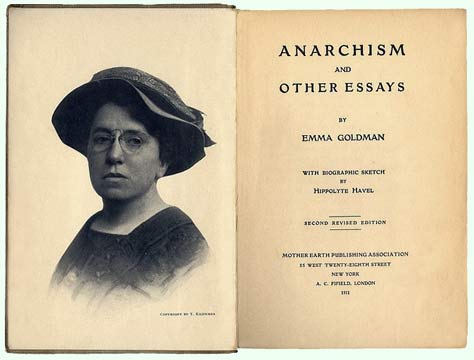
Excerpt:
PREFACE – Some twenty-one years ago I heard the first great Anarchist speaker—^the inimitable John Most. It seemed to me then^ and for many years after, that the spoken word hurled forth among the masses with such wonderful eloquence, such enthusiasm and fire, could
 Nochrisis