317 The judgment ofthe evening. – He who reflects on the work he has done during the day and during his life, but does so when he has finished it and is tired, usually arrives at a melancholy conclusion: this however is not the fault of his day or his life, but ofhis tiredness.- In the midst of our work we usually have no leisure to pass judgment on life and existence, nor in the midst ofour pleasures: but ifwe should happen to do so, we should no longer agree with him who waited for the seventh day and its repose before he decided that everything was very beautiful – he had let the better moment go by.
312 The forgetful – In outbursts of passion, and in the fantasising of dreams and insanity, a man rediscovers his own and mankind’s prehistory: animality with its savage grimaces; on these occasions his memory goes sufficiently far back, while his civilised condition evolves out of a forgetting of these primal experiences, that is to say out of a relaxation of his memory. He who, as a forgetter on a grand scale, is wholly unfamiliar with all this does not understand man- but it is to the general advantage that there should appear here and there such individuals as ‘do not understand us’ and who are as it were begotten by the seed of the gods and born of reason.
281 The ego wants everything.- It seems that the sole purpose of human action is possession: this idea is, at least, contained in the various languages, which regard all past action as having put us in possession of something (‘I have spoken, struggled, conquered’: that is to say, I am now in possession of my speech, struggle, victory). How greedy man appears here! He does not want to extricate himself even from the past, but wants to continue to have it!
Today I had a long “discussion” with AI. I have tried different versions now and also downloaded some AI models to try them offline. Story short. Some of them know a lot and can present it quite impressively. Here is an AI-generated summary and podcast of our exchange.
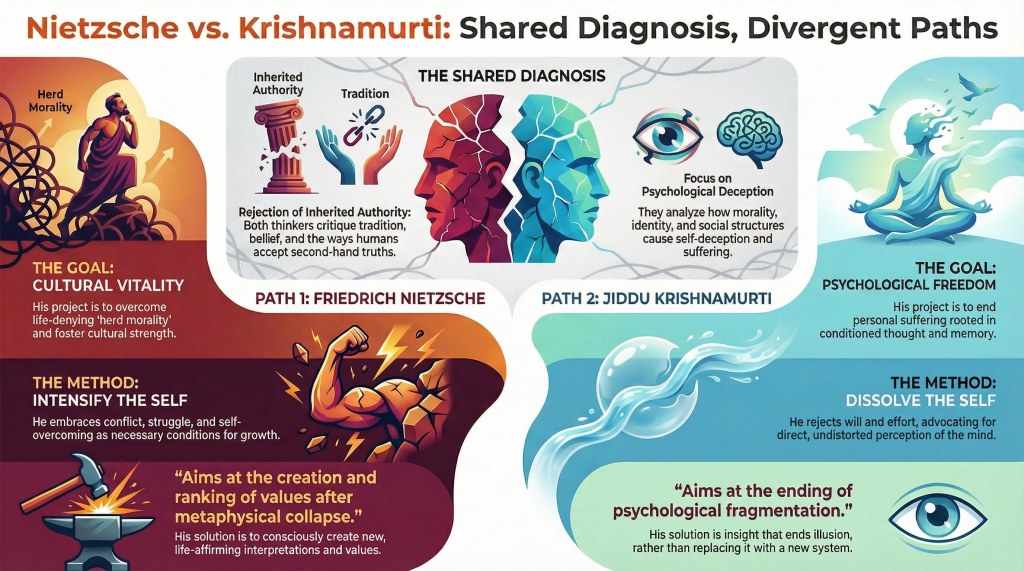
Understanding the Great Divide: Nietzsche vs. Krishnamurti
Introduction: Two Rebels, Two Different Paths
Both Friedrich Nietzsche and Jiddu Krishnamurti were radical thinkers who challenged the foundations of human belief and social structures. They saw humanity as trapped in a prison of its own making—a prison built from tradition, morality, and second-hand truths. This document is designed to guide you through their philosophies, starting with the common ground where they tore down the old world and then exploring the vastly different paths they forged. As one analysis puts it, their relationship can be summed up perfectly: “They meet in negation but diverge sharply in direction.”
257 Words present in us. -We always express our thoughts with the words that lie to hand. Or, to express my whole suspicion: we have at any moment only the thought for which we have to hand the words.
254 Anticipators. -The distinguishing, but also perilous quality in poetic natures is their exhaustive imagination: they anticipate, enjoy and suffer in advance that which is to come or could come, so that when it finally does come they are already tired of it. Lord Byron, who was only too familiar with all this, wrote in his diary: ‘If I have a son he shall become something quite prosaic- a lawyer or a pirate.’
249 Who is ever alone? – The timid man does not know what it is to be alone: an enemy is always standing behind his chair.- Oh, if there were someone who could tell us the history of that subtle feeling called solitude!
250 Night and music. – The ear, the organ of fear, could have evolved as greatly as it has only in the night and twilight of obscure caves and woods, in accordance with the mode of life of the age of timidity, that is to say the longest human age there has ever been: in bright daylight the ear is less necessary. That is how music acquired the character of an art of night and twilight.
251 Stoical. -There is a cheerfulness peculiar to the Stoic: he experiences it whenever he feels hemmed in by the formalities he himself has prescribed for his conduct; he then enjoys the sensation of himself as dominator.
243 The two directions. -When we try to examine the mirror in itself we discover in the end nothing but things upon it. If we want to grasp the things we finally get hold of nothing but the mirror.- This, in the most general terms, is the history of knowledge.
219 Deception in self-humiliation. -Through your irrational behaviour you have done your neighbour great harm and destroyed an irrecoverable happiness – and then you subdue your vanity sufficiently to go to him, expose your irrationality to his contempt and believe that after this painful and to you very difficult scene everything has again been put to rights- that your voluntary loss ofhonour compensates for his involuntary loss of happiness: suffused with this feeling you go away uplifted and restored in your virtue. But your neighbour is still as unhappy as he was before, he derives no consolation from the fact that you are irrational and have admitted it, he even remembers the painful sight ofyou pouring contempt upon yourselfbefore him as a fresh injury for which he has to thank you- but he has no thought of revenge and cannot grasp how you could in any way compensate him. At bottom that scene you performed was performed before yourself and for the sake of yourself: you invited in a witness of it, again for your own sake and not for his – do not deceive yourself.
My dear Friend: — Your letters arrive of late at some special festive occasion. Thus, when, not too long ago, I moved to my new residence in Leipzig, your letter which our friend Roscher had correctly dispatched here, was lying on the table. Soon thereafter I addressed the first part of my Laertianum to you so I may not be accused again of being ungrateful to my friends and through continuous silence create the impression as if I were dead. Nay, I live and, what’s more, live well and wish that you would sometime personally convince yourself of it, especially to realize that ϕιλοσοϕε (to philosophize) and being sick are not really identical concepts, but that, on the contrary, there is a certain “health,” the eternal foe of profound philosophy which, as you know, nowadays has become the nickname of certain kinds of border heroes and historians.
How the ‘Real World’ at last Became a Myth, The Four Great Errors
4 The error of imaginary causes . – To start from the dream: on to a certain sensation, the result for example of a distant cannon – shot, a cause is subsequently foisted (often a whole little novel in which precisely the dreamer is the chief character). The sensation, meanwhile, continues to persist, as a kind of resonance: it waits, as it were, until the cause – creating drive permits it to step into the foreground – now no longer as a chance occurrence but as ‘meaning’. The cannon – shot enters in a causal way, in an apparent inversion of time. That which comes later, the motivation, is experienced first, often with a hundred details which pass like lightning, the shot follows .… What has happened? The ideas engendered by a certain condition have been misunderstood as the cause of that condition. – We do just the same thing, in fact, when we are awake. Most of our general feelings – every sort of restraint, pressure, tension, explosion in the play and counter – play of our organs, likewise and especially the condition of the nervus sympathicus – excite our cause – creating drive: we want to have a reason for feeling as we do – for feeling well or for feeling ill. It never suffices us simply to establish the mere fact that we feel as we do: we acknowledge this fact – become conscious of it – only when we have furnished it with a motivation of some kind. – The memory, which in such a case becomes active without our being aware of it, calls up earlier states of a similar kind and the causal interpretations which have grown out of them – not their causality. To be sure, the belief that these ideas, the accompanying occurrences in the consciousness, were causes is also brought up by the memory. Thus there arises an habituation to a certain causal interpretation which in truth obstructs and even prohibits an investigation of the cause.
230 Esprit fort. – Compared with him who has tradition on his side and requires no reasons for his actions, the free spirit is always weak, especially in actions; for he is aware of too many motives and points of view and therefore possesses an uncertain and unpractised hand. What means are there of nonetheless rendering him relatively strong, so that he shall at least make his way and not ineffectually perish? How does the strong spirit (esprit fort) come into being? This is in the individual case the question how genius is produced. Whence comes the energy, the inflexible strength, the endurance with which the individual thinks, in opposition to tradition, to attain to a wholly individual perception of the world?
Advice? I don’t have advice. Stop aspiring and start writing. If you’re writing, you’re a writer. Write like you’re a goddamn death row inmate and the governor is out of the country and there’s no chance for a pardon. Write like you’re clinging to the edge of a cliff, white knuckles, on your last breath, and you’ve got just one last thing to say, like you’re a bird flying over us and you can see everything, and please, for God’s sake, tell us something that will save us from ourselves. Take a deep breath and tell us your deepest, darkest secret, so we can wipe our brow and know that we’re not alone. Write like you have a message from the king. Or don’t. Who knows, maybe you’re one of the lucky ones who doesn’t have to.
I am an anarchist because contemporary society is divided into two opposing classes: the impoverished and dispossessed workers and peasants who have created with their own hands and their own enormous toil all the riches of this earth; and the rich men, kings and presidents who have confiscated all these riches for themselves. Towards these parasitic capitalists and ruling kings and presidents there rose in me a feeling of outrage, indignation, and loathing, while at the same time I felt sorrow and compassion for the labouring proletariat who have been eternal slaves in the vice- like grip of the world wide bourgeoisie.
I am an anarchist because I scorn and detest all authority, since all authority is founded on injustice, exploitation and compulsion over the human personality. Authority dehumanises the individual and makes him a slave.
370 Discharging ill humor.-Any person who fails at something prefers to attribute this failure to the ill will of someone else, rather than to chance. His stimulated sensibility is relieved by thinking of a person and not of a thing as the reason for his failure; for we can revenge ourselves on people, but we have to choke down the injuries of chance. Therefore, when a prince has failed at something, his circle tends to designate some individual as the ostensible cause and to sacrifice that person in the interest of all the courtiers; for otherwise, the ill humor of the prince would be vented on all of them, since he cannot take any revenge on the goddess of fate herself.