An attempt at writing a philosophical story, written a few years ago. The original was in Dutch, but I translated it, revised some minor sections, and polished it.
Chapter 1
“So, death, huh?”
“Yes.”
We jump to the next stone to cross the small river. Actually, it’s more of a brook… or what do you call it here in the mountains? A stream?
“Hey, Gerderik… what do you call something like this? A small river like the one we’re crossing?”
“How do you come up with that now? I’m still thinking about what you just said. I guess it’s a brook. I’ve never really thought about it.”
“A brook, then. In my mind, those don’t flow down mountains, but I don’t know why I think that. I grew up among ditches. I don’t think I’ve ever seen a brook. Canals, yes, but a brook… no idea. How wide can a brook be, do you think?”
“Jesus, I don’t know. The fact that you worry about that.”
“Sorry. I’m just wondering.”
Gerderik stands on a stone, his legs pressed tightly together, and turns toward me. Just as he’s about to speak, I pretend I’m about to fall,jerking my arms up and bending my knees.
He reaches out to catch me, but because of his awkward stance, one foot slips off the stone and the rest of him follows.
I burst out laughing.
He gets back up, but the water is shallow enough for him to sit on the bottom. Sitting there, he looks at me, unsure whether to laugh or get angry.
“I think a stream is about half a meter deep and a brook at least a meter,” I say, and I see him give in and laugh.
I step into the water to help him up, and we wade the rest of the way to the bank. There’s some sunlight here, enough to warm up and dry off.
“Marit… are you afraid of death?” he asks.
“It’s still on your mind, I can tell. That little dip didn’t help. You shouldn’t take thoughts like that in big chunks. You have to give them time to settle.”
“Easy for you to say. But you’re saying quite a lot. To me, death is something that belongs to old people. And you’re telling me I should live as if I could die at any moment. That I should be afraid of death.”
“So you want to keep going. I guess I haven’t told you enough yet.”
I pause so I don’t repeat myself. In conversations like this, my thoughts tend to run ahead of me.
Gerderik looks at me, puzzled by my faint smile, but I decide not to tease him again. My thoughts just move the way they move.
“What is a human being?” I had asked him at the start of our walk, when he said he was interested in philosophy but didn’t really know what it was. He’d heard of it,something about thinking about life,but he wasn’t sure whether he actually did it.
So I kept it simple.
“A human being… that’s us, right?” he said.
“Okay. But are we a kind of animal?”
“Yes.”
“Well, Gerderik, that was your first philosophical thought.”
“Yes, but I already knew that.”
“I know. But now you’ve said it. Now you’re aware of it,more than during a biology test. Philosophizing is mostly asking questions, often with very simple answers. You know a little more now. You know you’re also an animal.”
“You call that philosophy? I thought it would be more difficult.”
“A bit more difficult, huh? Tell me,can an animal imagine something, like what you just did?”
That stops him. It started simple, but now I can see he doesn’t quite know where to go.
After some muttering, he asks, more to himself than to me, “What is imagining, actually?”
“Now that’s a real philosophical question,” I say. “You’re not bad at this.”
There’s a hint of mockery in my voice, but I keep it contained. He probably wouldn’t notice it anyway. He looks at me, slightly surprised, and I see a small trace of pride.
“It’s not easy to answer,” I continue. “Some animals might be able to do it, but humans definitely can. You could even say it’s a defining trait. A mental image is something you see or hear in your head,a picture, a text, music. It floats around in there somewhere. Now imagine this: what if you had no memory? Could you still form an image?”
“No memory? Then your head is empty… I think. You still see things, but they disappear again. No, I don’t think you could form an image.”
“That makes sense. Every image you form is built from memory.”
“But I can imagine a dragon.”
“Sure. But you’ve probably seen pictures of dragons. In your imagination, you combine things you’ve seen before,like a horse and a rhinoceros,and you get a unicorn.”
“So humans can imagine things… but apes can’t?”
“I don’t know for certain. We can’t look inside their heads. There have been tests, but the conclusions contradict each other. And we’re quick to project human traits onto animals. Personally, I don’t think they can,but I can’t be completely sure.”
“I once saw a documentary where apes used sticks to get food. Don’t you need imagination for that?”
“Maybe. Or maybe they’re just copying. The ape might have learned the trick from others in the group. That’s the problem,we can interpret what we see in different ways. That’s also the downside of imagination: we can doubt. Animals don’t doubt. They react.”
We walk in silence for a while, deeper into what is becoming a real forest I sse now.
He was supposed to show me the forest, the view from the top, but I’ve barely noticed any of it. I don’t even know how long we’ve been walking.
It doesn’t matter.
From the look on his face, I can tell I’ve drawn him in. And that’s worth more than the forest.
I have more memories of moments like this than of people who actually think about philosophy. A slightly bitter thought, but it surfaces anyway.
I met Gerderik on a bus months ago. We talked, and it flowed easily. He told me I could visit if I was ever nearby again.
At the time, I wasn’t sure whether he was just being polite, like most people here, or genuinely interested.
Not in me as a woman,he’s married, and he lit up completely when he talked about his wife,but he kept asking questions. About the city I live in. About traveling alone. About my work as a translator.
Everything pointed in the same direction: his world is small, and he knows it.
Through me, he could look beyond it.
Last week I decided to return to the small museum just outside his village. The tourist season was over, so the only hotel was closed. I called him to ask if I could stay with him and his wife for a few days.
His wife answered. Even though months had passed, she knew exactly who I was.
He had clearly talked about me.
Without hesitation, without even a trace of jealousy, she invited me and said she would prepare the guest room.
Again, I was struck by their ease. Almost naïve.
At twenty-eight, I sometimes see too much. If a man is a little too kind, I immediately suspect his motives. I assume he’s interested in what’s between my legs rather than what’s in my head.
But Evelien didn’t seem worried at all.
In that village, they must know about affairs too.
I don’t know why I’m so fixated on that thought.
Gerderik is in his forties, ordinary-looking, nothing remarkable. Usually, men notice me. Maybe that’s why this stands out.
He doesn’t.
He isn’t interested in me that way. He wants something else.
He wants what I know.
And that, I think, is why I came back. Interest in his interest.
Back in the city, I couldn’t shake the question: how can someone so far removed from the “real” world be so content?
Here, I see only worried faces and constant complaints.
As a translator, I travel the world, studying interesting languages in different cultures, but also as a translator on all kinds of conferences, you could call that my nine-to-five job. I wanted to go back to the museum, to see the archive again, that’s what I told my boss.
He believed me.
So now I’m here, walking through the forest.
I haven’t come across any obscure phrases written in this language region.
In truth, I’m conducting a dirty experiment.
I’m trying to seduce him, not physically, but mentally.
Can I make him see that the world is not the carefree place he thinks it is?
That same place I sometimes wish I could live in.
Strange, really.
Through philosophy, I’m trying to reach the state he and his wife already inhabit. But they don’t know any better. They’ve never experienced the complexity of the world the way I have.
I want to show him that complexity.
And then see what happens.
He’s genuinely interested, so I don’t feel entirely guilty.
Suddenly, Gerderik stops and taps me on the shoulder. With the same finger, he points to his head.
“So… it all happens in here?” he says.
“You’ve been thinking,” I reply. “Whether everything happens in our heads… well, it feels that way. Maybe that’s enough for now. But I can already tell you this: our thinking seems to come from the brain. And the brain is just an organ.”
“What do you mean by that?”
I’ll get to that later. Let’s not get ahead of ourselves. First, tell me, what other qualities do you believe set humans apart?
“Okay… we’re flesh and blood, and,”
“No,” I interrupt. “We were talking about what happens in the mind. All animals are flesh and blood. What makes us different is that we can imagine things. We agreed on that, right?”
“Yes.”
“So what else can we do, mentally, that animals can’t?”
He hesitates. I give him a push.
“Who are you?” I ask.
“I’m Gerderik.”
“What are you doing right now?”
“What do you mean?”
“You’re saying your name.”
“Yes… I’m saying my name. So?”
“Do you think a goldfish knows its name? Does it know it’s a goldfish?”
He looks at me strangely as we keep walking.
“My goldfish doesn’t. But Rensko, my dog, he reacts to his name. He knows he’s Rensko.”
“No. He knows that when he hears that sound, he gets food or goes outside. You could call him something else, and he’d still respond. Is it a he?”
“Yes. Twelve years old. A great dog. I couldn’t do without him. He really understands me, he has character.”
“To you,” I say. “That’s the key. We like to project human traits onto animals. Sad eyes, happy eyes, loyalty, concern. But think about your car. Haven’t you ever described its behavior in human terms?”
He smiles.
“My car is unpredictable. Sometimes I swear it breaks down exactly when I need it. And other times, on a sunny day, it just glides along like it’s enjoying itself.”
“Exactly. It’s easy to assign character.”
“But don’t we do that with people, too?”
“You’ve got a point.”
For someone who sorts logs in a sawmill, he thinks sharply. Where does he put all that energy?
“We don’t actually know if other people think the way we do,” I continue. “That’s one of those philosophical questions without a clear answer. A lot of people feel like they’re the only ones who really think. That raises the question: does the other person actually think, or just appear to, like your dog?”
He says nothing.
“That’s why,” I continue, “and I’ll repeat this again, philosophy is simple. You start with yourself. You know you think. You know you imagine. But do you know what you think about? Or why?”
He takes a moment.
“I think about work. About Evelien. My house. Fishing. Things like that.”
“Things around you.”
“Yes.”
“And what does that tell you?”
“That those things matter to me.”
“Why those things?”
He shrugs.
“They’ve always mattered.”
“Did you choose that?”
“What do you mean?”
“Did you choose to care about those things? To think about them?”
“Of course. I could have worked in my father’s garage instead. A lot of people hunt here.”
“But what if you had been born somewhere else? Somewhere without forests, without rivers. Would you still be doing this?”
“No. Of course not. I was born here. That’s a strange question.”
“Not really. It shows that you didn’t choose where you were born. You’re here. And your choices are limited by that. You could choose between forestry and the garage,but not, say, becoming a chemistry professor.”
“I could have gone to the city.”
“How were your grades?”
“…not great.”
“So you weren’t just born in a place. You were born with a body. A brain. And that brain wasn’t built for that path.”
For a moment, we just walk.
It strikes me that even here, in this remote place, modern thinking has taken hold. People believe they are fully in control of their lives, that they choose everything, without realizing how limited those choices really are.
Gerderik’s grandfather would probably have said he became what he was because it was expected of him. Gerderik, fifty years later, believes he played a decisive role in his own life. But in reality, his range of options wasn’t much wider.
“A German philosopher called that ‘being thrown into the world,’” I say. “You’re literally thrown into a world by your mother, and then you have to deal with it.”
He walks beside me, quiet now, thinking.
I wonder if he evaluates thoughts the same way he evaluates logs, turning them, inspecting them, deciding whether they’re sound.
After a while, he nods slowly. Then he smiles.
“I’ve never looked at it that way,” he says. “Actually… I don’t think I’ve ever really looked at it at all. I know how trees grow. I know what makes them strong or weak. But I’ve never thought about how a human works.”
He pauses.
“This feels… different. Like something new.”
“You mean exciting?”
“Yes. But not like danger. Not like when we’re cutting big trees, or when I argue with Evelien. That’s something I’ve felt before. This… this feels like the time I went on my honeymoon. Everything was new. Strange. Bigger than what I knew.”
I say nothing.
I’ve seen this before. People get enthusiastic when I talk about philosophy. Some of it is just my own energy rubbing off. And as long as it doesn’t go too deep, they enjoy it.
But with him, it feels different.
After a long silence, ten minutes, maybe more, I assume his thoughts have drifted back to the forest.
Then he speaks.
“We can ask questions.”
I glance at him.
“Good. Where did that come from?”
“I was thinking about what you said about animals. About Rensko. I pictured his face. And then it hit me, he can’t ask himself what he’s doing here. I can.”
“That’s right. We can ask what we are. Who we are. Why we’re here.”
I step over a fallen branch.
“An otter might ‘ask’ whether a tree is suitable for its lodge. But it only considers things like size and distance. It doesn’t wonder beyond that. We don’t need to either, but we can. And so we do.”
He nods.
“You think about this a lot, don’t you?” I say.
“Yes.”
“Have you never asked yourself these kinds of questions before?”
“No. Not really.”
“Strange.”
“What do you mean?”
“I’m thinking out loud. Where I come from, people ask themselves these questions all the time. Why do they do the work they do. Why they’re with the person they’re with. And if you follow those questions far enough, you end up at things like the meaning of life. Or fate.”
“Is everyone like that where you come from?”
“No. But in a city, there are more choices. And that makes choosing harder. People start doubting everything. Here, life is simpler.”
He thinks about that.
“I don’t know anyone like that,” he says. “Well… maybe Evelien’s friend. She changes her hairstyle every month. Always complaining about how she looks. We don’t understand it. She studied in the city. She’s our vet. Maybe that’s why.”
“Maybe,” I say. “But let’s not jump to conclusions. That’s a different topic.”
I look at him.
“We were talking about what makes a human being different. Do you want to continue?”
“Of course.”
I briefly summarize what we’ve covered, almost like a lesson.
“We can imagine things. We’re thrown into a world we didn’t choose. We can ask questions. We can reflect on our lives.”
He listens carefully.
“So let me ask you something,” I say. “Can we decide who we are?”
He looks at me, confused.
“After everything you just said? We’re thrown into the world. What can I change about that?”
“Your imagination.”
He frowns.
“My imagination doesn’t change reality. I was born here. I work in forestry. That’s just how it is.”
“It is, if you leave it there. But your imagination lets you shape your story.”
“My story?”
“Yes. You can tell yourself you’re the best at what you do. That you’ll travel. That you’ll teach others. You can expand your role.”
He shakes his head.
“I don’t want that. I’m fine with my life. Why would I want more?”
“Because you can.”
“But you just said I couldn’t become a professor. What if that’s what I wanted?”
“You have limits. Of course you do. But life isn’t just being born, eating, working, sleeping, and dying. Animals do that too. And we said humans are different.”
He looks down for a moment.
“I was happy with my life,” he says quietly. “But now… talking to you… I feel a bit stupid.”
“That has nothing to do with intelligence,” I say. “Happiness matters too. People here seem happy. Animals seem happy. But we’re not just animals. We can do more. We are more.”
He looks at me.
“So now I’m an animal?”
“We all are. You know the term ‘creature of habit,’ right?”
“Yes.”
“That’s what we are, to a large extent. We follow patterns. But we can also break them. That’s what makes us human. The first ape that broke a habit, that’s where humanity begins.”
He considers that.
“So we lost something too.”
“Yes. Maybe we lost a kind of simple happiness. But we gained everything else, culture, art, knowledge.”
He exhales slowly.
“I’m still happy.”
“I know.”
“And I don’t need to become something else.”
“I’m not saying you do.”
We walk in silence again.
Then he says, “So what happens if I imagine myself as the best tree expert there is?”
I glance at him.
“That depends,” I say. “First, tell me,who are you?”
He sighs.
“We’re doing this again?”
“Yes.”
“Fine. I’m Gerderik.”
“What does that mean?”
He gestures vaguely.
“I’m a forester. I’m married. I live here. I fish.”
“So that’s who you are?”
He hesitates.
“I’m… me.”
“Then explain that without referring to anything outside yourself.”
He stops.
Thinks.
And then, after a while:
“I can’t.”
“I can’t.”
“That’s right,” I say. “You can’t. We’re not just thrown into the world,we also have to refer to it to describe ourselves.”
I nod toward a tree.
“And when you introduced yourself just now, you didn’t only talk about what you are. You also talked about what you do, what you’ve done, and what you might do later.”
He smiles faintly, understanding.
“A human being isn’t just what he is in the moment. He’s also his past and his future. Who you are now is always explained by what came before, and by what you’re moving toward.”
He thinks about that.
“I can see that,” he says. “That’s how people talk about themselves. But what are you getting at?”
“That your personality isn’t something fixed inside you. It’s built from the things around you. From what you value. From what you plan. From how you interpret your past.”
“So if I imagine a different future… and connect myself to different things… I become a different person?”
“Yes,” I say. “That’s the idea.”
He nods slowly.
“That’s… simple.”
“It’s not simple,” I reply. “It’s a description. Understanding how something works doesn’t mean you can change it easily. I can explain how a computer works, I still can’t repair one.”
He looks at me again.
“So what can you actually do with it?”
I pause for a moment.
“Have you ever experienced real loss?” I ask.
“My parents died,” he says. “That was hard. But they were old.”
“You expected it,” I say. “But what if Evelien died suddenly?”
He stiffens.
“I’d rather not think about that.”
“But try.”
He shakes his head.
“My life would collapse.”
“That’s understandable,” I say. “But what happens after that? How would you go on?”
“I don’t know. I can’t imagine that. Our neighbor… he killed himself a year after his wife died. I hope I wouldn’t do that.”
He looks at me.
“Could your… method help with something like that?”
“It’s not a method,” I say. “It’s just a way of understanding. But yes, thinking about these things beforehand might prepare you, at least a little.”
He nods, then looks away.
He starts speaking again, but now more to himself than to me. He goes over his neighbor’s life, weighing it, trying to understand whether things could have been different.
I interrupt him.
“Do you talk to yourself often?”
He looks at me, slightly embarrassed.
“Yes. When I’m alone in the forest. Quite a lot, actually.”
“And now?”
He shrugs.
“Feels the same.”
That doesn’t surprise me.
He seems comfortable. As if I belong here.
Which is strange, because I’m the outsider.
After a while, he looks at me again.
“And you?” he asks. “How has all this… changed your life?”
I think about that.
“I’ve had to start over more than once,” I say. “Illness, bad luck… things falling apart just when they seemed to be going well.”
I step over a rock.
“But I’ve also been lucky. Very lucky. Things tend to fall into place for me. I travel. I meet people from different cultures. That changes how you see everything, yourself included.”
He listens closely.
“All of that made me realize something,” I continue. “We like to think we’re in control. That we’re shaping our lives. But in many ways, we’re just pieces in a much larger game.”
He frowns slightly.
“And that doesn’t bother you?”
“It does. Especially when people act as if their version of reality is the only one that matters. When they force it on others. Sometimes violently.”
I pause.
“I can’t stand that.”
He studies my face.
“But at the same time… I don’t let it consume me. I’ve accepted it. More or less. And that’s why I decided to take control of what I can control.”
“Which is?”
“My story,” I say. “How I interpret things. What I do next.”
He nods slowly.
We continue walking. The forest begins to thin out. The trees are smaller now, we’ve been climbing without noticing.
In the distance, I hear water again.
A stream, I think.
He looks at me.
“Why do you move around so much?” he asks. “Why not stay in one place?”
“In your world, that’s the norm,” I say. “Stability. Routine. People respect that.”
“They do,” he says. “People like you… not so much.”
“I know.”
He hesitates.
“Can’t you write your story in one place?”
“Of course you can,” I say. “Most people do.”
“But you don’t.”
“No.”
“Why?”
I look at him.
“Because I don’t think a story has to stay in one place to be real.”
He frowns.
“I don’t think I’m writing a story at all.”
“You are,” I say. “You just don’t see it that way. When you tell me who you are, you’re telling a story.”
“But I didn’t choose that story.”
“Not consciously,” I say. “But it’s still yours.”
He thinks about that.
“So the way you live… moving around… that’s your story too? Even if you didn’t fully choose it?”
“Partly,” I say. “But the difference is that I’ve become aware of it. And that means I can adjust it. Change direction. Add something new.”
He looks at me carefully.
“And how did you become aware of it?”
I hesitate.
“I’m not entirely sure anymore,” I say. “It’s been a long time.”
“That doesn’t make sense,” he says. “You must have some idea.”
I smile faintly.
“I could give you a nice story. Say it came from a study or insight. But that wouldn’t be entirely true.”
He waits.
So I give him the real answer.
“Fear of death,” I say.
He reacts immediately.
“Fear of death?”
He steps onto a stone to cross the stream,
He steps onto another stone and almost slips as he turns back toward me.
“Fear of death?” he repeats.
“Yes.”
He steadies himself, then carefully takes the next step.
“That’s where it started?”
“I think so,” I say. “Or at least that’s what stayed with me. It pushes you. It forces you to look.”
“At what?”
“At everything,” I say. “At your life. At what matters. At what doesn’t. At what you’re doing with the time you have.”
He reaches the other side and turns to face me.
“And that doesn’t make you… miserable?”
“Sometimes,” I say. “At first, more than now.”
I step onto the first stone and follow him across.
“But it also makes things clearer. If you really take it seriously, that you can die at any moment, then a lot of things lose their weight. The small things. The things people usually worry about.”
“And what stays?”
“What you decide to keep,” I say. “That’s the point.”
He watches me closely.
“So it’s still a choice.”
“Within limits,” I reply. “Always within limits.”
I step onto the bank beside him.
For a while, we walk in silence again, next to each other, where the path is wide enough.
The forest opens up ahead of us. The trees thin out even more, and light spreads across the ground. Somewhere higher up, there must be a clearing.
He speaks again, but more slowly now.
“I never thought about death like that,” he says. “Not really. It was always… something far away.”
“For most people, it is.”
“And you think that’s wrong?”
“I think it’s easier,” I say. “But I don’t think it’s honest.”
He nods.
“And you think I should think about it more.”
“I think you already are,” I say. “Otherwise, we wouldn’t be having this conversation.”
He gives a small, uncertain smile.
“That’s true.”
We keep walking.
After a while, he looks at me again.
“And what if I don’t want that?” he asks. “What if I just want to live the way I’ve been living? Without all this.”
“That’s possible,” I say.
“And?”
“And then you do that.”
He frowns.
“That’s it?”
“That’s it.”
He shakes his head slightly.
“That sounds too easy.”
“It is,” I say. “Because now you know there’s more. You can’t unknow it.”
That lands.
He looks ahead, not at me.
“So that’s what you’re doing,” he says quietly.
“What do you mean?”
“You’re showing me something I can’t ignore anymore.”
I don’t answer immediately.
“Yes,” I say finally. “That’s part of it.”
He exhales slowly.
“And the other part?”
I look at him.
“I want to see what happens,” I say.
He glances at me, just for a moment.
Then he looks away again.
We walk on.
The path becomes steeper now. The ground is uneven, covered in roots and loose stones. The air feels thinner, sharper.
After a while, he speaks again.
“You said something earlier,” he says. “About stories. About changing them.”
“Yes.”
“Do you ever regret yours?”
I think about that.
“Sometimes,” I say. “But not in the way you mean.”
“How then?”
“I don’t regret the changes,” I say. “I regret the times I didn’t change when I could have.”
He considers that.
“And now?”
“Now I try not to miss those moments.”
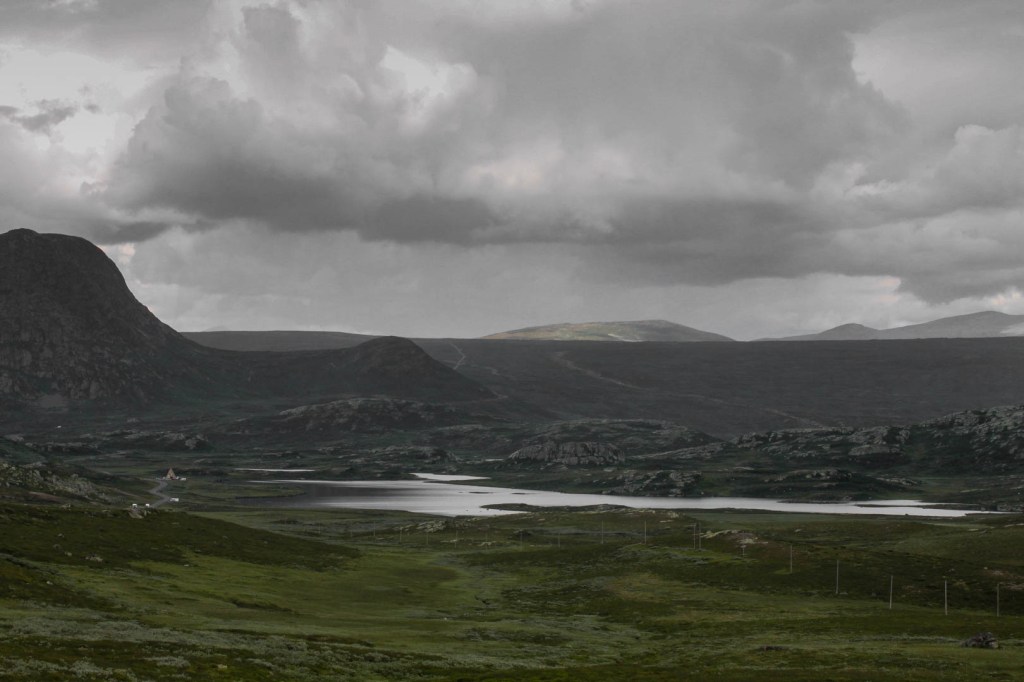
We reach a point where the trees fall away almost completely. The view opens up beneath us, valleys, ridges, layers of distance fading into gray.
He stops.
“So this is what you came for?” he asks.
“The museum?” I say.
He smiles.
“No.”
I look out over the landscape.
“No,” I say. “Not really.”
We stand there for a while without speaking.
Then he says, almost casually:
“I think I understand what you meant.”
“About what?”
“About imagining,” he says. “About being able to become something else. Not completely, but a little.”
I nod.
“That’s enough.”
He looks out again.
“And I don’t think I want to become someone else,” he says. “But… maybe I can see my life differently.”
“That’s already a change,” I say.
He nods.
We stand there in silence.
The wind moves through the open space, carrying the sound of water somewhere below.
After a while, he turns back toward the path.
“Come on,” he says. “There’s more to see.”
I follow him.
And for the first time since we started walking, I look around without thinking about what it means.
Just for a moment.
Then the thoughts return.
 Nochrisis