
If people set out towards their opinion, what they believe or think to know, do they know where to go? Or do you believe that your opinion comes from within you, arising from somewhere deep?
Some observations
Understanding where our knowledge comes from is important in our highly opinionated world. When and when not to trust our knowledge, opinions, and beliefs is important, in my opinion.
We all can live with our truths and go as far as to say that we all have “a right to our own truths.” If you say that the sky is blue, you will be right because most of us will agree, but if you say that that particular person is the best person for that job, you might find out that others disagree. You still have your truth, but it might be wise to find out what qualities you rank high and which ones the others do. If you like the character and attitude of the person you prefer, but the others point out the lack of qualification, you might have a starting point from where you can find out what is more important instead of just stating your opinion. It is often not enough to state your opinion, so finding out the reason why you have these opinions can also be important.
There is a possibility that you end up endlessly questioning your beliefs. If the question is, like in the example above, if personality or adjudication is more important, you might have anecdotal stories where an uneducated new employee lifted a company’s morals. Still, the other might use common sense that education is usually used to decide who to hire. Anecdotal evidence needs more scrutiny, but what is expected is not always the road to follow, especially when change is needed. In this example, the two sides might have discovered that one side thought that change was needed, and the other just wanted a new employee. Now you’re on the road to finding out what the reasons are that part of the company wants to change and the other part does not. From here, you can only go deeper, and maybe you will find out that you didn’t even know what you wanted or what the question was.
You say the sky is blue, but it is more correct to say that the sky looks blue. This is what my friendly AI minion says about it: The sky appears blue due to a phenomenon called Rayleigh scattering. When sunlight enters the Earth’s atmosphere, it collides with molecules and small particles, scattering the shorter blue wavelengths of light more than the longer red wavelengths. This scattering causes us to perceive the sky as blue during the day.
This is what NASA’s Space Place tells us: Sunlight reaches Earth’s atmosphere and is scattered in all directions by all the gases and particles in the air. Blue light is scattered more than the other colors because it travels as shorter, smaller waves. This is why we see a blue sky most of the time.
And here is a Quote from the scientist who wrote all of this down for the first time in 1871, John William strutt, 3rd Baron Rayleigh:
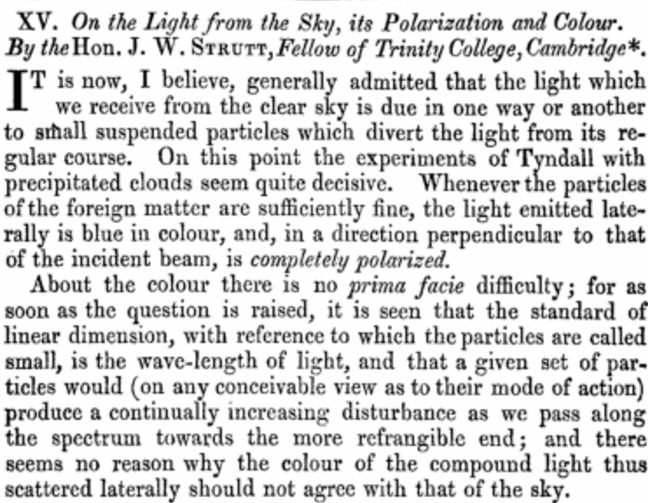
This was just a 10-minute search on the internet to “debunk” something that most of us take for granted. It is, of course, enough to say that the sky is blue, but say at least to the younger people that there is a but after you stated the obvious because for young people, there is still hope.
Friedrich Nietzsche
Human, All Too Human II
Mixed Opinions and Maxims
6 Against visionaries. -The visionary denies the truth to himself, the liar only to others.
261 One weapon twice as good as two. -It is an unequal battle when one person speaks for his position with head and heart, the other only with his head: the first has the sun and wind against him, as it were, and his two weapons interfere with each other: he loses the prize-in the eyes of truth. Admittedly, the victory of the second with his one weapon is seldom a victory according to the heart of all the other spectators and costs him his popularity among them.
270 The eternal child. -We believe that fairy tales and games belong to childhood: shortsighted as we are! As if we would like to live without fairy tales and games at any age! Admittedly, we call it something else and experience it differently, but this is precisely what speaks for it being exactly the same thing – for the child, too, feels that games are his work and fairy tales his truth. The brevity of life should preserve us from pedantically separating the ages oflife – as if each one brought something new – and a poet should sometime present to us a human being two hundred years old who really does live without fairy tales and games.
 Nochrisis