
There are many factors why there seems to be a resurgence of fascist-like sentiments. By fascism, I mean the tendency of large groups of people to walk behind a “strong” leader, like rats that follow the Pied Piper of Hamelin. Reading about colonialism and capitalism has something to do with it, but one of the better books to read is Escape from Freedom, also known as The Fear of Freedom, by Erich Fromm. In short, the book talks about the problems we humans have with freedom, or maybe better said, what we do to fill that void we feel when answers are absent.
The book was written in 1941, but as the following text shows, it could be written for our time where in America, half the population follows their dear leader blindly, but also in the Netherlands, where I come from where the word fascist might be a little bit to strong but following blindly of the leader not.
If we want to fight Fascism, we must understand it. Wishful thinking will not help us. And reciting optimistic formulae will prove to be as inadequate and useless as the ritual of an Indian rain dance. In addition to the problem of the economic and social conditions which have given rise to Fascism, there is a human problem which needs to be understood.
We forget that, although freedom of speech constitutes an important victory in the battle against old restraints, modern man is in a position where much of what “he” thinks and says are the things that everybody else thinks and says; that he has not acquired the ability to think originally – that is, for himself – which alone gives meaning to his claim that nobody can interfere with the expression of his thoughts.
Man represses the irrational passions of destructiveness, hate, envy, revenge; he worships power, money, the sovereign state, the nation; while he pays lip service to the teachings of the great spiritual leaders of the human race, those of Buddha, the prophets, Socrates, Jesus, Mohammed—he has transformed these teachings into a jungle of superstition and idol-worship. How can mankind save itself from destroying itself by this discrepancy between intellectual-technical overmaturity and emotional backwardness?
You can read the book here: https://pescanik.net/wp-content/uploads/2016/11/erich-fromm-the-fear-of-freedom-escape-from-freedom.pdf
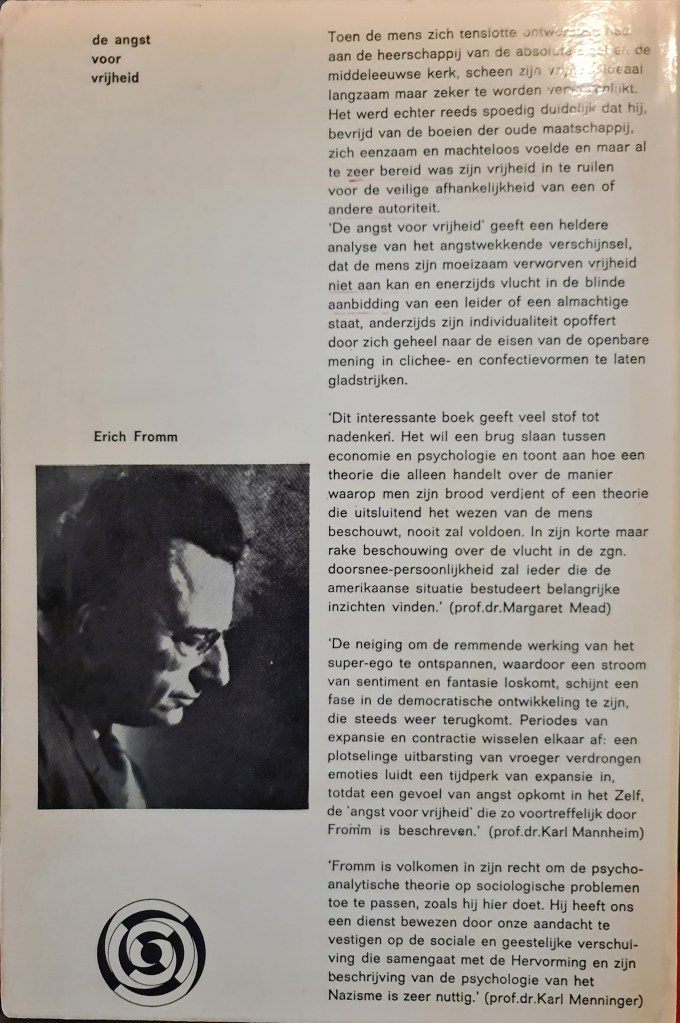

The following is a translation from the back cover of my Dutch copy of the book:
When man finally freed himself from the rule of the absolute state the medieval church, his ambition for freedom seemed to be realized slowly but surely. However, it soon became clear that, freed from the shackles of the old society, he felt lonely and powerless and was only too willing to exchange his freedom for the secure dependence of some authority.
‘The fear of freedom’ provides a clear analysis of the frightening phenomenon that man cannot cope with his hard-won freedom and on the one hand flees into the blind worship of a leader or an all-powerful state, and on the other hand sacrifices his individuality by allowing himself to be smoothed out in cliché and ready-made forms according to the demands of public opinion. “This interesting book gives much food for thought. It aims to bridge the gap between economics and psychology and shows how a theory that only deals with the way in which one earns one’s bread or a theory that only considers the essence of man will never suffice. In his short but pertinent consideration of the escape into the so-called average personality, anyone who studies the American situation will find important insights.’ (Prof. Dr. Margaret Mead)
‘The tendency to relax the inhibiting effect of the super-ego*, whereby a stream of sentiment and fantasy is released, seems to be a phase in democratic development that recurs again and again. Periods of expansion and contraction alternate: a sudden outburst of previously repressed emotions heralds an era of expansion, until a feeling of fear arises in the Self, ‘the fear of freedom’ that is so excellently described by Fromm.’ (Prof. Dr. Karl Mannheim)
‘Fromm is perfectly within his rights to apply psychoanalytic theory to sociological problems, as he does here. He has done us a service by drawing our attention to the social and spiritual shift that accompanied the Reformation, and his description of the psychology of Nazism is very useful.’ (Prof. Dr. Karl Menninger)
* The superego reflects the internalization of cultural rules, mainly as absorbed from parents, but also other authority figures, and the general cultural ethos. (https://en.wikipedia.org/wiki/Id,_ego_and_superego)
 Nochrisis
there is no word for fascism in the tongue of Native Americans
subservient behavior is learned at the point of a sword from people who will say anything to justify their oppression
freedom is easy
don’t listen to fools
LikeLike
Agree except, if freedom is easy why have so many people a problem with it. It is allready hard to find and fight your own demons and crippling certainties.
LikeLike