
Day 3577, education.

Daily picture, Quotes

Noam Chomsky

on MisEducation

The topic that was suggested, which I’m very happy to talk about, is “Democracy and Education.” The phrase democracy and education immediately brings to mind the life and work and thought of one of the outstanding thinkers of the past century, John Dewey, who devoted the greater part of his life and his thought to this array of issues. I guess I should confess a special interest. His thought was a strong influence on me in my formative years in fact, from about age two on, for a variety of reasons that I won’t go into but are real. For much of his life-later he was more skeptical-Dewey seems to have felt that reforms in early education could be in themselves a major lever of social change. They could lead the way to a more just and free society, a society in which, in his words, “the ultimate aim of production is not production of goods, but the production of free human beings associated with one another on terms of equality.” This basic commitment, which runs through all of Dewey’s work and thought, is profoundly at odds with the two lead-ing currents of modern social intellectual life; one, strong in his day-he was writing in the 1920s and 1930s about these things is associated with the command economies in Eastern Europe, the systems created by Lenin and Trotsky and turned into an even greater monstrosity by Stalin. The other, the state capitalist industrial society being constructed in the U.S. and much of the West, with the effective rule of private power. These two systems are similar in some fundamental ways, including ideologi-cally. Both were, and one of them remains, deeply authoritarian in fun-damental commitment, and both were very sharply and dramatically opposed to another tradition, the Left libertarian tradition, with roots in Enlightenment values, a tradition that included progressive liberals of the John Dewey variety, independent socialists like Bertrand Russell, lead-ing elements of the Marxist mainstream, mostly anti-Bolshevik, and of course libertarian socialists and various anarchist movements, not to speak of major parts of the labor movement and other popular sectors.

Let me return to one of Dewey’s central themes, that the ultimate aim of production is not production of goods but the production of free human beings associated with one another on terms of equality. That includes, of course, education, which was a prime concern of his. The goal of education, to shift over to Bertrand Russell, is “to give a sense of the value of things other than domination,” to help create “wise citizens of a free community,” to encourage a combination of citizenship with liberty and individual creativeness, which means that we regard “a child as a gardener regards a young tree, as something with a certain intrinsic nature, which will develop into an admirable form, given proper soil and air and light.” In fact, much as they disagreed on many other things, as they did, Dewey and Russell did agree on what Russell called this “hu-manistic conception,” with its roots in the Enlightenment, the idea that education is not to be viewed as something like filling a vessel with wa-ter but, rather, assisting a flower to grow in its own way-an eighteenth-century view that they revived. In other words, providing the circum-stances in which the normal creative patterns will flourish.

Read the rest here: https://www.scribd.com/doc/177531554/Noam-Chomsky-On-Miseducation-pdf
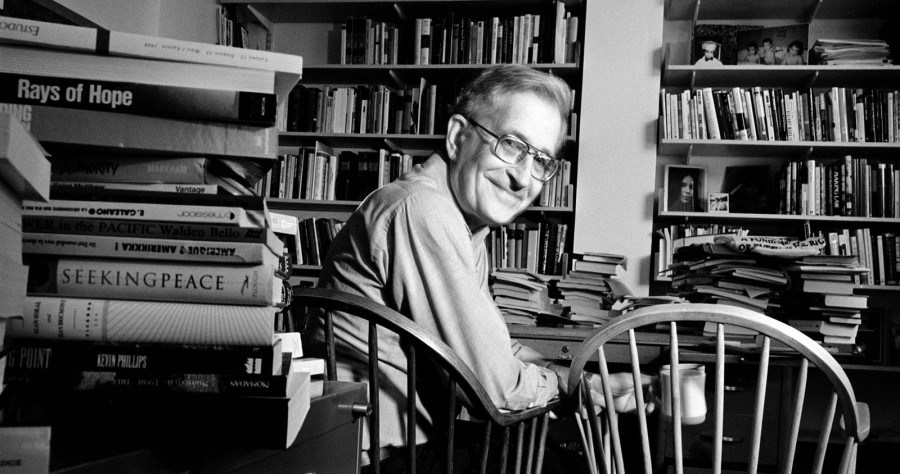
Noam Chomsky

Video

This is the interview i talked about in my previous post, it’s interesting, remember that he’s almost 90.

From Wikipedia.

Avram Noam Chomsky, born December 7, 1928) is an American linguist, cognitive scientist, historian, social critic, and political activist. Sometimes described as “the father of modern linguistics,” Chomsky is also one of the founders of the field of cognitive science. He is the author of over 100 books on topics such as linguistics, war, politics, and mass media. Ideologically, he aligns with anarcho-syndicalism and libertarian socialism. He holds a joint appointment as Institute Professor Emeritus at the Massachusetts Institute of Technology (MIT) and laureate professor at the University of Arizona..

Born to middle-class Ashkenazi Jewish immigrants in Philadelphia, Chomsky developed an early interest in anarchism from alternative bookstores in New York City. At the age of 16 he began studies at the University of Pennsylvania, taking courses in linguistics, mathematics, and philosophy. From 1951 to 1955 he was appointed to Harvard University’s Society of Fellows, where he developed the theory of transformational grammar for which he was awarded his doctorate in 1955. That year he began teaching at MIT, in 1957 emerging as a significant figure in the field of linguistics for his landmark work Syntactic Structures, which remodeled the scientific study of language, while from 1958 to 1959 he was a National Science Foundation fellow at the Institute for Advanced Study. He is credited as the creator or co-creator of the universal grammar theory, the generative grammar theory, the Chomsky hierarchy, and the minimalist program. Chomsky also played a pivotal role in the decline of behaviorism, being particularly critical of the work of B. F. Skinner.

An outspoken opponent of U.S. involvement in the Vietnam War, which he saw as an act of American imperialism, in 1967 Chomsky attracted widespread public attention for his anti-war essay “The Responsibility of Intellectuals”. Associated with the New Left, he was arrested multiple times for his activism and placed on President Richard Nixon’s Enemies List. While expanding his work in linguistics over subsequent decades, he also became involved in the Linguistics Wars. In collaboration with Edward S. Herman, Chomsky later co-wrote an analysis articulating the propaganda model of media criticism, and worked to expose the Indonesian occupation of East Timor. Additionally, his defense of unconditional freedom of speech – including for Holocaust deniers – generated significant controversy in the Faurisson affair of the early 1980s. Following his retirement from active teaching, he has continued his vocal political activism, including opposing the War on Terror and supporting the Occupy movement.

One of the most cited scholars in history, Chomsky has influenced a broad array of academic fields. He is widely recognized as a paradigm shifter who helped spark a major revolution in the human sciences, contributing to the development of a new cognitivistic framework for the study of language and the mind. In addition to his continued scholarly research, he remains a leading critic of U.S. foreign policy, neoliberalism and contemporary state capitalism, the Israeli–Palestinian conflict, and mainstream news media. His ideas have proved highly significant within the anti-capitalist and anti-imperialist movements, but have also drawn criticism, with some accusing Chomsky of anti-Americanism.