3. Appreciation of Simple Truths

Human all too human

You can read the aphorism  I discuss here below the main article.

Synopsis and my take on it:

An advanced civilization appreciates small scientific truth more than the blinding shine coming from metaphysical and artistic forms. The admirers of forms mock the admirers of “unpretentious truths” because the forms are so “beautiful, splendid, enchanting”. But the scientific truth is “hard won” and “manly”. Not only the individual but the whole of mankind “will be elevated to this manliness”. “The admirers of forms” will cling to the old truth after the scientific spirit succeeds, because they can’t or won’t appreciate the simple scientific truths. At the and of this aphorism Nietzsche writes that those worlds views have changed places and “the kingdom of the inward, spiritual beauty constantly grows deeper and wider”

This last quote was from the Helen Zimmern, 1914 translation. Below are the same passages but from different translators.

because it cannot see that the richness of inner, rational beauty always spreads and deepens” Alexander Harvey, 1908

spiritual beauty is continually growing deeper and wider” R. J. Hollingdale, 1986

“the realm of inner, spiritual beauty is continually deepening and expanding” Google translator 2017

“das Reich der inneren, geistigen Schönheit sich fortwährend vertieft und erweitert” F.Nietzsche 1878

In one sentence:

The appreciation of scientific beauty is slowly replacing the appreciation for external beauty.


Human, all too human a book for free spirits Part I, translated by Helen Zimmern 1914

3. ESTIMATION OF UNPRETENTIOUS TRUTHS.— It is the mark of a higher culture to value the little unpretentious truths which have been discovered by means of rigorous method more highly than the errors handed down by metaphysical ages and men, which blind us and make us happy. At first, one has scorn on his lips for unpretentious truths, as if they could offer no match for the others: they stand so modest, simple, sober, even apparently discouraging, while the other truths are so beautiful, splendid, enchanting, or even enrapturing. But truths that are hard won, certain, enduring, and therefore still of consequence for all further knowledge are the higher; to keep to them is manly, and shows bravery, simplicity, restraint. Eventually, not only the individual, but all mankind will be elevated to this manliness, when men finally grow accustomed to the greater esteem for durable, lasting knowledge and have lost all belief in inspiration and a seemingly miraculous communication of truths.

The admirers of forms, with their standard of beauty and sublimity, will, to be sure, have good reason to mock at first, when esteem for unpretentious truths and the scientific spirit first comes to rule, but only because either their eye has not yet been opened to the charm of the simplest form, or because men raised in that spirit have not yet been fully and inwardly permeated by it, so that they continue thoughtlessly to imitate old forms (and poorly, too, like someone who no longer really cares about the matter). Previously, the mind was not obliged to think rigorously; its importance lay in spinning out symbols and forms. That has changed ; that earnestness in the symbolical has become the mark of a lower culture. As our arts themselves grow evermore intellectual, our senses more spiritual, and as, for instance, people now judge concerning what sounds well to the senses quite differently from how they did a hundred years ago, so the forms of our life grow ever more spiritual, to the eye of older ages perhaps uglier, but only because it is incapable of perceiving how the kingdom of the inward, spiritual beauty constantly grows deeper and wider, and to what extent the inner intellectual look may be of more importance to us all than the most beautiful bodily frame and the noblest architectural structure


Menschliches allzumenschlich 1878/80

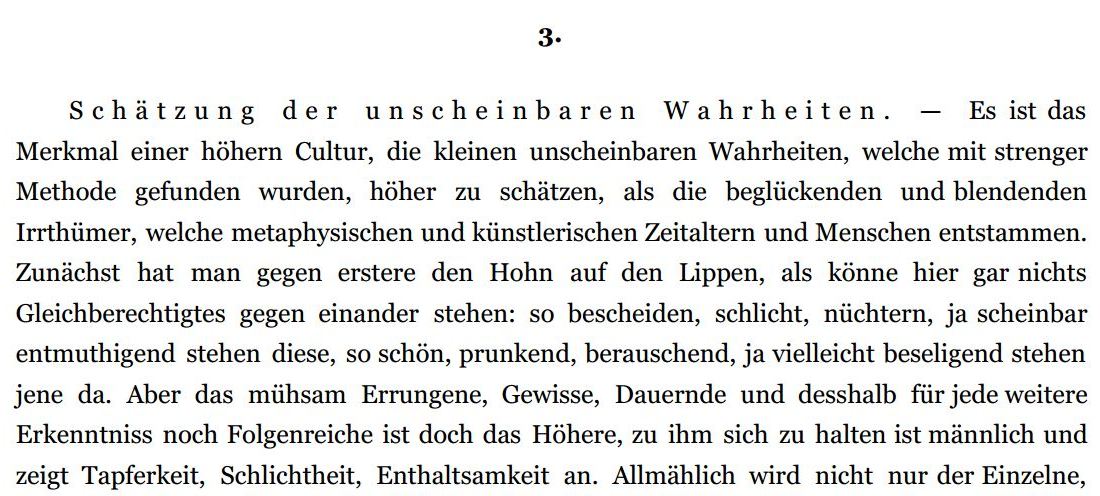
3. Schätzung der unscheinbaren Wahrheiten. – Es ist das Merkmal einer höhern Cultur, die kleinen unscheinbaren Wahrheiten, welche mit strenger Methode gefunden wurden, höher zu schätzen, als die beglückenden und blendenden Irrthümer, welche metaphysischen und künstlerischen Zeitaltern und Menschen entstammen. Zunächst hat man gegen erstere den Hohn auf den Lippen, als könne hier gar nichts Gleichberechtigtes gegen einander stehen: so bescheiden, schlicht, nüchtern, ja scheinbar entmuthigend stehen diese, so schön, prunkend, berauschend, ja vielleicht beseligend stehen jene da. Aber das mühsam Errungene, Gewisse, Dauernde und desshalb für jede weitere Erkenntniss noch Folgenreiche ist doch das Höhere, zu ihm sich zu halten ist männlich und zeigt Tapferkeit, Schlichtheit, Enthaltsamkeit an. Allmählich wird nicht nur der Einzelne, sondern die gesammte Menschheit zu dieser Männlichkeit emporgehoben werden, wenn sie sich endlich an die höhere Schätzung der haltbaren, dauerhaften Erkenntnisse gewöhnt und allen Glauben an Inspiration und wundergleiche Mittheilung von Wahrheiten verloren hat. – Die Verehrer der Formen freilich, mit ihrem Maassstabe des Schönen und Erhabenen, werden zunächst gute Gründe zu spotten haben, sobald die Schätzung der unscheinbaren Wahrheiten und der wissenschaftliche Geist anfängt zur Herrschaft zu kommen: aber nur weil entweder ihr Auge sich noch nicht dem Reiz der schlichtesten Form erschlossen hat oder weil die in jenem Geiste erzogenen Menschen noch lange nicht völlig und innerlich von ihm durchdrungen sind, so dass sie immer noch gedankenlos alte Formen nachmachen (und diess schlecht genug, wie es jemand thut, dem nicht mehr viel an einer Sache liegt). Ehemals war der Geist nicht durch strenges Denken in Anspruch genommen, da lag sein Ernst im Ausspinnen von Symbolen und Formen. Das hat sich verändert; jener Ernst des Symbolischen ist zum Kennzeichen der niederen Cultur geworden; wie unsere Künste selber immer intellectualer, unsere Sinne geistiger werden, und wie man zum Beispiel jetzt ganz anders darüber urtheilt, was sinnlich wohltönend ist, als vor hundert Jahren: so werden auch die Formen unseres Lebens immer geistiger, für das Auge älterer Zeiten vielleicht hässlicher, aber nur weil es nicht zu sehen vermag, wie das Reich der inneren, geistigen Schönheit sich fortwährend vertieft und erweitert und in wie fern uns Allen der geistreiche Blick jetzt mehr gelten darf, als der schönste Gliederbau und das erhabenste Bauwerk.

I use a Dutch translation that is based on the work of researchers Colli and Montinari. I also read a copyrighted translation by R.J.HolllingdaleI that is much better than the one I can show you here and that is a copyright free. It is a translation from 1914 that you can also read here and here. If you want to read it in German you can do that here, my German is not good enough to pretend that I can translate it better than the professionals do but I will use it as a referee. I did not find a copyright free Dutch edition but you can buy and then download it here if you like it, I will make some pictures of the first aphorism so you can see if you like it.


Sources:

I will read a Dutch translation that is based on the work of researchers Colli and Montinari. I also use a translation from R.J.Hollingdale that is more modern than the copyright free translation I use here. This is a translation from 1909 by Helen Zimmern, who knew Nietzsche personally, but there was no critical study of Nietzsche’s work done back then and this translation suffers from that. The same goes for the translation from Alexander Harvey. My German is not good enough to pretend that I can translate it better than the professionals do but I will use the original as a referee.

  1. Menselijk al te menselijk een boek voor vrije geesten, translated by Thomas Graftdijk, 2000. Buy it here
  2. Human, all too human a book for free spirits, translated by R.J.Hollingdale, 1996
  3. Human, all too human a book for free spirits I V3, translated by Gary handwerk 1997
  4. Human, all too human a book for free spirits Part I, translated by Helen Zimmern 1909. Read it  here
  5. Human, all too human a book for free spirits, translated by Alexander Harvey, 1908. Read it here
  6. Menschliches allzu menschlich 1878/80. Read it here


Opinion

Quotes

there are no eternal facts as there are no absolute truths.”

Day 595-1


This is a famous quote by Nietzsche and I am tempted to give my opinion about it, but I don’t. The reason I don’t like to that is complicated, but I can give an example that might explain it. If someone ask me what I think of a piece of music from for instance Mozart, I can tell them if I like it or not, but I cannot be critical about the quality of the music because that would mean that I think that I am at the same level as a Mozart. Only if I studied classical music, composition and so on, I can begin to understand Mozart’s quality’s and I can start thinking about giving a critique.

The same goes for a quote from a famous philosopher. I cannot critic it because I don’t know how it is connected with the rest of the philosopher’s work. If I have an opinion about it,  I must be honest and admit that that opinion is based on that of another philosophers work with a similar status than the one that I am commenting on. The same goes for agreeing to, do you really know what you are agreeing with?

An opinion is surrounded by pitfalls, watch your step.


2. Inherited faults of philosophers

Human all too human

You can read the aphorism  I discuss here below the main article.

Synopsis and my take on it:

Nietzsche begins with writing that “all philosophers” look upon man as “aeterna veritas” or eternal truth and unchangeable, but they only use a limited timeframe to define man. Some philosophers define man by recent developments like religion and political events. But man has evolved, including their understanding of things. Philosophers still see the instincts of humans as unalterable facts and key to the understanding of the world, but everything essential in human evolution took place ages ago, before our written history. Think of our “lizard brain combined with the aphorism 1. Nietzsche goes on by writing that they, the philosophers, speak of man since they started writing as unaltered or “eternal man”. And then follows a famous quote “Yet everything evolved: there are no eternal facts as there are no absolute truths.” In the light of this aphorism it seems to me that he speaks of man not fixt but ever changing despite he also pointed out thateverything essential in the development of mankind took place in primeval times, long before the four thousand years we more or less know about” hinting at a more stable beginning lingering on, in us.

In one sentence:

Man’s being cannot be fixed in time or connected to an event and identified with it.


Human, all too human a book for free spirits Part I, translated by Helen Zimmern 1914

2. INHERITED FAULTS OF PHILOSOPHERS.—All philosophers have the common fault that they start from man in his present state and hope to attain their end by an analysis of him. Unconsciously they look upon ” man ” as an aeterna veritas(eternal truth), as a thing unchangeable in all commotion, as a sure measure of things. Everything the philosopher has declared about man is, however, at bottom no more than a testimony as to the man of a very limited period of time. Lack of historical sense is the family failing of all philosophers; many, without being aware of it, even take the most recent manifestation of man, such as has arisen under the impress of certain religions, even certain political events, as the fixed form from which one has to start out. They will not learn that man has become, that the faculty of cognition has become; while some of them would have it that the whole world is spun out of this faculty of cognition. Now, everything essential in the development of mankind took place in primeval times, long before the four thousand years we more or less know about; during these years mankind may well not have altered very much. But the philosopher here sees “instincts” in man as he now is and assumes that these belong to the unalterable facts of mankind and to that extent could provide a key to the understanding of the world in general: the whole of teleology is constructed by speaking of the man of the last four millennia as of an eternal man towards whom all things in the world have had a natural relationship from the time he began. But everything has become: there are no eternal facts, just as there are no absolute truths. Consequently what is needed from now on is historical philosophizing, and with it the virtue of modesty.


Menschliches allzumenschlich 1878/80

2. Erbfehler der Philosophen. – Alle Philosophen haben den gemeinsamen Fehler an sich, dass sie vom gegenwärtigen Menschen ausgehen und durch eine Analyse desselben an’s Ziel zu kommen meinen. Unwillkürlich schwebt ihnen “der Mensch” als eine aeterna veritas, als ein Gleichbleibendes in allem Strudel, als ein sicheres Maass der Dinge vor. Alles, was der Philosoph über den Menschen aussagt, ist aber im Grunde nicht mehr, als ein Zeugniss über den Menschen eines sehr beschränkten Zeitraumes. Mangel an historischem Sinn ist der Erbfehler aller Philosophen; manche sogar nehmen unversehens die allerjüngste Gestaltung des Menschen, wie eine solche unter dem Eindruck bestimmter Religionen, ja bestimmter politischer Ereignisse entstanden ist, als die feste Form, von der man ausgehen müsse. Sie wollen nicht lernen, dass der Mensch geworden ist, dass auch das Erkenntnissvermögen geworden ist; während Einige von ihnen sogar die ganze Welt aus diesem Erkenntnissvermögen sich herausspinnen lassen. – Nun ist alles Wesentliche der menschlichen Entwickelung in Urzeiten vor sich gegangen, lange vor jenen vier tausend Jahren, die wir ungefähr kennen; in diesen mag sich der Mensch nicht viel mehr verändert haben. Da sieht aber der Philosoph “Instincte” am gegenwärtigen Menschen und nimmt an, dass diese zu den unveränderlichen Thatsachen des Menschen gehören und insofern einen Schüssel zum Verständniss der Welt überhaupt abgeben können; die ganze Teleologie ist darauf gebaut, dass man vom Menschen der letzten vier Jahrtausende als von einem ewigen redet, zu welchem hin alle Dinge in der Welt von ihrem Anbeginne eine natürliche Richtung haben. Alles aber ist geworden; es giebt keine ewigen Thatsachen: sowie es keine absoluten Wahrheiten giebt. – Demnach ist das historische Philosophiren von jetzt ab nöthig und mit ihm die Tugend der Bescheidung.


Sources:

I will read a Dutch translation that is based on the work of researchers Colli and Montinari. I also use a translation from R.J.Hollingdale and the Gary Handwerk translation from the Colli-Montinari edition. Both are more modern than the copyright free translation I use here. This is a translation from 1909 by Helen Zimmern, who knew Nietzsche personally, but there was no critical study of Nietzsche’s work done back then and this translation suffers from that. The same goes for the translation from Alexander Harvey. My German is not good enough to pretend that I can translate it better than the professionals do but I will use the original as a referee.

  1. Menselijk al te menselijk een boek voor vrije geesten, translated by Thomas Graftdijk, 2000. Buy it here
  2. Human, all too human a book for free spirits, translated by R.J.Hollingdale, 1986
  3. Human, all too human a book for free spirits I V3, translated by Gary handwerk 1997
  4. Human, all too human a book for free spirits Part I, translated by Helen Zimmern 1909. Read it  here
  5. Human, all too human a book for free spirits, translated by Alexander Harvey, 1908. Read it here
  6. Menschliches allzu menschlich 1878/80. Read it here


1. Chemistry of ideas and sensations

Human all too human

You can read the aphorism  I discuss here below the main article.

Synopsis and my take on it:

Nietzsche is predicting here the existence of what we now call neurotransmitters in a study field  (neurochemistry) that was not yet invented. First he pointed out that in metaphysical philosophy and in popular languages there is the assumption of “a miraculous origin for more highly valued things”. Things like making music that originates from “divine inspiration” instead of a cold hard chemistry process in the brain. Nietzsche talks about “chemistry of the moral, religious, esthetic ideas and sentiments” and about emotions we feel. And then, as Nietzsche often does in his work, he ends with a question that puts a thought in your mind that makes you feel challenged:Humanity likes to put all questions as to origin and beginning out of its mind; must one not be almost dehumanized to feel a contrary tendency in one’s self?”

In one sentence:

Chemistry takes over


Human, all too human a book for free spirits Part I, translated by Helen Zimmern 1914

First and last things

  1. CHEMISTRY OF IDEAS AND SENSATIONS. —Philosophical problems adopt in almost all matters the same form of question as they did two thousand years ago ; how can anything spring from its opposite ? for instance, reason out of unreason, the sentient out of the dead, logic out of unlogic, disinterested contemplation out of covetous willing, life for others out of egoism, truth out of error ? Metaphysical philosophy has helped itself over those difficulties hitherto by denying the origin of one thing in another, and assuming a miraculous origin for more highly valued things, immediately out of the kernel and essence of the ” thing in itself.” Historical philosophy, on the contrary, which is no longer to be thought of as separate from physical science, the youngest of all philosophical methods, has ascertained in single cases (and presumably this will happen in everything) that there are no opposites except in the usual exaggeration of the popular or metaphysical point of view, and that an error of reason lies at the bottom of the opposition : according to this explanation, strictly understood, there is neither an unegoistical action nor an entirely disinterested point of view, they are both only sublimations in which the fundamental element appears almost evaporated, and is only to be discovered by the closest observation. All that we require, and which can only be given us by the present advance of the single sciences, is a chemistry of the moral, religious, esthetic ideas and sentiments, as also of those emotions which we experience in ourselves both in the great and in the small phases of social and intellectual intercourse, and even in solitude; but what if this chemistry should result in the fact that also in this case the most beautiful colors have been obtained from base, even despised materials ? Would many be inclined to pursue such examinations? Humanity likes to put all questions as to origin and beginning out of its mind; must one not be almost dehumanised to feel a contrary tendency in one’s self?

Menschliches allzumenschlich 1878/80

Von den ersten und letzten Dingen.

  1. Chemie der Begriffe und Empfindungen. – Die Philosophischen Probleme nehmen jetzt wieder fast in allen Stücken dieselbe Form der Frage an, wie vor zweitausend Jahren.- wie kann Etwas aus seinem Gegensatz entstehen, zum Beispiel Vernünftiges aus Vernunftlosem, Empfindendes aus Todtem, Logik aus Unlogik, interesseloses Anschauen aus begehrlichem Wollen, Leben für Andere aus Egoismus, Wahrheit aus Irrthümern? Die metaphysische Philosophie half sich bisher über diese Schwierigkeit hinweg, insofern sie die Entstehung des Einen aus dem Andern leugnete und für die höher gewertheten Dinge einen Wunder-Ursprung annahm, unmittelbar aus dem Kern und Wesen des “Dinges an sich” heraus. Die historische Philosophie dagegen, welche gar nicht mehr getrennt von der Naturwissenschaft zu denken ist, die allerjüngste aller philosophischen Methoden, ermittelte in einzelnen Fällen (und vermuthlich wird diess in allen ihr Ergebniss sein), dass es keine Gegensätze sind, ausser in der gewohnten Uebertreibung der populären oder metaphysischen Auffassung und dass ein Irrthum der Vernunft dieser Gegenüberstellung zu Grunde liegt: nach ihrer Erklärung giebt es, streng gefasst, weder ein unegoistisches Handeln, noch ein völlig interesseloses Anschauen, es sind beides nur Sublimirungen, bei denen das Grundelement fast verflüchtigt erscheint und nur noch für die feinste Beobachtung sich als vorhanden erweist. – Alles, was wir brauchen und was erst bei der gegenwärtigen Höhe der einzelnen Wissenschaften uns gegeben werden kann, ist eine Chemie der moralischen, religiösen, ästhetischen Vorstellungen und Empfindungen, ebenso aller jener Regungen, welche wir im Gross- und Kleinverkehr der Cultur und Gesellschaft, ja in der Einsamkeit an uns erleben: wie, wenn diese Chemie mit dem Ergebniss abschlösse, dass auch auf diesem Gebiete die herrlichsten Farben aus niedrigen, ja verachteten Stoffen gewonnen sind? Werden Viele Lust haben, solchen Untersuchungen zu folgen? Die Menschheit liebt es, die Fragen über Herkunft und Anfänge sich aus dem Sinn zu schlagen: muss man nicht fast entmenscht sein, um den entgegengesetzten Hang in sich zu spüren? –

20171106_173550


Sources:

I will read a Dutch translation that is based on the work of researchers Colli and Montinari. I also use a translation from R.J.Hollingdale and the Gary Handwerk translation from the Colli-Montinari edition. Both are more modern than the copyright free translation I use here. This is a translation from 1909 by Helen Zimmern, who knew Nietzsche personally, but there was no critical study of Nietzsche’s work done back then and this translation suffers from that. The same goes for the translation from Alexander Harvey. My German is not good enough to pretend that I can translate it better than the professionals do but I will use the original as a referee.

  1. Menselijk al te menselijk een boek voor vrije geesten, translated by Thomas Graftdijk, 2000. Buy it here
  2. Human, all too human a book for free spirits, translated by R.J.Hollingdale, 1986
  3. Human, all too human a book for free spirits I V3, translated by Gary handwerk 1997
  4. Human, all too human a book for free spirits Part I, translated by Helen Zimmern 1909. Read it  here
  5. Human, all too human a book for free spirits, translated by Alexander Harvey, 1908. Read it here
  6. Menschliches allzu menschlich 1878/80. Read it here