Day 2079, Calydon.

Day's pictures
National archeological museum Athens – terracotta sphinx from Corinthia, ca.630 BC, Greece, 2014

I love to go to museums, but one thing that I do wrong is bringing a camera with me. With the camera in my hands, I look at the sculptures and jewelry but also how to take pictures of these objects and the rest that is exhibited. Doing this, I often forget to read what it is that I take pictures of, or I just glance at the text. I was in Greece 7 years ago, and for some reason, I felt the urge to see where all these objects I have taken pictures of are coming from.

I have found a lot of information on the internet, and you can read endlessly about the objects and where they came from and follow a trail of links. I do not intend to describe these objects in detail here on this blog; I just hope you get interested and start reading and searching yourself.

For this particular sculpture, I searched for the name of the museum in Athens, and after 30 pages of pictures, I finally saw a picture of this particular sculpture. I found the image on a site called hellenicaworld.com, and I found it specifically here and more here.  

Day 2078, Rhyton.

Day's pictures
National archeological museum Athens – Greece, Rhyton 1600 BC, 2014

According to Wikipedia, a Rhyton is: a roughly conical container from which fluids were intended to be drunk or to be poured in some ceremony such as libation*, or merely at table. They are typically formed in the shape of an animal’s head, and were produced over large areas of ancient Eurasia, especially from Persia to the Balkans. Many have an opening at the bottom through which the liquid fell; others did not, and were merely used as drinking cups, with the characteristic that they could not usually be set down on a surface without spilling their contents.

*a ritual pouring of a liquid, or grains such as rice, as an offering to a deity or spirit, or in memory of the dead.

I also found some good information on this site mywowo.net

Day 2077, amazing.

Day's pictures
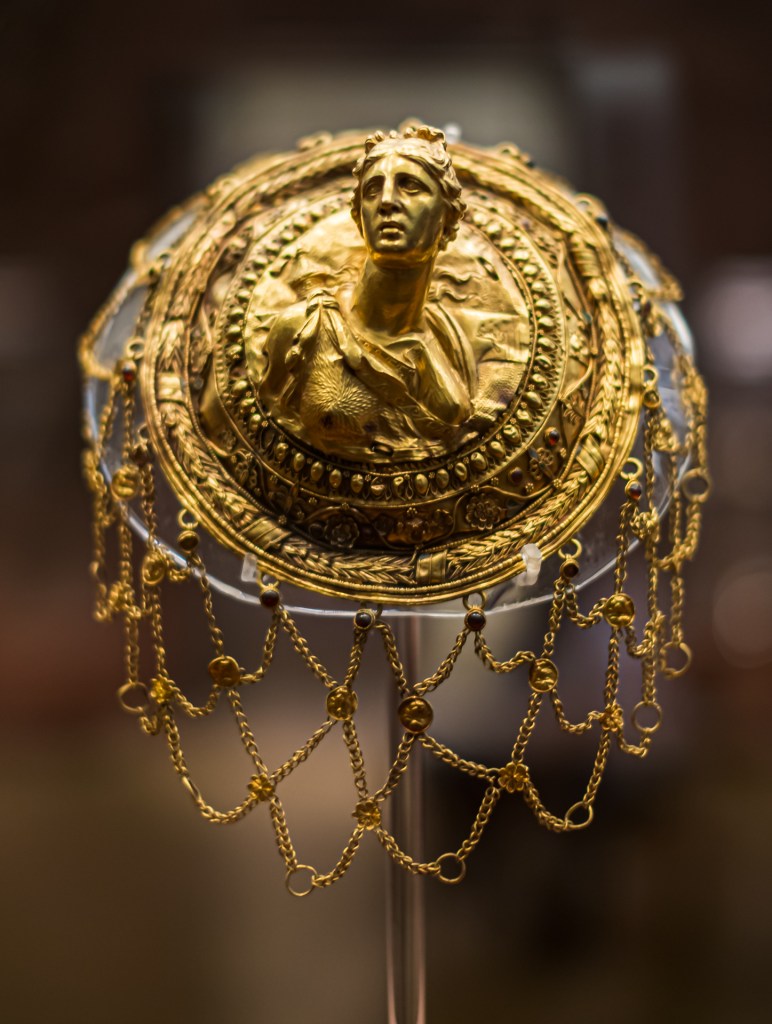
National archeological museum Athens – Greece, Hair jewel 3rd century BC, 2014

When I look at art or a jewel like this, especially made more than 2000 years ago, I always envision the artist or craftsman making this in patience, sitting in some contemporary workshop. I hear the noises outside their workshop and imagine what they think about while going for the groceries after work.

I also see all the little details and wonder how they made it and what kind of tools they used. Can you imagine making the little chains one by one, and what about the figure that protrudes out of the “chield”, if I correctly remember, it is not made out of solid gold but formed out of a thin plate. I think it is amazing, and the unknown artist will never have imagined that their work eventually ends up in a museum more than 2000 years later…and can be seen all over the world on a computer screen or telephone.