
The Core Themes of My Philosophical Journey
Summary of 10 years of writing by Chat.Mistral and curated by me.
As I reflect on my writings and the recurring ideas that have shaped my philosophical exploration, I see a tapestry of interconnected themes. These themes are not just abstract concepts but deeply personal reflections on what it means to be human, to search for meaning, and to navigate the complexities of existence. Here are the ten most common themes that have emerged in my work, expressed in my own voice and with the depth they deserve:
- The Nature of Reality
One of the central themes in my philosophy is the exploration of the nature of reality. I often find myself questioning how we perceive and understand the world around us. This theme involves delving into the complexities of human existence and the influence of our environment on our personal identity. As I’ve written, “The world is complex, much of our thinking is inherited, and certainty is rare.” This idea captures the essence of my inquiry into reality—acknowledging that our understanding is often shaped by factors beyond our immediate perception.
- The Human Condition
My writings frequently reflect on the essence of being human—the struggles, emotions, and experiences that define our existence. I delve into topics such as the role of visionaries, the impact of environment on mood, and the struggle with depression. These reflections are deeply personal, drawing on my own experiences and observations. In one of my entries, I wrote:
“Humanity learns to walk like a baby does, and what can you teach a baby? You can only encourage it with gestures and sounds because the rest has no meaning to them.”
This passage highlights my belief that our understanding of the human condition is a gradual process, shaped by our experiences and interactions with the world.
- The Search for Meaning
The search for meaning is a recurring theme in my work. I investigate the purpose and meaning of life, and how individuals can find meaning in their existence. This theme is central to my philosophical musings and reflections. As I’ve expressed:
“Philosophy gave me a manual for life, and maybe I’m still figuring it out, but one thing it has taught me so far is how to stand without ground beneath my feet, which is very useful if you’ve ever been depressed.”
This idea underscores the importance of finding meaning even in the face of uncertainty and instability. It’s about embracing the journey of self-discovery and understanding that meaning is not always readily apparent but must be sought through introspection and reflection.
- The Role of Philosophy
I often discuss the importance of philosophy in understanding the world and oneself, and its role in society. Philosophy is seen as essential for understanding the complexity of society and the limitations of human perception. As I’ve noted:
“Philosophy is like algebra, it is not easy to understand, and you get through life by just knowing what 1+1 is. Like algebra, philosophy is one of the cornerstones of our society.”
This analogy highlights my belief that philosophy, while challenging, is fundamental to our understanding of the world and our place within it. It’s not just about abstract ideas but about how we live our lives and make sense of the world around us.
- Questioning and Curiosity
I emphasize the importance of questioning one’s beliefs and being curious about the world. This theme is crucial for personal growth and understanding the world around us. As I’ve written:
“Questioning and curiosity are the best lubricants, even if you just look slightly to the side and don’t turn your world around. This way you make it easier for yourself to turn in the future when you want to, or out of necessity.”
This passage captures my belief that curiosity and questioning are essential for personal growth and understanding. They allow us to challenge our assumptions and expand our horizons, making it easier to adapt and grow in the future.
- The Impact of Environment
I explore how the environment shapes personal identity and influences human behavior. This theme is evident in my reflections on the influence of environment on personal identity and the complexities of human existence. As I’ve noted:
“We are the product of many millions of years of evolutionary development, and how and why we think the way we do is still not completely clear.”
This idea highlights my belief that our environment and evolutionary history play a significant role in shaping who we are and how we think. It’s about recognizing the influence of our surroundings and the broader context in which we live.
- The Limitations of Human Perception
I examine the boundaries of human perception and the challenges in understanding and communicating profound ideas. This theme is central to my philosophical musings and reflections. As I’ve expressed:
“But for the silent chaos in our minds, the scientific method doesn’t work; we cannot be judge, jury, and prosecutor at the same time in our own heads. But we can start with something.”
This passage underscores my belief that while the scientific method is useful for understanding the external world, it has limitations when applied to the internal chaos of our minds. It’s about recognizing the complexity of human perception and the need for introspection and self-awareness.
- The Influence of Philosophers
I reflect on the ideas of various philosophers and integrate their thoughts into my personal philosophical perspective. This theme involves drawing on the works of philosophers like Nietzsche, Krishnamurti, and Sartre. As I’ve written:
“When people say ‘make up your own mind,’ they assume that the mind is some independent source of ideas. But our thinking depends heavily on language, culture, and education. We assemble our thoughts from material we have absorbed from others.”
This idea highlights my belief that our thoughts and ideas are not entirely our own but are shaped by the influences of the philosophers and thinkers who have come before us. It’s about recognizing the debt we owe to those who have shaped our understanding of the world.
- The Therapeutic Value of Poetry
I use poetry as a means of self-expression and a tool for exploring and understanding emotions and experiences. This theme is evident in my reflections on the therapeutic value of poetry. As I’ve expressed in one of my poems:
“Red berries in the sun.
The air smells from afternoon rain.
Let me forget and stand still.
And leave me here.”
This poem captures the essence of my belief in the therapeutic value of poetry—its ability to capture emotions and experiences in a way that prose often cannot. It’s about using poetry as a tool for self-expression and understanding.
- The Critique of Society
I analyze societal issues and critique the influence of society on personal identity and behavior. This theme involves discussing the impact of societal influences and the limitations of rationality. As I’ve noted:
“We might not kill our neighbor, or raid the village next door as in the olden days, but at the same time we praise our global economy and borderless internet. Is our willingness to let thousands of children starve in poor countries not the same as letting your neighbor starve 2000 years ago?”
This passage highlights my critique of societal issues and the need to question the moral and ethical implications of our actions and beliefs. It’s about recognizing the influence of society on our behavior and the need for critical reflection.
These themes collectively form the core of my philosophical exploration, reflecting my deep introspection and relentless quest for understanding the self and the environment. Through my writings, I invite readers to question their own beliefs and perceptions, to seek truth and understanding in a world filled with uncertainty.
Fake Q&A of the same material
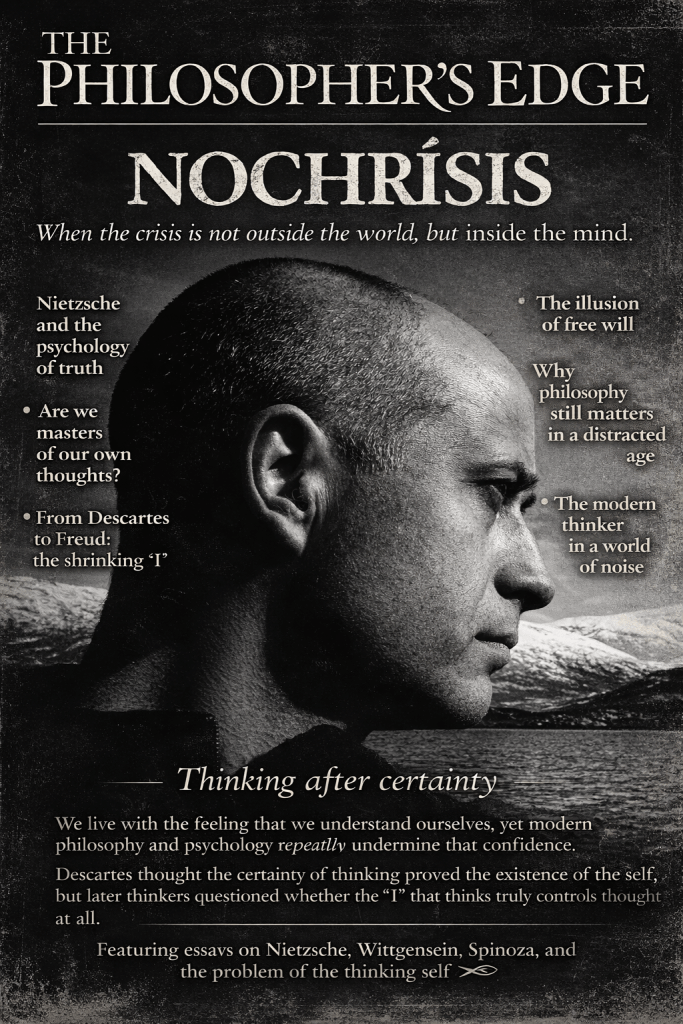
Nochrisis: On Chaos, Thought, and Amor Fati
An extended conversation with Sophy
When reading the writings of Nochrisis, one quickly notices that they do not resemble a conventional philosophical project. There is no systematic treatise, no single thesis carefully defended across chapters. Instead there are short essays, poems, reflections on philosophers, observations from daily life, and repeated returns to a small set of persistent questions: What is reality? How much control do we have over our own thinking? What role do science and philosophy play in understanding the world?
The project developed gradually through years of daily writing. The tone is exploratory. Rather than presenting finished conclusions, Nochrisis uses writing as a way of examining the assumptions behind everyday beliefs.
The subtitle of his blog—Amor Fati—suggests the orientation behind this work: an attempt to confront reality as it is, without seeking comforting illusions.
I asked him where this project began.
Sophy: When I read through your writing, I get the impression that it grew out of a habit rather than from a clear initial plan. Did you begin with a philosophical project in mind, or did it evolve over time?
Nochrisis: It definitely evolved. I started writing small pieces simply because I liked thinking about certain questions. Philosophy was always interesting to me, but I did not approach it academically. I would read a philosopher—Nietzsche for example—and then write a small reflection about something that struck me.
Over time those reflections accumulated. When you write almost every day, you eventually start seeing the same questions returning in different forms.
Sophy: So the writing itself became a method of thinking?
Nochrisis: Exactly. Writing forces you to slow down. When a thought remains only in your head, it feels coherent. Once you try to put it into words, you immediately see where the gaps are.
Sophy: And the public aspect—publishing these reflections online—does that change the way you think?
Nochrisis: A little. Even if almost nobody reads it, the possibility that someone might read it makes you slightly more careful. But the main purpose is still personal clarification.
Sophy: One of the first themes that appears in your work is the idea of chaos. You even connect it to the word “anarchy,” although not in a political sense. What do you mean by that?
Nochrisis: The word anarchy literally means “without a ruler.” I use it as a metaphor for the structure of the universe. When we look at reality scientifically, we do not find a central authority directing events. Things happen through natural processes.
Human beings respond to this uncertainty by creating systems that give the impression of order—religions, moral frameworks, political institutions.
Sophy: In other words, civilization itself becomes a strategy for dealing with chaos.
Nochrisis: Yes. The world itself is indifferent to us. The systems we create are attempts to make it more predictable and manageable.
Sophy: Does that perspective make life feel meaningless?
Nochrisis: Not necessarily. It only removes the idea that meaning is built into the universe. Meaning then becomes something humans create rather than something they discover.
Sophy: Science appears frequently in your writing when you talk about this. You seem particularly concerned about how people misunderstand scientific knowledge.
Nochrisis: The misunderstanding around the word “theory” is a good example. In everyday language, a theory is just an idea. In science it means something very different: an explanation supported by extensive evidence and testing.
When people say “it’s just a theory,” they are unintentionally dismissing one of the strongest forms of knowledge we have.
Sophy: Yet you also emphasize skepticism. How do you reconcile skepticism with trust in science?
Nochrisis: Skepticism should be directed at claims that lack evidence. Science itself is based on skepticism—experiments exist to test whether an idea survives scrutiny.
Trusting the scientific method is not the same as trusting authority blindly.
Sophy: Your writing often moves from science to biology and evolution. At one point you describe humans as vehicles for DNA. That is quite a stark way of looking at ourselves.
Nochrisis: It is stark, but it is also a useful perspective. Genes have persisted for billions of years by replicating through organisms. From that point of view, individual organisms—including humans—are temporary carriers of genetic information.
Sophy: Does that idea change the way you see human importance?
Nochrisis: It reduces human exceptionalism. We like to imagine that we occupy a central role in the universe, but evolution shows that we are part of a much larger biological process.
Sophy: Yet despite that, human beings experience themselves as free and autonomous individuals. You often question that sense of freedom.
Nochrisis: Yes, because when you look at the influences shaping our behavior—genetics, culture, upbringing—it becomes difficult to say how much of our thinking originates purely from ourselves.
Spinoza described freedom as the feeling we have when we are aware of our actions but unaware of their causes.
Sophy: That sounds almost deterministic. Do you believe free will is an illusion?
Nochrisis: I think our experience of freedom is real in a psychological sense. But the deeper causes behind our actions might be far more complex than we realize.
Sophy: And yet society still holds people responsible for their actions.
Nochrisis: It has to. Even if free will is philosophically uncertain, our social systems depend on the concept of responsibility.
Sophy: Another theme in your writing concerns originality. You often argue that most of our thoughts are not truly our own.
Nochrisis: When people say “make up your own mind,” they assume that the mind is some independent source of ideas. But our thinking depends heavily on language, culture, and education.
We assemble our thoughts from material we have absorbed from others.
Sophy: That sounds like a critique of intellectual ego.
Nochrisis: It is. Many people believe their opinions are entirely self-generated, when in reality they are largely inherited.
Sophy: Nietzsche seems to have influenced this view. You quote him often.
Nochrisis: Nietzsche was one of the first philosophers who really examined the psychological motivations behind beliefs. He asked why people hold certain moral views rather than only asking whether those views are logically consistent.
Sophy: And that connects to the subtitle of your blog: Amor Fati. Why choose that phrase?
Nochrisis: Amor Fati means “love of fate.” Nietzsche used it to describe an attitude toward life where you accept reality completely, including its difficulties.
Sophy: Acceptance in the sense of resignation?
Nochrisis: Not resignation. More like clarity. If the world is fundamentally chaotic and indifferent, then resisting that fact does not help. The only honest response is to accept reality as it is.
Sophy: And loving fate means embracing that reality rather than merely tolerating it.
Nochrisis: Exactly. It means saying yes to life, even when life includes suffering or uncertainty.
Sophy: That seems related to your reflections on identity and the self. In several places you question whether the “I” we refer to actually exists as a stable entity.
Nochrisis: Language encourages us to imagine a fixed self behind our actions. When we say “I think,” it sounds as if there is a thinker separate from the thought.
Nietzsche pointed out that this assumption might simply be a grammatical habit. Thinking may occur without a clearly defined “thinker.”
Sophy: So the self becomes more like a process than a fixed object.
Nochrisis: Yes. Identity is shaped continuously by biology, memory, and environment.
Sophy: That idea appears again in your reflections on perception. You often describe the brain as constructing reality.
Nochrisis: Our senses provide incomplete information. The brain interprets signals and fills in gaps. What we experience as reality is partly constructed inside our nervous system.
Sophy: That realization could lead to skepticism about knowledge.
Nochrisis: It could, but it can also lead to humility. Recognizing the limits of our perception encourages us to rely on methods that compensate for those limits—science being one example.
Sophy: You once compared philosophy to mathematics: essential but largely ignored.
Nochrisis: Mathematics underlies much of modern technology even though most people never study it deeply. Philosophy plays a similar role in shaping how we think about knowledge, ethics, and society.
Sophy: Yet philosophy often seems disconnected from everyday life.
Nochrisis: That may be partly a communication problem. Philosophers sometimes speak in technical language that discourages readers.
Sophy: Your own writing, by contrast, mixes philosophy with poetry.
Nochrisis: Poetry allows a different form of expression. A poem can capture an intuition or emotional insight that might be difficult to explain analytically.
Sophy: Do you expect readers to interpret those poems the same way you do?
Nochrisis: No. Once something is written, the reader brings their own interpretation. If someone finds a different meaning, that is fine.
Sophy: After years of writing these reflections, do you feel you are approaching a coherent philosophical position?
Nochrisis: Perhaps not a position in the traditional sense. What has become clearer is a general orientation: the world is complex, much of our thinking is inherited, and certainty is rare.
Sophy: And the role of writing is to examine those uncertainties.
Nochrisis: Exactly. Philosophy begins where certainty ends.
Sophy: Then Amor Fati becomes not just a motto but a way of approaching those uncertainties.
Nochrisis: Yes. If the world does not conform to our expectations, we can either resent that fact or learn to accept it. Loving fate means accepting the reality we are part of and trying to understand it as honestly as possible.
De KernThema’s van Mijn Filosofische Reis
Tien jaar schrijven samengevat door Chat.Mistral en gecontroleerd door mij.
Terwijl ik terugkijk op mijn geschriften en de terugkerende ideeën die mijn filosofische verkenning hebben gevormd, zie ik een weefsel van met elkaar verbonden thema’s. Deze thema’s zijn niet slechts abstracte concepten, maar diep persoonlijke reflecties over wat het betekent om mens te zijn, over de zoektocht naar betekenis en het navigeren door de complexiteiten van het bestaan. Hier zijn de tien meest voorkomende thema’s die naar voren zijn gekomen in mijn werk, uitgedrukt in mijn eigen woorden en met de diepgang die ze verdienen:
- De Aard van de Werkelijkheid
Een van de centrale thema’s in mijn filosofie is de verkenning van de aard van de werkelijkheid. Ik vraag me vaak af hoe wij de wereld om ons heen waarnemen en begrijpen. Dit thema omvat het duiken in de complexiteiten van het menselijk bestaan en de invloed van onze omgeving op onze persoonlijke identiteit. Zoals ik heb geschreven: “De wereld is complex, veel van ons denken is geërfd, en zekerheid is zeldzaam.” Dit idee vat de essentie van mijn onderzoek naar de werkelijkheid samen — het erkennen dat ons begrip vaak wordt gevormd door factoren buiten onze directe waarneming.
- De Menselijke Conditie
Mijn geschriften reflecteren vaak op de essentie van het mens-zijn — de worstelingen, emoties en ervaringen die ons bestaan definiëren. Ik ga dieper in op onderwerpen zoals de rol van visionairs, de impact van de omgeving op ons humeur, en de strijd met depressie. Deze reflecties zijn diep persoonlijk en putten uit mijn eigen ervaringen en observaties. In een van mijn aantekeningen schreef ik:
“De mensheid leert lopen zoals een baby dat doet, en wat kun je een baby leren? Je kunt het alleen maar aanmoedigen met gebaren en geluiden, want de rest heeft geen betekenis voor hen.”
Deze passage benadrukt mijn overtuiging dat ons begrip van de menselijke conditie een geleidelijk proces is, gevormd door onze ervaringen en interacties met de wereld.
- De Zoektocht naar Betekenis
De zoektocht naar betekenis is een terugkerend thema in mijn werk. Ik onderzoek het doel en de betekenis van het leven, en hoe individuen betekenis kunnen vinden in hun bestaan. Dit thema staat centraal in mijn filosofische overpeinzingen en reflecties. Zoals ik heb uitgedrukt:
“Filosofie gaf me een handleiding voor het leven, en misschien ben ik er nog niet helemaal uit, maar één ding dat het me tot nu toe heeft geleerd, is hoe ik zonder vaste grond onder mijn voeten kan staan, wat zeer nuttig is als je ooit depressief bent geweest.”
Dit idee benadrukt het belang van het vinden van betekenis, zelfs in het gezicht van onzekerheid en instabiliteit. Het gaat erom de reis van zelfontdekking te omarmen en te begrijpen dat betekenis niet altijd voor de hand ligt, maar gezocht moet worden door introspectie en reflectie.
- De Rol van Filosofie
Ik bespreek vaak het belang van filosofie bij het begrijpen van de wereld en jezelf, en de rol ervan in de samenleving. Filosofie is essentieel voor het begrijpen van de complexiteit van de samenleving en de beperkingen van de menselijke waarneming. Zoals ik heb opgemerkt:
“Filosofie is als algebra, het is niet gemakkelijk te begrijpen, en je komt door het leven met alleen maar te weten wat 1+1 is. Net als algebra is filosofie een van de hoekstenen van onze samenleving.”
Deze analogie benadrukt mijn overtuiging dat filosofie, hoewel uitdagend, fundamenteel is voor ons begrip van de wereld en onze plaats daarin. Het gaat niet alleen om abstracte ideeën, maar om hoe we ons leven leiden en zin geven aan de wereld om ons heen.
- Vragen Stellen en Nieuwsgierigheid
Ik benadruk het belang van het bevragen van je eigen overtuigingen en nieuwsgierig zijn naar de wereld. Dit thema is cruciaal voor persoonlijke groei en het begrijpen van de wereld om ons heen. Zoals ik heb geschreven:
“Vragen stellen en nieuwsgierigheid zijn de beste smering, zelfs als je slechts een beetje opzij kijkt en je wereld niet helemaal omgooit. Op deze manier maak je het voor jezelf gemakkelijker om in de toekomst te draaien wanneer je dat wilt, of uit noodzaak.”
Deze passage vat mijn overtuiging samen dat nieuwsgierigheid en vragen stellen essentieel zijn voor persoonlijke groei en begrip. Ze stellen ons in staat onze aannames uit te dagen en onze horizon te verbreden, waardoor het gemakkelijker wordt om ons in de toekomst aan te passen en te groeien.
- De Invloed van de Omgeving
Ik verkennen hoe de omgeving persoonlijke identiteit vormt en menselijk gedrag beïnvloedt. Dit thema komt naar voren in mijn reflecties over de invloed van de omgeving op persoonlijke identiteit en de complexiteiten van het menselijk bestaan. Zoals ik heb opgemerkt:
“Wij zijn het product van miljoenen jaren evolutionaire ontwikkeling, en hoe en waarom we denken zoals we doen, is nog steeds niet helemaal duidelijk.”
Dit idee benadrukt mijn overtuiging dat onze omgeving en evolutionaire geschiedenis een belangrijke rol spelen in wie we zijn en hoe we denken. Het gaat erom de invloed van onze omgeving en de bredere context waarin we leven te erkennen.
- De Beperkingen van de Menselijke Waarneming
Ik onderzoeken de grenzen van de menselijke waarneming en de uitdagingen bij het begrijpen en communiceren van diepgaande ideeën. Dit thema staat centraal in mijn filosofische overpeinzingen en reflecties. Zoals ik heb uitgedrukt:
“Maar voor de stille chaos in onze geest, werkt de wetenschappelijke methode niet; we kunnen niet tegelijkertijd rechter, jury en aanklager zijn in ons eigen hoofd. Maar we kunnen ergens beginnen.”
Deze passage benadrukt mijn overtuiging dat, hoewel de wetenschappelijke methode nuttig is voor het begrijpen van de externe wereld, deze beperkingen heeft wanneer toegepast op de interne chaos van onze geest. Het gaat erom de complexiteit van de menselijke waarneming te erkennen en de noodzaak van introspectie en zelfbewustzijn.
- De Invloed van Filosofen
Ik reflecteer op de ideeën van verschillende filosofen en integreer hun gedachten in mijn persoonlijke filosofische perspectief. Dit thema omvat het putten uit de werken van filosofen zoals Nietzsche, Krishnamurti en Sartre. Zoals ik heb geschreven:
“Wanneer mensen zeggen ‘vorm je eigen mening’, gaan ze ervan uit dat de geest een onafhankelijke bron van ideeën is. Maar ons denken hangt sterk af van taal, cultuur en opvoeding. We stellen onze gedachten samen uit materiaal dat we van anderen hebben geabsorbeerd.”
Dit idee benadrukt mijn overtuiging dat onze gedachten en ideeën niet geheel van onszelf zijn, maar gevormd worden door de invloeden van de filosofen en denkers die ons voorgingen. Het gaat erom de schuld te erkennen die we hebben aan degenen die ons begrip van de wereld hebben gevormd.
- De Therapeutische Waarde van Poëzie
Ik gebruik poëzie als middel tot zelfexpressie en als instrument om emoties en ervaringen te verkennen en te begrijpen. Dit thema komt naar voren in mijn reflecties over de therapeutische waarde van poëzie. Zoals ik heb uitgedrukt in een van mijn gedichten:
“Rode bessen in de zon.
De lucht ruikt naar middagregen.
Laat me vergeten en stil staan.
En laat me hier.”
Dit gedicht vat de essentie van mijn geloof in de therapeutische waarde van poëzie — het vermogen om emoties en ervaringen op een manier vast te leggen die proza vaak niet kan. Het gaat erom poëzie te gebruiken als een hulpmiddel voor zelfexpressie en begrip.
- Kritiek op de Samenleving
Ik analyseer maatschappelijke kwesties en kritiseer de invloed van de samenleving op persoonlijke identiteit en gedrag. Dit thema omvat het bespreken van de impact van maatschappelijke invloeden en de beperkingen van de rationaliteit. Zoals ik heb opgemerkt:
“We doden misschien onze buurman niet meer, of plunderen niet langer het dorp naast ons zoals in de oude dagen, maar tegelijkertijd prijzen we onze mondiale economie en het grensloze internet. Is onze bereidheid om duizenden kinderen in arme landen te laten verhongeren niet hetzelfde als het laten verhongeren van je buurman 2000 jaar geleden?”
Deze passage benadrukt mijn kritiek op maatschappelijke kwesties en de noodzaak om de morele en ethische implicaties van onze acties en overtuigingen in vraag te stellen. Het gaat erom de invloed van de samenleving op ons gedrag te erkennen en de noodzaak van kritische reflectie.
Deze thema’s vormen gezamenlijk de kern van mijn filosofische verkenning en weerspiegelen mijn diepe introspectie en onvermoeibare zoektocht naar begrip van mezelf en de omgeving. Door mijn geschriften nodig ik lezers uit om hun eigen overtuigingen en percepties in vraag te stellen, om waarheid en begrip te zoeken in een wereld vol onzekerheid.
Fantasie-interview gemaakt door dezelfde chatbot.
# Nochrisis: Over Chaos, Gedachte en Amor Fati
Een uitgebreid gesprek met Sophy
Bij het lezen van de geschriften van Nochrisis valt snel op dat ze niet lijken op een conventioneel filosofisch project. Er is geen systematisch traktaat, geen enkele stelling die zorgvuldig wordt verdedigd in verschillende hoofdstukken. In plaats daarvan zijn er korte essays, gedichten, reflecties over filosofen, observaties uit het dagelijks leven, en herhaalde terugkomsten naar een kleine set van aanhoudende vragen: Wat is de werkelijkheid? Hoeveel controle hebben we over ons eigen denken? Welke rol spelen wetenschap en filosofie bij het begrijpen van de wereld?
Het project ontwikkelde zich geleidelijk door jaren van dagelijks schrijven. De toon is verkennend. In plaats van afgeronde conclusies te presenteren, gebruikt Nochrisis schrijven als een manier om de aannames achter alledaagse overtuigingen te onderzoeken.
De ondertitel van zijn blog—Amor Fati—suggereert de oriëntatie achter dit werk: een poging om de werkelijkheid te confronteren zoals die is, zonder naar geruststellende illusies te zoeken.
Ik vroeg hem waar dit project begon.
Sophy: Wanneer ik je werk doorlees, krijg ik de indruk dat het meer uit een gewoonte is ontstaan dan uit een duidelijk initieel plan. Ben je begonnen met een filosofisch project in gedachten, of is het in de loop der tijd geëvolueerd?
Nochrisis: Het heeft zeker geëvolueerd. Ik begon kleine stukjes te schrijven simpelweg omdat ik graag over bepaalde vragen nadacht. Filosofie was altijd interessant voor mij, maar ik benaderde het niet academisch. Ik las een filosoof—Nietzsche bijvoorbeeld—en schreef daarna een kleine reflectie over iets dat me aansprak.
In de loop der tijd stapelden die reflecties zich op. Wanneer je bijna elke dag schrijft, begin je uiteindelijk dezelfde vragen in verschillende vormen terug te zien.
Sophy: Dus het schrijven zelf werd een methode van denken?
Nochrisis: Precies. Schrijven dwingt je om te vertragen. Wanneer een gedachte alleen in je hoofd blijft, voelt het coherent. Zodra je probeert het in woorden te vatten, zie je meteen waar de gaten zitten.
Sophy: En het publieke aspect—het online publiceren van deze reflecties—verandert dat de manier waarop je denkt?
Nochrisis: Een beetje. Zelfs als bijna niemand het leest, maakt de mogelijkheid dat iemand het zou kunnen lezen je iets voorzichtiger. Maar het belangrijkste doel blijft persoonlijke verduidelijking.
Sophy: Een van de eerste thema’s die in je werk opduikt, is het idee van chaos. Je verbindt het zelfs met het woord “anarchie”, alhoewel niet in politiek opzicht. Wat bedoel je daarmee?
Nochrisis: Het woord anarchie betekent letterlijk “zonder heerser”. Ik gebruik het als metafoor voor de structuur van het universum. Wanneer we naar de werkelijkheid kijken vanuit een wetenschappelijk perspectief, vinden we geen centrale autoriteit die gebeurtenissen stuurt. Dingen gebeuren door natuurlijke processen.
Mensen reageren op deze onzekerheid door systemen te creëren die de indruk van orde geven—religies, morele kaders, politieke instellingen.
Sophy: Met andere woorden, de beschaving zelf wordt een strategie om met chaos om te gaan.
Nochrisis: Ja. De wereld zelf is onverschillig tegenover ons. De systemen die we creëren zijn pogingen om het meer voorspelbaar en beheersbaar te maken.
Sophy: Maakt dat perspectief het leven zinloos?
Nochrisis: Niet noodzakelijk. Het verwijdert alleen het idee dat betekenis in het universum is ingebouwd. Betekenis wordt dan iets wat mensen creëren in plaats van iets wat ze ontdekken.
Sophy: Wetenschap komt vaak aan bod in je schrijven als je hierover spreekt. Je lijkt je vooral zorgen te maken over hoe mensen wetenschappelijke kennis misverstaan.
Nochrisis: Het misverstand rond het woord “theorie” is een goed voorbeeld. In het dagelijks taalgebruik is een theorie slechts een idee. In de wetenschap betekent het iets heel anders: een verklaring ondersteund door uitgebreid bewijs en testen.
Wanneer mensen zeggen “het is maar een theorie”, wijzen ze onbedoeld een van de sterkste vormen van kennis die we hebben af.
Sophy: Toch benadruk je ook scepticisme. Hoe verenig je scepticisme met vertrouwen in wetenschap?
Nochrisis: Scepticisme moet gericht zijn op beweringen die bewijs ontberen. Wetenschap zelf is gebaseerd op scepticisme—experimenten bestaan om te testen of een idee kritische beoordeling kan doorstaan.
Vertrouwen in de wetenschappelijke methode is niet hetzelfde als blind vertrouwen in autoriteit.
Sophy: Je schrijven gaat vaak van wetenschap naar biologie en evolutie. Op een gegeven moment beschrijf je mensen als voertuigen voor DNA. Dat is een nogal scherpe manier om naar onszelf te kijken.
Nochrisis: Het is scherp, maar het is ook een nuttig perspectief. Genen hebben miljarden jaren standgehouden door zich te repliceren via organismen. Vanaf dat standpunt zijn individuele organismen—inclusief mensen—tijdelijke dragers van genetische informatie.
Sophy: Verandert dat idee de manier waarop je menselijk belang ziet?
Nochrisis: Het reduceert menselijk exceptionalisme. We willen graag denken dat we een centrale rol in het universum spelen, maar evolutie toont aan dat we deel uitmaken van een veel groter biologisch proces.
Sophy: Toch ervaren mensen zichzelf als vrije en autonome individuen. Je stelt die ervaring van vrijheid vaak ter discussie.
Nochrisis: Ja, omdat wanneer je kijkt naar de invloeden die ons gedrag vormgeven—genetica, cultuur, opvoeding—het moeilijk wordt om te zeggen hoeveel van ons denken puur uit onszelf voortkomt.
Spinoza beschreef vrijheid als het gevoel dat we hebben wanneer we ons bewust zijn van onze acties maar ons niet bewust zijn van hun oorzaken.
Sophy: Dat klinkt bijna deterministisch. Geloof je dat vrije wil een illusie is?
Nochrisis: Ik denk dat onze ervaring van vrijheid reëel is in psychologische zin. Maar de diepere oorzaken achter onze acties zouden wel eens veel complexer kunnen zijn dan we ons realiseren.
Sophy: Toch houdt de samenleving mensen verantwoordelijk voor hun acties.
Nochrisis: Dat moet ook. Zelfs als vrije wil filosofisch onzeker is, hangen onze sociale systemen af van het concept van verantwoordelijkheid.
Sophy: Een ander thema in je schrijven betreft originaliteit. Je stelt vaak dat de meeste van onze gedachten niet echt van onszelf zijn.
Nochrisis: Wanneer mensen zeggen “vorm je eigen mening”, gaan ze ervan uit dat de geest een onafhankelijke bron van ideeën is. Maar ons denken hangt sterk af van taal, cultuur en opvoeding.
We stellen onze gedachten samen uit materiaal dat we van anderen hebben geabsorbeerd.
Sophy: Dat klinkt als een kritiek op intellectueel egoïsme.
Nochrisis: Dat is het ook. Veel mensen geloven dat hun meningen geheel door henzelf zijn gegenereerd, terwijl ze in werkelijkheid grotendeels zijn geërfd.
Sophy: Nietzsche lijkt deze visie te hebben beïnvloed. Je citeert hem vaak.
Nochrisis: Nietzsche was een van de eerste filosofen die echt de psychologische motivaties achter overtuigingen onderzocht. Hij vroeg waarom mensen bepaalde morele opvattingen hebben in plaats van alleen te vragen of die opvattingen logisch consistent zijn.
Sophy: En dat verbindt zich met de ondertitel van je blog: Amor Fati. Waarom heb je die zin gekozen?
Nochrisis: Amor Fati betekent “liefde voor het lot”. Nietzsche gebruikte het om een houding ten opzichte van het leven te beschrijven waarbij je de werkelijkheid volledig accepteert, inclusief de moeilijkheden.
Sophy: Acceptatie in de zin van berusting?
Nochrisis: Niet berusting. Meer als helderheid. Als de wereld fundamenteel chaotisch en onverschillig is, dan helpt het niet om dat feit te weerstaan. De enige eerlijke reactie is om de werkelijkheid te accepteren zoals die is.
Sophy: En het liefhebben van het lot betekent die werkelijkheid omarmen in plaats van haar slechts te tolereren.
Nochrisis: Precies. Het betekent ja zeggen tegen het leven, zelfs wanneer het leven lijden of onzekerheid inhoudt.
Sophy: Dat lijkt gerelateerd aan je reflecties over identiteit en het zelf. Op verschillende plaatsen stel je de vraag of het “ik” waar we naar verwijzen eigenlijk bestaat als een stabiel entiteit.
Nochrisis: Taal moedigt ons aan om ons een vast zelf achter onze acties voor te stellen. Wanneer we zeggen “ik denk”, klinkt het alsof er een denker is die gescheiden is van de gedachte.
Nietzsche wees erop dat deze aanname gewoon een grammaticaal gewoonte zou kunnen zijn. Denken kan plaatsvinden zonder een duidelijk gedefinieerde “denker”.
Sophy: Dus het zelf wordt meer een proces dan een vast object.
Nochrisis: Ja. Identiteit wordt continu gevormd door biologie, herinnering en omgeving.
Sophy: Dat idee komt weer terug in je reflecties over waarneming. Je beschrijft de hersenen vaak als iets dat de werkelijkheid construeert.
Nochrisis: Onze zintuigen geven onvolledige informatie. De hersenen interpreteren signalen en vullen gaten op. Wat we ervaren als werkelijkheid is gedeeltelijk geconstrueerd binnen ons zenuwstelsel.
Sophy: Die realisatie zou kunnen leiden tot scepticisme over kennis.
Nochrisis: Het zou kunnen, maar het kan ook leiden tot nederigheid. Het erkennen van de beperkingen van onze waarneming moedigt ons aan om ons te verlaten op methoden die die beperkingen compenseren—wetenschap is daar een voorbeeld van.
Sophy: Je hebt filosofie ooit vergeleken met wiskunde: essentieel maar grotendeels genegeerd.
Nochrisis: Wiskunde ligt ten grondslag aan veel moderne technologie, zelfs al bestuderen de meeste mensen het niet diepgaand. Filosofie speelt een vergelijkbare rol in hoe we nadenken over kennis, ethiek en samenleving.
Sophy: Toch lijkt filosofie vaak los te staan van het dagelijks leven.
Nochrisis: Dat kan gedeeltelijk een communicatieprobleem zijn. Filosofen spreken soms in technische taal die lezers afschrikt.
Sophy: Jouw eigen schrijven mengt daarentegen filosofie met poëzie.
Nochrisis: Poëzie laat een andere vorm van expressie toe. Een gedicht kan een intuïtie of emotioneel inzicht vastleggen dat moeilijk analytisch te verklaren is.
Sophy: Verwacht je dat lezers die gedichten op dezelfde manier interpreteren als jij?
Nochrisis: Nee. Zodra iets geschreven is, brengt de lezer zijn eigen interpretatie mee. Als iemand een andere betekenis vindt, is dat prima.
Sophy: Na jaren van het schrijven van deze reflecties, voel je dat je dichter bij een coherente filosofische positie komt?
Nochrisis: Misschien niet een positie in de traditionele zin. Wat duidelijker is geworden, is een algemene oriëntatie: de wereld is complex, veel van ons denken is geërfd, en zekerheid is zeldzaam.
Sophy: En de rol van schrijven is om die onzekerheden te onderzoeken.
Nochrisis: Precies. Filosofie begint waar zekerheid ophoudt.
Sophy: Dan wordt Amor Fati niet alleen een motto, maar een manier om die onzekerheden te benaderen.
Nochrisis: Ja. Als de wereld niet voldoet aan onze verwachtingen, kunnen we dat feit ofwel verafschuwen of leren accepteren. Van het lot houden betekent de werkelijkheid accepteren waar we deel van uitmaken en proberen die zo eerlijk mogelijk te begrijpen.
 Nochrisis