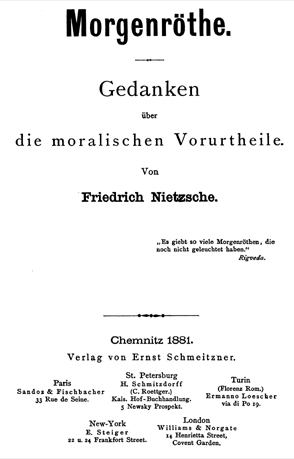
Morgenröte
The Dawn of Day or Daybreak (German: Morgenröte – Gedanken über die moralischen Vorurteile; historical orthography: Morgenröthe – Gedanken über die moralischen Vorurtheile; English: The Dawn of Day/ Daybreak: Thoughts on the Prejudices of Morality) is a 1881 book by the German philosopher Friedrich Nietzsche. (Wikipedia)
Text from this book:
108. Some Theses.—We should not give the individual, in so far as he desires his own happiness, any precepts or recommendations as to the road leading to happiness; for individual happiness arises from particular laws that are unknown to anybody, and such a man will only be hindered or obstructed by recommendations which come to him from outside sources. Those precepts which are called moral are in reality directed against individuals, and do not by any means make for the happiness of such individuals. The relationship of these precepts to the “happiness and well-being of mankind” is equally slight, for it is quite impossible to assign a definite conception to these words, and still less can they be employed as guiding stars on the dark sea of moral aspirations. It is a prejudice to think that morality is more favourable to the development of the reason than immorality. It is erroneous to suppose that the unconscious aim in the development of every conscious being (namely, animal, man, humanity, etc.) is its “greatest happiness”: on the contrary, there is a particular and incomparable happiness to be attained at every stage of our development, one that is neither high nor low, but quite an individual happiness. Evolution does not make happiness its goal; it aims merely at evolution, and nothing else. It is only if humanity had a universally recognised goal that we could propose to do this or that: for the time being there is no such goal. It follows that the pretensions of morality should not be brought into any relationship with mankind: this would be merely childish and irrational. It is quite another thing to recommend a goal to mankind: this goal would then be something that would depend upon our own will and pleasure. Provided that mankind in general agreed to adopt such a goal, it could then impose a moral law upon itself, a law which would, at all events, be imposed by their own free will. Up to now, however, the moral law has had to be placed above our own free will: strictly speaking, men did not wish to impose this law upon themselves; they wished to take it from somewhere, to discover it, or to let themselves be commanded by it from somewhere.
Synopsis

Daybreak marks the arrival of Nietzsche’s “mature” philosophy and is indispensable for an understanding of his critique of morality and “revaluation of all values.” This volume presents the distinguished translation by R. J. Hollingdale, with a new introduction that argues for a dramatic change in Nietzsche’s views from Human, All too Human to Daybreak, and shows how this change, in turn, presages the main themes of Nietzsche’s later and better-known works such as On the Genealogy of Morality. The edition is completed by a chronology, notes and a guide to further reading.
—
German philosopher Friedrich Nietzsche was a bold thinker whose ideas had a major impact on the development of the field. In the book The Dawn of Day, Nietzsche expounds on some of his most radical theories, including what he sees as the harmful nature of Christianity and the ways in which the motivation to achieve a position of power tends to influence human behavior.
—
In this book we find a “subterrestrial” at work, digging, mining, undermining. You can see him, always provided that you have eyes for such deep work,—how he makes his way slowly, cautiously, gently but surely, without showing signs of the weariness that usually accompanies a long privation of light and air. He might even be called happy, despite his labours in the dark. Does it not seem as if some faith were leading him on, some solace recompensing him for his toil?
—
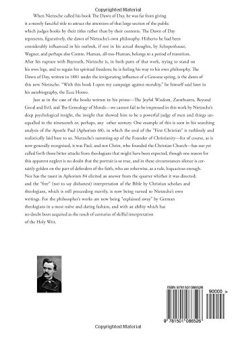
When Nietzsche called his book The Dawn of Day, he was far from giving it a merely fanciful title to attract the attention of that large section of the public which judges books by their titles rather than by their contents. The Dawn of Day represents, figuratively, the dawn of Nietzsche’s own philosophy. Hitherto he had been considerably influenced in his outlook, if not in his actual thoughts, by Schopenhauer, Wagner, and perhaps also Comte. Human, all-too-Human, belongs to a period of transition. After his rupture with Bayreuth, Nietzsche is, in both parts of that work, trying to stand on his own legs, and to regain his spiritual freedom; he is feeling his way to his own philosophy. The Dawn of Day, written in 1881 under the invigorating influence of a Genoese spring, is the dawn of this new Nietzsche. “With this book I open my campaign against morality,” he himself said later in his autobiography, the Ecce Homo. Just as in the case of the books written in his prime
Reading The dawn of day
Reading it here at archive.org or download the PDF here The day of dawn
 Nochrisis