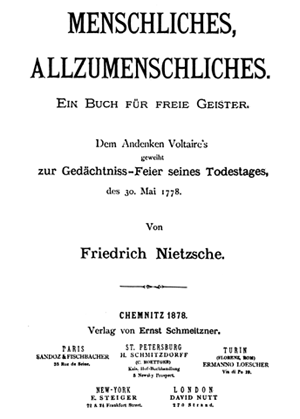
Menschliches, Allzumenschliches
Human, All Too Human: A Book for Free Spirits (German: Menschliches, Allzumenschliches: Ein Buch für freie Geister) is a book by 19th-century philosopher Friedrich Nietzsche, originally published in 1878. A second part, Assorted Opinions and Maxims (Vermischte Meinungen und Sprüche), was published in 1879, and a third part, The Wanderer and his Shadow (Der Wanderer und sein Schatten), followed in 1880. (Wikipedia)
Text from this book:
31. In the Desert of Science.—As the man of science proceeds on his modest and toilsome wanderings, which must often enough be journeys in the desert, he is confronted with those brilliant mirages known as “philosophic systems.” With magic powers of deception they show him that the solution of all riddles and the most refreshing draught of true water of life are close at hand. His weary heart rejoices, and he well-nigh touches with his lips the goal of all scientific endurance and hardship, so that almost unconsciously he presses forward. Other natures stand still, as if spellbound by the beautiful illusion: the desert swallows them up, they become lost to science. Other natures, again, that have often experienced these subjective consolations, become very disheartened and curse the salty taste which these mirages leave behind in the mouth and from which springs a raging thirst—without one’s having come one step nearer to any sort of a spring.
Synopsis

Written after Nietzsche had ended his friendship with Richard Wagner and had been forced to leave academic life through ill health, Human, All Too Human (1878) can be read as a monument to his personal crisis. It also marks the point when he matured as a philosopher, rejecting the German romanticism espoused by Wagner and Schopenhauer and instead returning to sources in the French Enlightenment. Here he sets out his unsettling views in a series of 638 stunning aphorisms – assessing subjects ranging from art to arrogance, boredom to passion, science to vanity and women to youth. This work also contains the seeds of concepts crucial to Nietzsche’s later philosophy, such as the will to power and the need to transcend conventional Christian morality. The result is one of the cornerstones of his life’s work.
—
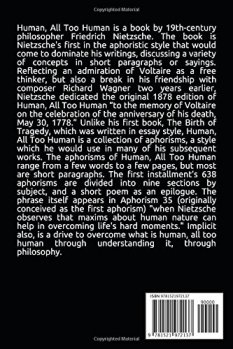
Human, All Too Human is a book by 19th-century philosopher Friedrich Nietzsche. The book is Nietzsche’s first in the aphoristic style that would come to dominate his writings, discussing a variety of concepts in short paragraphs or sayings. Reflecting an admiration of Voltaire as a free thinker, but also a break in his friendship with composer Richard Wagner two years earlier, Nietzsche dedicated the original 1878 edition of Human, All Too Human “to the memory of Voltaire on the celebration of the anniversary of his death, May 30, 1778.” Unlike his first book, The Birth of Tragedy, which was written in essay style, Human, All Too Human is a collection of aphorisms, a style which he would use in many of his subsequent works. The aphorisms of Human, All Too Human range from a few words to a few pages, but most are short paragraphs. The first installment’s 638 aphorisms are divided into nine sections by subject, and a short poem as an epilogue. The phrase itself appears in Aphorism 35 (originally conceived as the first aphorism) “when Nietzsche observes that maxims about human nature can help in overcoming life’s hard moments.” Implicit also, is a drive to overcome what is human, all too human through understanding it, through philosophy.
—

German scholar and thinker Friedrich Nietzsche began his career as a linguist and philologist, but over time, his work became increasingly philosophical in its scope. He came to embrace a radical point of view that prized personal freedom and choice over virtually everything else. In Human, All Too Human, Nietzsche explores the triumphs and tragic shortfalls of human nature in an eminently readable series of aphorisms and short vignettes.
Human, All Too Human (1878) is often considered the start of Friedrich Nietzsche’s mature period. A complex work that explores many themes to which Nietzsche later returned, it marks a significant departure from his previous thinking. Here Nietzsche breaks with his early allegiance to Schopenhauer and Wagner, and establishes the overall framework of his later philosophy. In contrast to his previous disdain for science, now Nietzsche views science as key to undercutting traditional metaphysics. This he sees as a crucial step in the emergence of free spirits who will be the avant-garde of culture.
Reading Human all too human
Read it here at Wikisource or download the PDF Human all to human 1914
 Nochrisis