Nochrisis

Amor fati

Menu

Skip to content
  • About me
  • My philosophy
    • My philosophy notebook.
    • All to human.
    • Anarchy, why not?
  • Friedrich Nietzsche
    • Older books about Nietzsche
    • Pictures of Nietzsche
    • Nietzsches letters
    • Reading Human all too human
    • Aphorisms in one sentence.
    • Nietzsche’s books with back covers
  • Pictures
    • Photography notebook
    • Insects
    • Flowers
    • Trees
    • Leaves
    • Dandelion
    • Landscapes
    • Nature abstract
    • Steel
    • Skorovos
    • Sheep shearing
    • Politics
    • Architecture
    • Old factory
    • One bridge
    • Museum
    • Mirrors
    • Framed
    • Fredrikstad
  • Tags
    • free will
    • Existentialism
    • anarchy
    • mikhail Bakunin
    • kropotkin
    • Noam Chomsky
    • Nikolai Pavlov
    • Nestor Makhno
    • Krishnamurti
    • Albert Einstein
    • Spinoza
    • plato
    • Albert Camus
    • Heraclitus
    • Martin Heidegger
    • Aristotle
    • Emma Goldman
    • Jean-Paul Sartre
    • Erich Fromm
    • Bertrand Russell
    • Voltaire
    • David Hume
    • Max stirner
    • Dostoyevsky
    • Thoreau
    • Charles Darwin
    • Josiah Warren
    • Mark Twain
    • Arthur Schopenhauer
    • Robert Sapolsky
    • bertolt brecht
    • søren Kierkegaard
    • Slavoj Zizek
    • James C. Scott
    • Seneca
    • Wittgenstein
    • John Locke
    • Alain Badiou
    • Daniel C Dennett
    • Edmund Husserl
    • Epictetus
    • Robert M. Pirsig
    • Rainer Maria Rilke
    • Ludwig Wittgenstein
    • Rousseau
    • Leo Tolstoy
    • Doris Lessing
    • Virginia Woolf
    • Michael de Montaigne
    • John Fire Lame Deer
    • Emile Cioran
    • Lao Tzu
    • Brian Lowery
    • Sextus Empiricus
    • Hitchens
    • Mencken
    • Herbert Marcuse
    • Nikola Tesla
    • E.O.Wilson
    • Sam Harris
    • Oscar Wilde
    • Goethe
    • Judith Butler
    • Max Nettlau
    • Daniel Pacheco
    • Joan Didion
    • Gilbert K. Chesterton
    • George Carlin
    • Churchill
    • Philipp Mainländer
    • Marcus Aurelius

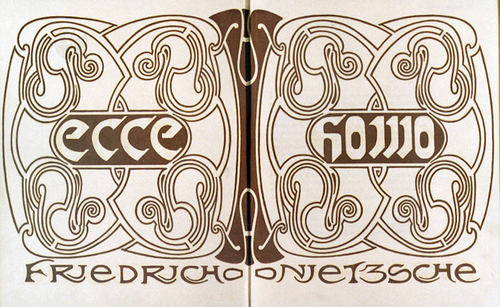
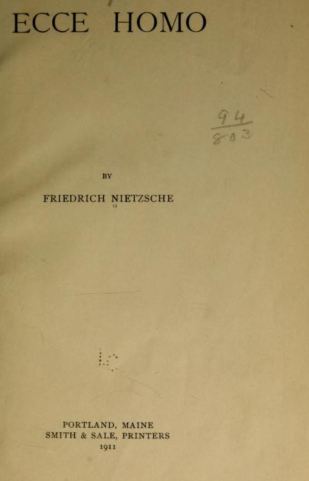
Ecce homo: How One Becomes What One Is

Ecce homo: Wie man wird, was man ist

Ecce Homo: How One Becomes What One Is (German: Ecce homo: Wie man wird, was man ist) is the last original book written by the German philosopher Friedrich Nietzsche before his final years of insanity that lasted until his death in 1900. It was written in 1888 and was not published until 1908. (Wiki)

Text from this book:

6. Freedom from ressentiment, enlightenment over ressentiment –who knows the extent to which I ultimately owe thanks to my protracted sickness for this too! The problem is not exactly simple: one has to have experienced it from a state of strength and a state of weakness. If anything whatever has to be admitted against being sick, being weak, it is that in these conditions the actual curative instinct, that is to say the defensive and offensive instinct in man becomes soft. One does not know how to get free of anything, one does not know how to have done with anything, one does not know how to thrust back – everything hurts. Men and things come importunately close, events strike too deep, the memory is a festering wound. Being sick is itself a kind of ressentiment…


Synopsis

Published posthumously in 1908, Ecce Homo was written in 1888 and completed just a few weeks before Nietzsche’s complete mental collapse. Its outrageously egotistical review of the philosopher’s life and works are redeemed from mere arrogance by masterful language and ever-relevant ideas ― in addition to settling scores with his many personal and philosophical enemies.

In late 1888, only weeks before his final collapse into madness, Nietzsche (1844-1900) set out to compose his autobiography, and Ecce Homo remains one of the most intriguing yet bizarre examples of the genre ever written. In this extraordinary work Nietzsche traces his life, work and development as a philosopher, examines the heroes he has identified with, struggled against and then overcome – Schopenhauer, Wagner, Socrates, Christ – and predicts the cataclysmic impact of his ‘forthcoming revelation of all values’. Both self-celebrating and self-mocking, penetrating and strange, Ecce Homo gives the final, definitive expression to Nietzsche’s main beliefs and is in every way his last testament.


Reading Ecce homo

Read it here at archive.org or download the PDF here Ecce homo
ecco homo 2

Share this:

  • Click to email a link to a friend (Opens in new window) Email
  • Click to share on Mastodon (Opens in new window) Mastodon
  • Click to share on Bluesky (Opens in new window) Bluesky
Like Loading...
Widgets

Top Posts

  • Day 1535, reach out.
    Day 1535, reach out.
  • Day 1526, empty space.
    Day 1526, empty space.
  • Day 1779, fading identity.
    Day 1779, fading identity.
  • Day 1340, around.
    Day 1340, around.
  • Day 2146, meaning.
    Day 2146, meaning.
  • Day 1511, circumstances.
    Day 1511, circumstances.
  • Day 1528, fog.
    Day 1528, fog.
  • Day 1603, patterns.
    Day 1603, patterns.
  • Day 1755, art.
    Day 1755, art.
  • Day 1763, dis like.
    Day 1763, dis like.

Archives

Tags

aphorism art black and white depression flower Friedrich Nietzsche future Haiku History Human all too human insects life macro photography mind nature Nederlands norway Philosophy photography photoshop picture pictures poem Poetry politics psychology senryu short poem Society winter

Enter your email address to subscribe to this blog and receive notifications of new posts by email.

Join 601 other subscribers

  • Twitter
  • Facebook
  • Google+
  • GitHub
  • WordPress.com
Create a website or blog at WordPress.com
  • Subscribe Subscribed
    • Nochrisis
    • Join 601 other subscribers
    • Already have a WordPress.com account? Log in now.
    • Nochrisis
    • Subscribe Subscribed
    • Sign up
    • Log in
    • Copy shortlink
    • Report this content
    • View post in Reader
    • Manage subscriptions
    • Collapse this bar
 

Loading Comments...
 

    %d